
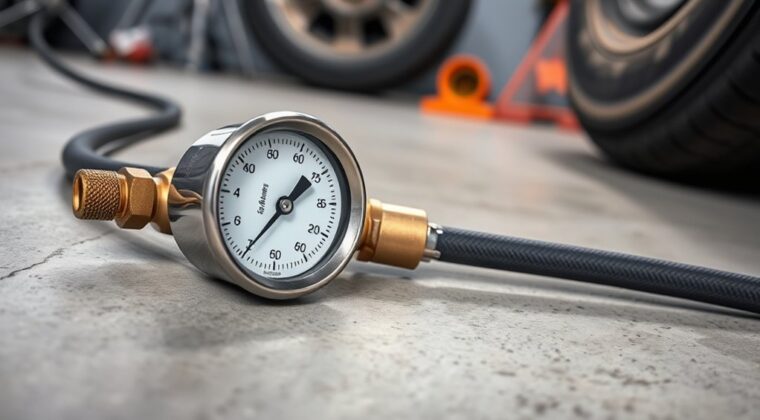
An analog tire inflator uses a Bourdon tube gauge to measure pressure. When air enters the curved metal tube, it straightens slightly and drives a linkage that moves the needle across the PSI scale in real time. You don’t need batteries or electronics, so the tool gives immediate visual feedback as you inflate. To get an accurate reading, keep your eye level with the dial and watch for needle bounce. More details explain calibration, accuracy, and best use cases.
Key Takeaways
- An analog tire inflator uses a Bourdon tube that straightens as air pressure rises, moving the needle on the dial.
- The gauge shows tire pressure in PSI with immediate visual feedback, requiring no batteries or electronics.
- Read the dial at eye level to avoid parallax error and note the needle’s highest point if it bounces.
- Analog gauges are durable, simple, and quick for routine checks, but they need regular calibration for accuracy.
- Their rugged design and low cost make them useful for fast tire inflation in garages, roadside use, and harsh conditions.
How an Analog Tire Inflator Works
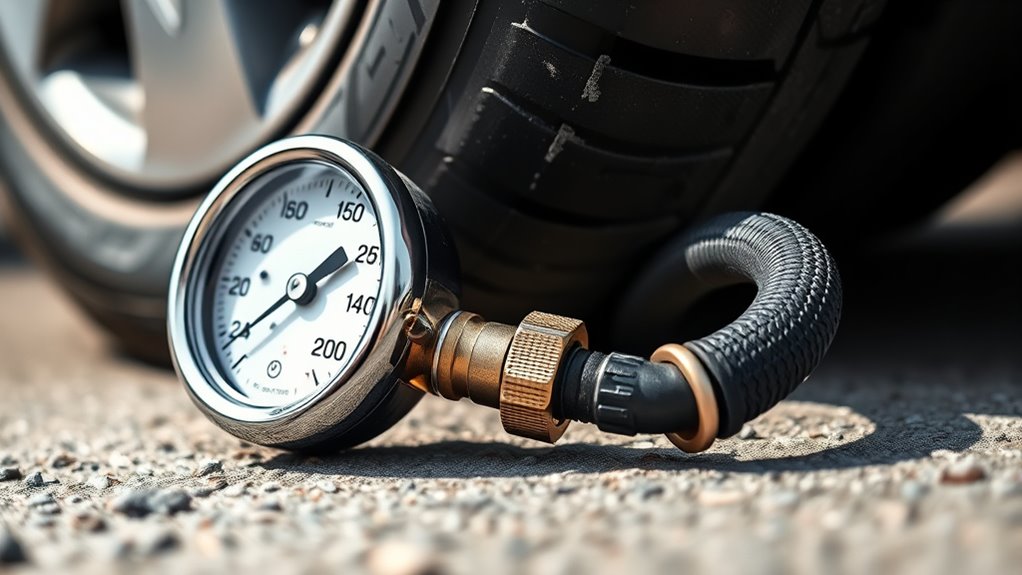
An analog tire inflator works through a Bourdon tube mechanism: as air pressure enters the gauge, a curved metal tube tends to straighten, and that movement drives a needle across the dial to show pressure.
You use this mechanical system to measure tire pressure in PSI without batteries or electronics, so the inflator gives immediate visual feedback the moment air enters the gauge. The dial usually targets about ±2% of full-scale accuracy, which gives you a practical, repeatable reading for routine checks.
Because the system is rugged, you can trust it in oil, moisture, and other harsh conditions where fragile devices may fail.
Still, parallax error can distort what you see if you don’t face the gauge directly, so your position matters for accuracy. With this analog design, you keep control in your hands and read pressure through a direct physical response.
How to Read an Analog Gauge Correctly
To read an analog tire inflator gauge correctly, keep your eyes level with the dial so you don’t introduce parallax error and misread the needle.
On analog gauges, the needle gives your pressure reading in PSI, so you need to watch the scale closely and trust the manual reading, not a guess from an angle. At eye level, you preserve PSI accuracy and get a cleaner, more liberated decision about your tire pressure.
On analog gauges, trust the needle at eye level for accurate PSI readings, not a guess from an angle.
Check the maximum and minimum limits printed on the face before you inflate; that range tells you whether the gauge can handle the target value.
If the needle bounces, note the highest point of its swing for high accuracy. Then compare the result with a known reference and calibrate the gauge regularly.
That simple discipline keeps your readings consistent, reduces error, and lets you control pressure with precision, confidence, and independence.
Inside the Bourdon Tube Gauge
Inside the Bourdon tube gauge, pressurized air enters a curved, hollow metal tube that wants to straighten as internal pressure rises. You see the Bourdon tube deform, and that deformation drives a linkage that turns the needle across the calibrated scale.
In these mechanical gauges, the force of pressure becomes visible motion, so you can read tire inflation without electronics. The design targets roughly ±2% of full scale, giving you reliable readings for quick checks.
Because the tube resists vibration and grime, it works well in automotive settings where tools take abuse. You still need to watch angle and lighting: parallax error can shift your view of the needle and distort accuracy if you’re not aligned with the dial.
When you understand that the gauge converts pressure into controlled movement, you reclaim the reading process and can judge inflation with confidence, precision, and less dependence on hidden black-box systems.
Analog Inflator Gauge Pros and Cons
Analog inflator gauges give you fast, battery-free pressure readings through a simple Bourdon tube mechanism, which makes them dependable in shop, garage, and roadside conditions. Their pros and cons are clear: you get an affordable inflator gauge for quick checks, but you must manage accuracy limits.
| Aspect | Benefit | Limitation |
|---|---|---|
| Cost | Affordable | Less refined display |
| Speed | Quick checks | Limited detail |
| Accuracy | Good when calibrated | Parallax error |
You’ll appreciate the analog layout when you want direct feedback and minimal setup. However, reading the dial at an angle can skew results, so you need to face the gauge squarely. Maintenance matters too: keep the lens dry, avoid impacts, and schedule calibration to preserve accuracy. If you value simple, rugged control, this design supports practical pressure management without digital dependency.
When to Choose an Analog Gauge
When you need fast tire pressure checks, an analog gauge gives you immediate visual feedback without batteries or complex setup. You should choose analog gauges when you value a tire pressure gauge that supports quick checks in the garage, shop, or roadside.
The Bourdon tube mechanism delivers dependable accuracy, typically about ±2% of full scale, which is enough for routine maintenance and spotting underinflated or overinflated tires before they cause wear or safety loss. You’ll also benefit from their cost-effective price range, usually $15–$50, if you want reliable tools without paying for digital features.
Their rugged construction improves durability in dusty, wet, or high-vibration environments, and their ease of use lets you work faster when you’re servicing multiple tires. Because they don’t depend on batteries, analog gauges keep working when downtime isn’t an option, so you stay free to move, inspect, and inflate with confidence.
Frequently Asked Questions
How to Read an Analog Tire Pressure Gauge?
You read an analog tire pressure gauge by seating it firmly on the valve stem, then watching the needle settle on the PSI scale.
Read at eye level to avoid parallax errors, and compare it with your target pressure.
For gauge calibration tips, check against a trusted tool.
Apply pressure measurement techniques, watch temperature effects, and avoid common gauge mistakes.
Good tire maintenance practices improve benefits of accuracy and support tire inflation frequency.
How to Use a Tire Inflator Gauge?
You’ll tame a thousand PSI storms: remove the valve cap, clamp the hose tight, set inflator pressure settings to spec, then fill while you watch the gauge.
Choose among tire inflator types carefully; follow inflator usage safety, gauge maintenance tips, and gauge calibration methods.
If you hit common inflator issues, use inflator troubleshooting steps.
Ignore tire pressure myths, and do seasonal tire checks for disciplined tire maintenance tips and liberation.
What Is More Accurate, a Digital or Analog Tire Pressure Gauge?
Digital gauges are more accurate than analog for pressure measurement, giving you a clearer accuracy comparison.
You’ll usually get finer resolution, better gauge calibration, and stronger reliability factors across temperature changes and other environmental influence.
Analog units can still suit your user preference if you want lower cost analysis and simpler maintenance tips, but they’re typically less precise.
For the best brands, check calibration regularly and choose the mode that fits your needs.
How to Read an Air Compressor Gauge?
You read an air compressor gauge by matching the needle to the PSI scale, then comparing it with tire pressure recommendations.
Watch gauge types, use steady inflation techniques, and keep your eyes level to avoid parallax errors.
For tire health, follow safety practices, avoid common mistakes, and verify gauge calibration regularly.
Include seasonal checks and maintenance tips, because accurate readings support disciplined liberation, informed control, and safer operation.
Conclusion
In short, when you use an analog tire inflator, you’re reading a remarkably simple machine that can still deliver impressive control. The Bourdon tube flexes under pressure, and that tiny movement becomes a clear, immediate needle reading. You’ll get durability, no batteries, and dependable performance, though you may sacrifice a bit of precision. If you want rugged, fast, and intuitive inflation, an analog gauge is a smart choice—plain, mechanical, and nearly bulletproof.