
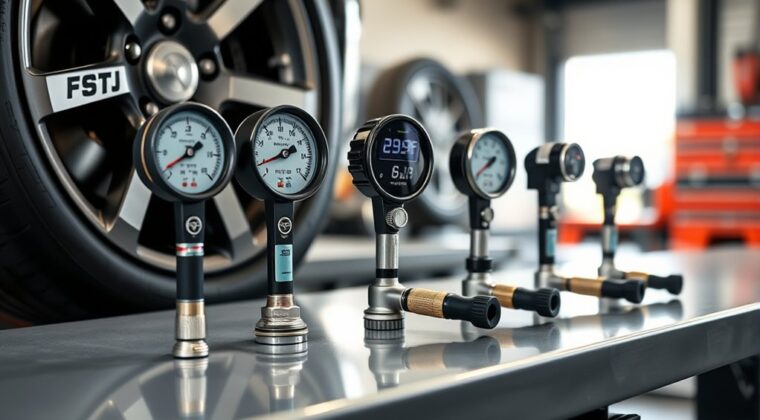
Choosing the right tire pressure gauge matters more than many drivers realize. The best options in 2027 range from simple pencil tools to advanced digital models, each built for different habits and vehicles. Some prioritize portability, others focus on precision or added features like inflators and backlit displays. What separates the top seven from the rest becomes clear when the details are compared closely.
Pencil Tire Pressure Gauge 2 Pack, 10-120PSI Dual Head
https://m.media-amazon.com/images/I/61SmBnrkTAL._SX522_.jpg
The Pencil Tire Pressure Gauge 2 Pack, with its 10–120 PSI range and dual-head design, is a practical pick for drivers who want a compact, easy-to-store gauge for routine tire checks. Its zinc alloy head and electroplated finish add durability, while built-in rubber helps improve sealing during use. The four-sided scale in PSI and bar supports quick readings, and the pocket-size body with clip enhances portability. Suitable for cars, trucks, SUVs, RVs, motorcycles, bikes, ATVs, and buses, it also includes four metal valve stem caps. Premium customer support is available if issues arise.
Best For: Drivers and riders who want a compact, easy-to-carry tire pressure gauge for routine checks on cars, trucks, SUVs, motorcycles, bikes, ATVs, RVs, and buses.
Pros:
- Dual-head, pocket-size design makes it convenient to store and use on the go.
- 10–120 PSI range with a clear four-sided PSI/bar scale supports quick, readable measurements.
- Zinc alloy head with electroplated finish and built-in rubber improves durability and sealing.
Cons:
- Manual pencil-style gauges may be less convenient than digital models for some users.
- The 10–120 PSI range may not suit every specialized high-pressure application.
- Must avoid exceeding the gauge limit to prevent damage.
Digital Tire Pressure Gauge 150 PSI 2-Pack
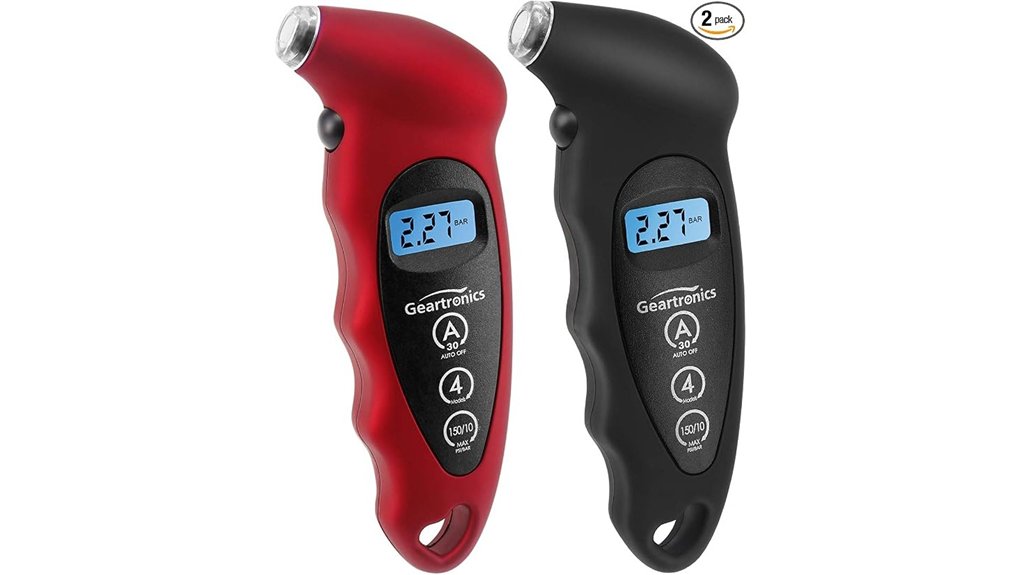
For drivers needing a simple two-pack, this digital gauge suits cars, motorcycles, and bikes. It measures up to 150 PSI, giving enough range for most vehicle tires, and its tight nozzle helps create an airtight seal on valve stems. The backlit LED display improves visibility in dim garages or roadside checks, while the ergonomic, non-slip handle supports steady use. Operation is straightforward: power on, choose units, and connect. It shuts off after 30 seconds of inactivity. Compact and lightweight, it fits riding, off-roading, and routine pressure maintenance. It does not fit presta stems.
Best For: Drivers, cyclists, and riders who want a simple, compact 2-pack digital tire pressure gauge for quick and accurate checks on cars, motorcycles, and bikes.
Pros:
- Measures up to 150 PSI, covering most car, motorcycle, and bike tire needs
- Backlit LED display and airtight nozzle make readings easier in low light and help ensure a secure connection
- Lightweight, ergonomic, and easy to use with automatic shut-off for convenience
Cons:
- Not compatible with presta stems
- Limited to basic pressure-checking features with no advanced functions
- Battery-powered device may require occasional battery replacement
AstroAI Heavy Duty Digital Tire Pressure Gauge 0-230 PSI
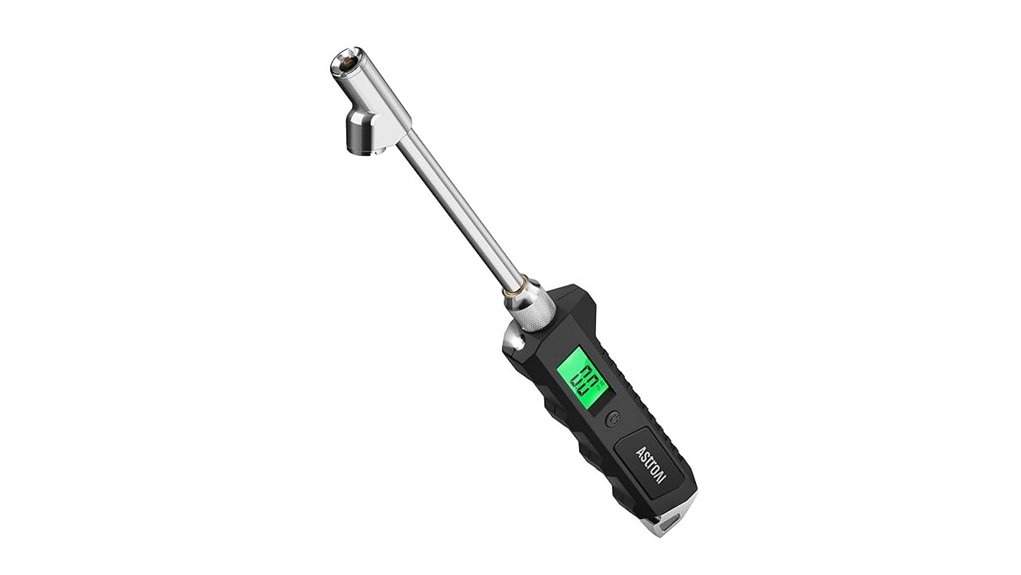
Built for larger vehicles, the AstroAI Heavy Duty Digital Tire Pressure Gauge suits RV and truck owners best. Its 0-230 PSI range, along with bar, kg/cm², and kPa units, covers a wide spread of pressures. Stainless steel construction and an ergonomic non-slip texture support durability and control. A green backlit LCD and built-in flashlight improve readability in dim conditions. Readings appear quickly in 0.1 increments, and the ON/UNIT/OFF button keeps operation simple. Auto shut-off conserves power. Batteries are included, and a one-year warranty adds reassurance. It also works with cars, motorcycles, and bicycles.
Best For: RV and truck owners who need a durable, easy-to-read tire pressure gauge for a wide range of vehicles.
Pros:
- Wide pressure range supports RVs, trucks, and other vehicles
- Green backlit LCD and flashlight improve visibility in low light
- Stainless steel build with non-slip grip feels sturdy and secure
Cons:
- Best suited for larger vehicles, so it may be overkill for basic use
- Auto shut-off may be too quick for some users
- Digital operation depends on batteries, even though they are included
ETENWOLF Pencil Tire Pressure Gauge 2 Pack (10-50PSI, 20-120PSI)
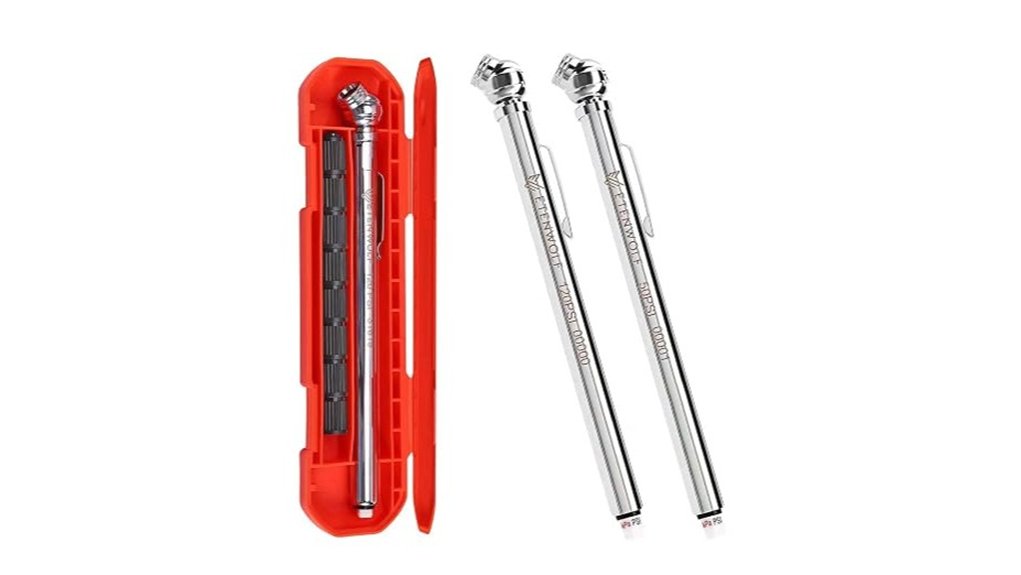
ETENWOLF’s dual-range pencil gauges suit drivers who need coverage from compact cars to higher-pressure vehicles. The two-piece set spans 10-50 PSI and 20-120 PSI, making it adaptable across many tire applications. Both gauges are calibrated to ANSI B40.1 Grade B, with stated accuracy of 2% in the middle range and 3% near the ends. Their solid metal construction, including a zinc alloy head and stainless steel body, supports long service life. Each unit can also release excess air, and the package adds 16 valve caps plus two storage cases for tidy, practical use.
Best For: Drivers who want a durable, dual-range pencil tire pressure gauge set for checking and adjusting tire pressure across a wide range of vehicles.
Pros:
- Covers both low- and higher-pressure tires with 10-50 PSI and 20-120 PSI gauges.
- Calibrated to ANSI B40.1 Grade B with solid stated accuracy.
- All-metal build plus extra valve caps and storage cases for convenience.
Cons:
- Pencil-style gauges can be less convenient than digital models for some users.
- Two separate gauges may be more than needed for drivers with only one vehicle type.
- No backlit display or advanced features like memory or automatic shutoff.
AstroAI Digital Tire Pressure Gauge with Inflator
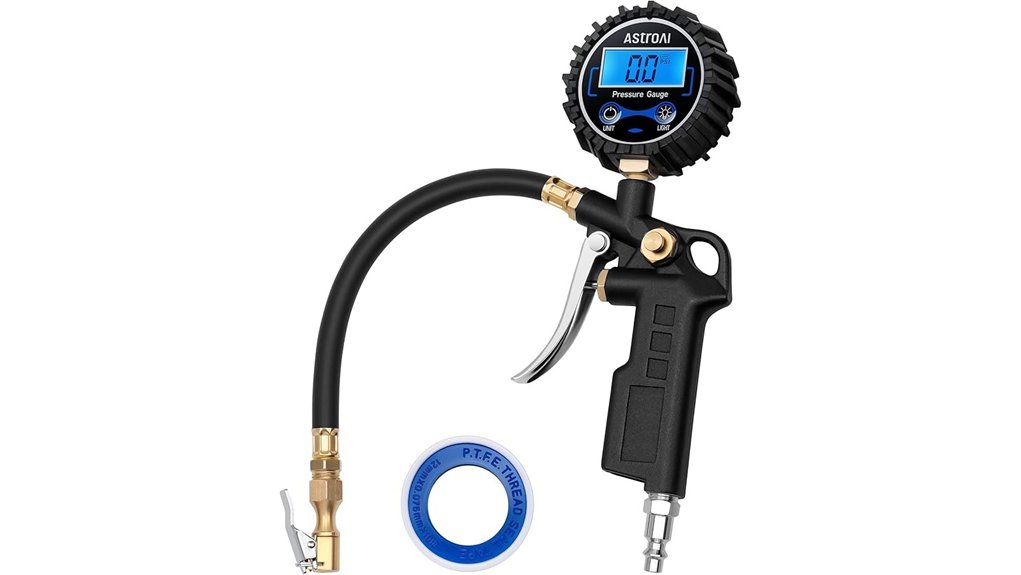
The AstroAI Digital Tire Pressure Gauge with Inflator suits drivers who want one precise, heavy-duty tool. Trusted by over 3 million users, it pairs professional-grade accuracy with durable construction. Its calibration meets ANSI B40.7 Grade 2A standards, and its 0.1 PSI resolution gives finer readings than many common gauges. The 3-in-1 design inflates, deflates, and measures without extra tools. A brass chuck, brass fitting, and 19.7-inch rubber hose support leak-resistant use. The backlit LCD, auto on/off function, and LED flashlight improve visibility in low light.
Best For: Drivers, DIYers, and fleet owners who want a precise, durable all-in-one tire inflator and gauge with easy-to-read digital features.
Pros:
- Highly accurate calibration with 0.1 PSI resolution for precise tire pressure readings.
- 3-in-1 inflate, deflate, and measure design eliminates the need for extra tools.
- Durable brass components, rubber hose, backlit LCD, and LED flashlight improve reliability and usability.
Cons:
- Requires airflow to activate, which may feel less convenient than always-on gauges.
- Heavier-duty build and integrated features may be more than casual users need.
- Digital operation means it depends on batteries or power for display and lighting features.
AstroAI Tire Pressure Gauge 0-60 PSI, Large Glow Dial for Car, SUV
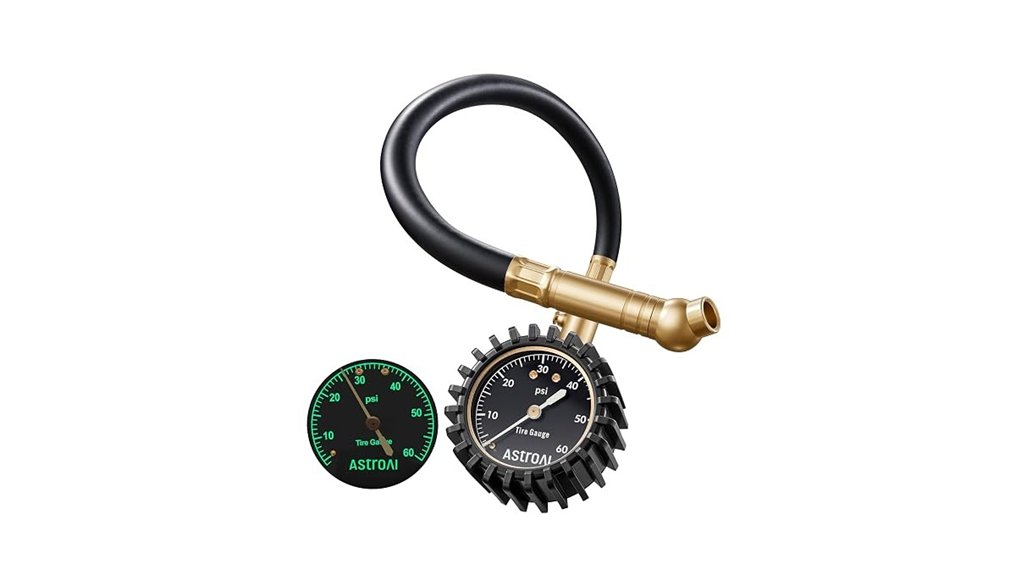
AstroAI’s 0-60 PSI gauge suits drivers who need quick, accurate readings in low light. Its large glow dial improves visibility, while the stainless steel body, brass fittings, and rubber hose add durability. Calibrated to ANSI B40.1 Grade A standards, it claims ±1% accuracy for cars, SUVs, trucks, motorcycles, and bicycles with Schrader valves. The 360-degree swivel chuck helps prevent leaks and reach awkward stems. An air bleeder valve supports fine adjustments. At 6.22 x 2.95 x 1.38 inches and 9.1 ounces, it remains compact and practical.
Best For: Drivers, mechanics, and cyclists who want a durable, highly accurate tire pressure gauge with an easy-to-read glow dial for use in low light.
Pros:
- Large glow-in-the-dark dial improves visibility in dark or low-light conditions.
- ANSI B40.1 Grade A calibration with claimed ±1% accuracy supports precise readings.
- 360-degree swivel chuck and air bleeder valve make it easier to seal, reach awkward stems, and fine-tune pressure.
Cons:
- Analog design may be less convenient than digital gauges for some users.
- 0-60 PSI range may be limiting for higher-pressure applications.
- Slightly bulkier than ultra-compact pocket gauges.
JACO ElitePro Tire Pressure Gauge – 100 PSI
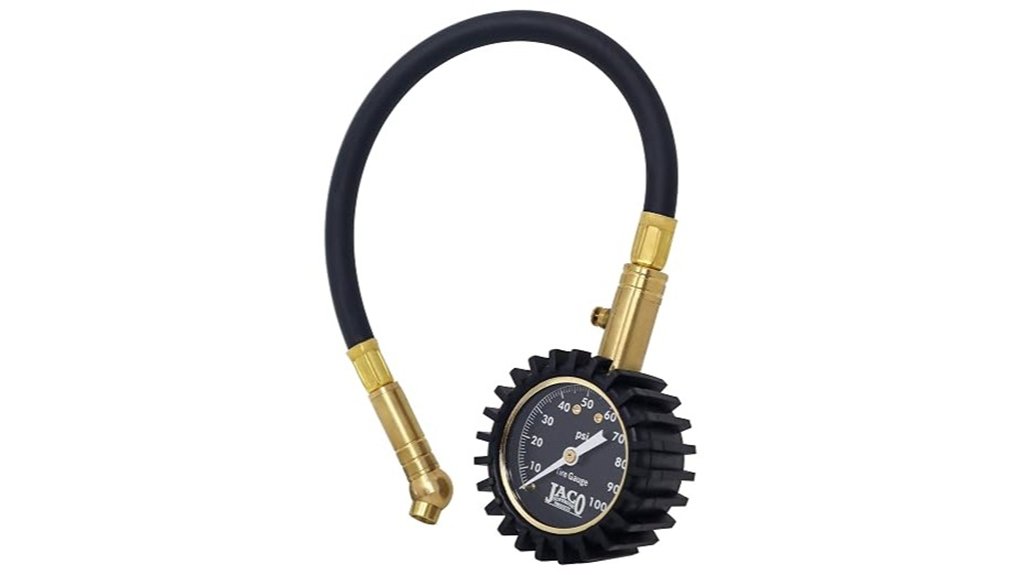
Built for drivers who want precise, easy-to-read inflation checks, JACO ElitePro suits regular car owners. The JSP-014 uses solid brass construction with a shock-resistant guard, plus a leak-proof HybridFlex hose for durability and control. Its 360-degree swivel chuck helps reach awkward valves, while the built-in bleeder valve allows fine pressure adjustments. The larger glowing dial reads to 100 PSI in single increments and locks after measurement. Mechanic recommended, performance tested, and calibrated to ANSI standards, it stays within ±1.5%. JACO backs it with a lifetime warranty.
Best For: Drivers and regular car owners who want a durable, highly accurate, easy-to-read tire pressure gauge for precise inflation checks.
Pros:
- Solid brass construction with a shock-resistant guard for durability
- 360-degree swivel chuck and flexible HybridFlex hose make valve access easier
- ANSI-calibrated accuracy within ±1.5% with a large glowing dial that locks in place
Cons:
- Max pressure is limited to 100 PSI, so it may not suit higher-pressure applications
- Analog dial design may be less convenient than digital gauges for some users
- Heavier than basic plastic gauges at 5.6 ounces
Factors to Consider When Choosing a Tire Pressure Gauge for Cars
When choosing a tire pressure gauge for cars, accuracy and calibration are essential for obtaining reliable readings. The pressure range, display readability, build quality, and valve compatibility also affect how practical the gauge will be in everyday use. A well-matched gauge offers both dependable performance and ease of handling.
Accuracy And Calibration
Accuracy is the foundation of a dependable tire pressure gauge, since even small errors can lead to improper inflation and uneven tire wear. Many reliable models are calibrated to standards such as ANSI B40.1 or B40.7, helping readings stay within tight tolerances, often ±1% or ±0.5% of full scale. Some gauges claim ±1.5% accuracy or better, which supports consistent maintenance of ideal tire pressure. Resolution also matters; a display that reads in 0.1 PSI increments can reveal subtle pressure changes that coarser instruments may miss. Regular calibration checks remain important, especially for digital gauges that may drift with use or environmental exposure. Careful attention to calibration gives buyers greater confidence in every measurement and improves long-term usefulness.
Pressure Range
Pressure range is another key factor in choosing a tire pressure gauge, since the tool must match the PSI needs of the vehicle it serves. Most cars operate between 30 and 35 PSI, while trucks may require readings up to 80 PSI. A gauge with a 10-120 PSI range covers cars, SUVs, and light trucks well, making it a practical all-purpose option. For RVs or heavy-duty trucks, a higher-capacity model, such as 0-230 PSI, is more appropriate because their tires demand greater pressure. Selecting a gauge outside the intended range can reduce accuracy and risk damage if pushed beyond limits. The best choice is one that matches the vehicle’s requirements while still providing enough headroom for safe, reliable measurement.
Display Readability
Display readability can make the difference between a quick check and a misread tire pressure. A clear, large screen helps users catch numbers fast, especially when lighting is poor. Backlit LCDs improve visibility in garages or at night, while glow-in-the-dark dials remain legible in dim conditions. Digital gauges often offer finer resolution, sometimes down to 0.1 PSI, giving more precise information than analog models that may show only whole numbers. Clear markings and a straightforward interface reduce confusion during use. A swivel chuck can also improve viewing angles, letting the display face the user without awkward positioning. When the readout is easy to see, pressure checks become faster, more accurate, and less likely to cause errors.
Build Quality
Build quality shapes how well a tire pressure gauge holds up over time and how dependable it feels in regular use. Durable materials such as stainless steel or solid brass generally offer better resistance to wear, impact, and corrosion, making them a practical choice for frequent use. Shock-resistant guards add another layer of protection by shielding internal parts from damage during storage or handling. An ergonomic shape can also improve control, giving the user a steadier grip and reducing hand strain. Hose quality matters as well; flexible, crush-resistant construction helps prevent kinks and supports easier positioning. A reliable sealing mechanism, including a tight nozzle, is essential for limiting air leaks and preserving accurate readings. Overall, sturdy construction supports long-term performance and consistency.
Valve Compatibility
Valve compatibility determines whether a tire pressure gauge can connect cleanly and deliver an accurate reading. Most car, truck, and SUV gauges are built for Schrader valves, so that standard should be the first check. Compatibility with Presta valves matters for bicycles and some specialized vehicles. A tight nozzle can help digital gauges form an airtight seal on the valve stem, reducing leakage and improving measurement accuracy. A 360-degree swivel chuck also improves fit on awkward or recessed stems, making connection easier. The gauge’s pressure range should match the vehicle’s needs, since some models are intended for lower PSI limits and others for higher ones. An air bleeder valve adds practical value by letting the user release excess air from overinflated tires.
Portability And Storage
Portability matters when selecting a tire pressure gauge for a car, because a lightweight, compact design is easier to keep in a vehicle and use when needed. A pocket-sized gauge, often about 6 inches long, fits comfortably in a hand, pocket, or small storage area. Models with clips or protective cases improve convenience, letting the gauge attach to a bag or rest neatly in a glove compartment. Storage efficiency also improves when a single tool offers dual or multiple measurement ranges, reducing the need to carry extra equipment. Durability should not come at the expense of weight, since bulky gauges can be awkward during quick roadside checks. The best choices balance toughness, compactness, and ease of transport for reliable, everyday use.
Frequently Asked Questions
How Often Should I Check My Car Tire Pressure?
Car tire pressure should be checked at least monthly and before long trips. It should also be checked when temperatures change considerably, because pressure can drop or rise with weather, affecting safety and fuel efficiency.
What PSI Should My Car Tires Be?
What PSI should car tires be? The correct pressure is usually listed on the driver’s door placard, typically 30–35 PSI, though it varies by vehicle. The sidewall’s maximum is not the recommended setting.
Do Tire Pressure Gauges Need Calibration?
Yes, tire pressure gauges do need calibration occasionally, especially if dropped or used heavily. Regular checks against a known standard help guarantee accuracy, since even small errors can affect tire inflation and safety.
Can Tire Pressure Gauges Work in Cold Weather?
Yes—like a watch in winter, they can. Tire pressure gauges generally work in cold weather, though readings may shift slightly as temperatures drop. Metal parts stay functional, but handling and battery performance can suffer.
Are Digital Gauges More Accurate Than Analog Ones?
Digital gauges are often more accurate, offering clearer readings and easier calibration, though quality matters more than type. Well-made analog gauges can match them, but cheaper versions of either may drift or misread.
Conclusion
In 2027, the best tire pressure gauges proved that small tools can make a big difference. From simple pencil models to advanced digital options, each gauge offered a reliable way to keep tires safe, efficient, and ready for the road. Choosing the right one depends on accuracy, ease of use, and durability. Like a steady compass for every driver, a good tire pressure gauge helps guide vehicles toward better performance and peace of mind.
