
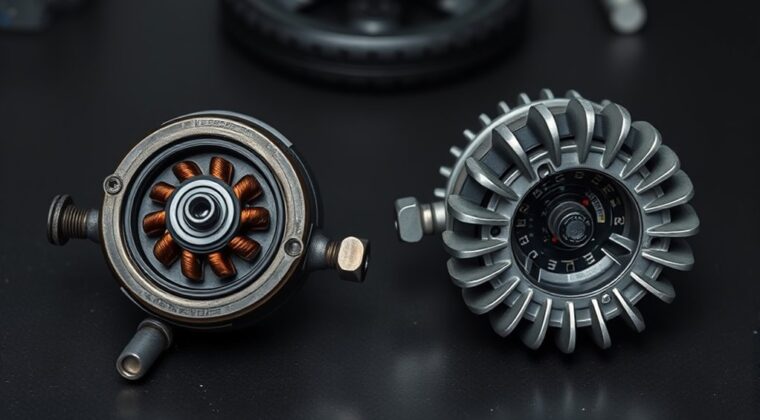
If you want faster inflation, longer runtime, and lower maintenance, you should choose a brushless tire inflator motor. It uses electronic commutation instead of brushes, so it runs cooler, wastes less energy, and typically lasts far longer than a brushed motor. Brushed motors cost less upfront, but they wear faster, generate more heat, and lose efficiency under load. The tradeoff is clear, and the details become even more useful when you compare real use cases.
Key Takeaways
- Brushless tire inflator motors are more efficient, often reaching 80–90% efficiency versus about 60% for brushed motors.
- Brushless motors inflate tires faster, with less performance drop under load and more consistent power delivery.
- Brushed motors use carbon brushes and a commutator, causing friction, wear, heat, and shorter lifespan.
- Brushless motors use electronic commutation, run cooler, and usually last much longer with less maintenance.
- Brushed motors cost less upfront, but brushless models save more over time through better battery life and durability.
Which Tire Inflator Motor Is Better?
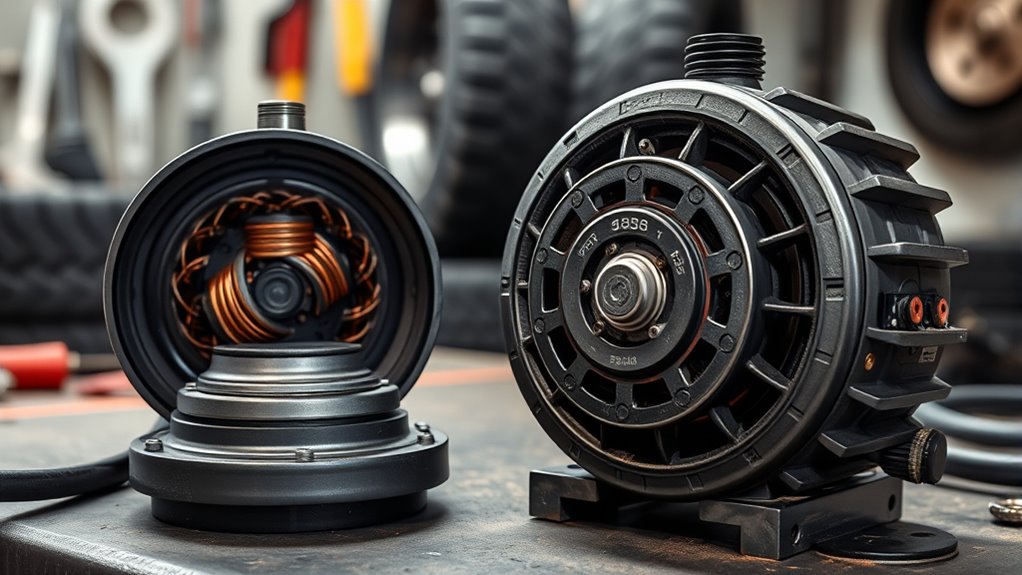
When you compare tire inflator motors directly, brushless models are usually the better choice because they deliver higher efficiency, faster speed, and longer service life.
Brushless Motors can reach 80-90% efficiency, so you waste less energy and get longer run times. Their lifespan often exceeds 10,000 hours because they avoid brush wear, while Brushed Motors typically last 1,000-3,000 hours.
You also gain stronger speed performance, with brushless units exceeding 10,000 RPM, which cuts inflation time. Maintenance requirements stay low, since you only need occasional bearing lubrication, not frequent brush replacements.
The main tradeoff is cost implications: brushless units cost more upfront because they use an electronic controller and additional components.
Still, you’re usually better off choosing them if you value durability, lower upkeep, and efficient operation. Brushed motors can suit tight budgets, but they don’t match the long-term freedom brushless designs give you.
How Do These Motors Work?
You can see a brushed tire inflator motor work by using carbon brushes and a commutator to switch current through the rotor windings, which creates torque and rotation.
In a brushless motor, you’ll rely on an electronic controller and Hall-effect sensors to time current flow without physical brush contact.
The key difference is commutation: brushed motors switch mechanically, while brushless motors switch electronically.
Brushed Motor Operation
A brushed motor uses mechanical commutation to convert electrical energy into rotation, with carbon brushes maintaining physical contact against a commutator to feed current into the windings.
You see brushed motors operate with four core parts: stator magnets, rotor coils, a commutator, and carbon brushes.
The brushes and commutator deliver electrical current into the rotor, turning its windings into electromagnets. That magnetic field interacts with the stator’s permanent magnets, and you get rotational motion.
These motors run only on DC power supplies, and you reverse direction by flipping current polarity. This simple control gives you direct mechanical freedom, but the tradeoff is clear: brush wear and tear limits lifespan to roughly 1,000 to 3,000 hours, depending on load, heat, and duty cycle.
Brushless Motor Operation
Brushless motors work through electronic commutation, where an external controller switches current to the stator coils instead of using physical brushes.
You get a Brushless Motor with permanent magnets in the rotor, and Hall-effect sensors report rotor position so the controller can maintain precise torque production.
Because no brushes slide against a commutator, you avoid the mechanical wear that limits a Brushed design. That reduction in friction raises efficiency to about 85-90%, and some units reach 95%.
In tire inflators, cooler operation can run 20-30°C lower under the same load, which helps battery life and thermal stability.
This architecture also extends lifespan beyond 10,000 hours, giving you a durable, liberated power source for demanding inflation tasks.
Commutation Differences
Unlike brushed tire inflator motors, which use carbon brushes and a commutator for mechanical commutation, brushless motors switch current electronically through an external controller.
You get direct control of commutation in brushed motors through contact, but that contact creates friction, heat, wear and tear, and lower efficiency.
Brushless motors use Hall-effect sensing to read rotor position, then the controller times current switching without physical contact. That electronic commutation reduces losses, so you can push higher speeds and better inflation performance.
Because brushed motors depend on physical brush contact, their lifespan usually stays near 1,000-3,000 hours.
Brushless motors avoid that constraint, often exceeding 10,000 hours.
If you want reliable, liberated operation with less maintenance, brushless motors give you cleaner power transfer and longer service life.
Performance Differences That Matter
When you compare brushless and brushed tire inflator motors, speed and inflation time are the first measurable differences you’ll notice. A brushless unit can run above 10,000 RPM and usually inflates faster, while a brushed motor’s lower RPM limits throughput.
You’ll also see efficiency and runtime gains with brushless designs, since they convert more input power into output work and drain the battery more slowly.
Speed And Inflation Time
Speed is one of the clearest performance gaps between brushless and brushed tire inflator motors.
You’ll usually see brushless motors exceed 10,000 RPM, while brushed motors often top out near 5,000 RPM, so inflation time drops fast. In a tire inflator, that means a flat-to-30 PSI fill in about 4-5 minutes with brushless motors, versus 8-10 minutes with brushed motors.
Brushless efficiency also keeps output steadier, so speed stays high under load. Lower heat generation helps prevent thermal slowdowns, which protects performance during long fills.
Because brushless motors have longer lifespan and less wear, they keep that pace over time. If you want faster, more reliable inflation, brushless design gives you the edge.
Efficiency And Runtime
Efficiency and runtime are where brushless tire inflator motors show a clear performance advantage, because they typically convert 80-90% of input energy into useful work, while brushed motors waste more power through brush friction.
You get less energy loss, so your battery lasts longer and your runtime can improve by 25-30% on a single charge.
Brushless motors also sustain steadier power delivery and torque consistency under heavy loads, which matters when you’re inflating multiple tires or fighting high pressure.
Because they run 20-30°C cooler, they reduce stress on internal components and extend operational lifespan beyond 10,000 hours, versus 1,000-3,000 for brushed motors.
That means you’re not just buying performance—you’re choosing freedom from frequent replacements, heat-related wear, and weak, inconsistent output.
Which Motor Lasts Longer on Battery?
Brushless tire inflator motors last longer on battery because they waste less energy and suffer less internal wear than brushed designs. You get higher efficiency, typically 80-90%, so more of each charge drives useful work instead of heat and friction.
Brushless inflator motors last longer on battery, turning more charge into useful work with less heat and wear.
In contrast, brushed motors lose about 15-20% of input energy, which shortens runtime and drains the battery faster. Because brushless motors have no carbon brushes to erode, you also avoid the wear that limits longevity in brushed motors.
That means less maintenance, steadier torque under load, and more consistent performance when you need freedom from interruption. In demanding inflator use, brushless units can extend runtime by 25-30% over brushed models.
Over time, that extra efficiency compounds into longer service life and better battery-backed operation. If you want maximum battery endurance, brushless motors are the stronger choice.
Why Brushless Motors Cost More
What drives up the price of a brushless tire inflator motor is its more complex electrical architecture, which needs electronic commutation, Hall-effect sensors, and a controller to manage operation. You pay for advanced control, tighter tolerances, and a more demanding production line than Brushed motors require. That precision raises the higher cost, yet it also gives you stronger efficiency, better use of electrical energy, and long life.
| Factor | Effect |
|---|---|
| Sensors and controller | Adds parts and assembly cost |
| Precision manufacturing | Raises quality control demands |
| Efficiency gain | Cuts operating energy waste |
| Minimal maintenance | Reduces service over time |
Brushless motors also deliver mechanical performance that suits demanding inflators, so the price reflects capability, not excess. If you want liberation from frequent repairs and weak output, the upfront premium can be rational. Over time, fewer replacements and less maintenance can offset the initial investment.
Which Motor Handles Heat and Heavy Use Better?
Under sustained load, a brushless tire inflator motor handles heat and heavy use better because it runs 20–30°C cooler than a brushed motor and avoids brush-friction heat entirely.
You get lower heat generation, less wear, and stronger longevity in demanding cycles. Brushless motors keep efficiency near 95% even under load, so performance stays stable instead of sagging as temperature rises.
Lower heat, less wear, and near-95% efficiency keep brushless motors stable under demanding load.
That matters in heavy-duty applications where you need consistent torque across long inflation sessions. Brushed motors rely on contact interfaces that add resistance, raise heat, and accelerate wear, which cuts service life and weakens output under stress.
If you push the unit repeatedly, the brushless design keeps operating conditions controlled and preserves mechanical integrity.
In practical terms, you’re choosing a motor that resists thermal drift, maintains torque, and sustains output without forcing premature replacement.
That’s the technical advantage when duty cycles are high and freedom from failure matters.
Which Motor Fits Your Needs?
Your best choice depends on how you use the inflator: if you need occasional, short bursts, a brushed motor can be adequate because it costs less upfront, but for frequent or continuous use, a brushless motor fits better.
In tire inflators, your duty cycle should drive the decision. Brushed motors suit low-duty-cycle tasks, yet their efficiency is lower, near 60%, so they waste more energy and shorten cordless runtime.
Brushless motors reach about 90% efficiency, deliver higher speed and torque, and hold output under load, so you inflate faster with less strain. You’ll also reduce maintenance needs because brushless designs eliminate brush replacement, improving long-term usability.
If you value liberation from repeated service and weak performance, the higher cost consideration often pays back through durability and energy savings.
For you, that means selecting the motor that matches your workload, not just the sticker price, when comparing tire inflators.
Brushed Vs Brushless Tire Inflator Motors
Brushed and brushless tire inflator motors differ most clearly in efficiency, durability, and sustained output.
If you want a freer, more capable tool, brushless motors convert more electrical energy from your power source into useful work, reaching 80-90% efficiency versus about 60% for brushed motors. That means longer runtime, less heat, and stronger speed and torque under load.
Their lifespan also scales differently: brushless units often exceed 10,000 hours, while brushed motors usually wear out after 1,000-3,000 hours as brushes degrade.
- Brushed motors cost less upfront, but you pay in upkeep.
- Brushless motors need minimal maintenance and fewer downtime interruptions.
- Higher speed and torque make brushless inflators better for demanding inflation tasks.
- Brushed motors can still suit low-cost, occasional use when initial cost matters most.
Frequently Asked Questions
What Are the Key Differences Between Brushed and Brushless Electric Motors?
Brushed motors use brushes and a commutator; brushless motors use electronic control.
You’ll get better motor efficiency, lower power consumption, less heat generation, and longer lifespan durability from brushless designs.
Brushed motors usually cost less upfront, but they need more maintenance requirements and create higher noise levels.
Brushless units also offer tighter torque characteristics and broader application suitability, especially when you need reliable performance, freedom from frequent service, and lower cost comparison over time.
What Are the Key Differences Between Brushed and Brushless Fuel Pumps?
Brushless fuel pumps use one data point like a compass: they last 10,000+ hours, while brushed units often stop at 1,000-3,000.
You get better fuel efficiency, lower operational noise, and steadier power output. Their maintenance requirements stay minimal, but brushed pumps need brush replacement and face contact wear.
Brushless designs boost temperature resistance, torque characteristics, and application suitability, though cost analysis favors brushed options when you need simple control.
What Are the Downsides of a Brushless Motor?
Brushless motors can cost more upfront, need electronic controllers, and if sensors fail, you may lose operation.
You’ll also face more complex repairs, possible coil whine, and less immediate response in some uses. That affects motor efficiency, maintenance requirements, and cost comparison.
Longevity factors improve, but performance consistency can suffer. Heat generation may vary, power consumption depends on control quality, and application suitability isn’t always ideal.
How Do I Know if My Motor Is Brushed or Brushless?
You can tell by checking the wires and internals: brushed motor types usually have two leads and visible carbon brushes, while brushless units use three to five wires and no brushes.
Compare identifying features, performance comparison, noise levels, and efficiency ratings to confirm. Brushless models often show longer lifespan differences and lower heat.
For maintenance tips, inspect cost factors and usage scenarios, since brushed motors need more wear-related service.
Conclusion
When you choose a tire inflator, you’re really choosing between simplicity and efficiency. Brushless motors typically deliver up to 20% better energy efficiency than brushed designs, which can translate into longer runtime and less heat under load. If you want lower cost and easy replacement parts, a brushed motor may fit your needs. But if you value durability, battery life, and consistent performance, you’ll usually get better long-term results with a brushless inflator.