
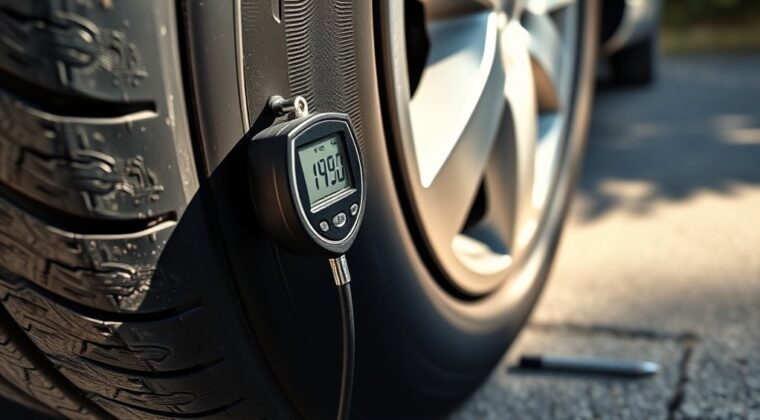
Tire inflator gauges can be fairly accurate, but you shouldn’t assume every one is exact. In practice, readings can vary by 2 to 6 psi or more because of calibration, leaks, temperature, and build quality. Digital gauges usually give the most precise readings, while analog and stick gauges trade some accuracy for durability or portability. If you compare your gauge with a trusted reference and test it regularly, you’ll know which numbers you can trust—and why.
Key Takeaways
- Tire inflator gauge accuracy varies widely; even similar models can differ by more than 6 psi.
- Price does not guarantee accuracy, so compare your gauge against a trusted reference regularly.
- Digital gauges are usually easier to read and often more precise, while analog gauges are durable.
- A good seal on the valve stem is essential, because leaks and poor contact can skew readings.
- Check pressure when tires are cold, and replace gauges that consistently differ by 2 psi or more.
How Accurate Are Tire Inflator Gauges?
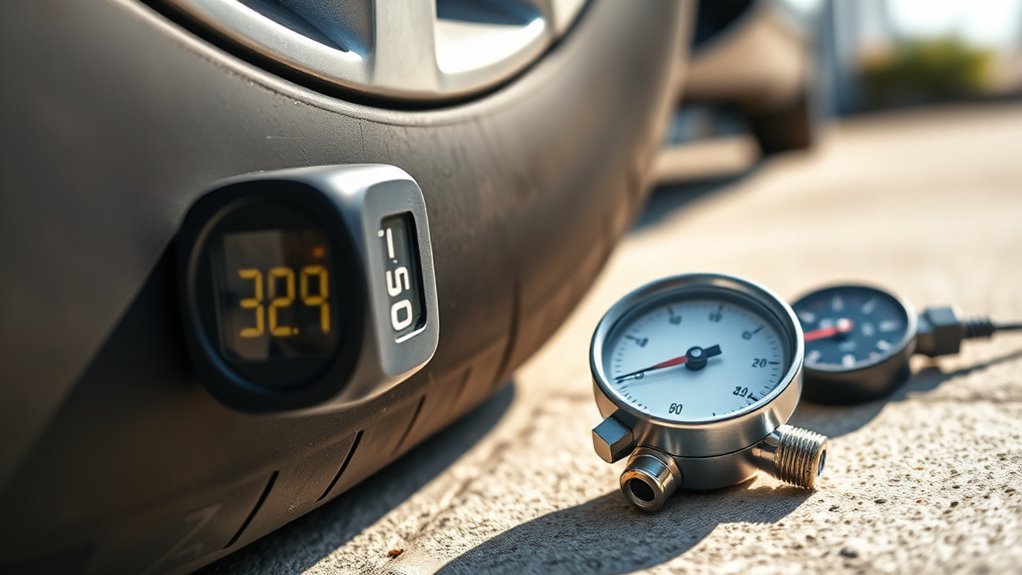
Tire inflator gauges can be surprisingly inconsistent, with some reading more than 6 psi high or low whether they’re inexpensive or premium models. You can’t assume one tire gauge stays accurate across the full pressure range.
Testing shows some gauges read well at low pressure but drift at higher values, while others do the opposite. A study of 40 gauges found that even identical units from the same brand could differ, so you should verify each tool, not the label.
Digital gauges often give finer resolution, sometimes to 0.1 psi, which helps you control pressure precisely. Analog gauges usually offer broader tolerances, often around ±2%, so you need to check them carefully.
To stay free from bad readings, compare your gauge against a trusted reference and schedule regular calibration. That habit helps you trust the number on screen or dial and make informed tire decisions.
Why Tire Gauge Readings Vary
You’ll see gauge accuracy differences even among models from the same brand, because manufacturing tolerances can shift readings by several psi.
You’ll also notice pressure range variance, since some gauges read low or high at different inflation levels or temperatures.
In real-world use, pressure drop during measurement and small air leaks can further distort the value you get.
Gauge Accuracy Differences
Gauge readings can vary by more than 6 psi between supposedly comparable inflator gauges, and price doesn’t guarantee accuracy. When you choose a tire pressure gauge, you’ll see accuracy differences rooted in design, tolerances, and calibration stability.
Digital gauges often deliver high accuracy and 0.1 psi resolution, while analog gauges usually carry broader ±1–2 psi error bands. Even identical brand and model units can drift, so don’t assume consistency from packaging alone.
Testing shows some gauges read well at low pressure but slip at higher values, or the reverse, which skews confidence. For liberation from guesswork, perform calibration verification against a reference standard and compare results over repeated checks.
That’s how you secure consistent readings and make informed pressure decisions.
Pressure Range Variance
Accuracy doesn’t stay fixed across the full pressure range, and that’s where many inflator gauges start to separate from one another. Your tire pressure gauge may read well at low pressure yet drift at higher pressure, or the reverse, cutting reliability.
In testing, some gauges miss by over 6 psi, and even identical inflator gauges can disagree. Price won’t rescue accuracy; cheap and expensive models both vary. Watch the pressure range, because calibration often isn’t uniform.
- Check low pressure behavior.
- Check higher pressure behavior.
- Compare repeated readings.
- Reject gauges that lose pressure during measurement.
You deserve tools that tell the truth, not ones that constrain your choices with vague numbers. When a tire gauge shifts across the pressure range, freedom turns into guesswork.
Real-World Reading Errors
Real-world tire gauge readings vary because small mechanical errors quickly add up, and some inflator gauges can be off by 6+ psi or more.
When you use a tire pressure gauge, you can’t assume price or brand guarantees accurate readings. In analog vs digital units, the display type doesn’t prevent drift, leakage, or calibration loss.
Some gauges read fine at low pressure, then deviate as pressure rises. During testing gauges, even 40 models showed gaps between identical units, proving that consistency isn’t automatic.
You may also see pressure drops while measuring, which distorts the result. If your gauge disagrees with TPMS systems, treat both as data points, not truth.
For liberation from guesswork, verify tools regularly and replace any gauge that can’t hold stable readings.
Which Tire Inflator Gauge Type Is Best?
Which type works best depends on what you value most: precision, durability, or speed. If you want the highest accuracy, choose digital tire pressure tire inflators; they often read to 0.1 PSI, and their backlit display helps you verify numbers clearly. In performance vehicles and EVs, that precision matters.
- Digital gauges: best for exact inflation, but they need calibration and battery changes.
- Analog gauges: best for harsh use, because mechanical gauges use a Bourdon tube and resist abuse.
- High-volume shops: digital tire inflators save time by reading, inflating, and bleeding in one workflow.
- Simple ownership: analog gauges avoid batteries, yet parallax can weaken accuracy.
You’re not choosing a winner for everyone; you’re choosing the tool that lets you control pressure on your own terms. For many drivers, that freedom means pairing the gauge type to the job, not chasing one universal standard.
Which Tire Inflator Gauge Features Matter Most?
Beyond the gauge type itself, the features around the chuck, display, and adjustment controls determine how well the tool performs in practice. You need a tire pressure gauge with a chuck that seals firmly on the valve stem, because leaks waste time and reduce accuracy, especially in cramped wheel wells.
For a digital tire inflator, prioritize ease of reading: large numbers, backlit displays, and clear units help you verify pressure in low light. A built-in bleed valve matters when you want to trim excess air with control instead of guessing.
Check the measurement range too; it should cover your vehicle’s recommended pressures without forcing you into the top or bottom edge of the scale. High resolution, such as 0.1 PSI, improves precision.
Finally, don’t ignore durability. You want a gauge that survives drops, rough storage, and repeated use, because reliable tools support your autonomy rather than limiting it.
How Can You Test a Tire Gauge?
To test a tire gauge, compare its readings against a calibrated reference gauge at several pressures, such as 30, 60, and 80 PSI, and record any deviation.
Use your tire pressure gauge on a known accurate source, like a professional tire shop, to verify your gauge and judge whether it stays within accuracy limits.
Keep temperature steady, because thermal drift can skew results and mask real error.
Test multiple gauges of the same model if you can; identical units don’t always agree.
For a disciplined check tire pressure routine, follow these steps:
- Set both gauges at common pressures.
- Note each reading and calculate the offset.
- Repeat at the same temperature.
- Recheck every few months, especially after rough handling.
You’re not dependent on guesswork when you measure carefully.
When Should You Replace Your Tire Gauge?
You should replace your tire gauge when it consistently differs by 2 PSI or more from a reliable reference gauge or TPMS reading, because that level of variance can compromise pressure checks.
If your gauge leaks air while you use it, don’t trust it; replace it immediately. A cracked housing, bent needle, or other physical damage can shift internal mechanics and erode accuracy.
Age matters too: after five years, wear can degrade the instrument enough that calibration no longer holds. Keep your tire gauge free, but never keep a bad one.
After five years, wear can defeat calibration; keep your tire gauge clean, but never keep a bad one.
Test it regularly against a known standard, and if calibration fails, retire it. Precise pressure control depends on tools that report truth, not noise.
When your gauge can’t deliver consistent PSI readings, it limits your ability to make informed, autonomous decisions about tire safety and performance.
Replace it decisively, and keep your measurement chain accurate.
Frequently Asked Questions
What Is the Accuracy of Tire Inflators With Gauges?
Tire inflators with gauges’re usually accurate within about ±0.5 to 2 PSI, depending on inflator types comparison and digital vs analog design.
You’ll get better results with gauge calibration methods, because common gauge errors like parallax, hysteresis, and backlash can skew readings.
Temperature effects also shift pressure, so you should check often.
Follow gauge maintenance tips, and protect tire pressure importance by verifying against a trusted reference regularly.
Will It Ruin Tires if You Inflate Them to 40 PSI Instead of 35 PSI When the Recommended PSI Is 35?
Yes—if you inflate them to 40 psi instead of 35 psi, you can damage tire wear patterns and cut handling performance.
You’ll likely get more center wear, more pressure fluctuations, and less grip. Higher pressure also raises heat buildup, which increases safety concerns and can shorten lifespan reduction.
Fuel efficiency might improve slightly, but the tradeoff isn’t worth it.
Keep pressure at the manufacturer’s spec to protect performance and freedom.
What Is the 4 PSI Rule on Tires?
The 4 PSI rule means you can run tires about 4 psi above their cold tire pressure when they’re hot, because temperature effects raise readings during driving.
You should check tire pressure with a reliable gauge, consider gauge calibration, and watch psi differences after parking. This helps you manage inflation frequency, limit tire wear, and protect safety.
It won’t free you from maintenance, but it gives you control.
How to Tell if a Tire Pressure Gauge Is Accurate?
Compare your gauge with a certified reference at 30 and 60 PSI, then repeat gauge comparison tests across its range.
You’ll spot common gauge errors, including digital vs analog drift and temperature effects. Use gauge calibration methods regularly, especially if you rely on precise tire pressure maintenance.
If readings differ by more than 1–2 PSI, replace or recalibrate it. Trust data, not price, and practice proper inflation techniques.
Conclusion
So, how accurate are tire inflator gauges? Accurate enough to keep you from inventing your own “recommended PSI,” but not so magical that you should trust them blindly. You need to check for worn seals, bad calibration, and temperature drift, then test your gauge against a known standard. If it’s consistently off, replace it. In tire care, guesswork is just expensive creativity, and your dashboard light is not a pressure oracle.