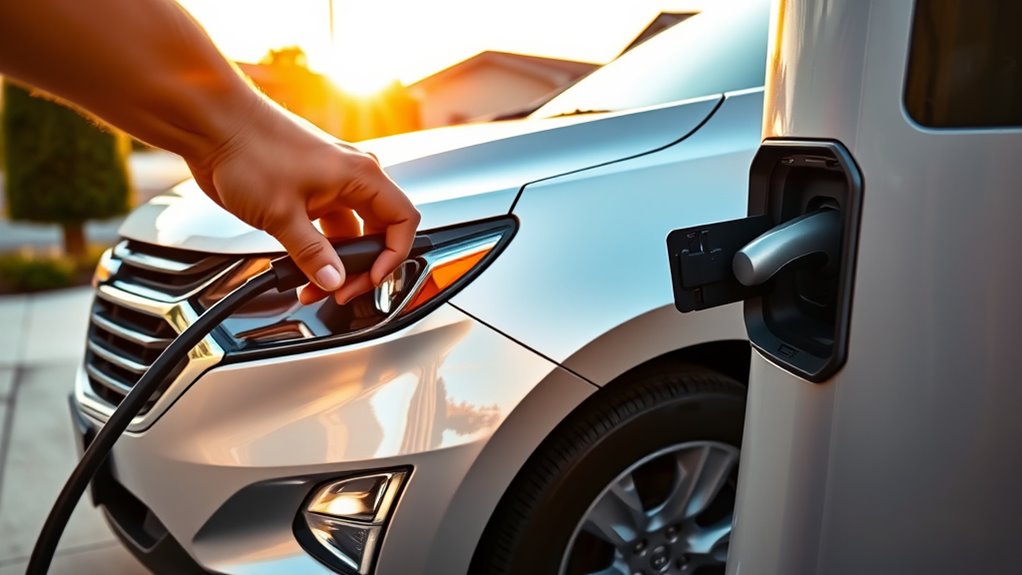
Charging a Chevy Equinox EV is simple once you match the charger, connector, outlet, and settings to your daily driving. For home charging, you can use a 120-volt Level 1 outlet for slow overnight top-offs or a 240-volt Level 2 setup for much faster daily charging. For public fast charging, use a compatible DC fast charger, and use only a GM-approved NACS DC adapter when accessing compatible Tesla Superchargers.
Quick Answer
To charge a Chevy Equinox EV, put the vehicle in Park, open the charge port, plug in a compatible Level 1, Level 2, or DC fast-charging connector until it clicks, then confirm charging on the center screen, EVSE, or myChevrolet app. Set a daily charge limit that fits your range needs, stop the session before unplugging, and close the port door securely.
Key Takeaways
- Use Level 1 only when slow charging is enough; use Level 2 for normal daily home charging.
- A 240-volt Level 2 outlet or hardwired charger should be installed and checked by a qualified electrician.
- Set charge limits and schedules in the vehicle or myChevrolet app so charging matches your commute and utility rates.
- For compatible Tesla Superchargers, use the GM-approved NACS DC adapter rather than an unapproved adapter.
- Stop the charging session before pulling the connector, and never twist, yank, or force a stuck plug.
At a Glance
| Time Required | 1 to 2 minutes to plug in or unplug; charging time depends on battery level, charger output, temperature, and charge limit. |
| Difficulty | Easy for plugging in; professional help required for new 240-volt wiring, panel work, or hardwired charger installation. |
| Tools Needed | Compatible charging cord or EVSE, safe outlet or wall charger, myChevrolet app, and a GM-approved NACS DC adapter only for compatible Tesla Superchargers. |
| Cost | Level 1 may use included equipment if you have a safe outlet. Level 2 cost varies by charger, wiring distance, permits, panel capacity, and electrician labor. |
How to Charge a Chevy Equinox EV at Home
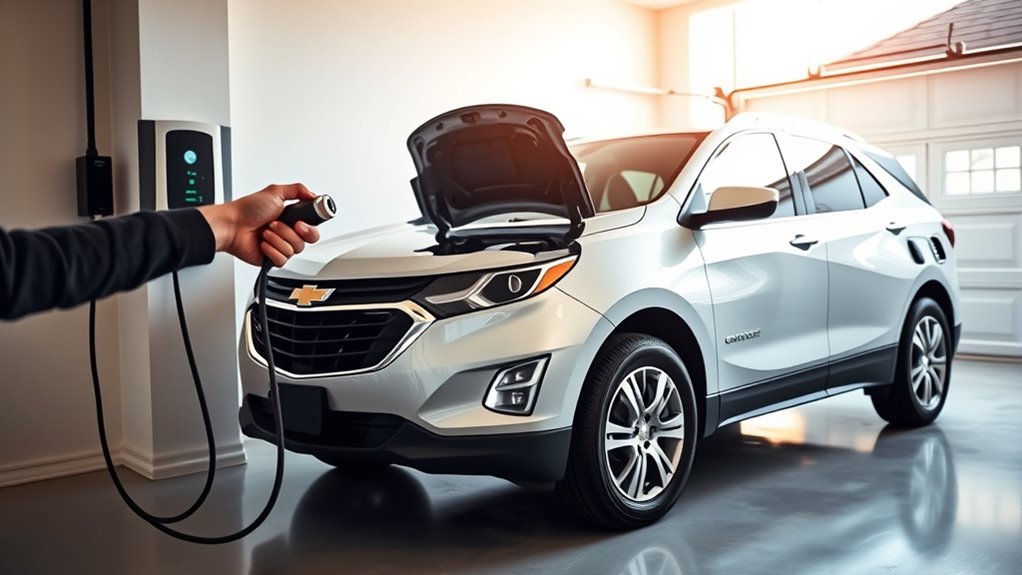
To charge your Chevy Equinox EV at home, start with the charging method that fits your routine. Chevrolet lists two common home options: Level 1 charging through a 120-volt outlet and Level 2 charging through a 240-volt outlet or hardwired wall charger. The Chevrolet home charging guide describes Level 1 as the slower option and Level 2 as the better fit for overnight battery recovery.
For light driving, Level 1 can work because you may only need to replace a short commute overnight. For daily driving, colder weather, or back-to-back trips, Level 2 is usually the better setup because it adds range much faster. Chevrolet estimates Level 1 home charging at about 1 to 4 miles of range per hour and Level 2 at about 7 to 40 miles of range per hour, depending on the charger and vehicle conditions.
Before you plug in, put the vehicle in Park, open the charge port, insert the connector straight into the inlet, and listen or feel for the latch to seat. Then confirm the session on the center display, the charging equipment, or the myChevrolet app. If charging is delayed, check whether you selected Charge Later, a departure time, or a charge limit.
Warning: Do not use a damaged outlet, loose receptacle, overheated plug, undersized extension cord, or improvised adapter. If you are not sure the circuit can handle EV charging, stop and have a qualified electrician inspect the outlet, breaker, wiring, grounding, and panel capacity.
Confirm Your Outlet and Charging Gear
Before plugging in, make sure your charging gear matches the outlet and the Equinox EV charging port. A 120-volt household outlet can support Level 1 charging when the outlet is in good condition and the circuit is suitable. A 240-volt outlet or hardwired wall charger supports Level 2 charging, but it must be properly installed for continuous EV charging loads.
| Item | What to verify | Why it matters |
|---|---|---|
| Outlet | 120V for Level 1 or 240V for Level 2 | Matches the charging equipment and expected speed |
| Circuit | Dedicated, correctly sized, and code-compliant | Helps prevent nuisance trips, overheating, and unsafe loads |
| Condition | No cracks, heat marks, loose fit, corrosion, or buzzing | Damaged electrical parts can fail under continuous charging |
| EVSE | Listed, compatible, and rated for the circuit | The charger should not demand more current than the circuit can safely provide |
| Connector | Correct J1772/CCS connector for most home and public charging, or approved adapter when required | Prevents failed sessions and connector damage |
The U.S. Department of Energy Alternative Fuels Data Center explains that charging time depends on battery state of charge, battery size, onboard charger capacity, charging level, EVSE output, and electrical service. That is why two homes with the same vehicle can see different results.
Note: A NEMA 14-50 or similar 240-volt outlet is not automatically safe just because the plug fits. The circuit, breaker, conductor size, receptacle quality, installation method, and local code requirements all matter.
Choose Level 1 or Level 2 Charging
Choose Level 1 if you drive short distances and can leave the Equinox EV plugged in for many hours. Level 1 uses 120-volt AC power and is the easiest entry point because it may work with the portable charging cord and a suitable household outlet. It is best for topping off after light use, not for recovering a deeply depleted battery quickly.
Choose Level 2 if the Equinox EV is your main vehicle or you want the battery ready each morning. Level 2 uses 240-volt AC power and is the fastest common home charging method. Chevrolet says Level 2 home charging can add far more range per hour than Level 1, and AFDC describes Level 2 as the common overnight home-charging choice for many EV owners.
- Use Level 1 for short commutes, occasional charging, or backup charging.
- Use Level 2 for daily home charging, colder climates, longer commutes, and faster turnaround.
- Use public DC fast charging for road trips or quick stops away from home, not as your only routine charging method unless you have no home option.
- Use a GM-approved NACS DC adapter only where Chevrolet supports compatible Tesla Supercharger access.
Chevrolet says the 2026 Equinox EV has an 85 kWh battery pack and can charge from 10% to 80% in about 42 minutes on compatible public DC fast charging.
Start Charging the Equinox EV
Once your outlet and charger are ready, the charging process is straightforward. Park close enough that the cable reaches without tension, put the vehicle in Park, open the charge port door, and insert the connector straight into the inlet until it seats securely.
Prepare the Vehicle for Charging
Before you connect the cable, make sure the Equinox EV is fully stopped and in Park. Turn off climate settings if you do not need them, remove tension from the cable path, and make sure the connector is clean and dry. Do not let the cable cross a walking path where someone could trip over it.
- Verify the vehicle is in Park.
- Open the charge port door fully.
- Check the connector for dirt, moisture, cracks, or bent pins.
- Keep the cable straight enough that it does not pull down on the port.
- Confirm your selected charge limit or schedule before walking away.
Connect the Charger to the Port
Hold the connector level with the charge port and push it in firmly until it clicks or locks. Do not angle the plug upward, twist it, or use force. If it does not seat cleanly, pull it back out, inspect the connector and inlet, then try again.
After connecting, check the vehicle screen, EVSE status indicator, or myChevrolet app to confirm that charging has started. If you scheduled a delayed session, the vehicle may show that it is plugged in but waiting to charge. That is normal when Charge Later, time-of-use settings, or a departure time is active.
Pro Tip: If you charge overnight, set a departure time before bed. The vehicle can prepare the battery and cabin while still plugged in, which helps preserve driving range in hot or cold weather.
Set Charge Limits and Schedules
Use the charging settings in the center display or myChevrolet app to set your target charge level and schedule. For everyday use, many EV owners choose a limit around 80% when that still covers their routine. Use 100% when you need the extra range before a long trip, then drive soon after the vehicle reaches that level.
Charge limits help you avoid filling the battery more than you need. Schedules help you start charging during lower-cost utility periods, reduce grid demand, and have the vehicle ready by a set departure time. Chevrolet’s EV charging guide notes that charging during off-peak hours can reduce utility costs and help reduce strain on the electrical grid.
- Select Charge Now when you want charging to begin immediately.
- Select Charge Later or a schedule when you want charging to wait for a set time.
- Use time-of-use settings if your utility charges less during off-peak hours.
- Set a departure time if you need the vehicle ready by a specific hour.
- Raise the target to 100% only when you need maximum range for a trip.
If the Equinox EV does not start charging right away, check the schedule before assuming the charger failed. A delayed charging plan can make the vehicle wait even when the connector and outlet are working correctly.
Use Public DC Fast Charging and NACS Adapters Correctly
Home charging is the most convenient option for many owners, but public charging matters on road trips. Chevrolet says customers have access to more than 250,000 public chargers across North America through its charging ecosystem and myChevrolet app tools. The app can help you plan routes, find public chargers, and check charging options away from home.
For the 2026 Equinox EV, Chevrolet lists public DC fast-charging capability up to 150 kW and an approximate 10% to 80% charge time of 42 minutes under suitable conditions. Real charging speed can still vary based on charger output, battery temperature, current state of charge, site limits, and whether another vehicle is sharing power at the same station.
For compatible Tesla Superchargers, follow Chevrolet’s current guidance and use a GM-approved NACS DC adapter. Do not use random third-party adapters for high-power DC charging. Also remember that a DC NACS adapter is not the same thing as a home Level 2 adapter, and adapters are not universal across every charging situation.
Stop Charging and Unplug Safely
When you are ready to leave, stop the session first, then unplug. Ending the session before pulling the connector helps prevent errors, protects the latch, and makes the connector easier to remove.
Stop Charge in the App or Center Display
Use the center display, charging station screen, or myChevrolet app to stop the charging session. Wait for confirmation that charging has ended. If you are at a public station, also follow the station’s stop-session instructions because payment and connector release can be tied to the charger network.
- Tap or select Stop Charge when available.
- Wait for the vehicle or station to confirm the session has ended.
- Check that the connector is unlocked before pulling.
- Keep one hand on the connector body rather than the cable.
Release the Connector Latch
Press the connector’s latch release button, then pull the connector straight out. Keep it aligned with the charge port. Do not twist, rock, yank, or drag the connector against the inlet.
If the connector does not release, confirm that the charging session has stopped, the vehicle is unlocked, and the charger has completed its own release process. At public DC fast chargers, the station may need a few seconds to end the session before the connector unlocks.
Close the Port Door Safely
After the connector is free, inspect the inlet for debris or moisture, close the charge port door, and return the cable to its holder, wall dock, bag, or station cradle. Do not leave the connector on the ground where it can collect dirt or be driven over.
- Unplug smoothly and straight.
- Keep the connector away from water, grit, and road salt.
- Close the port door fully.
- Check for warning messages before driving away.
- At public stations, return the cable properly so the next driver can use it.
Troubleshoot Common Charging Problems
If your Chevy Equinox EV will not charge, isolate one variable at a time. Start with the simple checks: Park, connector fit, charge schedule, charge limit, outlet power, breaker status, and EVSE error lights.
| Problem | Likely cause | What to do |
|---|---|---|
| Vehicle says plugged in but not charging | Charge Later, time-of-use setting, or departure schedule is active | Switch to Charge Now or adjust the schedule. |
| EVSE shows an error light | Ground fault, overheating, outlet issue, or charger fault | Stop charging, read the EVSE manual, and do not reuse a hot or damaged outlet. |
| Charging is slower than expected | Low EVSE amperage, cold battery, high state of charge, shared public charger, or circuit limit | Check charger rating, battery percentage, weather, and station output. |
| Connector will not seat | Misalignment, debris, wrong adapter, or damaged connector | Remove it, inspect both sides, and reconnect straight. Do not force it. |
| Breaker trips | Circuit overload, EVSE setting mismatch, wiring fault, or shared load | Stop using the circuit and call a qualified electrician. |
If you smell burning, see melted plastic, hear buzzing, or feel unusual heat at the outlet or plug, stop immediately. Do not try another charging session on that outlet until it has been inspected.
Frequently Asked Questions
How do I charge my Chevy Equinox EV?
Put the Equinox EV in Park, open the charge port, plug in a compatible Level 1, Level 2, or DC fast-charging connector, and confirm charging on the center screen, EVSE, or myChevrolet app. If a schedule is active, the vehicle may wait before it starts charging.
Can I just plug my EV into a 240V outlet?
Yes, if the outlet, circuit, breaker, wiring, and EVSE are compatible and properly rated. A 240-volt outlet for Level 2 charging should be installed or inspected by a qualified electrician. Do not use a loose, damaged, overheated, or improvised outlet setup.
Should I charge my Equinox EV to 80% or 100%?
For daily driving, set a charge limit that comfortably covers your routine. Many owners choose about 80% for normal use when they do not need full range. Charge to 100% before long trips or days when you need maximum range, then drive soon after charging completes.
How long does it take to charge a Chevy Equinox EV?
Charging time depends on charger output, battery percentage, temperature, and settings. Chevrolet estimates Level 1 home charging at about 1 to 4 miles of range per hour and Level 2 at about 7 to 40 miles per hour. On compatible public DC fast charging, the 2026 Equinox EV can charge from 10% to 80% in about 42 minutes under suitable conditions.
Does the Chevy Equinox EV use NACS or CCS?
For current Equinox EV guidance, treat normal home and CCS public charging separately from Tesla Supercharger access. Chevrolet tells owners to use a GM-approved NACS DC adapter for compatible Tesla Superchargers. Always match the connector or adapter to the charger type and vehicle instructions.
What stops someone from unplugging my electric car?
Many charging sessions use connector latches, vehicle locks, station controls, and app notifications to reduce tampering. Security varies by charger type and station. At home, park where the cable is visible and protected. In public, check the station and app status before walking away.
Why is my Equinox EV plugged in but not charging?
The most common causes are an active charging schedule, a charge limit that has already been reached, a tripped breaker, an EVSE fault, a loose connector, or an incompatible station or adapter. Check the screen, app, charger indicator, and breaker before trying another outlet.
Conclusion
Charging your Chevy Equinox EV is easy when the setup is safe and the settings match your routine. Use Level 1 for slow top-offs, Level 2 for daily home charging, and DC fast charging for road trips or quick public stops. Confirm the session starts, set a practical charge limit, stop charging before unplugging, and never force a connector. If charging fails, check the schedule, plug, outlet, breaker, and charger error lights before trying again.
Sources
- Chevrolet 2026 Equinox EV, Equinox EV range, DC fast-charging details, battery size, and GM-approved NACS DC adapter guidance.
- Chevrolet EV Charging, home charging, public charging, off-peak charging, and myChevrolet app charging support.
- Chevrolet Home Charging, Level 1 and Level 2 voltage, range-per-hour estimates, and charger options.
- Chevrolet Public Charging, public charging steps, public network access, Level 2, and DC fast-charging context.
- U.S. Department of Energy Alternative Fuels Data Center, EV charging levels, EVSE terminology, connector definitions, and charging-speed factors.