
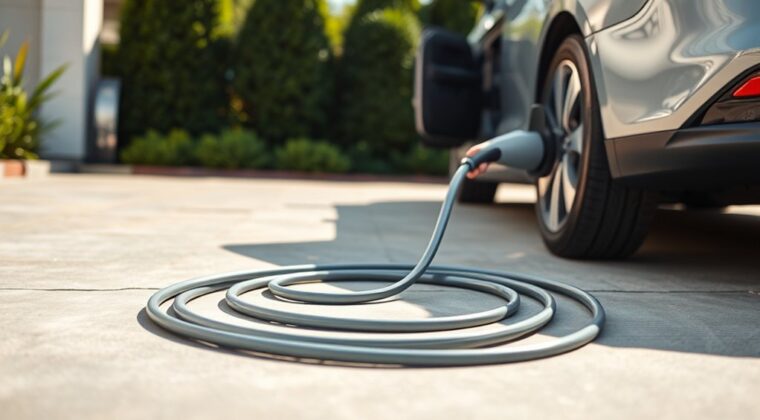
EV charger cables usually twist and kink because they are wound the same way every time, forced into tight bends, pulled from the connector, or stored while cold and stiff. The safest fix is simple: straighten the cable, use large relaxed loops, support it on a wide holder, and inspect the jacket and connector before charging.
Quick Answer
To prevent an EV charger cable from twisting and kinking, never force tight coils. Lay the cable straight first, let natural twists relax, then store it in large loose loops on a wide cable holder. Keep the connector off the ground, avoid sharp bends, and stop using the cable if you see cracks, exposed wiring, heat damage, or a damaged plug.
Key Takeaways
- Use large, relaxed loops instead of tight coils, knots, or small hooks.
- Keep the connector in your hand or holster while storing the cable. Do not drag it across the floor.
- A wide wall holder or cable reel with a large radius reduces bend stress better than a small peg.
- Inspect the jacket, strain relief, connector pins, latch, and plug area before charging.
- Cold cables kink more easily, so warm them naturally and handle them slowly in winter.
At a Glance
| Time Required | 5 to 10 minutes for the first untwist; 30 to 60 seconds after each charge |
| Difficulty | Easy |
| Tools Needed | Wide cable holder, connector holster, microfiber cloth, flashlight, and mounting hardware if installing a holder |
| Cost | $0 if you already have a holder; usually $10 to $40 for a basic wall-mounted cable holder and holster |
Immediate Solutions for Cable Twisting and Kinks
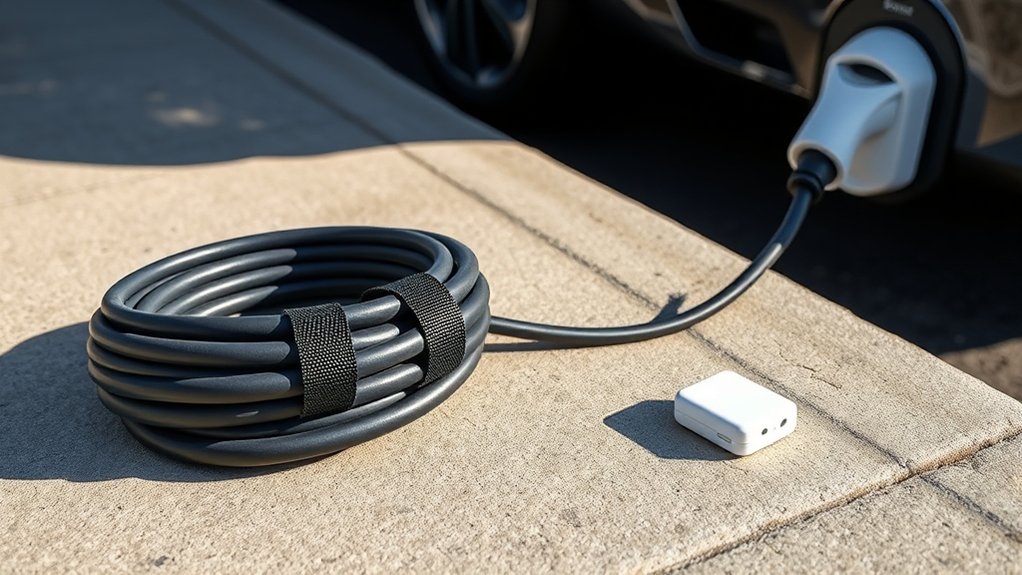
If your EV charger cable is already twisted, start by removing the twist before you store it again. Unplug the connector from the vehicle, hold the connector off the ground, and walk the cable out in a straight line. Let the cable relax naturally for a minute, then gently rotate the loose end until the printed text or molded line on the jacket runs straight.
Warning: Do not drag the J1772 connector, NACS connector, or any EV charging plug across concrete, gravel, water, mud, or garage debris. Dirt and impact can damage the connector face, latch, pins, or strain relief. Keep the connector in your hand or place it in a holster.
Once the cable is straight, coil it in large relaxed loops. Do not force it into a perfect circle. If the cable wants to turn, follow its natural curve instead of twisting your wrist harder. A cable that fights you is usually telling you there is still twist stored inside it.
If the cable has a stubborn kink, do not sharply bend it backward. Instead, make a wide counter-bend with both hands and release it slowly. The goal is to relax the jacket, not crease it.
Pro Tip: Use the printed text on the cable as a twist indicator. If the text spirals around the cable instead of running in a steady line, the cable still has stored twist.
Best Practices for Storing Your EV Charger Cable
The best storage method is the one that supports the cable without sharp bends, keeps the connector clean, and makes the cable easy to unwind the next time you charge. For most home chargers, that means a wide wall holder, a separate connector holster, and loose loops that hang naturally.
Proper Coiling Techniques
Use large loops that are roughly the width of your forearm or larger. Small loops create tighter bend stress and make the cable more likely to remember that shape. If your charger cable is thick or cold, make the loops even larger.
Use this simple storage routine after each charge:
- Unplug the vehicle by holding the connector body, not the cable.
- Walk the cable back toward the charger so it lies loose and untwisted.
- Wipe dirt or moisture from the connector and cable jacket with a dry cloth.
- Place the connector in its holster.
- Lift the cable onto the holder in wide, relaxed loops.
- Leave enough slack so the cable does not pull against the charger housing or connector strain relief.
Avoid tight coils, knots, figure-eight knots, or wrapping the cable around a narrow peg. A cable can bend safely only within its intended bend radius. If the loop is so small that the cable flattens, creases, or springs off the holder, the loop is too tight.
Ideal Storage Locations
Store the cable in a clean, dry, and easy-to-reach location. A garage wall beside the charger is usually best because it keeps the cable off the floor and away from tires, snow melt, lawn tools, and foot traffic.
- Keep the cable off the ground to reduce abrasion and dirt buildup.
- Keep the connector in a holster to protect the face and latch.
- Avoid routing the cable under a garage door, floor mat, rug, tire, or storage bin.
- Keep slack away from walkways so no one trips over it.
- For outdoor charging, use weather-resistant hardware and follow your charger manufacturer’s outdoor storage instructions.
Protective Cable Accessories
Protective accessories can help, but they must not trap heat, pinch the cable, or interfere with the connector. Choose manufacturer-approved holsters, wall mounts, hooks, or cable management arms whenever possible.
Avoid tightly wrapping the charging cable in aftermarket sleeves unless the charger manufacturer says it is allowed. Some wraps can hold moisture, reduce heat dissipation, or make the cable harder to inspect. If you use a protective cover in a high-traffic garage, keep it loose and remove it during inspections so you can check the actual cable jacket.
Step-by-Step Storage Routine After Each Charge
A consistent routine prevents most twisting problems. Use the same sequence every time so the cable does not develop a tight memory.
- Stop the charging session properly. End the session from the vehicle, app, or charger if your setup requires it.
- Disconnect by the connector body. Do not pull on the cable to unplug it.
- Check for heat or damage. The connector and cable may be slightly warm during normal charging, but they should not smell burnt, feel unusually hot, or show soft spots.
- Straighten the cable. Walk it out gently so any twist can move to the free end.
- Make loose loops. Let each loop follow the cable’s natural curve.
- Store the connector first or last depending on your holder. The key is that the connector should rest in a holster, not hang by the cable.
Note: Do not charge while the cable is trapped in a tight bundle, under a mat, or wrapped tightly around a small hook. Leave slack in open, loose curves so the cable is not pinched and heat can dissipate.
Effective Handling Techniques to Minimize Twisting
Most twisting starts during everyday plugging and unplugging. Use two hands when needed: one hand on the connector and the other guiding the cable. This reduces stress on the internal conductors and the strain relief near the plug.
- Pull straight from the connector body. Never yank from the cable.
- Do not spin the connector while plugged in. If you need to adjust position, unplug first and reposition the cable gently.
- Let the cable untwist before storage. If it loops around itself, lay it out and rotate the loose end until it relaxes.
- Avoid driving over the cable. Even a slow roll can flatten the jacket or stress internal wires.
- Keep the cable away from sharp edges. Concrete corners, metal shelving, and garage door tracks can scrape the jacket.
If your cable always twists in the same direction, you may be wrapping it the same way every time. Alternate your hand position slightly while coiling so the cable is guided into loops rather than twisted into loops.
How to Choose the Best Cable Holder for EV Charging Cables
A good EV charger cable holder supports the cable’s weight without forcing a tight bend. The best holder is wide, smooth, sturdy, and positioned close enough to the charger that the cable does not pull against the unit.
Key Holder Features
Look for these features when choosing a holder:
- Wide radius: A broad hook or rounded saddle is better than a small peg.
- Connector holster: The connector should have its own resting place so it does not hang from the cable.
- Strong load rating: Level 2 charging cables can be heavy, especially in cold weather.
- Smooth edges: Avoid sharp metal edges that can cut or rub the jacket.
- Weather resistance: Outdoor holders should resist UV, rain, snow, and temperature swings.
Installation Ease
Install the holder where the cable naturally wants to rest. For most wall-mounted chargers, place the holder near the charger and at a comfortable height so you can lift the cable without dragging it.
| Feature | Why It Helps | Best Choice |
|---|---|---|
| Wide cable saddle | Reduces tight bend stress | Rounded wall holder |
| Separate connector holster | Keeps plug face clean and supported | Holster matched to your connector |
| Weather-resistant material | Handles sun, rain, and cold | UV-resistant plastic or coated metal |
| Solid wall mounting | Prevents sagging and cable drop | Stud-mounted or masonry-mounted hardware |
Cable Compatibility Considerations
Choose a holder that matches both your cable thickness and connector type. A portable Level 1 cable may be lighter and easier to loop, while a Level 2 cable is often thicker and needs a wider holder. If your charger uses a J1772-style connector, SAE J1772 is the North American conductive charge coupler standard for that connector family. You can verify connector details through SAE International.
If your charger has a fixed cable, use the holder recommended by the charger manufacturer when possible. If your setup uses a removable cable, store it in a dry bag or case only after it is clean, dry, and loosely looped.
How Temperature Affects Your EV Charger Cables
Temperature changes how a cable feels in your hands. In cold weather, the jacket can feel stiff, making the cable easier to kink if you force it into small loops. In hot weather, the cable may feel more flexible, but you still should avoid sharp bends, direct strain, and storage against hot surfaces.
- Cold weather: Use larger loops and move slowly. Do not force the cable flat if it resists.
- Hot weather: Keep the cable off hot asphalt and away from sharp sun-baked edges.
- Rain or snow: Wipe the cable and connector before storage. Do not store a wet connector face inside a dirty holster.
- Outdoor storage: Use a weather-rated charger setup and follow the manufacturer’s manual.
If the cable becomes extremely stiff, let it warm naturally in the garage or in sunlight before reshaping it. Do not use a heat gun, open flame, space heater, or boiling water to soften a charger cable.
Inspect Your Cables Regularly: Key Areas to Check
Regular inspection is the best way to catch small cable problems before they become charging failures or safety hazards. OSHA’s electrical safety rules for cord-and-plug equipment require visual inspection for external defects in workplace settings, and the same habit is useful for home EV charging care. You can review the general rule at OSHA 1910.334.
Before charging, check these areas:
- Cable jacket: Look for cracks, cuts, flat spots, swelling, melted areas, or exposed wire.
- Strain relief: Check the flexible area where the cable enters the connector and charger body.
- Connector face: Look for dirt, bent parts, burn marks, broken plastic, or moisture.
- Latch or release button: Make sure it moves normally and does not stick.
- Plug or wall connection: If using a plug-in EVSE, check for heat discoloration, looseness, or arcing marks.
- Printed text: If the cable text spirals, untwist the cable before storing it.
Warning: Stop using the charger cable if you see exposed conductors, deep cuts, melted insulation, burn marks, a cracked connector, a loose plug, or repeated overheating. Do not tape over damaged EV charging cables or repair them yourself. Contact the charger manufacturer or a qualified electrician.
Tips for Unkinking and Maintaining Flexibility
If your EV charger cable has a mild kink, lay it straight in a safe, dry area and let it relax. Warm sunlight can help soften the jacket, but do not overheat it. Once the cable is more flexible, use both hands to guide the kink into a broad curve in the opposite direction.
Do not sharply fold the kink backward. That can make the crease worse. If the kink left a flat spot, crack, raised bubble, or soft section, treat it as damage and stop using the cable until it is inspected.
To maintain flexibility:
- Store the cable in large loops every time.
- Keep it off the ground when not in use.
- Do not leave heavy objects sitting on it.
- Do not close a garage door, trunk, or gate on it.
- Keep the connector clean and dry before placing it in the holster.
Troubleshooting Common Cable Twisting Problems
Use this quick guide to identify what is causing your cable to twist, curl, or kink.
| Problem | Likely Cause | Fix |
|---|---|---|
| Cable twists every time you store it | You are winding it in the same direction with wrist twist | Lay it straight, release stored twist, then make larger natural loops |
| Cable springs off the holder | Loops are too small or holder is too narrow | Use a wider holder and fewer, larger loops |
| Cable feels stiff in winter | Cold jacket material is less flexible | Use larger loops and let it warm naturally before reshaping |
| Printed text spirals around cable | Stored twist remains in the cable | Walk the cable out straight and rotate the free end until the text runs straight |
| Cable has a flat spot or cracked jacket | Compression, sharp bend, or physical damage | Stop using it and contact the manufacturer or a qualified electrician |
Community Tips for Effective Cable Management
Experienced EV owners often solve cable twisting with simple habits rather than expensive accessories. The most useful habits are consistent: keep the cable off the floor, avoid tight bends, and untwist it before it becomes a permanent curl.
- Use a dedicated parking routine: Park close enough that the cable reaches without being stretched across the garage.
- Keep the same storage area clear: Do not let tools, bikes, or storage bins crowd the cable holder.
- Check the cable path: Route it where people will not step on it and tires will not cross it.
- Teach other drivers in the house: A cable stays healthier when everyone stores it the same safe way.
The Future of Cable Management: Innovations on the Horizon
EV cable management is improving, especially for public and fleet chargers. Some networks are testing stronger cables, tamper alerts, overhead cable supports, retractors, and better connector holsters. These upgrades may reduce damage and downtime at public charging stations.
For home charging, the best current solution is still practical care: a wide holder, a clean connector holster, loose loops, and regular inspection. Even as cable designs improve, safe handling will remain important because every charging cable still needs protection from sharp bends, abrasion, moisture, and strain.
Essential Maintenance for Optimal Charging Performance
Good cable care supports safe and reliable charging. You do not need a complicated maintenance routine, but you should make inspection and storage part of every charging session.
- Inspect before use: Look for cracks, cuts, heat marks, damaged pins, and loose strain relief.
- Clean gently: Use a dry cloth for the cable jacket and connector exterior. Do not spray water or cleaner into the connector face.
- Store loosely: Use a wide holder and avoid tight bends.
- Protect the connector: Use the holster whenever the cable is not connected to the vehicle.
- Follow the manual: Your charger manufacturer’s instructions should override general advice.
If you notice repeated breaker trips, burning smells, unusual heat, visible arcing, or charging errors after cable damage, stop charging and call a qualified electrician or the charger manufacturer.
Frequently Asked Questions
How do I keep my EV charger cable from getting tangled?
Store it in large loose loops on a wide holder, not in tight coils. Before hanging it up, walk the cable straight and let any twist move out through the free end. Keep the connector in a holster so the cable does not hang from the plug.
How do I stop an EV charging cord from twisting?
Lay the cord out straight, hold the connector off the ground, and rotate the loose end until the printed text on the cable runs straight again. Then store it in wide loops without twisting your wrist as you wind.
Can I charge my EV with the cable coiled?
Do not charge with the cable tightly coiled, trapped under a mat, or bundled where heat cannot dissipate. If you have extra slack, leave it in loose open curves and keep it away from tires, sharp edges, and walkways.
Why is my charger cord curling?
A charger cord usually curls because it has developed cable memory from repeated tight coiling, being twisted the same way every time, or being stored in cold conditions. Straighten it gently, use larger loops, and avoid forcing the cable into a small holder.
When should I stop using an EV charger cable?
Stop using it if you see exposed wire, deep cuts, cracked insulation, melting, burn marks, a damaged connector, a loose plug, or repeated overheating. Do not tape or DIY-repair an EV charging cable. Contact the charger maker or a qualified electrician.
Conclusion
Preventing EV charger cable twisting comes down to a few repeatable habits: keep the connector clean and supported, straighten the cable before storing it, use large loose loops, and hang it on a wide holder. Avoid tight coils, sharp bends, dragging, and charging with the cable trapped in a bundle. With regular inspection and careful storage, your charging cable will stay easier to handle and safer to use.
Sources
- SAE International — SAE J1772_202401 — backs J1772 connector and conductive charge coupler reference.
- OSHA 1910.334 — backs visual inspection and damaged cord-and-plug equipment safety guidance.
- National Renewable Energy Laboratory — EVSE Reliability and Uptime Reporting — backs EV charging equipment reliability context and the importance of functional charging hardware.