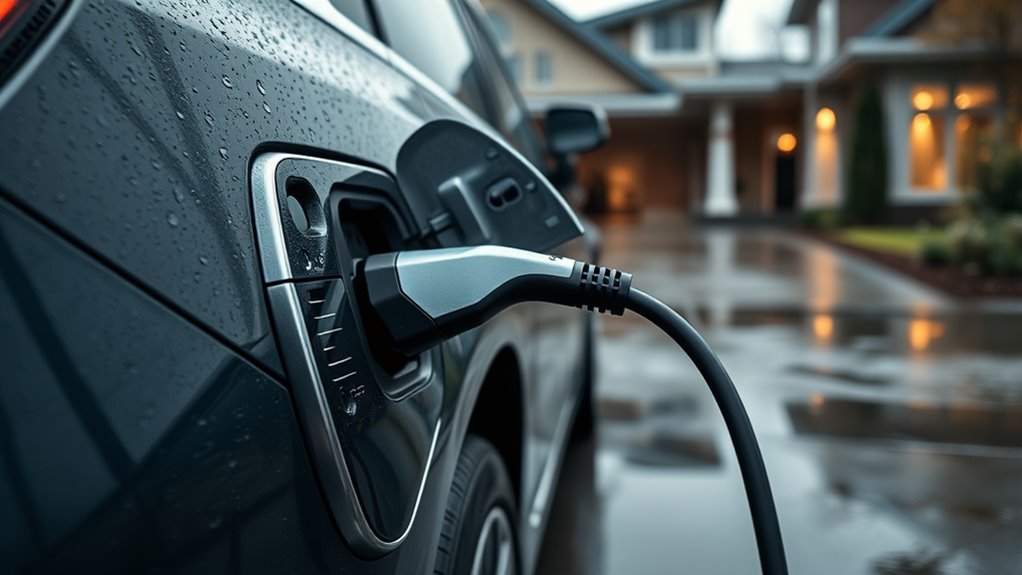
You can usually charge an EV in normal rain, but only when the charger, outlet, cable, and connector are rated for outdoor use and are in good condition. Rain is different from flooding, damaged insulation, exposed metal, or a submerged plug. A properly installed EV charger uses weather-resistant housing, connector checks, grounding, and fault protection to reduce shock risk before power flows.
Quick Answer
Yes, EV chargers are safe to use in rain when the equipment is outdoor-rated, undamaged, and installed correctly. The charger and vehicle confirm a proper connection before charging power flows, and fault protection can shut the circuit down if leakage is detected. Do not charge in flooding, standing water, lightning nearby, or with damaged parts.
Key Takeaways
- Normal rain is usually safe for outdoor-rated EV charging equipment, but “weather-resistant” does not mean submersible.
- Check the charger label or manual for an outdoor rating such as IP65, IP66, NEMA 3R, NEMA 4, or NEMA 4X.
- Never plug in if the cable, plug, outlet, or charge port is cracked, corroded, melted, loose, or sitting in pooled water.
- If a breaker, GFCI, app alert, or charger fault appears during wet weather, stop charging and have the equipment checked before using it again.
- Rain on a charger is routine. A vehicle that has actually sat in floodwater is a different, more serious hazard — don’t charge or drive it until it’s been inspected.
At a Glance
| Time Required | 1–2 minutes before plugging in |
| Difficulty | Easy visual safety check |
| Tools Needed | Dry cloth, flashlight, charger manual or app |
| Cost | $0 for inspection; repair costs vary if damage is found |
Are EV Chargers Safe in the Rain?
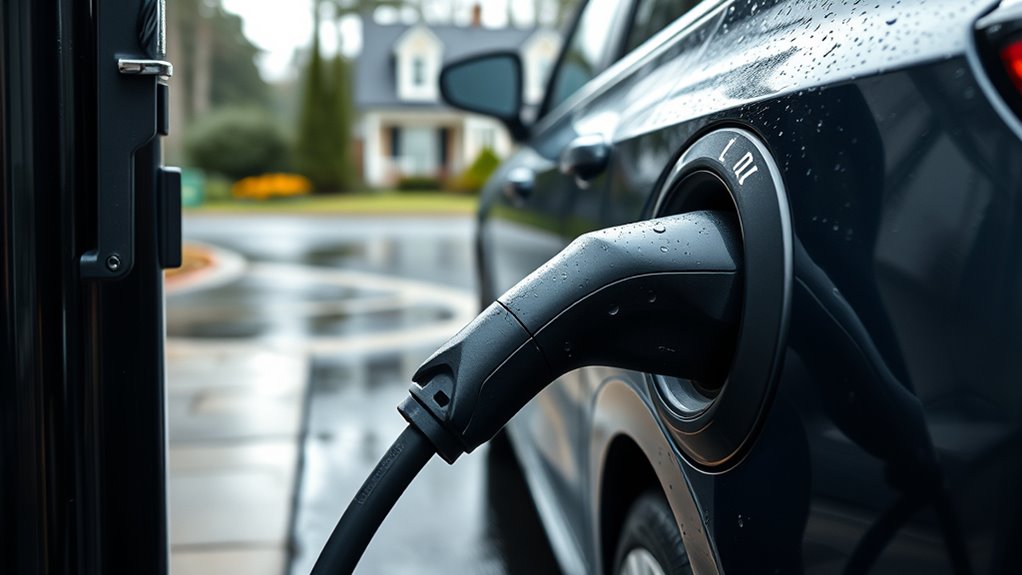
Yes, EV chargers are safe in the rain when you use equipment rated for outdoor wet conditions and the installation is code-compliant. The U.S. Department of Energy’s Alternative Fuels Data Center states plainly that outdoor installation and use of home charging equipment is safe, including while the vehicle is charging in the rain, as long as the equipment carries an outdoor rating.
A wall-mounted Level 2 charger, a portable Level 1 cordset, and a public DC fast charger can have different ratings, connectors, covers, and instructions, so always follow the charger manual and the vehicle manual before assuming a rating carries over from one type of equipment to another.
Rain alone usually is not the problem. Damage, poor installation, wrong equipment, standing water, and ignored fault warnings are the real risks.
For home installations, charging equipment should comply with local codes, permitting rules, and National Electrical Code requirements. NEC 2026 is now the most recently published edition, though NEC 2023 remains the version most states have actually adopted, so the applicable rules depend on which edition your local jurisdiction enforces. The AFDC also recommends safety-certified equipment and a certified electrical contractor for home charging installations.
Note: The charging device is technically called electric vehicle supply equipment, or EVSE. Many people call it a charger, but the onboard charger inside the vehicle often converts AC power into battery-charging DC power.
What Waterproof Ratings Actually Mean
Most EV charging equipment is better described as weather-resistant or outdoor-rated, not fully waterproof. Ratings such as IP65, IP66, NEMA 3R, NEMA 4, or NEMA 4X describe tested protection levels, and none of them mean you can submerge the plug, pressure-wash the connector, or ignore a cracked housing.
| Rating | What it usually tells you | Rain-use takeaway |
|---|---|---|
| IP65 | Dust-tight and protected against low-pressure water jets. | Commonly suitable for outdoor rain when installed as directed. |
| IP66 | Dust-tight and protected against stronger water jets. | Good outdoor protection, but still not a license to submerge the connector. |
| NEMA 3R | Designed for outdoor protection against rain, sleet, and external ice formation. | Common for outdoor electrical enclosures in North America; not tested against hose-directed or splashing water. |
| NEMA 4 / 4X | Watertight enclosure protection; 4X adds corrosion resistance. | Useful for harsher outdoor locations, coastal areas, or exposed sites. |
Pro Tip: If you’re washing or detailing the car near where it charges, close the charge port door first and never aim a pressure washer directly at the port, the connector, or the EVSE housing. Even NEMA 4X and IP66 gear is tested against directed water jets under specific lab conditions, not the close-range pressure a wash wand puts out.
If you cannot find the rating on the charger label, plug, app, or manual, treat the equipment as unknown. For permanent home units, ask the installer or manufacturer before relying on it outdoors.
Why EV Chargers Don’t Shock You
EV charging equipment is designed so charging power does not flow just because you hold the connector. With common systems such as SAE J1772, the vehicle and EVSE use pilot and proximity signals to confirm that the connector is seated and that the vehicle is ready to accept power. Tesla vehicles and the growing number of non-Tesla EVs now switching to the NACS connector — standardized by SAE as J3400 in 2024 — follow the same underlying logic: dedicated signaling and grounding pins confirm a complete, safe connection before the power pins ever energize.
In normal operation, the charger waits for this communication before energizing the power pins. The system also checks grounding and current limits, then continues to monitor the session while charging.
A wet connector is not the same as a live bare wire. The connector is built to shield the contacts, control when power flows, and stop power when the connection is released or a fault is detected.
Pro Tip: Plug and unplug with dry hands when possible, hold the connector by the handle, and keep the connector off the ground. A simple wall hook or cable holster prevents water, grit, and road salt from collecting in the plug.
How GFCI and Safety Circuits Help
Ground-fault protection helps reduce shock risk by detecting current leakage and opening the circuit when a fault occurs. In the U.S., these devices are tested to the UL 2231-1 and UL 2231-2 personnel-protection standards, and the National Electrical Code requires GFCI protection on 15- and 20-amp, 125- and 250-volt receptacles that supply EV charging equipment (NEC 625.54). Many EV charging setups also use internal monitoring, relays, insulation checks, temperature sensing, and communication checks on top of that baseline requirement.
These protections are important, but they do not make damaged equipment safe. If a cable is cut, a connector is melted, a wall outlet is loose, or a charger keeps tripping, do not keep resetting it. A repeated trip is a warning, not an inconvenience to bypass.
For Level 2 home charging, EVSE is treated as a continuous electrical load under the NEC, which is why circuits are sized at 125% of the charger’s maximum current — a 40-amp charger typically needs a 50-amp circuit, for example. That is also why correct breaker sizing, wire size, torque, grounding, permitting, and inspection matter. A licensed electrician should handle installation, hardwired repairs, circuit upgrades, and any wet-location wiring issue.
How Home EV Chargers Handle Wet Weather
Home EV chargers handle rain through a combination of outdoor-rated housings, sealed cable entries, covered terminals, proper grounding, and code-compliant installation. A hardwired outdoor Level 2 unit usually has fewer exposed plug-and-receptacle points than a plug-in setup, but either style must be installed exactly as the manufacturer allows.
If you use a portable charger, confirm that the cordset itself is rated for outdoor use and that the wall outlet has the right weather-resistant cover. A household extension cord, multi-plug adapter, or loose outdoor outlet is not a safe substitute for a proper EV charging circuit.
Before buying or installing a home charger, check for safety certification. ENERGY STAR now splits its certified-equipment list into an AC-output charger finder and a DC-output charger finder, both listing Level 1 and Level 2 equipment tested by nationally recognized laboratories for safety and energy performance. ENERGY STAR has also noted that some chargers sold through major online marketplaces carry false safety-certification claims, which is one more reason to confirm certification yourself rather than trust a product listing.
Are Public EV Chargers Safe in Storms?
Public EV chargers are built for outdoor use, but storm safety depends on the condition of the station and the severity of the weather. Normal rain is usually acceptable. Flooding, nearby lightning, broken connectors, downed wires, damaged screens, exposed metal, or water pooling around the pedestal are reasons to stop.
Public chargers also include networked controls, payment hardware, cable management, and larger electrical infrastructure. If anything looks damaged, choose another charger and report the problem through the charging app, station phone number, or site host.
The AFDC notes that charging infrastructure should be planned with weather impacts, permitting, inspections, maintenance, and safety in mind. It also recommends checking parts periodically, storing cables securely, and keeping equipment clean as part of charger maintenance.
What to Do if Your EV Has Been in a Flood or Hurricane
Everything above is about a charger getting rained on, which is routine. A vehicle whose battery pack has actually sat in floodwater is a different and more serious situation. The National Highway Traffic Safety Administration warns that lithium-ion batteries in EVs and hybrids are highly corrosive and should never be exposed to standing water, and that a flooded battery pack can create high-voltage shock and fire hazards.
Warning: If your EV or hybrid has been submerged or sat in deep floodwater, do not try to charge or drive it. NHTSA recommends keeping a flooded EV at least 50 feet from your home, other vehicles, and anything else combustible, and watching for hissing, popping, smoke, bulging near the battery compartment, or an unusual odor — signs of possible thermal runaway. Contact your dealer, the manufacturer, or emergency services rather than attempting to inspect, dry out, or restart the vehicle yourself.
This risk is separate from the charger-safety guidance elsewhere in this article and is worth planning for ahead of hurricane season if you live somewhere prone to flooding: move the vehicle to higher ground before water rises, rather than trying to assess the damage after the fact.
What to Check Before Charging in Rain
Before you plug in during rain, do a quick safety check. You are not trying to repair the charger; you are deciding whether it looks safe enough to use.
| Check | Why it matters | Safe action |
|---|---|---|
| Outdoor rating | Confirms the charger is designed for wet-location exposure. | Look for IP, NEMA, UL, ETL, or manual guidance before using it outdoors. |
| Cable jacket | Cuts, crushed areas, or exposed conductors can defeat insulation. | Do not use a damaged cable. Report it or call an electrician. |
| Connector and pins | Melt marks, corrosion, or debris can cause poor contact and heat. | Use a dry cloth on the exterior only. Never scrape inside the plug. |
| Vehicle charge port | Cracks, bent pins, or trapped debris can stop the connection from sealing. | Stop if the port looks damaged or the connector does not seat smoothly. |
| Standing water | Flooding can reach parts not designed for immersion. | Do not charge if the charger, cord, plug, or parking area is flooded. |
| Fault lights or app alerts | A trip or warning may signal leakage, overheating, or communication failure. | Stop charging and follow the charger manual before resetting anything. |
When You Should Not Charge in Wet Weather
Rain is manageable. Extreme wet-weather conditions are different. The safest choice is to wait or choose another station if the area looks unsafe.
Warning: Do not charge if the charger or connector is submerged, the parking area is flooded, lightning is close, the cable is damaged, the outlet is loose, the plug is hot, or you see exposed metal, smoke, burning smells, or repeated fault trips.
You should also avoid charging through ordinary extension cords, multi-plug adapters, or indoor-only outlets. EV charging pulls power for a long time, so weak cords and loose connections can overheat even without rain.
What to Do if the Charger Trips or Gets Wet
If rain gets on an outdoor-rated charger during normal use, you usually do not need to do anything. Let the equipment work as designed. If the session stops, the breaker trips, or the charger shows a fault, follow these steps:
- Do not touch exposed metal, damaged cable, or standing water around the charger.
- If it is safe, stop the session from the vehicle screen, charger app, or charger button.
- Unplug by holding the connector handle, not the cable.
- Check the charger manual for the fault code or warning light.
- For a public charger, report the fault and move to another station.
- For a home charger, stop using it until a licensed electrician or the manufacturer confirms it is safe.
Do not open a charger housing, dry internal parts with a hair dryer, tape over a damaged cable, or reset a tripping breaker over and over. Those are repair problems, not normal rain-use problems.
Frequently Asked Questions
Are EV chargers safe in the rain?
Yes, EV chargers are safe in normal rain when the equipment is outdoor-rated, properly installed, undamaged, and used according to the manual. Do not charge in flooding, standing water, lightning nearby, or with cracked, melted, corroded, or loose parts.
Can you leave your EV charger outside?
Yes, you can leave an EV charger outside if the manufacturer rates it for outdoor installation or outdoor use. A permanent home charger should be installed on the correct circuit, with proper weather-resistant wiring methods, permits, and inspection where required.
What happens if an electric car charger gets wet?
If an outdoor-rated charger gets rained on, usually nothing unusual happens. The housing, connector design, grounding, and fault protection are meant to handle wet weather. If the charger is submerged, damaged, tripping, or showing an error, stop using it until it is checked.
Can I leave my Tesla to charge outside in the rain?
Yes, with a permanently installed, outdoor-rated Tesla Wall Connector or a public Supercharger, rain is not a problem. The portable Mobile Connector that ships with the car is different: Tesla’s own owner’s manual tells drivers not to use it when it, the vehicle, or they are exposed to severe rain, snow, or an electrical storm. So treat the Mobile Connector as fine in light rain but move charging indoors or wait out a real storm, and always keep the connector off wet ground.
Is an IP65 EV charger waterproof?
IP65 means the enclosure is dust-tight and protected against water jets under defined test conditions. It is good for many outdoor rain situations, but it does not mean the charger or connector can be submerged, pressure-washed, or used after visible damage.
Can I use an extension cord to charge an EV in the rain?
Do not use a normal household extension cord for EV charging in rain. EV charging is a long continuous load, and many cords are not rated for the current, plug fit, outdoor exposure, or heat. Use the manufacturer-approved charger setup instead.
Is it safe to charge my EV after it’s been in a flood?
No. If the vehicle’s battery pack was submerged or sat in deep floodwater, don’t charge or drive it. NHTSA warns that flooded EV batteries are a fire and shock hazard, and recommends parking the vehicle at least 50 feet from structures, other vehicles, and combustibles, then contacting the manufacturer, dealer, or emergency services for inspection before doing anything else.
Conclusion
You can charge in the rain with confidence when the EV charger is outdoor-rated, installed correctly, and free from damage. The charger and vehicle communicate before charging power flows, while grounding and fault protection help reduce shock risk. Still, no charger should be treated like a submarine. Check for cracks, loose plugs, exposed metal, fault alerts, and standing water before you plug in — and remember that a charger getting rained on and a vehicle that has actually sat in floodwater are two very different problems. Rain is usually safe; flooding, damage, and ignored warnings are not.
Sources
- U.S. Department of Energy AFDC: Charging Electric Vehicles at Home — outdoor home charging, rain safety, safety-certified equipment, NEC Article 625 guidance.
- U.S. Department of Energy AFDC: Procurement and Installation for EV Charging Infrastructure — installation planning, weather impacts, permitting, certified electrical contractors, and compliance.
- U.S. Department of Energy AFDC: Operation and Maintenance for EV Charging Infrastructure — cable storage, periodic checks, cleaning, maintenance, and repair responsibility.
- U.S. Department of Energy AFDC: Electric Vehicle Charging Stations — EV charging terminology, AC Level 1, AC Level 2, DC fast charging, J1772, CCS, and J3400 connector context.
- NFPA 70: National Electrical Code — electrical code reference for EV charging installations, including Article 625 and GFCI requirements.
- SAE J1772 Standard — conductive EV charging coupler standard and EVSE-to-vehicle connection basis.
- ENERGY STAR: Electric Vehicle Chargers — certified AC-output and DC-output charger product finders and safety-certification guidance.
- UL Solutions: EV Personnel Protection Systems (UL 2231) — ground-fault detection and shock-protection testing standards for EVSE.
- NHTSA: Electric and Hybrid Vehicles — Battery, Charging & Safety — flood-damaged EV battery hazards and post-flood safety guidance.
- Tesla Gen 2 Mobile Connector Owner’s Manual — manufacturer weather-use warnings for the portable charging cordset.