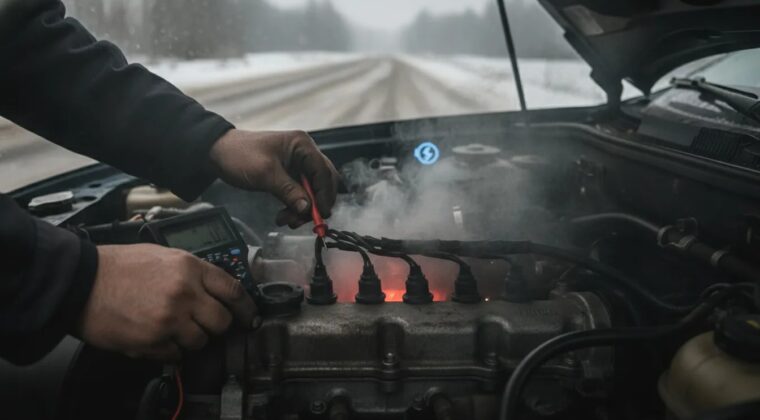
The clearest signs of bad glow plugs are hard cold starts, white or gray-white exhaust with an unburned-diesel smell, and a rough or misfiring idle that improves as the engine warms. A glow-plug or engine warning light, reduced cold-running smoothness, lower fuel efficiency, and black smoke can also occur, but none of these symptoms proves that a glow plug itself has failed.
The timing of the symptoms matters. Problems that are worst at cold start and fade as combustion temperature rises make the glow-plug system a stronger suspect. Symptoms that continue after the engine is fully warm call for a broader check of the battery and starter, fuel delivery, injectors, airflow, compression, and engine-management system.
The best next step is to read stored fault codes, check battery and cranking condition, and test the glow-plug circuit and individual plugs to the vehicle manufacturer’s specifications before replacing parts.
Key Takeaways
- Hard cold starts, white fuel-smelling smoke, and a temporary rough idle are the strongest glow-plug clues.
- A warning light or fault code identifies a system that needs diagnosis; it does not automatically prove the heating element is bad.
- There is no universal resistance value for every glow plug. Compare measurements with the exact service specification and with the other plugs on the engine.
- Repeated early failure can point to excessive voltage, control-system faults, injector problems, abnormal combustion heat, or carbon-related issues.
- Modern glow plugs may continue heating after startup to improve combustion stability and emissions, so their job is not limited to pre-start heating.
Table of Contents
- Bad Glow Plug Symptoms at a Glance
- What Glow Plugs Do in a Diesel Engine
- How to Interpret the Six Warning Signs
- What Else Can Mimic Bad Glow Plugs?
- How to Check Suspected Glow Plug Failure
- Why Glow Plugs Fail, Including Soon After Replacement
- Common Diagnostic Mistakes to Avoid
- The Best Next Step
- Technical References
Bad Glow Plug Symptoms at a Glance
| Symptom | Pattern that suggests glow-plug trouble | Important distinction |
|---|---|---|
| Extended cranking | The engine takes longer than usual to fire, especially when cold. | Slow cranking can also point to a weak battery, starter, cable, or connection problem. |
| White smoke at startup | White or gray-white smoke appears with rough running and an unburned-diesel smell, then fades as the engine warms. | Light condensation vapor is normal in some conditions; persistent white smoke can have other causes. |
| Rough idle or misfiring | The engine shudders or runs unevenly immediately after a cold start, then smooths out. | Roughness that remains when warm needs a broader diagnosis, including fuel and mechanical causes. |
| Glow-plug or engine warning light | The vehicle reports a glow-system or engine-management fault. | Indicator behavior varies by vehicle, and the fault may involve a plug, wiring, relay, control module, or another monitored system. |
| Reduced fuel efficiency or poor cold-running response | The engine runs less cleanly or smoothly during warm-up, particularly when other cold-start symptoms are present. | These are less specific clues than hard starting, white smoke, or a cold misfire. |
| Black smoke | Black smoke appears with other cold-running symptoms and reduces as the engine warms. | Overfueling, injector faults, restricted airflow, boost problems, and other causes may be more likely if smoke continues when warm. |
What Glow Plugs Do in a Diesel Engine
A diesel engine ignites fuel mainly from the heat created when air is compressed, rather than from a spark plug. During a cold start, the cylinder head, cylinder walls, pistons, and valves absorb heat, which can make stable ignition harder.
A glow plug is an electrical heating element that adds heat in or near the combustion chamber to support reliable cold combustion. Modern systems may also keep the glow plugs active after startup to improve combustion stability, reduce smoke, and support emissions control.
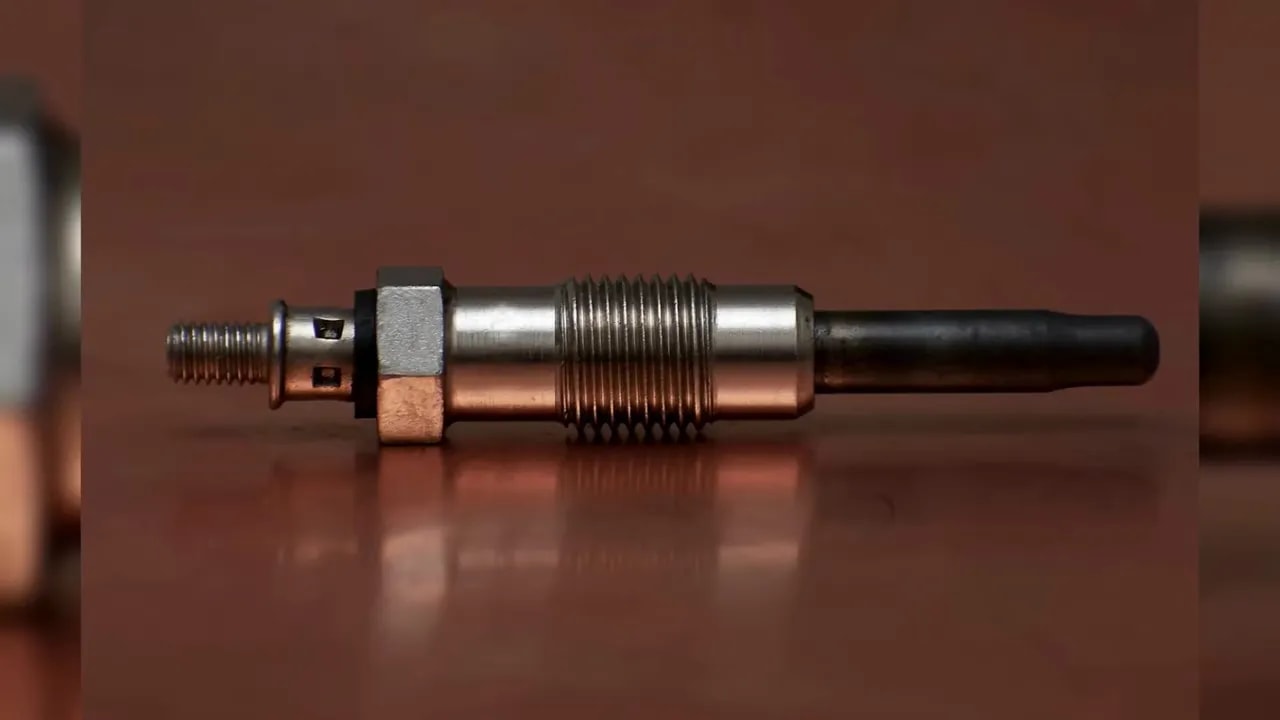
Operating temperature and heat-up time vary by design. DENSO states that many of its glow plugs are designed to operate around 850°C to 1,100°C, while NGK/Niterra high-temperature ceramic designs can reach about 1,000°C in less than two seconds and can maintain much higher post-glow temperatures in some applications.
A diesel engine commonly uses one glow plug for each cylinder. That is why the effect of a failure can depend on how many plugs or circuits are affected:
- One failed plug: The engine may still start, but cold running can be uneven and smoky.
- Several failed plugs: Cold starting usually becomes harder, especially as ambient temperature falls.
- Little or no effective preheat: A cold engine may crank for a long time or fail to start under demanding conditions.
Warm weather can hide a weak preheat system because the engine needs less assistance to establish combustion. Symptoms may become obvious again when temperatures drop.
How to Interpret the Six Warning Signs
1. The Glow-Plug or Engine Warning Light Appears
Many diesel vehicles use a coil-shaped indicator for the glow system, but the exact lamp behavior is manufacturer-specific. During normal operation, a preheat indicator may illuminate briefly before starting and then go out.
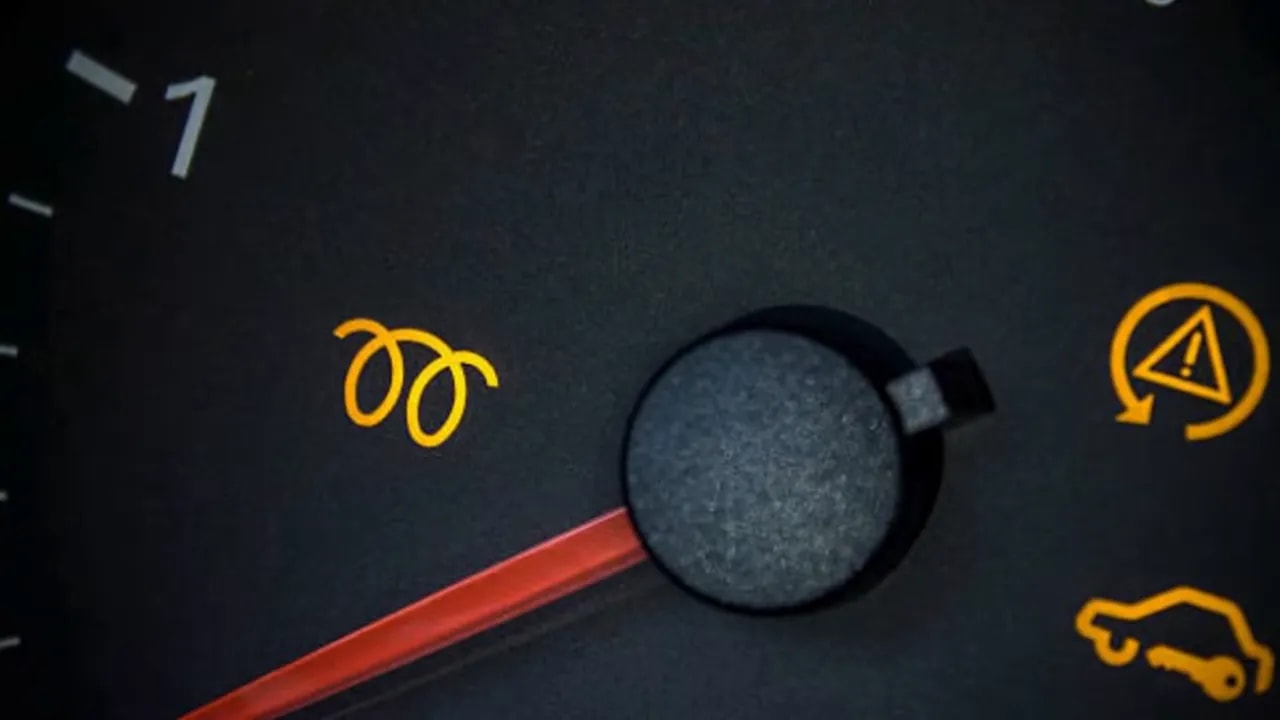
If a glow-system light stays on, flashes, or appears unexpectedly while driving, check the owner’s manual and scan the vehicle for stored faults. On some vehicles, a flashing coil symbol can indicate a broader engine-management fault rather than one failed plug.
Treat a warning light as a reason to diagnose the system, not as an instruction to replace every glow plug.
2. The Engine Cranks Longer Before Starting
A common early clue is a change from the engine’s normal cold-start behavior. Instead of firing promptly, it cranks longer, needs another attempt, or starts more reluctantly as outside temperature falls.
Glow-plug trouble is more plausible when the starter turns the engine at a normal speed and the delay is accompanied by white smoke or rough initial running. If the engine cranks slowly, check battery condition, cables, grounds, and the starter before blaming the glow plugs.
There is no universal cranking-time cutoff that diagnoses a bad glow plug. Compare the vehicle with its usual behavior and look for a repeatable cold-versus-warm pattern.
3. The Engine Idles Roughly When Cold
A cylinder that is too cold may not burn injected fuel as consistently as the others. The result can include:
- Shuddering through the vehicle.
- An uneven or lumpy engine sound.
- Temporary misfiring after a cold start.
The strongest clue is that the roughness improves as combustion temperature rises. Modern systems may continue post-glow after startup, so a glow-system fault can affect the first part of warm-up as well as the initial crank.
If the engine remains rough after it is fully warm, look beyond glow plugs. Injector faults, fuel-pressure problems, air leaks, EGR-related faults, low compression, or other mechanical issues can produce similar symptoms.
4. White Smoke Appears at Startup
White exhaust needs context. A small amount of pale vapor on a cold day can be condensation and normally disappears quickly without a strong raw-fuel smell.
A more useful glow-plug pattern is:
- White or gray-white smoke immediately after a cold start.
- A noticeable unburned-diesel smell.
- Uneven idle or misfiring at the same time.
- Smoke that reduces as the engine warms and combustion stabilizes.
This can happen when some injected fuel does not burn completely in a cold cylinder. Faulty glow plugs are one possible cause, but injector leakage, low compression, fuel-system faults, and other problems can produce similar smoke.
Do not diagnose a glow plug from exhaust color alone. The timing, smell, engine behavior, stored codes, and test results matter more than color by itself.
5. Fuel Efficiency Drops or Cold Acceleration Feels Weak
Glow-plug manufacturers list reduced fuel efficiency among the possible signs of a glow-system fault. Incomplete or unstable combustion during warm-up can also make a cold engine feel hesitant or less smooth.
These symptoms are not specific enough to justify replacing plugs on their own. They become more meaningful when they occur with hard cold starting, startup smoke, a temporary misfire, or relevant fault codes.
Persistent power loss after the engine is warm needs a broader engine diagnosis.
6. Black Smoke Appears
DENSO and NGK/Niterra both list black smoke as a possible glow-plug fault symptom, but black smoke is not specific to glow plugs. It more commonly signals that the engine is burning too much fuel for the available air or is not burning the mixture cleanly.
Glow-plug trouble becomes more plausible when the smoke is part of a cold-start pattern and improves as the engine warms. If black smoke continues under normal warm driving, investigate injectors, intake restriction, boost control, EGR operation, sensors, and other fuel-air problems as appropriate for the vehicle.
Black smoke is supporting evidence, not a stand-alone glow-plug test.
What Else Can Mimic Bad Glow Plugs?
Cold-start symptoms overlap with many other diesel problems. Before buying glow plugs, consider whether the symptom pattern fits one of these alternatives:
| Possible cause | Clue that points away from glow plugs |
|---|---|
| Weak battery, poor cables, or starter problem | The engine cranks slowly instead of turning at its normal speed. |
| Injector or fuel-delivery fault | Roughness, smoke, or misfiring continues after the engine is warm, or fuel-pressure/injector data is abnormal. |
| Low compression | Hard starting remains after the glow system and fuel system test correctly. |
| Airflow, EGR, or boost fault | Black smoke and weak performance are more obvious during warm driving and under load. |
| Glow-plug relay, module, wiring, fuse, or connector fault | Several plugs appear inactive, or circuit codes return despite plugs testing within specification. |
The distinction matters because replacing good plugs will not repair a supply-voltage, wiring, control-module, injector, or compression problem.
How to Check Suspected Glow Plug Failure
If several symptoms occur together, diagnose the whole preheat system rather than jumping directly to parts replacement. Exact access, activation, and test procedures vary by engine, so use the vehicle service information for the final specifications.
Step 1: Record the Cold-to-Warm Pattern
Before testing, note:
- Whether the starting problem occurs only when the engine is cold.
- Whether it becomes worse as outside temperature falls.
- How long smoke or roughness lasts after startup.
- Whether the engine behaves normally after warm-up.
- Whether a glow-plug or check-engine light is present.
A diesel that cranks at normal speed, starts poorly when cold, produces fuel-smelling white smoke, and then runs normally once warm presents a stronger glow-system pattern than one that lacks power all the time.
Step 2: Check Battery Condition and Cranking Speed
Glow plugs and the starter both depend on adequate electrical supply. A weak battery, high-resistance connection, poor ground, or failing starter can reduce cranking speed and can also affect glow-system operation.
Test the battery and starting system to the vehicle manufacturer’s procedure. Do not rely on one universal voltage number because battery technology, temperature, charging strategy, and vehicle design vary.
Step 3: Read the OBD-II Fault Codes
Generic codes P0671 through P0678 refer to cylinder-specific glow-plug circuit faults for cylinders 1 through 8. P0670 is a common glow-plug control-module/circuit code, while P0380 is another generic glow-plug/heater-circuit fault code.
A code identifies the circuit that needs diagnosis. It does not prove that the heating element itself has failed. Check the plug, connector, wiring, power supply, relay or control module, and any manufacturer-specific diagnostic information.
A clean scan does not prove that every plug is performing correctly, especially on older or less extensively monitored systems.
Step 4: Test the Plugs and Circuit Correctly
A digital multimeter can be used for a basic resistance check on many metal-sheathed glow plugs. Follow the service procedure, make sure the circuit is unpowered for resistance testing, and account for test-lead resistance because glow-plug values can be very low.
Do not use 0.5 to 2 ohms as a universal pass/fail range. NGK/Niterra notes that some quick-glow plugs can measure around 0.1 ohm at ambient temperature and ceramic plugs are commonly below 1 ohm, while DENSO advises comparing the reading with the vehicle specification and the other plugs.
| Reading or test result | Interpretation |
|---|---|
| Within the manufacturer’s specified range and similar to peer plugs | The element has electrical continuity, but this alone does not prove full heating performance under load. |
| Clearly higher than the specified value or the other plugs | The plug is suspect and needs further assessment. |
| Confirmed open circuit | The heating element is electrically broken. |
| Several plugs show no effective operation | Check shared power supply, relay or control module, fuse, wiring, and connectors before condemning every plug. |
On newer systems, scan-tool activation and current-draw testing may be more informative than resistance alone. If the procedure requires access to high-current circuits, ceramic plugs, or difficult connectors, a qualified technician is the safer choice.
Why Glow Plugs Fail, Including Soon After Replacement
Glow-plug life varies with plug design, operating strategy, engine condition, duty cycle, and the vehicle manufacturer’s service guidance. Avoid treating one mileage figure as a universal replacement interval.
Common causes of early or repeat failure include:
- Excessive voltage or faulty control: A relay, controller, alternator, regulator, or wiring problem can overheat the plug.
- Injector or injection-timing problems: Abnormal fuel delivery or overly advanced injection can expose the tip to damaging heat.
- Carbon deposits: Deposits around the plug or bore can interfere with heat transfer, removal, or correct operation.
- Incorrect installation: Wrong torque, cross-threading, damaged threads, contamination, or the wrong plug specification can cause damage.
- Engine wear or oil contamination: Abnormal conditions in the combustion chamber can damage or swell the probe on some failures.
If replacement plugs fail unusually soon, inspect the charging system, glow controller or relay, wiring, injectors, combustion condition, and installation before fitting another set.
Common Diagnostic Mistakes to Avoid
- Assuming every winter hard start is a glow-plug fault: Slow cranking, poor battery condition, fuel problems, and low compression can look similar.
- Replacing parts from symptoms alone: Combine the cold-start pattern with codes and electrical testing.
- Treating a cylinder code as proof of a bad plug: The code identifies a circuit that needs diagnosis.
- Using one universal resistance range: Glow-plug designs differ, and very low resistance is normal on some types.
- Confusing condensation with unburned-fuel smoke: Consider duration, smell, and engine behavior.
- Ignoring warm-engine symptoms: Persistent roughness, smoke, or power loss points toward other possible faults.
- Overlooking repeat failures: Early failure after replacement can indicate an unresolved electrical, injection, or installation problem.
- Applying battery voltage directly to an unknown glow plug: Some quick-glow and electronically controlled designs can be damaged, and an exposed hot plug can cause burns.
The Best Next Step
The most useful indicator of glow-plug trouble is a group of symptoms that is worst when the engine is cold and improves as it warms. Start by confirming that the engine cranks normally, record the cold-start pattern, scan for codes, and then test the plug circuits to the exact vehicle specification.
Confirm the fault before replacing parts. If several plugs are affected or new plugs fail early, diagnose the power supply, relay or control module, wiring, charging system, injectors, and combustion condition instead of simply installing another set.
Technical References
- DENSO: Glow-plug function, symptoms, and failure causes
- DENSO: Glow-plug fault finding and problem solving
- NGK/Niterra: Glow-plug function and technology