
Last updated: July 8, 2026
Quick Answer
The best time to charge your EV at home is usually when your electricity plan is cheapest, often overnight on a time-of-use plan. Many drivers use a smart charger or vehicle timer to charge during their utility’s off-peak window, then stop around 80% for everyday driving. Still, the best schedule depends on your local rate plan, commute, battery size, weather, and whether daytime solar-heavy electricity is cheaper or cleaner in your area.
Key Takeaways
- Check your utility’s exact off-peak hours before you set a charging schedule.
- Overnight charging is convenient and often cheaper, but it is not automatically the best option everywhere.
- A smart charger or built-in vehicle timer can start charging only when your lower rate begins.
- For everyday use, many EV owners keep the battery around 20% to 80% and charge higher before long trips.
- Extreme heat or cold can slow charging and may make a milder time of day more practical.
You’ll usually spend less by charging your EV at home during your utility’s lowest-rate hours. For many households, that means overnight charging, but the exact window can vary by provider, season, day of the week, and plan type.
If you use a time-of-use plan, shifting charging away from expensive peak periods can make your monthly energy costs easier to control. A smart charger or your EV’s built-in schedule can handle the timing automatically, so you do not need to plug in at an awkward hour.
Battery care matters too. For normal daily driving, keeping the battery around 20% to 80% is a common habit that may reduce stress on the pack. You can still charge to 100% when you need full range for a road trip or a long workday.
Best Time to Charge Your EV at Home
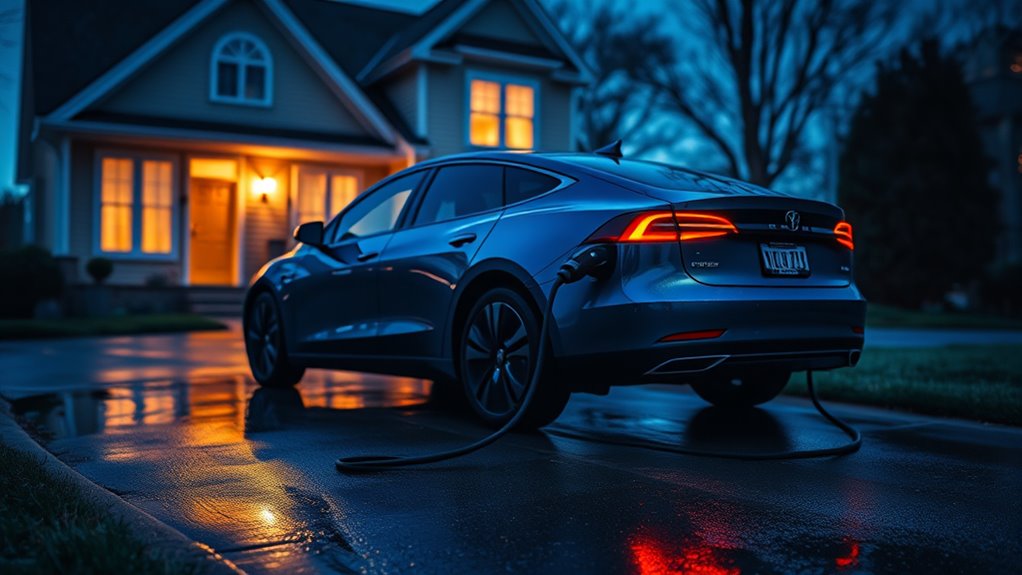
The best time to charge your EV at home is the lowest-cost window on your electricity plan. In many areas, that window happens late at night or early in the morning, when household and business electricity demand is lower.
Do not assume every utility uses the same schedule. Some plans make midnight to early morning the cheapest period. Others offer cheaper midday charging when solar generation is high. A few plans also change rates by season, weekday, weekend, or holiday.
Start by checking your utility account, rate sheet, or app. Look for terms such as off-peak, super off-peak, time-of-use, EV rate plan, or demand charge. Then set your charger to match the lowest-rate period that still gives you enough range before your next drive.
Why Off-Peak EV Charging Saves Money
Off-peak charging saves money because some utilities charge less when grid demand is lower. If your plan uses time-based pricing, the same 30 kWh charging session can cost different amounts depending on when it happens.
You can estimate your charging cost with a simple formula:
Charging cost = kWh added × electricity rate per kWh
Example: If you add 30 kWh and your off-peak rate is lower than your peak rate, the off-peak session will usually cost less. Use your own bill or utility app for the exact rate.
The savings depend on your vehicle efficiency, battery size, miles driven, charger losses, and local electricity prices. Avoid fixed savings claims unless you calculate them with your real plan.
Smart chargers make this easier. Once you set your preferred window, the charger can wait until the lower-rate period starts, then stop when the car reaches your target charge level.
Peak vs. Off-Peak EV Charging Hours
Peak and off-peak hours describe when electricity demand is higher or lower. Under a time-of-use plan, peak hours usually cost more, while off-peak hours cost less.
| Charging Window | What It Usually Means | Best For |
|---|---|---|
| Peak | Higher-demand hours when electricity may cost more. | Only when you need range soon and cannot wait. |
| Off-peak | Lower-demand hours when rates may be cheaper. | Most routine home charging on time-of-use plans. |
| Super off-peak | A special low-rate period offered by some utilities. | Drivers who can schedule charging very precisely. |
| Midday low-rate window | A cheaper period that may appear in areas with high solar generation. | Work-from-home drivers or homes with solar-friendly rate plans. |
Peak-Hour Pricing
Peak-hour pricing can make EV charging more expensive because it often overlaps with heavy household, business, heating, or cooling demand. Charging during this window may be unavoidable sometimes, but it should not be your default if your plan charges more for it.
If your battery is low and you need the car soon, charging during peak hours is fine. Just understand that convenience may cost more than waiting for the lower-rate period.
Off-Peak Savings
Off-peak charging works best when your plan has a clear price gap between peak and off-peak electricity. The larger the rate difference and the more you drive, the more useful scheduled charging becomes.
If you only drive a few miles each day, your savings may be modest. If you drive often, use a larger battery, or charge several times a week, the timing can matter much more.
Smart Charging Schedules
A smart charging schedule lets you plug in when you get home while the charger waits for your chosen start time. This keeps the process simple and avoids expensive accidental charging during peak hours.
Most drivers should set three things: the start time, the target battery percentage, and the departure time. That gives the charger enough information to finish the session before you need the car.
How Time-of-Use Plans Affect Your Bill
A time-of-use plan changes your bill by charging different rates at different times. That means your EV charging cost depends on both how much electricity you use and when you use it.
This is different from a flat-rate plan, where each kWh costs about the same no matter when you charge. Under a flat-rate plan, charging time may matter less for your bill, though it can still matter for grid demand or solar use.
Peak vs. Off-Peak Rates
Peak rates are usually the most expensive. Off-peak rates are usually cheaper. Some utilities also use shoulder periods, which sit between peak and off-peak pricing.
Read your plan carefully before switching to an EV rate. A plan with cheap overnight charging may also have higher evening rates for the rest of your home. If you use a lot of air conditioning, electric heating, laundry, or cooking during peak hours, the total household bill matters more than the EV rate alone.
Saving With Off-Peak Charging
To estimate savings, compare the same charging session under two rates. For example, multiply the kWh you usually add by your peak rate, then multiply the same kWh by your off-peak rate. The difference is your estimated savings for that session.
- Find your EV’s usual kWh use per week.
- Check your peak, off-peak, and super off-peak rates.
- Estimate charger losses by allowing a small buffer.
- Compare the monthly cost under each schedule.
- Choose the schedule that fits both your bill and your routine.
Smart Scheduling for Lower Bills
Smart scheduling is one of the easiest ways to reduce charging mistakes. You can plug in after dinner, but the charger can wait until the lower-rate window begins.
This is especially helpful if your off-peak window starts after you go to sleep. You get the convenience of plugging in early without paying for the wrong time block.
When Daytime Charging Makes Sense
Daytime charging can make sense when your utility offers a cheap midday rate, your home has solar panels, your workplace offers low-cost charging, or your local grid has extra clean electricity during the day.
This is why “always charge at night” is too simple. Night charging is convenient and often cheaper, but the best schedule depends on your local pricing and electricity mix.
- Work from home: Midday charging may work well if your plan rewards it.
- Home solar: Charging while your panels produce power may reduce grid use.
- Workplace charging: A reliable workplace charger can reduce home energy costs.
- Hot climates: Charging during a cooler part of the day may be easier on the battery system.
How Climate Affects EV Charging Time
Weather can change charging speed and efficiency. In very cold weather, the battery may accept power more slowly until it warms up. In very hot weather, the vehicle may limit charging speed to manage battery temperature.
Home Level 1 and Level 2 charging is usually gentler than public DC fast charging, but temperature still matters. If your garage or driveway gets extremely hot or cold, your car may use extra energy for battery conditioning.
When possible, charge during milder hours, park in shade during extreme heat, and use your vehicle’s preconditioning settings before long trips. Your owner’s manual should always guide the final battery-care routine.
Choose the Right Charging Time for Your Routine
The right charging schedule should match your real driving pattern. You do not need to charge every night if you only use a small amount of range each day. You also should not wait too long if your next trip requires more range.
| Driver Type | Best Charging Habit | Why It Works |
|---|---|---|
| Short daily commute | Charge every few days during off-peak hours. | Avoids unnecessary full charges while keeping enough range. |
| Long daily commute | Schedule nightly charging to a practical target. | Keeps the car ready without paying peak rates. |
| Work-from-home driver | Compare overnight and midday rates. | Midday charging may be better on some solar-heavy plans. |
| Frequent road tripper | Charge higher before trips, then return to a daily limit. | Balances range needs with everyday battery care. |
- Check how many miles you drive in a normal week.
- Find your EV’s average efficiency in miles per kWh or kWh per 100 miles.
- Review your utility’s rate schedule.
- Set a normal charge limit for daily use.
- Adjust the limit before long trips or unusual driving days.
Should You Charge Your EV Every Night?
You do not have to charge your EV every night unless your driving requires it. Many drivers can charge every few days and still keep plenty of range for errands, commuting, and unexpected trips.
Nightly charging can still be a good habit if you set a sensible charge limit and use off-peak rates. In that case, the car stays ready, and the charger stops once it reaches your target.
The bigger issue is not plugging in every night. The bigger issue is repeatedly charging to 100% and leaving the car full for long periods when you do not need that range. For everyday use, a lower charge limit is often more practical.
Set Up Off-Peak Charging at Home
Setting up off-peak charging is simple once you know your rate schedule. You can use either a smart Level 2 charger or your vehicle’s built-in charging timer.
- Log in to your utility account and find your current rate plan.
- Write down peak, off-peak, and super off-peak hours.
- Check whether weekends or seasons use different rates.
- Set your EV or charger to start during the cheapest useful window.
- Set a daily charge target, such as 80%, if it fits your driving needs.
- Test the schedule for one week and confirm it appears correctly on your bill or charger app.
Level 1 vs. Level 2 Home Charging
Your charging time also depends on the equipment you use. Level 1 charging uses a standard household outlet and is slower. Level 2 charging uses higher-voltage equipment and is much faster for most daily EV use.
| Charging Type | Typical Home Use | Main Advantage | Main Limitation |
|---|---|---|---|
| Level 1 | Standard outlet charging. | Low setup cost if a suitable dedicated outlet is available. | Slow for long commutes or large batteries. |
| Level 2 | Dedicated home charging equipment. | Faster charging and easier overnight recovery. | May require installation, permits, or panel capacity checks. |
Common Home EV Charging Mistakes to Avoid
- Assuming one off-peak window fits everyone: Always check your own utility plan.
- Charging to 100% every day without needing it: Use a daily limit when your vehicle supports it.
- Ignoring seasonal rates: Some utilities change schedules during summer or winter.
- Using unsafe extension cords: Follow your charger manual and electrical code.
- Forgetting charger losses: Your wall energy use can be slightly higher than the energy stored in the battery.
- Not checking the first bill: Review your bill after setting a schedule to confirm the savings are real.
Frequently Asked Questions
What Time Should I Charge My EV at Home?
Charge during the cheapest useful window on your electricity plan. For many drivers, that is overnight, but some utilities offer cheaper midday or special EV charging periods. Check your local rate schedule before choosing a time.
Is It Cheaper to Charge an EV at Home at Night?
Yes, it often is cheaper if your utility offers lower overnight rates. It is not guaranteed, though. Some plans use different off-peak periods, and some households may benefit from midday charging if solar-heavy pricing is available.
How Often Should an EV Be Charged at Home?
Charge as often as your driving requires. Short-distance drivers may only need to charge every few days. Long-distance commuters may prefer scheduled charging every night with a daily charge limit.
Should I Charge My EV to 100 Percent?
Charge to 100% when you need maximum range, such as before a long trip. For normal daily driving, many owners use a lower limit, such as 80%, when their vehicle supports it. Follow your owner’s manual for model-specific guidance.
What Drains an EV Battery the Most?
High speeds, hard acceleration, steep climbs, heavy cabin heating or cooling, cold weather, roof racks, towing, and underinflated tires can all reduce range. Smooth driving and proper tire pressure help your battery energy go farther.
Does Cold Weather Change the Best Charging Time?
It can. Cold batteries may charge more slowly, and the car may use energy to warm the battery. In winter, it can help to schedule charging so the battery finishes closer to your departure time.
Conclusion
The best time to charge your EV at home is the time that gives you the lowest practical electricity cost while keeping the car ready for your next drive. For many drivers, that means scheduled overnight charging during off-peak hours. For others, midday charging, workplace charging, or a solar-friendly plan may work better.
Check your utility’s exact rate schedule, set a smart charging timer, choose a daily battery target that fits your driving, and review your bill after a few charging cycles. Once the schedule is dialed in, home EV charging becomes cheaper, easier, and more predictable.