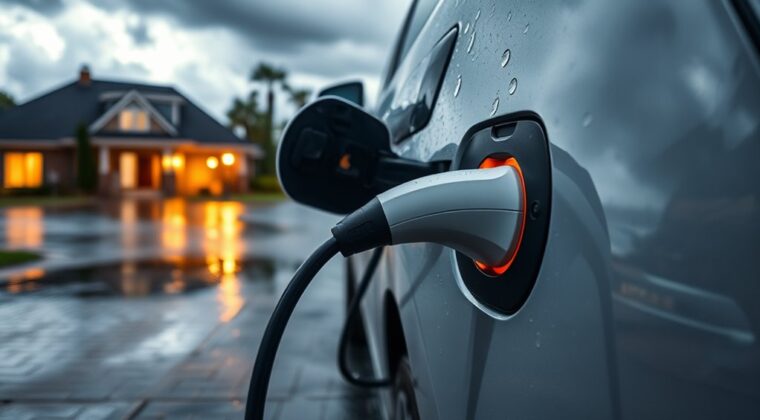
You can charge an EV outside in the rain when the charger, outlet, cable, and vehicle charge port are rated for outdoor use and are not damaged. Normal rain is different from flooding, lightning, storm surge, or a wet outlet sitting in standing water. The safe move is simple: inspect the equipment, keep the connector off the ground, and stop charging when weather or damage makes the setup questionable.
Quick Answer
Yes, you can charge an EV in the rain if you use outdoor-rated, safety-certified charging equipment that is properly installed and undamaged. Do not charge during lightning, flooding, deep standing water, saltwater exposure, or when the cable, plug, outlet, or charge port looks damaged.
Key Takeaways
- Rain alone is usually not a problem when the EVSE is outdoor-rated, safety-certified, and installed correctly.
- Standing water, floodwater, saltwater, damaged cables, hot plugs, and nearby lightning are hard-stop conditions.
- Home and public chargers can both be safe in rain; the charger’s condition, rating, and installation matter more than the location.
- Avoid extension cords, loose adapters, and indoor-only outlets when charging outside.
At a Glance
| Time Required | 30 to 60 seconds for a pre-charge safety check |
| Difficulty | Easy, but stop if you see damage, flooding, or electrical faults |
| Tools Needed | Outdoor-rated EV charger, intact cable, dry hands, and a flashlight if visibility is poor |
| Cost | $0 for routine checks; professional repair or installation costs vary |
Can You Charge an EV in the Rain?
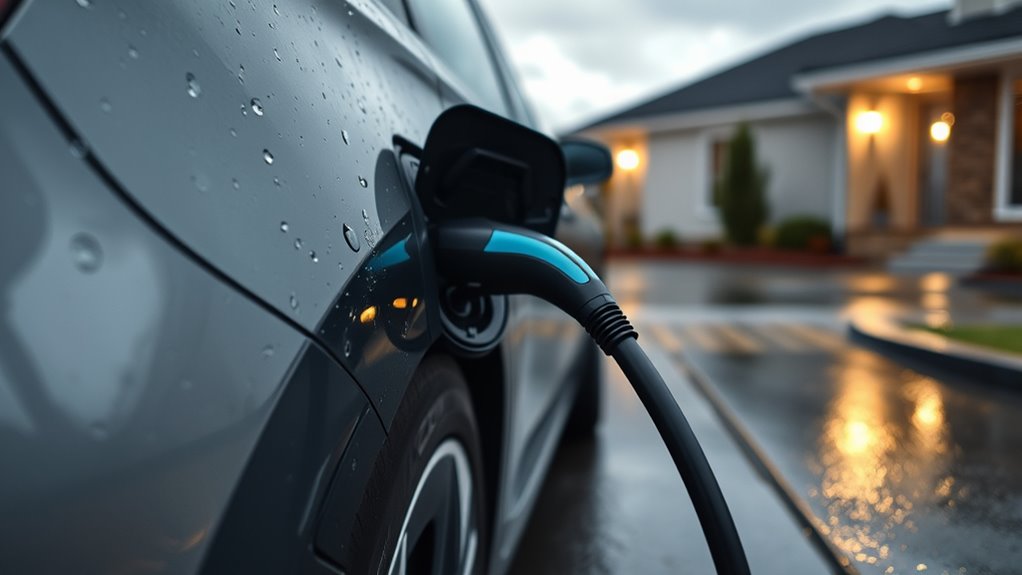
Yes, you can charge an EV in light to steady rain when the charging equipment is made for outdoor use. The U.S. Department of Energy’s Alternative Fuels Data Center says outdoor EV charging installation and use can be safe in rain, but outdoor installations require outdoor-rated equipment.
That does not mean every plug, outlet, adapter, or portable cord is safe outdoors. You still need a charger that is rated for the location, a properly installed circuit, and a connector that is clean, seated firmly, and not lying in water.
The safest habit is to treat rain as normal exposure and flooding as a hazard. A damp vehicle body or falling rain is not the same as a submerged cable, a flooded driveway, a cracked connector, or a wet wall outlet.
Warning: Do not start, charge, or continue charging if your EV, charger, cable, outlet, or connector has been exposed to floodwater or saltwater. Move away from the vehicle if you see smoke, popping sounds, heat, or a burning smell, and call emergency services.
How EV Chargers Stay Safe in Wet Weather
EV charging systems use several layers of protection. The exact design depends on the vehicle and charger, but outdoor-rated equipment usually combines a sealed enclosure, a rated connector, grounding, fault monitoring, and a circuit that can shut down when unsafe current leakage is detected.
Home installations also need to follow local electrical code. The AFDC notes that EV charging installations must comply with local and state codes and that NEC Article 625 contains much of the information used for charging equipment installation. If you are installing Level 2 charging at home, use a licensed electrician or certified electrical contractor.
| Safety feature | What it does | Why it matters in rain |
|---|---|---|
| Outdoor-rated housing | Helps keep rain out of electrical parts | Reduces the chance of water reaching energized parts |
| Ground-fault protection | Trips or shuts down when leakage current is detected | Helps reduce shock risk if moisture creates a fault path |
| Rated connector | Fits tightly into the vehicle charge port | Keeps the connection stable and protected during normal rain |
| Fault monitoring | Stops or prevents charging when a fault is detected | Gives the system a way to fail safe instead of continuing blindly |
| Safety certification | Shows the unit was tested by a recognized lab | Helps you avoid low-quality chargers with questionable protection |
When buying a home charger, look for safety certification. ENERGY STAR notes that certified EV chargers are tested for safety by a nationally recognized testing laboratory, and that not all chargers sold online or in stores are safety-certified.
What IP Ratings Mean for Outdoor EV Charging
An IP rating tells you how well an enclosure resists dust and liquid getting inside. The International Electrotechnical Commission explains that IP ratings use two numerals: the first rates protection against solid objects and dust, while the second rates protection against liquids.
For EV charging, the key point is not to chase the biggest number. The key point is to use equipment rated for the actual location. A covered carport, open driveway, coastal area, freezing climate, and public curbside station may need different enclosure ratings.
Note: “Water-resistant” does not mean “safe underwater.” IP ratings help describe tested resistance to dust and water exposure, but they do not make a charger safe to use in floodwater, saltwater, or with a damaged connector.
Is Home or Public EV Charging Safer in Rain?
Home and public EV chargers can both be safe in rain. The safer choice is the one that is properly installed, outdoor-rated, undamaged, and not surrounded by standing water.
A professionally installed home charger gives you control because you can inspect the outlet, cable route, wall unit, and breaker history. A public charger may be built for heavy outdoor use, but you do not know how the last driver treated the cable or whether the connector was dropped, run over, or left in water.
Before using either one, check the basics:
- Is the connector cracked, loose, burned, or corroded?
- Is the cable cut, crushed, kinked, or exposing inner insulation?
- Is the plug or outlet sitting in water?
- Does the charger screen or app show a fault?
- Is there lightning nearby or floodwater rising?
If the answer to any of those is yes, do not plug in. Pick another charger or wait until the equipment can be inspected.
When to Stop Charging Your EV in Storms
Stop charging when weather moves beyond ordinary rain. EV charging equipment is designed for normal outdoor exposure, not for every storm condition.
You should stop or delay charging if:
- Lightning is nearby.
- Water is pooling around the outlet, charger, cable, or tires.
- The cable path crosses deep puddles or flowing water.
- Wind is moving the cable or connector.
- The charger trips repeatedly or shows a fault warning.
- The connector feels hot, smells burned, or will not seat firmly.
- The vehicle or charger has been exposed to floodwater or saltwater.
The National Weather Service warns that lightning can strike in the United States millions of times each year and can injure or kill people. If thunder is close enough to hear, do not stand outside handling a charging cable. Go indoors and wait for the storm to pass.
Normal rain is a charging condition. Lightning, flooding, saltwater, damaged equipment, and standing water are stop conditions.
Can You Use an Extension Cord to Charge an EV in Rain?
No, you should not use a regular extension cord to charge an EV in rain. EV charging is a long, high-load electrical session, and a household extension cord can overheat, loosen, or let water reach the connection.
Use the cordset or EVSE approved by the vehicle or charger manufacturer. If the factory portable charger cannot reach safely, the correct fix is a properly located outlet or a hardwired charging unit installed by a qualified electrician, not a chain of extension cords or adapters.
Warning: Do not run EV charging through indoor extension cords, loose adapters, power strips, or a receptacle that is not rated for the load and location. Heat, rain, and a poor connection can turn a simple charge into a fire or shock hazard.
Tips for Charging Your EV Outside Safely
Use this quick checklist before charging your EV outside in wet weather:
- Check the weather. Light or steady rain is usually fine. Lightning, flooding, storm surge, and high winds are not.
- Inspect the cable. Look for cuts, crushed spots, exposed insulation, melted areas, or sharp bends.
- Inspect the connector. Make sure it is clean, intact, and free of mud, corrosion, or debris.
- Keep the connection off the ground. Do not let the plug, portable control box, or connector sit in a puddle.
- Seat the connector firmly. Do not force it. If it does not click or lock normally, stop.
- Watch for faults. If the charger trips, shuts down, or shows an error, do not keep retrying in the rain.
- Follow the manual. Your vehicle and charger manual set the real limits for temperature, storage, rain exposure, and fault handling.
Pro Tip: Mount a home charger where the connector can reach the vehicle without crossing a walkway, gutter, or low spot where water collects. A shorter, cleaner cable path is safer and easier to inspect.
What to Do if Something Goes Wrong
If charging stops in the rain, do not assume the charger is being annoying. Treat the fault as useful information and check the situation calmly.
| Problem | What to do |
|---|---|
| GFCI or breaker trips once | Stop, inspect for water, damage, and overheating. Reset only if the equipment is dry, intact, and the manual allows it. |
| GFCI or breaker trips again | Stop using the charger and call a qualified electrician or the charger manufacturer. |
| Connector feels hot | Stop charging. Heat can mean a loose, dirty, worn, or overloaded connection. |
| Plug or connector fell into water | Do not use it until it is dry and inspected. Replace damaged equipment. |
| Vehicle or charger was flooded | Do not charge or drive. Contact the vehicle manufacturer, charger maker, dealer, electrician, or emergency services if there are signs of battery damage. |
Flooding deserves extra caution. Saltwater can leave conductive residue behind even after water recedes. Reports citing federal safety officials have linked saltwater flooding with EV fire risk, so a flood-exposed EV should be inspected before charging or driving.
Frequently Asked Questions
Can it be too cold to charge an EV?
Yes. Very cold weather can slow charging and reduce driving range because the battery may need energy for heating and protection. Many EVs manage this automatically, but charging is easier if you park where possible, precondition the battery when your vehicle supports it, and keep the vehicle plugged in before cold-weather driving.
What drains EV batteries the most in wet or cold weather?
Speed, hard acceleration, cabin heat, battery heating, heavy cargo, hills, low tire pressure, and headwinds can all reduce range. Rain can also add rolling resistance and force you to use wipers, defogging, lights, and climate control, but driving style and temperature usually matter more than rain alone.
Can I charge my EV outside while it is raining?
Yes, if the charger and outlet are outdoor-rated, properly installed, safety-certified, and undamaged. Keep the connector and portable control box out of standing water, do not use a damaged cable, and stop if there is lightning, flooding, repeated tripping, heat, smoke, or a fault warning.
What is the 80/20 rule for EV charging?
The 80/20 rule means many EV owners try to keep daily battery use between about 20% and 80% to reduce battery stress. It is not a rain-safety rule. For bad weather or storm season, it can make sense to charge higher before travel or possible power outages if your owner’s manual allows it.
Should I unplug my EV during lightning?
If lightning is nearby, do not stand outside handling the cable. If the vehicle is already charging and conditions become dangerous, go indoors and wait. Once the storm has passed, inspect the charger and cable before touching or unplugging anything.
What should I do if my EV or charger was flooded?
Do not charge, drive, or keep retrying the charger. Floodwater, especially saltwater, can damage high-voltage and low-voltage components. Keep clear if you notice smoke, heat, hissing, popping, or a burning smell, and contact emergency services, the vehicle maker, the charger maker, or a qualified professional.
Conclusion
Charging your EV in the rain is usually safe when the setup is built for outdoor use, properly installed, safety-certified, and undamaged. The danger starts when rain turns into flooding, the connector sits in standing water, lightning is nearby, or the cable, outlet, charger, or vehicle port shows damage. Inspect before you plug in, avoid extension cords, follow the manufacturer’s instructions, and treat flood or saltwater exposure as a reason to stop and get professional help.
Sources
- U.S. Department of Energy Alternative Fuels Data Center – supports outdoor EV charging safety in rain, outdoor-rated equipment, installation code, and NEC Article 625 guidance.
- ENERGY STAR Electric Vehicle Chargers – supports safety-certified charger guidance and nationally recognized testing laboratory language.
- International Electrotechnical Commission IP Ratings – explains IP ratings for dust and liquid ingress resistance.
- National Weather Service Lightning Safety – supports lightning hazard guidance during outdoor charging.
- Associated Press report on EVs and saltwater flooding – summarizes NHTSA and NTSB context on flood and saltwater-related EV battery fire risk.