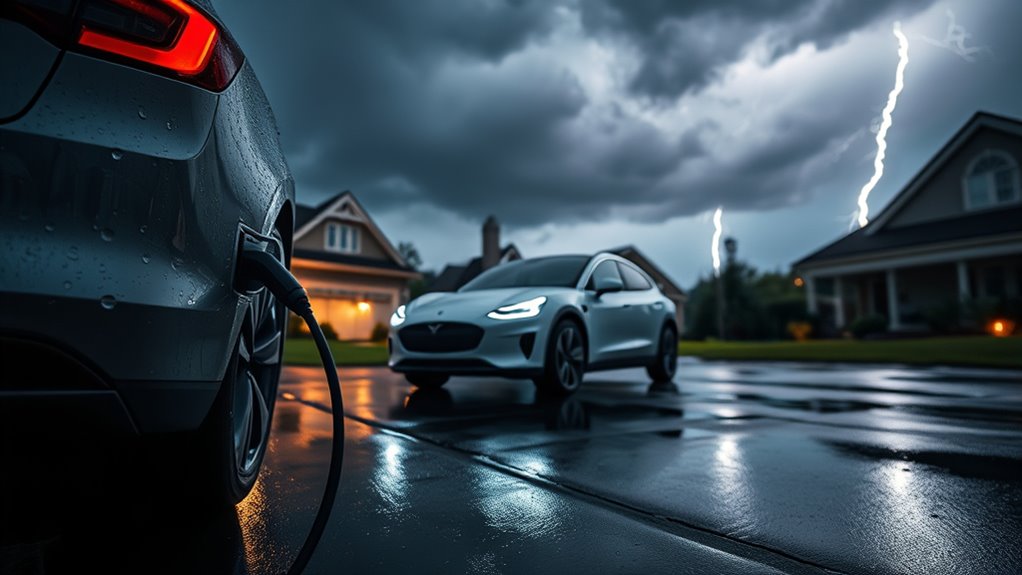
You can usually leave your EV plugged in during a normal rainstorm if the charger is properly installed, outdoor-rated, undamaged, and not sitting in water. The real danger starts when storms bring flooding, active lightning, power surges, hail, high wind, damaged cables, or a wet charging port. Before you connect, check the charger, cable, connector, outlet, and vehicle port so you are not trusting damaged equipment in bad weather.
Quick Answer
Yes, you can usually leave an EV plugged in during rain, but only when the charger is rated for the location, installed correctly, and visibly dry and intact. Do not plug in, unplug, or stand near charging equipment during flooding, active lightning, damaged wiring, or water around the charger.
Key Takeaways
- Rain alone is usually not a problem for a properly installed, outdoor-rated EV charger.
- Floodwater, standing water, exposed wiring, cracked housings, and damaged cables mean you should stop and avoid the equipment.
- If thunder is close, stay indoors and avoid handling plugged-in electrical equipment until the storm has passed.
- Outdoor chargers rely on a code-compliant installation, ground-fault protection, and weatherproof covers — not luck — to handle rain safely.
- Use manufacturer-approved charging equipment, avoid extension cords, and have recurring trips or water damage checked by a qualified electrician.
At a Glance
| Time Required | 1 to 3 minutes for a visual safety check before plugging in or walking away |
| Difficulty | Easy for basic inspection; call an electrician for tripping, damaged wiring, flooding, or water intrusion |
| Tools Needed | Flashlight, weather alert app, owner’s manual, and the charger’s status lights or app |
| Cost | Free for inspection; electrician or surge-protection upgrades vary by home and local code |
Is It Safe to Leave an EV Plugged In During a Storm?
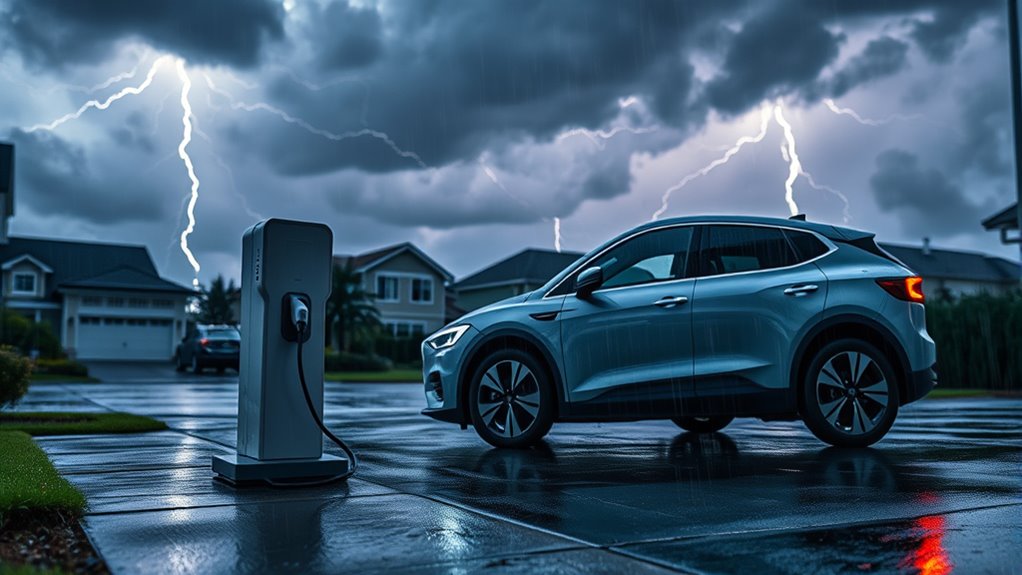
Yes, it is usually safe to leave your EV plugged in during a storm when the system is in good condition and installed for the location. Modern electric vehicle supply equipment, often called EVSE, is built around safety standards, sealed parts, and fault protection. UL 2594, for example, covers conductive EV supply equipment intended for indoor and outdoor use.
That does not mean every charger is safe in every storm. A charger that is cracked, loose, submerged, buzzing, sparking, repeatedly tripping, or surrounded by standing water should be treated as unsafe. The same is true if the cable jacket is split, the connector pins look burned, or your vehicle’s charge port is wet inside.
Normal rain is usually manageable for a properly installed outdoor EV charger. Floodwater, visible damage, and active lightning change the answer from “usually safe” to “stop and stay away.”
Public chargers and home chargers also depend on installation quality. The U.S. Department of Energy’s Alternative Fuels Data Center explains that a charging location can have one or more EV charging ports, and each port has connectors that plug into the vehicle. Those parts must be intact, dry where they make contact, and suitable for the charging environment.
Warning: Do not plug in, unplug, reset a breaker, or touch charging equipment while standing in water. If floodwater reaches the charger, outlet, cable, connector, or vehicle battery area, keep away and call the charging provider, utility, electrician, or emergency services as appropriate.
Which Storm Conditions Are Riskiest?
The riskiest storm conditions for EV charging are flooding, standing water, active lightning, severe wind, hail, and power instability. A normal rain shower is very different from water rising around the charger or vehicle.
Flooding is the clearest stop sign. If water reaches the charger pedestal, wall connector, outlet, portable cord, extension point, or vehicle charging port, do not continue charging. The CDC’s flood guidance says to be prepared to turn off electrical power when there is standing water, fallen power lines, or before evacuation. That same caution applies around EV charging equipment.
Lightning is also a handling risk. The CDC says lightning can travel through electrical systems and advises people not to use anything connected to an electrical outlet during a thunderstorm. If the EV is already plugged in and the equipment is outside, the safer move during active thunder is to stay indoors, not walk outside to handle the connector.
Wind and hail can damage the hardware. Hail can crack plastic housings, wind can drag cables across rough ground, and flying debris can strike a charger or vehicle. After the storm, inspect before you restart charging.
Pro Tip: If severe weather is forecast, charge earlier in the day. A full or nearly full battery gives you more options if power goes out, roads close, or public chargers lose service.
How EV Chargers Stay Safe in Rain and Lightning
EV chargers stay safer in rain through enclosure design, sealed connectors, ground-fault protection, and vehicle-to-charger communication. When the equipment is working correctly, power is managed by the charger and the vehicle rather than exposed at an open plug.
The connector matters too. UL 2251 covers EV plugs, receptacles, vehicle inlets, vehicle connectors, and EV couplers intended for conductive EVSE use in indoor or outdoor nonhazardous locations. That helps explain why an undamaged EV connector can be used in rain when the product is rated for it.
- Weather-rated housings help limit water intrusion.
- Sealed connectors help protect the electrical contact area when properly mated.
- Ground-fault and personnel-protection systems help shut down unsafe current leakage.
- Vehicle communication tells the charger when to start, stop, or limit current.
- Installation rules help ensure the circuit, breaker, wiring, and mounting location match the load.
Lightning is different from rain. No residential charger can promise total protection from a nearby or direct lightning surge. Whole-home or panel-level surge protection, proper grounding, and a code-compliant installation can reduce risk, but they do not make severe lightning harmless.
Note: A plug-in power strip is not the same as properly installed surge protection for an EV charging circuit. Ask a licensed electrician about whole-home surge protection, panel protection, and local code requirements.
Installation Codes and Weatherproof Ratings That Matter
Outdoor EV charging is built to be safe by design, not by luck. The U.S. Department of Energy’s Alternative Fuels Data Center confirms that outdoor installation and use are safe, including charging in the rain, as long as the equipment is outdoor-rated and installed to code. In the United States, EV charging equipment installations fall under Article 625 of the National Electrical Code, and a qualified electrician should handle circuit sizing, grounding, and any required local permits.
Two protections do most of the work in wet conditions. Ground-fault circuit interrupter (GFCI) protection — built into most listed Level 2 units or provided at the breaker — is designed to cut power the instant it detects current leaking to ground. And if your setup uses a plug-in outdoor receptacle rather than a hardwired charger, that receptacle needs a weatherproof “in-use” cover that closes around the cord even while it is plugged in, not just a flip-lid that only protects it when idle.
Note: If your outdoor setup is a plug-in receptacle rather than a hardwired charger, an ordinary porch-light-style cover is not enough. Ask a licensed electrician to confirm you have a while-in-use weatherproof cover and code-compliant GFCI protection before relying on it through a season of storms.
What to Check Before Charging
Before you plug in during stormy weather, take a short safety walkaround. You are not doing electrical testing; you are looking for obvious warning signs that should stop the charge.
Home Charger Checklist
- Look for cracks, loose mounting, missing covers, burned areas, buzzing, or error lights.
- Make sure the cable is not lying in a puddle or stretched across a drainage path.
- Check that the connector is clean, dry at the contact area, and free of mud or debris.
- Inspect the vehicle charging port for water, dirt, corrosion, or bent pins.
- Use only the charger or cordset approved for your vehicle and outlet type.
- Do not use a damaged outlet, loose receptacle, or adapter that feels hot.
Public Charger Checklist
- Check the charger screen or app for fault warnings before connecting.
- Inspect the connector for cracked plastic, exposed metal, burn marks, or water pooling inside.
- Keep the cable off standing water when possible.
- Do not use a charger that has been hit by debris, surrounded by floodwater, or marked out of service.
- If the station trips, will not latch, smells hot, or shows repeated errors, stop the session and report it to the network operator.
Portable Level 1 Charger Caution
A portable Level 1 cord can be useful, but storm use calls for extra caution. Plug it only into a properly grounded, undamaged outlet that matches the manufacturer’s instructions. Do not run the control box or connection point through puddles, and do not use ordinary household extension cords for EV charging unless the vehicle or EVSE manufacturer specifically allows the setup.
If anything looks uncertain, wait. A delayed charge is better than using equipment that may be wet, damaged, or overloaded.
What to Do About Flooding and Power Surges
If flooding is possible, charge early and move the vehicle and portable charging gear to higher ground before water rises. Never use a charging station, wall connector, outlet, or portable cord that is submerged or has been submerged.
If your EV was exposed to floodwater, especially saltwater, do not charge it until it has been inspected according to the vehicle manufacturer’s guidance. The National Highway Traffic Safety Administration advises keeping a flood-damaged EV at least 50 feet away from your house, other structures, vehicles, and combustibles, since a damaged high-voltage battery can heat up and ignite hours, days, or even weeks after exposure. Do not park a flood-exposed EV inside a garage. Watch for smoke, unusual odors, popping sounds, or warning messages, and call emergency services immediately if you see any signs of fire or battery overheating.
Power surges are harder to see. Nearby lightning, utility switching, and storm damage can send abnormal voltage through wiring. Your charger may shut down, your breaker may trip, or the vehicle may stop charging. Do not keep resetting a breaker or restarting a failed charge during a storm. Repeated trips are a warning, not an inconvenience.
- Stop charging if water reaches the charger, cable, connector, outlet, or vehicle port.
- Stay indoors during active thunder and avoid handling outdoor charging equipment.
- Wait at least 30 minutes after the last thunder before going outside to unplug or restart charging.
- Report public charger damage to the network operator.
- Have a licensed electrician inspect home equipment after flooding, repeated breaker trips, scorching, or water intrusion.
After the Storm: What to Inspect Before Restarting
After severe weather passes, do not assume the charger is fine just because the screen turns on. Make one more visual check before restarting the session.
- Look for water inside covers, around the outlet, or near the connector latch.
- Check for cracked housings, loose conduit, exposed conductors, or damaged seals.
- Make sure the cable has no cuts, crushed spots, or heat damage.
- Check the vehicle port for moisture, debris, or warning messages.
- Confirm the charger app or screen shows normal status before walking away.
If your home lost power, wait until power is stable before starting a high-load charging session. If lights flicker heavily, breakers trip, or the charger cycles on and off, stop charging and get the circuit checked.
Frequently Asked Questions
Should I unplug my EV during a storm?
Unplug before the storm if flooding, hail, high wind, or severe lightning is forecast and it is still safe to do so. If thunder is already active and the car is outside, staying indoors may be safer than walking out to handle the connector. Never unplug while standing in water.
What drains an EV battery the most during storm prep?
Climate control, high-speed driving, steep climbs, heavy accessory use, and battery heating or cooling can drain range quickly. For storm prep, charge before the worst weather arrives, precondition while plugged in when conditions are safe, and avoid leaving the cabin climate running for long periods during an outage.
What is the 30 minute thunder rule?
The 30 minute thunder rule means you should wait at least 30 minutes after the last thunder before resuming outdoor activity. For EV charging, use that rule before going outside to plug in, unplug, inspect the charger, or restart a stopped session.
Is it bad to leave an electric car plugged in overnight?
No, it is usually fine to leave an EV plugged in overnight when the charger is properly installed and the vehicle manages charging automatically. Set a charge limit if your vehicle recommends one for daily use, and avoid overnight charging if floodwater, damaged equipment, or repeated faults are present.
Can I charge my EV in heavy rain?
Yes, you can usually charge in heavy rain if the charger is rated for outdoor use, the connector and port are not damaged, and there is no standing water around the equipment. Stop if you see pooling water, exposed wiring, water inside the connector, or charger fault warnings.
What should I do if the charger trips during a storm?
Do not keep resetting it. Stop the session, stay clear of water, and wait until the storm passes. Then inspect the cord, connector, outlet, charger, and vehicle port. If the problem repeats, contact the charging network, vehicle service center, or a licensed electrician.
Do I need GFCI protection for a home EV charger?
Most listed Level 2 charging equipment includes built-in ground-fault protection, and installations fall under the National Electrical Code’s Article 625, which addresses ground-fault protection for EV charging circuits. If you use a plug-in outdoor receptacle instead of a hardwired charger, ask a licensed electrician to confirm the circuit, GFCI protection, and weatherproof cover all meet current code.
What does “outdoor-rated” mean for an EV charger?
An outdoor-rated charger is listed for wet locations under a safety standard such as UL 2594 and installed according to the National Electrical Code’s Article 625. In practice, that means a weatherproof enclosure, code-required ground-fault protection, and, for plug-in units, a cover that stays closed around the connector while it is charging.
Conclusion
You can usually leave your EV plugged in during a storm when the charger is outdoor-rated, properly installed, dry where it matters, and free of visible damage. The decision changes when water rises, lightning is active, equipment trips, or the cable, connector, outlet, or charging port looks compromised. Charge early when severe weather is forecast, stay indoors during thunder, avoid all charging equipment near floodwater, and restart only after a careful inspection. Behind the scenes, a code-compliant installation with GFCI protection and the right weatherproof rating is what makes routine rain a non-issue — and if a vehicle is ever exposed to floodwater, keep it at least 50 feet from structures and combustibles until a professional confirms the battery is safe.
Sources
- UL 2594: Electric Vehicle Supply Equipment — supports EVSE indoor/outdoor equipment coverage and safety-standard context.
- UL 2251: Plugs, Receptacles, and Couplers for Electric Vehicles — supports connector, plug, receptacle, and coupler safety context.
- U.S. Department of Energy AFDC: Electric Vehicle Charging Stations — supports EVSE, charging port, connector, and charging equipment terminology.
- U.S. Department of Energy AFDC: Charging Electric Vehicles at Home — supports outdoor-rated equipment, NEC Article 625, and code-compliant installation guidance.
- CDC Lightning Safety Guidelines — supports indoor lightning safety, avoiding outlet-connected equipment, and the 30 minute rule.
- CDC Preparing for Floods — supports electrical power caution around standing water, fallen power lines, and flood preparation.
- NHTSA: Electric and Hybrid Vehicles — Battery, Charging & Safety — supports flood-damaged EV distance and battery fire-risk guidance.
- National Weather Service Lightning Safety — supports general lightning risk awareness and storm safety guidance.