
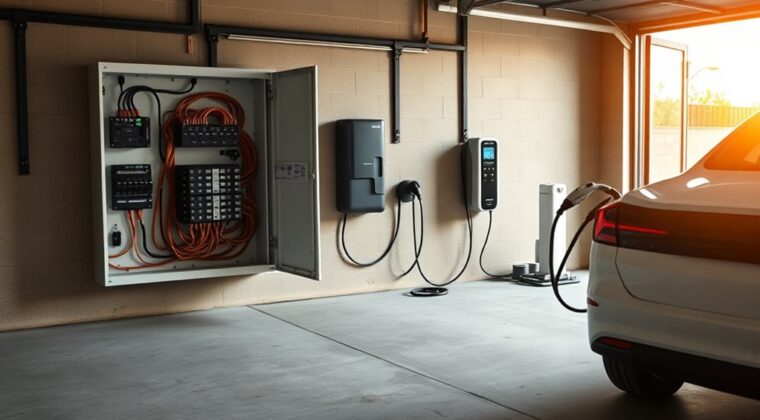
Your electrical panel can handle an EV charger only if the panel’s service rating, existing household load, breaker space, wiring condition, and local code requirements all support the added charging load. A 200-amp panel often gives you the easiest path for Level 2 charging, but it is not always required. Many 100-amp homes can still charge safely with a lower-amp charger, a proper load calculation, or an approved load management system.
Quick Answer
Your panel can handle an EV charger if a licensed electrician confirms enough spare capacity for the charger’s continuous load. Do not judge by empty breaker spaces alone. Check the main breaker size, charger output, major appliances, panel condition, and whether load management can safely limit charging when household demand rises.
Key Takeaways
- A 200-amp panel usually has the most room for Level 2 charging, but a 100-amp panel may work with lower charger output or approved load management.
- EV charging is a continuous load, so charger output is normally lower than the breaker rating. For example, a 48-amp charger commonly needs a 60-amp circuit.
- Open breaker spaces do not prove your home has enough electrical capacity. A load calculation is the real test.
- Breaker trips, flickering lights, warm breakers, rust, burning odors, or an old fuse box mean you should fix the panel before installing a charger.
At a Glance
| Time Required | 15–30 minutes for a safe homeowner pre-check; longer for an electrician’s load calculation and permit review. |
| Difficulty | Easy for visual checks; professional-only for panel work, wiring, breaker installation, and final approval. |
| Tools Needed | Main breaker rating, EV charger output rating, appliance list, utility bill, panel photos, and a licensed electrician for verification. |
| Cost | The self-check is free. Professional costs vary by panel condition, charger output, permits, utility work, wiring distance, and whether load management or a panel upgrade is needed. |
Warning: Do not remove the panel cover, touch bus bars, move breakers, or install EV charger wiring yourself unless you are qualified and licensed to do that work in your area. Electrical panels can contain dangerous voltage even when some breakers are off.
What Electrical Panel Size Do You Need for EV Charging?
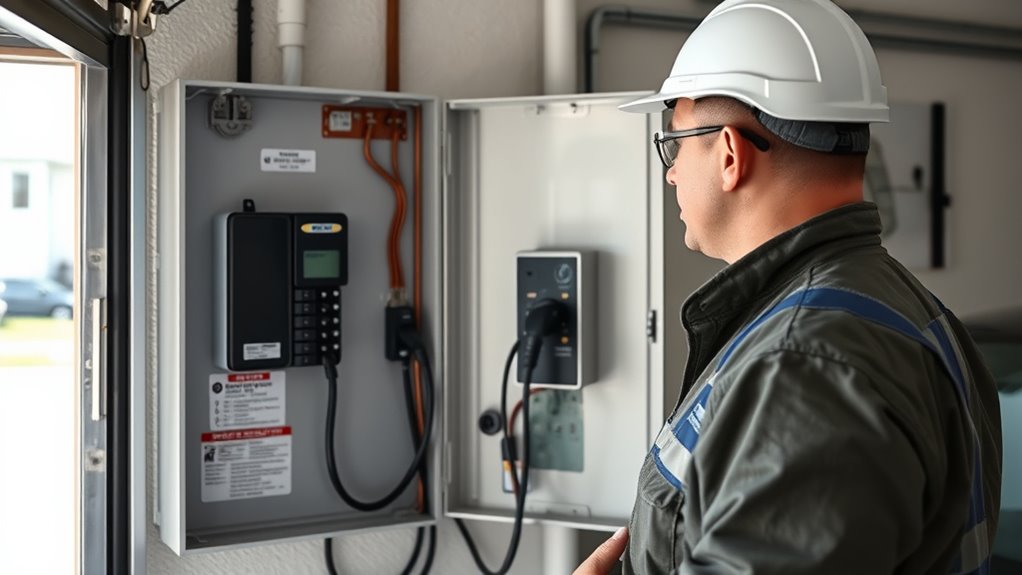
For home EV charging, panel size is the first thing to check, but it is not the only thing that matters. Residential electrical service is commonly 100, 150, or 200 amps. A 200-amp panel usually gives more room for a 240-volt Level 2 charger, HVAC equipment, an electric range, a dryer, and future electrification.
A 100-amp panel can still work in some homes if the charger output is modest, the existing loads are light, or a listed energy management device reduces charging when the house is using too much power. A 60-amp service, old fuse box, damaged panel, or obsolete panel brand is much more likely to need correction before EV charging is added.
The real answer comes from a load calculation. That calculation compares your home’s existing demand with the added EV charging load and the rules adopted by your local authority having jurisdiction. The National Electrical Code, NFPA 70 is the main U.S. electrical installation standard, but local adoption and amendments vary.
Safe Homeowner Check Before Calling an Electrician
You can gather useful information without opening the panel or touching wiring. This helps an electrician give better advice and can reduce guesswork.
- Find the main breaker rating. Look for 100, 150, 200, or another amp rating on the main breaker handle or panel label.
- Write down the charger output. Check whether the EV charger is set for 16, 24, 32, 40, or 48 amps. The charger output is not always the same as the breaker size.
- List major electric loads. Include central air, heat pump, electric furnace, electric water heater, range, dryer, hot tub, pool equipment, workshop tools, and any existing subpanels.
- Check for visible warning signs. Look for rust, scorch marks, buzzing, missing covers, warm breakers, frequent trips, or a burning smell. Do this from the outside only.
- Take clear photos. Photograph the panel label, main breaker, breaker directory, and the area where the charger would be installed.
Note: Empty breaker spaces are helpful, but they do not prove the panel has enough service capacity. A Level 2 charger usually needs a two-pole 240-volt circuit, and the home still needs enough load capacity to support it safely.
Check Your Panel’s Amp Rating
Start with the main breaker because it tells you the service size the panel is designed to carry. Common ratings are 100, 150, and 200 amps. If you are planning an EV charger, compare that rating with the charger’s continuous output and the rest of your home’s electrical demand.
A 200-amp panel often gives the most flexibility. It may support a 40-amp or 48-amp Level 2 charger if the existing load calculation leaves enough room. A 150-amp panel can also work well in many homes, especially with a 24-amp or 32-amp charger. A 100-amp panel needs closer review because one high-output charger can use a large share of the available service.
Do not assume that a bigger charger is always better. Many drivers only need enough overnight charging to replace daily miles. A lower output setting can be safer, cheaper, and easier to approve than forcing a full panel upgrade.
EV Charger Amps vs Breaker Size
EV charging is treated as a continuous load. That is why the charger’s maximum output is normally about 80% of the branch-circuit breaker rating. For example, the Tesla Gen 3 Wall Connector installation manual lists a 60-amp breaker for 48-amp output, a 50-amp breaker for 40-amp output, and a 40-amp breaker for 32-amp output. SAE J1772 also defines common AC charging levels for North American EV charging equipment.
| Typical Charger Output | Common Circuit Breaker Size | Best Fit |
| 16 amps | 20 amps | Small battery, plug-in hybrid, tight panel capacity |
| 24 amps | 30 amps | 100-amp homes with limited spare capacity |
| 32 amps | 40 amps | Common Level 2 home charging setup |
| 40 amps | 50 amps | Faster overnight charging when capacity allows |
| 48 amps | 60 amps | High-output hardwired charger with strong panel capacity |
This table is a planning guide, not a wiring instruction. Your electrician must size the conductors, breaker, disconnects, GFCI protection, and installation method according to the charger manual and local code.
What’s Already Drawing Power at Home?
Before adding an EV charger, you need to know what your home already uses. Your available capacity depends on the combined load of major appliances such as HVAC equipment, water heaters, ranges, dryers, pool pumps, and hot tubs.
An electrician does not simply add every breaker handle together. Breaker totals often exceed the main breaker size because not every load runs at full power at the same time. Instead, the electrician performs a load calculation that accounts for the home’s square footage, fixed appliances, heating and cooling loads, and the new EV charging load.
This matters because EV charging can run for several hours. If your charger runs while the air conditioner, dryer, oven, and water heater are also active, a panel with limited headroom may trip breakers, overheat weak connections, or fail inspection.
Pro Tip: Tell the electrician how many miles you drive per day. If you only need to replace 25–40 miles overnight, a lower-amp Level 2 setup may be enough and may avoid a larger upgrade.
How Much Power Does Your EV Charger Need?
How much power your EV charger needs depends on the charger level, the charger output setting, and your vehicle’s onboard AC charging limit.
A Level 1 charger uses a standard 120-volt outlet and is the easiest electrical fit, but it is slow. It can work for short commutes, plug-in hybrids, or drivers who can leave the vehicle plugged in for long periods.
A Level 2 charger uses a 208- or 240-volt supply and is the common choice for faster home charging. Depending on the charger and vehicle, it may use a 20-, 30-, 40-, 50-, or 60-amp circuit. Higher output can shorten charging time, but only if your vehicle can accept that AC charging rate and your electrical system can support it.
Instead of assuming you need the largest charger, match the output to your daily driving. Many homes do well with 24-amp or 32-amp charging, especially when charging overnight.
Warning Signs Your Panel Is Maxed Out
If your breakers trip often, your panel may already be operating near or beyond a safe load limit. You should also treat flickering lights, warm breakers, buzzing, rust, scorch marks, or a discolored panel cover as warning signs.
These symptoms do not automatically mean an EV charger is impossible, but they do mean the panel needs professional evaluation before you add a new 240-volt circuit.
Frequent Breaker Trips
Frequent breaker trips are a strong sign that your panel or a branch circuit may be overloaded, worn, or affected by another electrical fault. The risk increases when an EV charger runs at the same time as other high-demand appliances.
If trips happen only during charging, the charger output may be too high for the circuit or the panel may not have enough spare capacity. If trips happen even without EV charging, fix the existing electrical issue first.
- Note which breaker trips and when it trips.
- Write down whether the EV was charging at that time.
- Stop using damaged, hot, or repeatedly tripping equipment until it is inspected.
Flickering Lights And Heat
Flickering lights can point to voltage drop, loose connections, overloaded circuits, or utility-side issues. A warm panel cover, hot breaker, or burning odor is more urgent and should be treated as a safety problem.
Older systems, especially panels more than 25–30 years old, may have worn breakers, outdated wiring, limited grounding, or corrosion. Those problems should be corrected before EV charger installation.
Warning: If you smell burning, see smoke, hear loud buzzing, or feel unusual heat at the panel, stop using high-load equipment and call a licensed electrician or emergency service as appropriate.
Can a Load Management System Help?
A load management system can help you add EV charging when the panel has limited headroom. It monitors household demand and reduces or pauses charging when other appliances need power. When demand drops, charging resumes.
This is different from simple app scheduling. Scheduling can delay charging to off-peak hours, but it may not actively protect the service if several large appliances turn on at the same time. A proper load management device must be suitable for the installation and accepted by the electrician, permit office, and local authority.
Load Balancing Benefits
Load management lets you use available capacity more efficiently. Instead of upgrading the full service just to handle a worst-case moment, the system limits EV charging when the house is already busy.
- It can prioritize essential household loads first.
- It can reduce charger output when demand spikes.
- It may let a 100-amp or 150-amp home add Level 2 charging without an immediate service upgrade.
Some EVSE equipment also allows lower amperage settings. For example, a charger that can run at 48 amps may be set lower if the supply cannot support the highest output. The final setting should match the installed breaker, wiring, and approved load calculation.
When It Makes Sense
Load management makes sense when the panel is in good condition but has limited spare capacity. It is especially useful for homes with 100-amp service, electric heat, electric water heating, or other large appliances.
It may not be the right solution if the panel is damaged, obsolete, overcrowded, corroded, or already unsafe. In those cases, repair or replacement may be the better long-term choice.
When Does a Panel Upgrade Make Sense?
A panel upgrade makes sense when your existing service cannot safely support the added load of a Level 2 EV charger, even after considering lower charger output or load management.
You should also consider an upgrade if the panel has no safe breaker space, uses an obsolete fuse box, has corrosion or heat damage, lacks proper grounding, or fails the electrician’s load calculation.
The best EV charger setup is not the highest-amp setup. It is the setup your panel, wiring, charger manual, local code, and daily driving needs can all support safely.
| Situation | Likely Best Option |
| Panel is modern, has capacity, and has room for a two-pole breaker | Install a properly sized Level 2 circuit |
| Panel is safe but load calculation is tight | Use lower charger output or approved load management |
| Panel is full but service capacity is adequate | Electrician may add a code-compliant subpanel or approved breaker solution |
| Panel is old, damaged, overheated, corroded, or underpowered | Repair, replace, or upgrade the panel before EV charging |
Hardwired vs Plug-In EV Chargers
Some home EV chargers are hardwired. Others plug into a 240-volt receptacle such as a NEMA 14-50 outlet. The better choice depends on charger rating, local code, weather exposure, GFCI requirements, and whether you want portability.
Hardwired chargers are common for higher output levels such as 48 amps. Plug-in chargers can be convenient, but the receptacle, box, wiring, breaker, and GFCI protection must all be rated and installed correctly. Outdoor installations also need weather-rated equipment.
Do not install a dryer outlet adapter, extension cord, or non-approved converter to make an EV charger fit. Use the charger manufacturer’s instructions and have the circuit installed for that specific equipment.
What an Electrician Checks Before Installation
Before an EV charger goes in, an electrician checks whether your panel can safely support the added demand. The installer reviews the electrical panel amp rating, charger output, available breaker spaces, panel condition, grounding, local code, and the permit requirements for your area.
They also look at existing loads such as HVAC, range, dryer, water heater, and other large appliances. Then they decide whether the home can support the charger as planned or whether you need a lower charger setting, a load management device, a subpanel, a service upgrade, or panel replacement.
Finally, they verify that the installation matches the charger manual. That includes breaker size, conductor size, torque specifications, grounding, GFCI requirements, indoor/outdoor rating, and whether the charger must be hardwired.
Frequently Asked Questions
How do I know if my electrical panel can handle an EV charger?
Check the main breaker rating, charger output, existing major appliances, panel condition, and available breaker space. Then have a licensed electrician perform a load calculation. Empty breaker slots alone are not enough because the panel must also have spare electrical capacity.
Do I need a 200 amp panel for an EV charger?
Not always. A 200-amp panel is helpful, especially for a 40-amp or 48-amp charger, but many homes can charge safely with a lower-output Level 2 charger or an approved load management system. A load calculation determines whether your existing service is enough.
Can a 100 amp panel support Level 2 charging?
Sometimes. A 100-amp panel may support a lower-output Level 2 charger, such as 16, 24, or 32 amps, if the home’s other loads are modest. If the home has electric heat, an electric water heater, a range, dryer, and air conditioning, load management or a service upgrade may be needed.
What kind of charger does the Hyundai Kona Electric use?
It depends on market and model year. In North America, the Hyundai Kona Electric commonly uses a J1772-style connector for Level 1 and Level 2 AC charging and CCS1 for DC fast charging. In Europe and other Type 2 markets, it commonly uses Type 2 for AC and CCS2 for DC. Always confirm with your owner’s manual and charge-port label.
Can a normal electrician fit an EV charger?
A licensed electrician can install an EV charger if they are qualified for residential EVSE work and understand load calculations, local permits, charger manuals, GFCI requirements, wiring methods, and panel capacity. Ask whether they have installed EV chargers before and whether they will pull the required permit.
Is load management the same as charging at night?
No. Charging at night is a schedule. Load management is active control that reduces or pauses charging when your home’s electrical demand gets too high. Scheduling can save money on time-of-use rates, but it does not replace a code-approved load management device when the panel capacity is tight.
Conclusion
Before you install an EV charger, confirm your panel has enough spare capacity, not just enough breaker spaces. A 200-amp panel often handles Level 2 charging more easily, but a 100-amp panel may still work with a lower charger output or approved load management. The safest path is to gather your panel rating, charger output, and major appliance list, then have a licensed electrician perform a load calculation. If the margin is tight, solving it now can prevent nuisance trips, overheating, failed inspections, and costly service calls later.
Sources
- Tesla Gen 3 Wall Connector Installation Manual — breaker size, charger output, load management, and installation safety guidance.
- SAE J1772 Electric Vehicle Conductive Charge Coupler — North American AC charging connector and charging-level standard.
- NFPA 70 National Electrical Code — electrical installation standard used by many U.S. jurisdictions.
- Tesla Wall Connector Power Management — examples of reducing charging output and sharing available electrical capacity.