
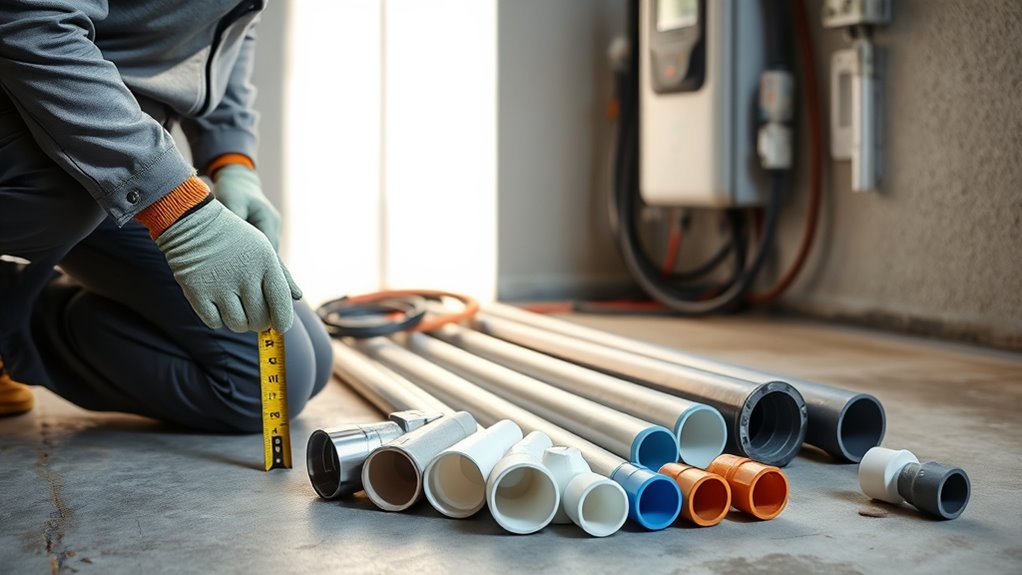
For most EV charger installs, conduit size depends on the charger amperage, wire gauge, conductor count, insulation type, conduit material, bends, and your local electrical code. For many 40A to 60A Level 2 charger circuits using #6 copper conductors, 1-inch conduit is the safer planning choice because it gives more room for pulls and future changes. Still, the final answer should come from an NEC conduit-fill calculation and your local authority having jurisdiction.
Quick Answer
Most home EV charger runs use 3/4-inch or 1-inch conduit. A simple hardwired charger with two #6 copper conductors and a grounding conductor may fit in 3/4-inch conduit in some raceway types, but 1-inch conduit is usually easier to pull, leaves more fill margin, and works better around bends.
Key Takeaways
- Use conductor count and wire gauge, not guesswork, to choose conduit size.
- For many #6 copper EV charger circuits, 1-inch conduit is the best practical choice even when 3/4-inch may calculate as acceptable.
- A hardwired EV charger often needs two hot conductors plus an equipment grounding conductor; a NEMA 14-50 receptacle also needs a neutral.
- Outdoor and underground raceways are treated as wet locations, so use conductors and fittings rated for that environment.
- Always confirm breaker size, conductor size, conduit fill, permits, and service capacity with a licensed electrician and your local inspector.
At a Glance
| Time Required | Planning takes 30 to 60 minutes; installation time varies by run length, trenching, panel work, and permitting. |
| Difficulty | Advanced electrical work; homeowners should use this as planning guidance and hire a licensed electrician for installation. |
| Tools Needed | Conduit-fill calculator, charger installation manual, tape measure, route plan, permit requirements, and electrician’s load calculation. |
| Cost | Conduit is usually a small part of the project; total cost depends on distance, trenching, panel capacity, permits, and whether upgrades are needed. |
What Conduit Size Does an EV Charger Need?
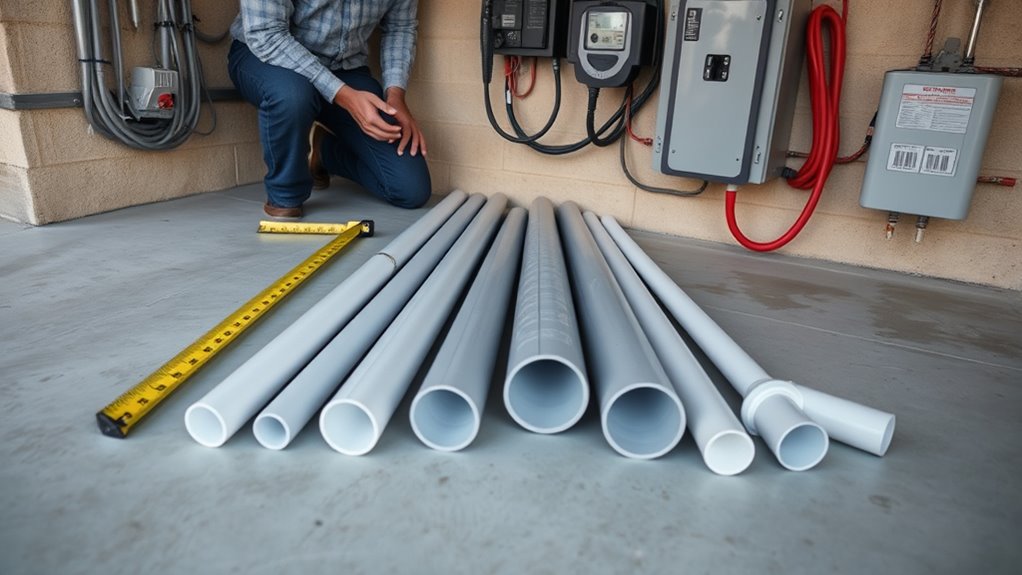
The conduit size for your EV charger should be based on a real conduit-fill calculation, not only on the charger brand or breaker size. The calculation should include the wire gauge, number of conductors, insulation type, and the raceway type, because EMT, PVC Schedule 40, PVC Schedule 80, and flexible conduit do not all have the same usable internal area.
For a common 48A Level 2 charger on a 60A breaker, many installations use #6 copper conductors when the equipment terminals and breaker temperature ratings allow it. For example, the Tesla Universal Wall Connector installation manual lists a 60A breaker with 48A maximum output and gives conductor requirements that depend on breaker temperature rating.
In many of those #6 copper layouts, 1-inch conduit is the best practical choice. It gives you more room for the pull, helps around bends, reduces the risk of insulation damage, and gives the electrician more flexibility if the route changes.
Warning: Do not size or install an EV charger circuit from an online rule of thumb alone. EV charger circuits involve continuous load, grounding, conductor temperature ratings, wet-location rules, permits, and panel capacity. Have a licensed electrician confirm the final design before work begins.
Why Use Conduit for EV Wiring?
Conduit gives EV charger wiring a durable protective path. It shields conductors from impact, moisture, abrasion, sunlight exposure where rated, and other conditions that can damage insulation. It also makes the installation cleaner and easier to inspect.
Conduit is especially useful when the charger is mounted outside, installed in a garage where wiring could be hit, or placed away from the main panel. A raceway can also make future service easier because individual conductors can be pulled, replaced, or upgraded without opening finished walls.
- Protects conductors from physical damage
- Helps satisfy local electrical code requirements
- Supports cleaner exposed wall routing
- Allows easier service or future upgrades
- Works with PVC outdoors or underground and EMT in many indoor exposed areas
Correct conduit sizing also avoids overcrowding. Crowded raceways are harder to pull, harder to service, and more likely to create heat and insulation problems.
Match Conduit Size to Wire Gauge
Start with the EV charger’s maximum output, then match the breaker, conductors, and conduit to that load. A 60A breaker commonly supports a 48A charger output, while a 50A breaker commonly supports 40A output. That 80% output relationship is common because EV charging is a continuous load.
| Breaker Size | Typical Max Charger Output | Common Planning Note |
| 40A | 32A | May use smaller conductors than a 60A circuit, depending on charger manual and code. |
| 50A | 40A | Common for NEMA 14-50 receptacle layouts, which also need a neutral. |
| 60A | 48A | Often uses #6 copper conductors when terminal ratings allow; 1-inch conduit is usually easier to pull. |
For #6 AWG conductors, you’ll often plan around 1-inch conduit so the wires fit comfortably and pull cleanly. Some 3/4-inch raceways may pass a conduit-fill calculation for a simple hardwired setup, but the smaller raceway leaves less room for bends, fitting changes, and future upgrades.
Do not forget the equipment grounding conductor. It must be included in the layout and sized by code. For many hardwired wall chargers, you do not need a neutral conductor, but for a NEMA 14-50 receptacle you do need two hots, a neutral, and a ground.
3/4-Inch vs 1-Inch Conduit for EV Chargers
When choosing between 3/4-inch and 1-inch conduit, think beyond whether the conductors technically fit. The best conduit size is the one that passes code, protects the conductors, and can be pulled without damaging insulation.
- 3/4-inch conduit may work for some basic hardwired EV charger runs with fewer conductors.
- 1-inch conduit gives better working room for #6 conductors, longer routes, and bends.
- 1-inch conduit is usually the better choice if you might later increase charger capacity or change equipment.
- 1-inch conduit can reduce labor frustration because wire pulls are smoother.
The price difference between 3/4-inch and 1-inch conduit is usually small compared with the total cost of the charger, electrician, trenching, permit, and panel work. For that reason, many electricians prefer 1-inch conduit when routing #6 copper conductors for a higher-output Level 2 charger.
Pro Tip: If your route has several bends, a long pull, or an outdoor-to-indoor transition, upsizing from 3/4-inch to 1-inch conduit can save labor and reduce the chance of scuffed insulation.
How Many Wires Fit in Conduit?
How many wires fit in conduit depends on conduit diameter, conductor gauge, insulation type, and raceway type. The National Electrical Code uses conduit-fill rules to limit how much of the raceway can be occupied by conductors, and local inspectors may apply local amendments.
For a typical hardwired Level 2 charger, the conductor count is often:
- Hot conductor 1
- Hot conductor 2
- Equipment grounding conductor
For a 240V receptacle such as a NEMA 14-50, the conductor count is usually:
- Hot conductor 1
- Hot conductor 2
- Neutral conductor
- Equipment grounding conductor
That extra neutral can change the conduit-fill result. It can also change conductor cost and pulling difficulty. This is one reason a hardwired charger often has a cleaner wiring layout than a receptacle-fed charger.
Also separate conduit fill from ampacity derating. Conduit fill asks, “How much physical space do these wires occupy?” Derating asks, “Do bundled current-carrying conductors need their ampacity adjusted?” Both checks matter, and both should be handled before wire is pulled.
Choose PVC Conduit for Outdoor Runs
PVC conduit is a solid choice for many outdoor EV charger runs because it resists moisture and corrosion. It also works well where metal conduit would be exposed to weather or soil conditions that shorten service life.
Outdoor EV charger conduit must protect the conductors from both physical damage and water intrusion. The raceway, fittings, and conductors all need to match the location.
- Use conduit and fittings rated for the location.
- Use wet-rated conductors, such as THWN-2 or XHHW-2, where required.
- Support exposed conduit at the required intervals.
- Use watertight fittings where the charger manual or location requires them.
- Protect the conduit from impact in driveways, garages, and exposed wall areas.
The Tesla wiring route instructions, for example, tell installers to use appropriate cable glands, bushings, or fittings to secure wiring and protect it from water and debris intrusion.
Plan the Shortest Safe Conduit Route
After choosing the conduit type, map the most direct route that still meets code and protects the wiring. A shorter route can reduce material cost, voltage drop, trenching work, and pull difficulty.
Keep the path straight where possible. Every bend adds pulling tension, and too many bends can make the conductors difficult or unsafe to install. Use wide sweeps, plan access points, and avoid sharp direction changes.
For underground PVC, verify burial depth with your local authority before trenching. Some residential branch-circuit installations may use an 18-inch planning depth, but the correct cover depth depends on wiring method, GFCI protection, location, vehicle traffic, and local amendments.
A clean route also helps future maintenance. If your next EV needs more charging power, or if you later add a second charger, a well-planned conduit path can reduce rework.
Use PVC Conduit for Underground EV Charging
When you’re running power underground to an EV charger, PVC conduit is commonly used because it resists moisture and corrosion. Use conduit listed for the job, solvent-weld joints correctly, and protect risers where they come out of the ground.
Do not run ordinary indoor cable through underground conduit. The inside of underground or exterior conduit is treated as a wet location, so your electrician should use conductors or cable assemblies rated for wet locations and approved by local code.
- Use PVC conduit rated for underground use.
- Confirm cover depth before trenching.
- Use wet-rated conductors such as THWN-2 or XHHW-2 where required.
- Seal and support fittings so water and debris cannot enter the charger enclosure.
- Use smooth bends to reduce pulling tension.
If your charger is far from the panel, also ask your electrician to check voltage drop. Conduit size and conductor size are separate choices, but a long run can require larger conductors even when the conduit-fill calculation looks acceptable.
When You Need a Subpanel
A subpanel may make sense when the EV charger is far from the main service panel, when breaker space is limited, when you want to serve multiple garage loads, or when you plan to add more than one charger. It is not required simply because the charger is over 30A.
The right first step is a residential load calculation. Your electrician needs to confirm whether the existing service can support the EV charger along with heating, cooling, cooking, laundry, lighting, and other major loads.
If the main panel cannot support a full 60A EV circuit, you may still have options. Many modern chargers can be commissioned at lower output, and some systems offer load management. Tesla’s branch circuit setup guidance notes that a dedicated load center may be prudent when panel space is limited or the main supply is far from the charger.
Note: A lower charger output can still be useful. Many drivers can recharge overnight with 24A, 32A, or 40A Level 2 charging, so a full 48A setup is not always necessary.
What to Ask Your Electrician First?
Before you buy conduit or start trenching, ask your electrician to confirm the full EV charger plan. The conduit size is only one part of the installation.
- What charger output will my service panel safely support?
- Will the charger be hardwired, or will it use a receptacle?
- How many conductors are needed, including the equipment grounding conductor?
- What conductor insulation type is required for outdoor or underground conduit?
- Does the route require 3/4-inch, 1-inch, or larger conduit after fill is calculated?
- How many bends will the route have, and will pull boxes be needed?
- What burial depth and permit rules apply in this municipality?
- Does the charger manual require copper conductors, watertight fittings, or a specific entry size?
- Would load management avoid a service upgrade or subpanel?
These questions help you avoid failed inspections, undersized raceways, difficult pulls, and expensive rework. They also help the electrician match the installation to the charger manufacturer’s instructions and local code.
Frequently Asked Questions
What size conduit for electric car charger?
Many home Level 2 EV charger runs use 3/4-inch or 1-inch conduit. For #6 copper conductors on a higher-output charger, 1-inch conduit is usually the better planning choice because it gives more room for the pull and future upgrades. The final size must be confirmed with a conduit-fill calculation.
What is the 80/20 rule for EV charging?
For wiring, people usually mean the continuous-load rule: the charger output is commonly limited to 80% of the breaker rating. For example, a 60A breaker commonly supports 48A charging, and a 50A breaker commonly supports 40A charging. For battery care, some drivers also use “80%” to describe daily charge limits, but that is a separate vehicle-setting topic.
What are the NEC requirements for EV chargers?
EV charger installations must follow the NEC version adopted in your area, local amendments, permit rules, charger listing, and manufacturer instructions. Key items include branch-circuit sizing, continuous-load sizing, equipment grounding, conductor temperature ratings, GFCI rules where applicable, wet-location wiring outdoors, and inspection by the local authority having jurisdiction.
How do you choose the right conduit size?
Choose conduit size by listing every conductor, noting the wire gauge and insulation type, selecting the raceway type, and checking the NEC conduit-fill table or a trusted fill calculator. Then consider bends, pull length, wet-location needs, future upgrades, and the charger manual.
Does a hardwired EV charger need a neutral wire?
Many hardwired 240V wall chargers do not need a neutral. They often use two hot conductors and an equipment grounding conductor. A NEMA 14-50 receptacle usually does need a neutral, so the conduit-fill calculation changes. Always follow the charger manual and local code.
Can I use indoor cable in underground conduit for an EV charger?
Do not use ordinary indoor cable such as NM-B in underground or outdoor conduit. Underground and exterior raceways are wet locations, so the wiring method must be rated for wet conditions. Ask your electrician whether individual THWN-2 or XHHW-2 conductors, or another approved wiring method, is required.
Conclusion
When you choose conduit size for your EV charger, you’re planning the protected path your charging circuit will use for years. For many #6 copper Level 2 charger circuits, 1-inch conduit is the most practical choice because it gives better pulling room and upgrade flexibility. Still, 3/4-inch conduit may work for some simple layouts, and larger conduit may be needed for extra conductors, long runs, or future expansion.
The safest answer comes from a full plan: charger output, breaker size, conductor count, grounding, conduit-fill calculation, wet-location rating, route length, bends, service capacity, and local inspection rules. Ask your electrician early, because the right conduit is not just tubing. It is part of a safe, code-ready charging system.
Sources
- NFPA 70, National Electrical Code — primary electrical-code reference for EV charger circuit planning and conduit-fill requirements.
- Tesla Universal Wall Connector: Circuit Breaker Rating / Maximum Output — supports breaker/output examples, conductor temperature-rating caveats, and grounding guidance.
- Tesla Universal Wall Connector: Prepare Wirebox for Conduit Fittings — supports 1-inch conduit entry and conduit fitting planning for a current EVSE example.
- Tesla Universal Wall Connector: Route Wiring Through Wirebox — supports water/debris protection, bushings, fittings, and copper conductor caution.
- Tesla Universal Wall Connector: Breaker and Branch Circuit Setup — supports subpanel and load-center planning examples.
- OSHA Control of Hazardous Energy — backs the safety warning about not working on energized electrical systems.