
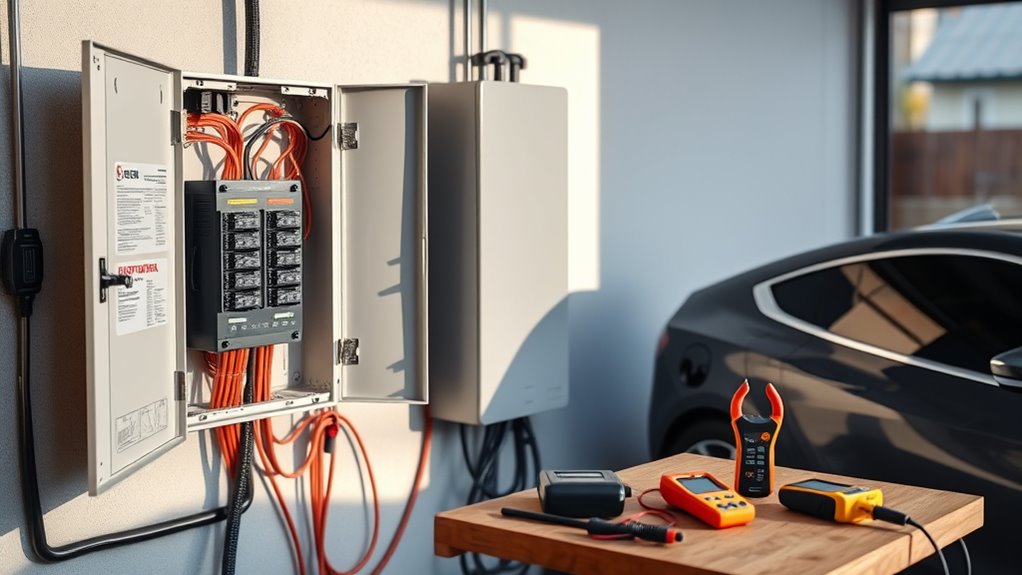
You size an EV charger circuit from the charger’s maximum continuous output, not from the plug shape alone. For most U.S. home Level 2 chargers, that means applying the 125% continuous-load rule, matching the breaker to the charger setting, and then verifying the conductor size, panel capacity, grounding, GFCI protection, permit requirements, and local code before anything is energized.
Quick Answer
A home EV charger circuit is usually sized at 125% of the charger’s continuous output. A 32-amp charger needs a 40-amp circuit, a 40-amp charger needs a 50-amp circuit, and a 48-amp hardwired charger needs a 60-amp circuit. A licensed electrician must confirm wire size, panel capacity, GFCI rules, and local code.
Key Takeaways
- Use the charger’s maximum output setting, not the receptacle type, to size the circuit.
- Multiply EVSE output by 1.25, then choose the next matching standard breaker size.
- Common matchups are 24A output on 30A, 32A on 40A, 40A on 50A, and 48A on 60A.
- Wire size depends on copper or aluminum, insulation type, cable or conduit, terminal temperature rating, derating, and run length.
- Confirm load calculation, permit, inspection, GFCI protection, and utility or panel limits before installation.
At a Glance
| Time Required | 30 to 90 minutes for planning and load review; professional installation may take a few hours or longer if panel work, trenching, conduit, or service upgrades are needed. |
| Difficulty | High. This is permit-level electrical work and should be handled by a licensed electrician. |
| Tools Needed | Charger manual, panel schedule, load calculation, permit documents, and electrician’s installation tools such as meter, torque screwdriver, conduit tools, and approved conductors. |
| Cost | Varies widely. Hardware, labor, permits, distance from panel, receptacle or hardwired setup, and panel upgrades can change the total. |
Warning: Do not install, modify, or energize an EV charger circuit unless you are qualified to do the work. EV charging is a long-duration electrical load, and mistakes can overheat wiring, damage equipment, fail inspection, or create a shock or fire hazard.
What Size Circuit Does an EV Charger Need?
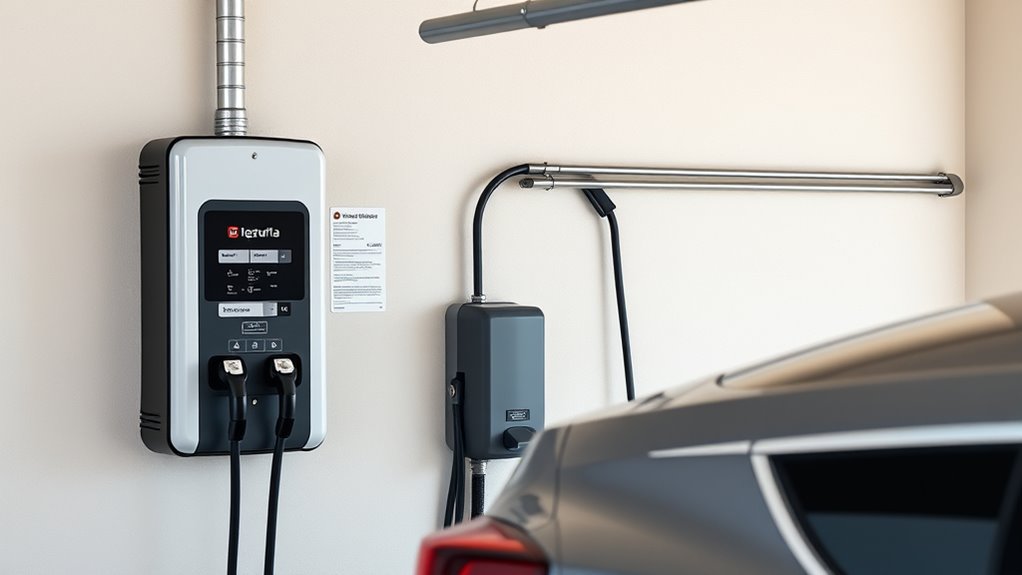
The circuit size your EV charger needs depends on four things: the charger’s output amperage, supply voltage, whether it is plug-in or hardwired, and how much capacity your electrical panel has available.
For a Level 1 charger, charging usually happens from a 120-volt circuit. Many portable cordsets draw 12 amps on a 15-amp circuit or 16 amps on a 20-amp circuit. Level 1 is slower, but it may be enough if you drive fewer miles each day.
For a Level 2 charger, charging usually uses 240 volts in a home. The common residential sizes are 24, 32, 40, and 48 amps of charger output. Because EV charging can run for several hours, the branch circuit is sized above the charger’s running output.
The practical rule is simple: charger output × 1.25 = minimum circuit rating. That is why a 32-amp EVSE needs a 40-amp circuit, a 40-amp EVSE needs a 50-amp circuit, and a 48-amp EVSE needs a 60-amp circuit. The U.S. Department of Energy’s Alternative Fuels Data Center notes that Level 2 charging commonly uses 240 volts in homes and that a 30-amp residential Level 2 unit requires a dedicated 40-amp circuit under NEC Article 625 guidance.
| Charger Output | Minimum Circuit / Breaker | Voltage | Approx. Power | Common Use |
|---|---|---|---|---|
| 12 A | 15 A | 120 V | 1.4 kW | Level 1 portable charging |
| 16 A | 20 A | 120 V or 240 V | 1.9 to 3.8 kW | Level 1 or low-power Level 2 |
| 24 A | 30 A | 240 V | 5.8 kW | Smaller Level 2 circuit |
| 32 A | 40 A | 240 V | 7.7 kW | Common plug-in Level 2 limit |
| 40 A | 50 A | 240 V | 9.6 kW | NEMA 14-50 or hardwired setups |
| 48 A | 60 A | 240 V | 11.5 kW | Higher-output hardwired Level 2 |
Use the 125% Rule for EV Charger Sizing
EV charging is treated as a continuous load because the charger may run for three hours or longer. For continuous loads, the circuit must be larger than the charger’s running output. That extra margin helps prevent nuisance trips and overheating during long charging sessions.
Use this formula:
Charger maximum output amps × 1.25 = minimum circuit amp rating.
Here is how it works in real numbers:
- 24A charger: 24 × 1.25 = 30A circuit.
- 32A charger: 32 × 1.25 = 40A circuit.
- 40A charger: 40 × 1.25 = 50A circuit.
- 48A charger: 48 × 1.25 = 60A circuit.
This is also why a 50-amp receptacle does not mean you can charge at 50 amps. A 50-amp circuit usually supports up to 40 amps of continuous EVSE output.
Pro Tip: Many adjustable chargers can be set below their maximum output. If your panel cannot support a 48-amp charger on a 60-amp circuit, your electrician may be able to commission the charger at 40, 32, 24, or 16 amps instead.
Match Breaker Size to Charger Amps
You need to match the breaker to the charger’s output setting. The breaker protects the circuit wiring. It does not make the charger faster by itself. If the EVSE is set to 32 amps, a 40-amp breaker is the correct match. If the EVSE is set to 40 amps, a 50-amp breaker is the correct match.
125% Sizing Rule
A practical way to size an EV charger circuit is to start with the charger’s maximum continuous output, multiply by 1.25, and then select the matching standard circuit size. This keeps the continuous charging load within the circuit’s safe operating range.
Do not oversize the breaker to avoid tripping. If a charger is connected to a breaker that is too large for the wire, the wire can overheat before the breaker responds. The conductor, breaker, receptacle or hardwired EVSE, and charger setting all need to match.
Common Amp Matchups
The most common residential Level 2 matchups are straightforward:
- 30A circuit: up to 24A charger output.
- 40A circuit: up to 32A charger output.
- 50A circuit: up to 40A charger output.
- 60A circuit: up to 48A charger output.
Some chargers and vehicles will not use the full available output. The vehicle’s onboard charger, battery temperature, state of charge, and manufacturer limits can all reduce the actual charging rate.
Choose the Right Wire for the Circuit
Choosing the right wire for an EV charger circuit is not just a matter of picking an AWG number from a chart. Your electrician must confirm conductor material, insulation temperature rating, terminal temperature rating, conduit or cable type, number of current-carrying conductors, ambient temperature, run length, voltage drop, and local code.
The table below gives common copper conductor starting points for residential planning only. Final sizing must come from the applicable electrical code, charger manual, and local inspector.
| Circuit / Breaker | Max EVSE Output | Common Copper Starting Point | Important Notes |
|---|---|---|---|
| 15 A | 12 A | 14 AWG copper | Level 1 cordsets often use a standard 120V circuit. |
| 20 A | 16 A | 12 AWG copper | Used for higher-output Level 1 or small Level 2 setups. |
| 30 A | 24 A | 10 AWG copper | Good option when panel capacity is limited. |
| 40 A | 32 A | 8 AWG copper | Common for many plug-in Level 2 chargers. |
| 50 A | 40 A | 6 AWG copper | Often used with NEMA 14-50 or hardwired EVSE. |
| 60 A | 48 A | 6 AWG or 4 AWG copper, depending on conditions | Terminal temperature ratings, cable type, derating, and the charger manual decide the final size. |
For example, the Tesla Gen 3 Wall Connector manual lists 48 amps of output on a 60-amp breaker and says maximum-power conductor sizing depends on breaker temperature rating: 4 AWG copper THWN-2 for 60°C rated breakers or 6 AWG copper THWN-2 for 75°C rated breakers. That is why a blanket “60 amps always means 4 AWG” or “60 amps always means 6 AWG” answer is not safe enough.
Note: Long wire runs can need larger conductors to reduce voltage drop. Runs over about 100 feet deserve a voltage-drop check before the circuit is finalized.
Plug-In vs. Hardwired EV Chargers
You can install some Level 2 chargers as plug-in units, often using a NEMA 14-50 receptacle. Others are hardwired directly to the branch circuit. Both can work well, but they have different limits and inspection details.
Plug-In Charger Limits
A plug-in EV charger is convenient because the unit can be unplugged for service or replacement. The tradeoff is that the receptacle, plug, breaker, GFCI protection, enclosure, and conductor size all become part of the safety path.
A NEMA 14-50 circuit is commonly rated at 50 amps, but EV charging on that circuit is normally limited to 40 amps continuous. Some plug-in chargers are limited to 32 amps and can be used on a properly installed 40-amp circuit only if the charger manual allows that setup.
Use a high-quality, code-compliant receptacle that is rated for EV charging use and installed with the correct box, cover, conductor size, torque, and strain relief. Do not use extension cords, adapters, loose receptacles, damaged plugs, or warm-to-the-touch outlets.
Hardwired Installation Benefits
Hardwired EV chargers remove the receptacle and plug from the load path. That can reduce one common heat point and may allow higher output, such as 48 amps on a 60-amp circuit, if the panel and wiring support it.
Hardwired units can also be better for outdoor installations, garages where the cord will stay permanently mounted, and higher-output chargers. Many listed hardwired EVSE units include built-in ground-fault protection or CCID protection, but that does not automatically override local code. Your electrician still needs to follow the charger manual and the Authority Having Jurisdiction.
Know the GFCI Rules for EV Charging
GFCI protection is one of the most misunderstood parts of EV charger installation. The rule depends on the NEC edition adopted in your area, whether the setup is plug-in or hardwired, whether the circuit is indoors or outdoors, and how the EVSE is listed.
As a practical homeowner rule, expect a plug-in EV charger receptacle to need GFCI breaker protection in many jurisdictions. For a hardwired EV charger, the answer depends on the equipment listing, built-in protection, local amendments, and inspection requirements.
Do not remove, bypass, or “work around” GFCI protection because of nuisance trips. If a GFCI trips repeatedly, the cause may be moisture, damaged equipment, incorrect wiring, incompatible protection, a failing receptacle, or a ground fault that needs professional diagnosis.
Confirm Your Panel Has Enough Capacity
Before you choose the final EV charger circuit size, confirm that your electrical panel can handle the added load. A 200-amp service often has enough capacity for Level 2 charging, but not always. A 100-amp or 150-amp service may still work with a lower charger setting or load-management equipment.
A proper load calculation looks at major existing loads, including HVAC, electric range, electric dryer, water heater, heat pump, pool equipment, hot tub, and other large circuits. Then it adds the EV charger as a continuous load.
| Panel Check | What to Verify |
|---|---|
| Main service size | 100A, 150A, 200A, or larger |
| Load calculation | Existing demand plus EV charging load |
| Breaker space | Correct space for the required breaker type |
| Panel condition | No overheating, corrosion, obsolete equipment, or unsafe modifications |
| Load management | May allow charging without a full service upgrade |
If your panel cannot support a 48-amp charger, that does not always mean you need a service upgrade. You may be able to use a 24-amp or 32-amp charger setting, install approved load-management equipment, or choose a charger that automatically reduces output when household demand is high.
Permits, Inspection, and Code Approval
EV charger installation is usually permit-level work. The exact process depends on your city, county, state, utility, and electrical inspector. Many areas require a permit, load calculation, approved equipment, correct breaker type, inspection, and final approval before regular use.
The U.S. Department of Energy’s Alternative Fuels Data Center recommends checking codes, regulations, permitting requirements, inspection requirements, certified equipment, and licensed electrical contractor requirements before installing charging infrastructure.
Before work begins, confirm these items:
- The charger is listed or certified by an accepted testing body.
- The charger manual allows the planned breaker size and wiring method.
- The panel has capacity for the added continuous load.
- The circuit has the required breaker, conductor, grounding, GFCI, and disconnect arrangement.
- The installation will pass the Authority Having Jurisdiction inspection.
Use the Right Breaker and Wire for Your Setup
For a Level 2 EV charger, match the breaker, wire, and charger setting as one system. Do not size one part in isolation.
- Breaker: Must match the charger output using the 125% rule.
- Wire: Must match the breaker, insulation rating, terminal rating, conduit or cable type, and derating conditions.
- Grounding: Must include the correct equipment grounding conductor.
- GFCI: Must follow local code and the charger’s listing instructions.
- Panel: Must have enough load capacity and the correct breaker space.
- Commissioning: Adjustable chargers must be set to the circuit size actually installed.
For common residential planning, a 40-amp breaker supports up to 32 amps of charger output, a 50-amp breaker supports up to 40 amps, and a 60-amp breaker supports up to 48 amps. Your electrician should verify the exact conductor and breaker requirements before installation.
Troubleshooting Common Circuit Problems
If your EV charger trips a breaker, trips a GFCI, runs hot, or charges more slowly than expected, do not keep resetting it without finding the cause.
| Problem | Possible Cause | What to Do |
|---|---|---|
| Breaker trips during charging | Charger set too high, loose connection, overloaded circuit, weak breaker, or wiring fault | Stop charging and have the circuit inspected. |
| GFCI trips | Moisture, ground fault, incompatible protection, damaged cord, or wiring issue | Do not bypass protection; diagnose the cause. |
| Receptacle or plug feels warm | Loose blades, low-grade receptacle, poor torque, or heat damage | Stop using it and replace or repair the setup properly. |
| Charging is slower than expected | Vehicle onboard charger limit, lower EVSE setting, battery temperature, or shared load management | Check charger settings and vehicle charging limits. |
| Charger derates output | Heat, voltage drop, equipment protection, or load-management setting | Check ventilation, wiring run, charger logs, and circuit setup. |
Frequently Asked Questions
What size circuit do I need for an EV charger?
Use the charger’s maximum output setting and multiply by 1.25. A 12-amp Level 1 charger needs a 15-amp circuit, a 16-amp charger needs a 20-amp circuit, a 24-amp Level 2 charger needs a 30-amp circuit, a 32-amp charger needs a 40-amp circuit, a 40-amp charger needs a 50-amp circuit, and a 48-amp charger needs a 60-amp circuit.
What is the 80/20 rule for EV charging?
For circuit sizing, people often call it the 80% rule because a continuous EV charging load should not exceed 80% of the circuit rating. That is the same math as sizing the circuit at 125% of the charger output. For example, a 50-amp circuit supports 40 amps of continuous EV charging.
Is 200 amps enough for a house with an EV charger?
A 200-amp service is often enough for a home EV charger, but it is not automatic. The correct answer depends on your existing loads, HVAC, water heater, range, dryer, panel condition, and charger output. A load calculation can show whether you can use a 48-amp charger, a lower charger setting, load management, or a service upgrade.
Can I use a 60 amp breaker for a Tesla Wall Connector?
Yes, a Tesla Wall Connector can use a 60-amp breaker for up to 48 amps of output when the wiring, panel capacity, breaker, conductor temperature rating, grounding, and commissioning settings support it. Tesla’s manual also allows lower breaker settings, such as 50A for 40A output and 40A for 32A output.
What wire size do I need for a 60 amp EV charger circuit?
There is no single safe answer without knowing the wiring method and terminal ratings. Some hardwired 60-amp EVSE installations may allow 6 AWG copper THWN-2 with 75°C rated equipment, while 4 AWG copper may be required with 60°C rated equipment or other conditions. Your electrician must size conductors using the applicable code and charger manual.
Does a NEMA 14-50 EV charger outlet need GFCI protection?
In many jurisdictions, yes. Plug-in EVSE receptacles commonly require GFCI breaker protection under modern code adoption. Local rules vary, so confirm the requirement with your electrician and Authority Having Jurisdiction before installing the receptacle.
Can I install an EV charger without upgrading my panel?
Possibly. If the panel cannot support a 48-amp charger, you may still be able to install a 16, 24, 32, or 40-amp setup, or use approved load-management equipment. A load calculation will show what your existing service can safely support.
Conclusion
The right EV charger circuit starts with the charger’s continuous output. Multiply that output by 1.25, match it to the correct breaker, and then verify the conductor size, grounding, GFCI protection, panel capacity, permit, and inspection requirements. A 32-amp charger usually needs a 40-amp circuit, a 40-amp charger needs a 50-amp circuit, and a 48-amp hardwired charger needs a 60-amp circuit. When in doubt, lower the charger setting or use approved load management instead of forcing more load onto a panel that cannot safely support it.
Sources
- NFPA 70, National Electrical Code — primary U.S. electrical code reference for branch circuits, EVSE, and local adoption.
- U.S. Department of Energy Alternative Fuels Data Center: Electric Vehicle Charging Stations — Level 1, Level 2, DC fast charging, voltage, power, connector, and EVSE terminology.
- U.S. Department of Energy Alternative Fuels Data Center: Procurement and Installation — permitting, inspection, licensed contractor, certified equipment, and installation planning guidance.
- Tesla Gen 3 Wall Connector Installation Manual — breaker-to-output table, CCID20 protection, conductor notes, and commissioning guidance.