
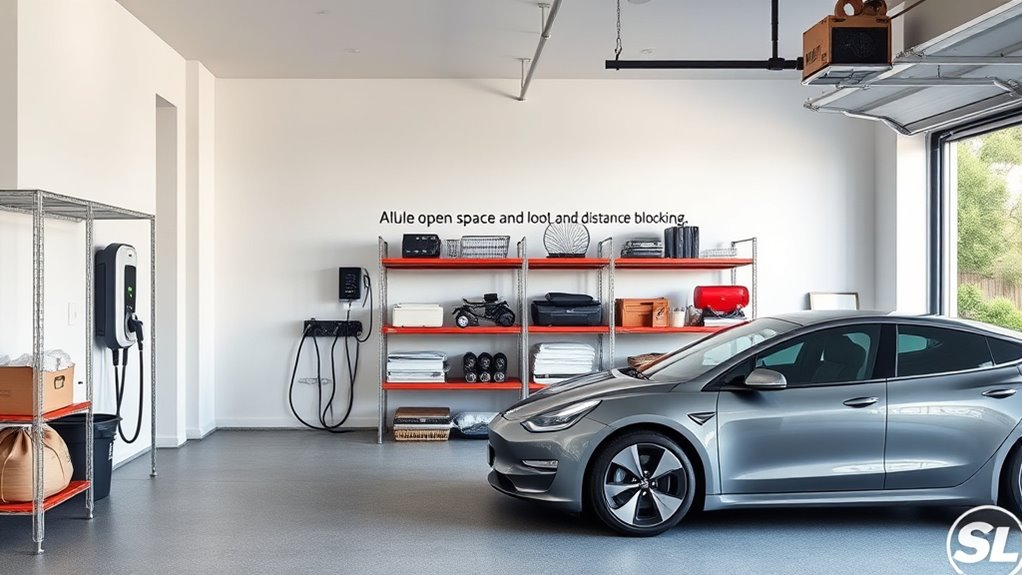
EV charger clearance is the open, usable space around an electric vehicle charging station that lets drivers reach the controls, handle the connector, move around the vehicle, and keep cords out of walking paths. The safest layout separates four ideas: the accessible route, the clear floor or ground space at the charger, the vehicle charging space, and the access aisle beside the vehicle. General, non-accessible chargers — like a Level 2 unit in a home garage — have their own simpler mounting-height and working-space rules, covered later in this guide.
Quick Answer
For an accessible EV charger layout, plan an accessible route at least 36 inches wide and a clear floor or ground space of at least 30 by 48 inches at the controls. Accessible charging spaces should be at least 11 feet by 20 feet with a 5-foot access aisle, firm level surface, and reachable controls. General home or workplace chargers just need standard NEC mounting-height and working-space clearance.
Key Takeaways
- Use a 36-inch minimum accessible route, but do not confuse that with charger clear floor space.
- Provide at least 30 by 48 inches of clear floor or ground space at accessible charger controls.
- For chargers with accessible mobility features, the U.S. Access Board recommends an 11-foot by 20-foot vehicle charging space plus a 5-foot access aisle.
- Keep cords, bollards, curbs, wheel stops, trash cans, and landscaping out of the access aisle and clear floor space.
- These accessible EV charging dimensions are currently design recommendations rather than a finalized federal rule, so state and local codes may add their own binding requirements.
- Always confirm the final layout with the local authority having jurisdiction, a qualified electrician, and current local code.
At a Glance
| Time Required | 15–45 minutes for a basic layout check; longer for new construction, curbside work, or permit review |
| Difficulty | Moderate for planning; electrical installation should be handled by qualified professionals |
| Tools Needed | Tape measure, digital level, site plan, marking paint or chalk, charger cut sheet, and local code checklist |
| Cost | Usually $0–$200 for layout review tools; installation, trenching, bollards, signage, and electrical work vary by site |
What EV Charger Clearance Means
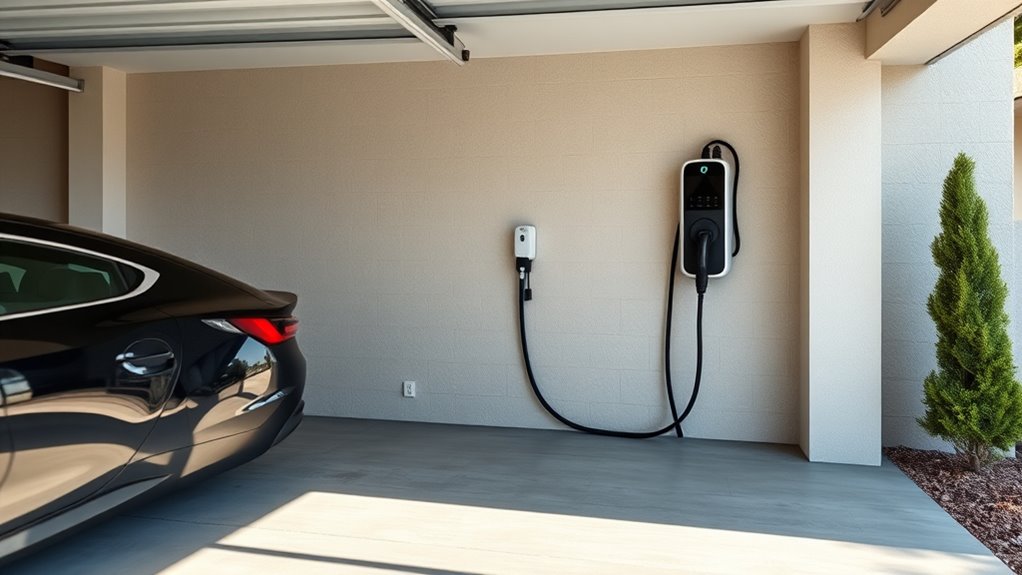
EV charger clearance means the open space needed for safe approach, accessible use, connector handling, and vehicle movement around a charging station.
EV charger clearance is not just one number. A good layout combines a clear route, a clear floor space at the charger, a usable vehicle charging space, and an access aisle that stays free of obstructions.
For covered public and commercial sites, the U.S. Access Board’s EV charging station guidance explains how ADA and ABA accessibility standards apply to EV chargers. The guidance separates required accessibility standards from recommended EV-specific layouts, which is important because a charger is a service point, not just a parking stall.
The most common mistake is saying “36 inches around the charger” as if that is the whole rule. In reality, 36 inches is the typical minimum clear width for an accessible route under ADA accessible route standards. The charger itself also needs a clear floor or ground space, and accessible EV charging spaces need enough room for a driver to exit, move around the vehicle, retrieve the connector, and reach the vehicle charging inlet.
Note: The 11-by-20-foot charging space and 5-foot access aisle are U.S. Access Board design recommendations, not yet a finalized federal ADA rule. The Board proposed a rule in September 2024 to make similar dimensions mandatory nationwide, but its own regulatory agenda has since proposed moving that rulemaking to long-term or inactive status. Until a final rule exists, treat these numbers as strong best practice — and check whether your state or city (several already have their own accessible EV charging codes) requires something different.
EV Charger Clearance Requirements for Parking Spaces
For an EV charging space with accessible mobility features, the U.S. Access Board recommends a vehicle charging space at least 11 feet wide by 20 feet long. It also recommends an adjoining 5-foot-wide access aisle that runs the full length of the vehicle charging space.
This larger layout matters because EV charging inlets are not in the same place on every vehicle. Some are at the front, some are at the rear, and some are on the driver or passenger side. A driver with a mobility device may need to move around the vehicle and still keep the charging cable from blocking the access aisle.
How many accessible charging spaces a site needs is still being worked out at the federal level, but the Access Board’s 2024 proposal outlined a sliding scale tied to the total number of charging spaces on site — generally one accessible space for the first 25 charging spaces, with the requirement stepping up as the total grows. Because this scoping table is part of the still-pending rulemaking, confirm current numbers with your local building department; some states, including Massachusetts, already publish their own scoping guidance for state-owned facilities.
Note: Accessible EV charging spaces should not automatically replace required accessible parking spaces. If an existing accessible parking space is converted to EV charging, the site may need new accessible parking elsewhere to avoid reducing overall accessibility.
| Element | Recommended or Required Dimension | Why It Matters |
|---|---|---|
| Accessible route | 36 inches minimum clear width | Lets people move between the charging space, charger, sidewalk, and building entrance |
| Clear floor or ground space at charger | 30 inches by 48 inches minimum | Gives a wheelchair, scooter, or walker user a stable place to reach the controls |
| Accessible EV charging space | 11 feet wide by 20 feet long | Provides space to move around different vehicle shapes and inlet locations |
| Access aisle | 5 feet wide, full length of the charging space | Supports entry, exit, connector handling, and mobility device movement |
| Ground slope at required clear spaces | No steeper than 1:48 | Helps keep wheelchairs and mobility devices stable |
| Unobstructed reach range | 15 to 48 inches above the clear floor or ground space | Keeps controls, card readers, buttons, and connector handles within reach |
Accessible Routes and Reach Ranges for Chargers
Accessible EV chargers should connect to an accessible route that leads to the same building, facility, sidewalk, or site amenities served by the charging station. The route should be firm, stable, slip-resistant, and free of objects that narrow the path below the required clear width.
At the charger, provide a clear floor or ground space of at least 30 inches by 48 inches. Keep this space on the same level as the charging space and access aisle when possible. Grass, curbs, wheel stops, bollards, trash cans, landscaping, and cable slack should not sit inside this clear space.
Reach range matters too. Operable parts include the connector handle, release button, touch screen, card reader, payment terminal, start/stop button, and emergency stop button. Under ADA building block standards, operable parts must be within accessible reach ranges and usable without tight grasping, pinching, or twisting of the wrist. For an unobstructed side reach, keep operable parts no higher than 48 inches above the clear floor or ground space.
Pro Tip: A parallel approach is often easier at EV chargers because the user can line up beside the controls and handle the connector without turning into a narrow pocket.
Keep Clearances Around Cords, Pedestals, and Curbs
Once you have the route, access aisle, and clear floor space planned, check the objects that commonly ruin clearance in real life: cords, pedestals, bollards, curbs, wheel stops, signs, and landscaping.
Charging Cables
Charging cables should not cross the accessible route or lie across the access aisle. If the charger uses a short DC fast charging cable, place the charger so the controls and clear floor space line up with the access aisle and the most likely vehicle charging inlet location. If the cable is long, use cable management to keep slack off the ground and out of walking paths.
Bollards
Bollards can protect the charger from impact, but they must not block the clear floor space, access aisle, or accessible route. Align bollards beside the charger where they protect the equipment without forcing a wheelchair user to reach around them.
Curbs
Curbs need special care. Do not treat a curb as a harmless edge. An accessible charger mounted on or behind a curb can become unusable for someone using a wheelchair or scooter. The better design is to place the charger, access aisle, and clear floor space on the same level. If a curb-mounted charger is unavoidable, place the charger as close as possible to the curb face and no farther than 10 inches from it, while keeping the operable parts within reach.
Warning: Do not install a charger, pedestal, bollard, or wheel stop inside the required clear floor space or access aisle. A layout can look compliant on paper and still fail if the final hardware blocks the approach.
- Confirm a 36-inch minimum accessible route to the charger and site entrance or sidewalk.
- Mark a 30-by-48-inch clear floor or ground space at the charger controls.
- Keep the access aisle open for the full vehicle length.
- Route charging cables away from walkways and mobility-device paths.
- Place bollards beside the charger, not in front of the controls.
- Avoid curbs; if curb mounting is unavoidable, keep the charger close enough for accessible reach.
EV Charger Clearance by Site Type
Site type changes the details. A public parking lot, curbside space, parking garage, apartment complex, fleet depot, and pull-through fast charger can all need different layouts. The goal stays the same: keep the route, charger controls, access aisle, and cable path usable.
| Site Type | Clearance Priorities |
|---|---|
| Public parking lot | Use an 11-foot by 20-foot accessible charging space, 5-foot access aisle, accessible route, and clear floor space at the charger. |
| Existing parking lot retrofit | Check whether the charger can be added without reducing required accessible parking or blocking an accessible route. |
| Curbside or public right-of-way | Place chargers near curb ramps or block ends where possible, keep sidewalks passable, and avoid cable runs across pedestrian paths. |
| Parking garage | Maintain accessible route connections, check ceiling clearance, and avoid platforms that lift controls above reach range. |
| Residential shared charger | For shared or common-use chargers, provide accessible controls, route access, and space for residents or visitors with mobility needs. |
| Fleet lane | Keep circulation lanes clear, protect equipment from vehicle impact, and provide accessible mobility features where employees or customers may need them. |
| Pull-through charger | Plan wider drive-up space, cable reach to different inlet locations, and clear floor space beside the charger without curb obstruction. |
General (Non-Accessible) Clearance for Home and Workplace Chargers
Most home garages and single-family driveways don’t need the full accessible-parking layout above — they need standard electrical working clearance instead. A typical Level 2 charger is wall- or pedestal-mounted, and the National Electrical Code (Article 625) commonly guides installers to mount the unit’s controls at least 18 inches above the floor for indoor installations and at least 24 inches above grade outdoors, which keeps the charger clear of flooding, road spray, and accidental bumper contact.
Around the charger itself, electricians also need standard NEC working space to safely service the unit and its disconnect: commonly cited minimums are roughly 30 inches wide, 36 inches deep, and 78 inches (6.5 feet) of headroom in front of the equipment. Keep this working zone free of shelving, storage, lawn equipment, or parked vehicles.
Beyond code minimums, plan for everyday use: park so the charge port lands within comfortable reach of the cable (most Level 2 cables run 18–25 feet), keep the cable off the walking path between the house and the vehicle, and consider a wheel stop or bollard on driveway installations to protect the unit from a mis-parked car.
Pro Tip: Before your electrician arrives, park your own vehicle where it normally sits and confirm the cable reaches the charge port without stretching across a walkway — it’s the cheapest clearance check you can do yourself.
Electrical Code and Safety Clearance Checks
Physical clearance is only one part of EV charger installation. Electrical work must also follow the locally adopted edition of the National Electrical Code, NFPA 70, utility requirements, equipment listing instructions, and any local amendments. NEC 2026 is now the most recently published edition, but NEC 2023 remains the version most states currently enforce, so confirm which edition your local jurisdiction has adopted before finalizing conductor sizing, disconnect placement, or mounting height. In most U.S. locations, the local authority having jurisdiction has the final say on permits, inspections, overcurrent protection, disconnects, conductor sizing, and site-specific safety requirements.
For public chargers funded under federal highway programs, 23 CFR Part 680 also includes requirements for installation, operation, maintenance, payment access, reporting, technician qualifications, equipment certification, and accessibility-related customer support. Even if your project is not federally funded, those standards are useful benchmarks for a professional installation plan.
Warning: Do not use this guide as a substitute for a permit review, electrical design, or inspection. EV charger circuits can carry continuous high loads, and installation should be planned by qualified professionals under the code adopted in your jurisdiction.
EV Charger Clearance Checklist
Use this checklist before finalizing the charger location, pouring pads, installing bollards, or trenching conduit.
- Measure the vehicle charging space: For accessible mobility features, plan at least 11 feet wide by 20 feet long.
- Mark the access aisle: Provide a 5-foot-wide aisle for the full length of the charging space.
- Confirm accessible route width: Keep at least 36 inches of clear route to the charger and connected site features.
- Mark charger clear floor space: Keep at least 30 by 48 inches clear at the controls and connector.
- Check slope: Keep required clear floor spaces and access aisles no steeper than 1:48.
- Check reach: Keep operable parts within accessible reach, usually 15 to 48 inches above the clear floor or ground space for unobstructed reach.
- Confirm mounting height: For general home or workplace chargers, mount controls at least 18 inches above an indoor floor or 24 inches above outdoor grade.
- Test cable path: Plug in a vehicle from likely parking positions and confirm the cable does not cross the access aisle or route.
- Place bollards carefully: Protect the charger without blocking the approach, controls, or connector movement.
- Check lighting and visibility: Make sure the charger, controls, signs, and pavement markings are visible at night.
- Verify local approval: Confirm building code, electrical code, utility, and AHJ requirements before installation, since accessible EV charging rules are still evolving at the federal level.
Common Clearance Mistakes to Avoid
Many EV charger clearance problems happen after the drawing is approved. A pedestal is shifted a few inches, bollards are added too close, a wheel stop blocks the route, or the charging cable is shorter than expected.
- Using a regular parking stall: A standard stall may not give enough room for a mobility device user to move around the vehicle and handle the connector.
- Blocking the access aisle: Cords, signs, bollards, curbs, and wheel stops should not reduce the aisle’s usable space.
- Mounting controls too high: Screens may be visible above 48 inches, but touch controls, buttons, card readers, and connector handles need to be reachable.
- Ignoring vehicle inlet locations: Short cables can fail even when the stall dimensions look correct.
- Putting chargers behind curbs: Curbs can make the clear floor space unusable and place controls out of reach.
- Assuming Access Board numbers are already mandatory everywhere: They’re strong recommendations, but the federal rulemaking to make them binding is still pending — check your state and local code too.
- Forgetting maintenance access: Leave enough working space for service technicians without sacrificing user clearance.
Frequently Asked Questions
What are the NEC requirements for EV chargers?
The NEC requirements for EV chargers are mainly found in Article 625, but the exact rules depend on the NEC edition adopted by your state or city. A qualified electrician should verify circuit capacity, overcurrent protection, grounding, disconnect requirements, equipment listing, wet-location suitability, conduit routing, and permit requirements with the local authority having jurisdiction.
What is the 80/20 rule for EV charging?
The 80/20 rule is a charging habit guideline, not a clearance rule. It usually means most daily charging happens at home or work, while a smaller share happens at public chargers. It can help with charging planning, but it does not replace ADA, building code, electrical code, or site-layout requirements.
What is the code height for EV charger controls?
For accessible use, operable parts should be within accessible reach range. For an unobstructed side reach, keep controls, card readers, buttons, and connector release points no higher than 48 inches above the clear floor or ground space. A 15-inch minimum low reach is also commonly used for adult accessibility.
What are the recommended heights for EV charger installation?
A practical target is to place the main user interface, start/stop buttons, payment reader, and connector handle within 15 to 48 inches above the clear floor or ground space. Many installers place high-use controls around 36 to 42 inches when the charger design allows it, but the charger model and local code still matter.
Is 36 inches enough clearance around an EV charger?
Not by itself. A 36-inch clear width is typically used for accessible routes, but the charger also needs a 30-by-48-inch clear floor or ground space at the controls. Accessible EV charging spaces also need vehicle space and an access aisle, especially where drivers must move around the vehicle with a mobility device.
How far should an EV charger be from a curb?
Avoid placing accessible EV chargers on or behind curbs when possible. The best layout keeps the charger, access aisle, and clear floor space on the same level. If curb mounting is unavoidable, place the charger as close as possible to the curb face and no farther than 10 inches from it, while keeping controls within reach.
Are the accessible EV charger dimensions legally required?
Not yet at the federal level. The 11-by-20-foot charging space, 5-foot access aisle, and related dimensions come from U.S. Access Board design recommendations. A 2024 proposed rule would have made similar requirements mandatory under the ADA and ABA, but the rulemaking has since been proposed for long-term or inactive status. Some states and cities already require these or similar dimensions on their own, so always check local code.
What is the minimum mounting height for a home EV charger?
For a typical home Level 2 charger, controls are commonly mounted at least 18 inches above the floor for an indoor garage installation and at least 24 inches above grade for an outdoor installation, per NEC Article 625 practice. Your electrician can confirm the exact mounting height required under the NEC edition your city has adopted.
Conclusion
EV charger clearance works best when you plan the whole user path, not just the charger pedestal. For accessible installations, start with a 36-inch accessible route, a 30-by-48-inch clear floor space at the charger, an 11-foot by 20-foot accessible charging space, a 5-foot access aisle, level ground, and controls within reach. For a standard home or workplace charger, focus on NEC mounting height and working-space clearance instead. Either way, check cords, curbs, bollards, wheel stops, lighting, and current local code before installation — accessible EV charging rules are still evolving at the federal level, so the local authority having jurisdiction has the final word. Good clearance protects safety, access, and long-term usability.
Sources
- U.S. Access Board: Design Recommendations for Accessible Electric Vehicle Charging Stations — backs EV charging space size, access aisle guidance, curb placement, clear floor space, and site-type recommendations.
- U.S. Access Board: ADA Chapter 4, Accessible Routes — backs accessible route width and walking surface requirements.
- U.S. Access Board: ADA Chapter 3, Building Blocks — backs clear floor space, turning space, reach ranges, and operable part requirements.
- U.S. Access Board: Electric Vehicle Charging Stations Rulemaking — backs the current status of the proposed federal rule on accessible EV charging stations.
- NFPA 70: National Electrical Code — backs the need to follow the locally adopted NEC for EV charger electrical installation, including mounting height and working clearance.
- 23 CFR Part 680: National Electric Vehicle Infrastructure Standards and Requirements — backs federal standards for covered publicly accessible EV charging infrastructure.