
If your EV charger suddenly stops working, loses power, smells hot, or keeps tripping the breaker, do not keep trying to charge. The problem may be a blown fuse, a tripped circuit breaker, a GFCI fault, a damaged receptacle, or an internal charger fault. Start with a safe visual check, then use the charger manual and a licensed electrician for anything inside the panel, disconnect, or hardwired charger.
Quick Answer
A blown EV charger fuse often shows up as no power, a dead display, a tripped breaker, charger error lights, a burning smell, discoloration, or melted plastic. Turn off the circuit, stop charging, and never replace a fuse with a larger rating. If damage or repeated trips appear, call a licensed electrician.
Key Takeaways
- Many home EV chargers are protected by a circuit breaker, not a user-replaceable fuse.
- Heat marks, burning smells, buzzing, crackling, melted plastic, or repeated trips mean you should stop using the charger.
- Use only the fuse, breaker, and circuit rating listed on the charger nameplate, manual, and approved installation plan.
- Hardwired Level 2 charger, panel, disconnect, and internal EVSE repairs should be handled by a licensed electrician.
At a Glance
| Time Required | 5 to 10 minutes for a safe visual check; professional repair time depends on the fault and parts. |
| Difficulty | Easy for outside inspection; advanced and electrician-only for panels, disconnects, hardwired chargers, or internal fuses. |
| Tools Needed | Flashlight, phone camera, charger manual, charger app or display; electricians may use a meter, insulated tools, PPE, and approved replacement parts. |
| Cost | The fuse or breaker part may be inexpensive, but the real cost depends on diagnosis, labor, wiring damage, panel condition, and local permit rules. |
Warning: Do not open an electrical panel, fused disconnect, hardwired EV charger, or burned outlet unless you are qualified to do that work. If you see melted plastic, scorch marks, smoke, water damage, or hear buzzing or crackling, turn the circuit off and call a licensed electrician.
How to Identify a Blown Fuse in Your EV Charger
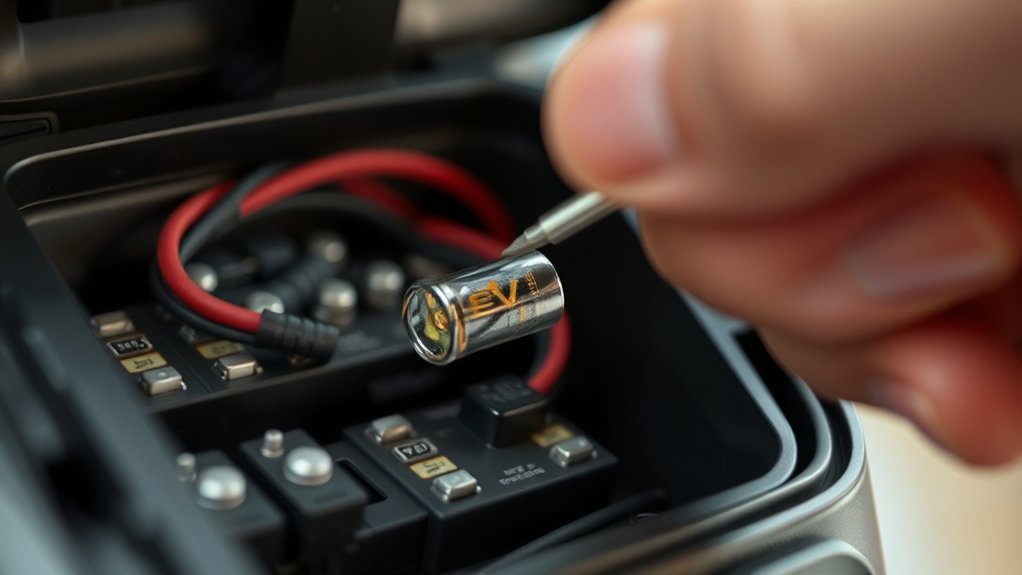
First, confirm what “fuse” means in your setup. In many U.S. homes, an EV charger is protected by a two-pole circuit breaker. Some systems may also have a fused disconnect, an internal charger fuse, a plug-in charger fuse, or a vehicle-side charging fuse. These are not the same part, and they are not replaced the same way.
Start with the safest checks from the outside:
- Stop the charging session. Use the car screen, charger app, or charger button if it is still responding.
- Unplug only if it is safe. If the plug, cable, outlet, or charger body is hot, melted, smoking, or wet, do not touch it.
- Look at the charger display. Note any error light, fault code, red indicator, or blank display.
- Check the breaker position. A tripped breaker may sit between ON and OFF. Do not keep resetting it if it trips again.
- Inspect from a distance. Look for charring, brown marks, cloudy fuse glass, melted plastic, a warped plug, a loose receptacle, or a burned smell.
- Listen before touching. Buzzing, crackling, popping, or arcing sounds are warning signs, not normal charger behavior.
The Electrical Safety Foundation International lists frequent tripping of circuit breakers or blown fuses, buzzing sounds, and discolored outlets as warning signs of an overloaded electrical system. You can review its home electrical safety guidance at ESFI Home Electrical Safety.
Note: A charger that works after one reset may still need attention if it trips again. A breaker, fuse, or GFCI device is a safety device. Repeated trips usually mean the circuit is overloaded, the charger has a fault, the wiring has a problem, moisture entered the system, or the vehicle is drawing current in a way the protection device does not accept.
Why Replacing Your EV Charger Fuse Matters
A fuse or breaker is there to open the circuit when current rises beyond a safe limit. Replacing it without fixing the cause can hide a serious problem. EV charging is a high-load, long-duration use, so loose terminals, undersized wiring, worn receptacles, damaged plugs, and water intrusion can create heat over time.
The U.S. Department of Energy’s Alternative Fuels Data Center explains that home Level 2 charging equipment often uses 240-volt service and that EV charging infrastructure is treated as a continuous load under the National Electrical Code. That is why the charger’s output, the wire size, the breaker or fuse rating, and the installation method must match.
A blown fuse or tripped breaker is not the repair by itself. It is the signal that the charger, circuit, plug, disconnect, or vehicle needs a safe diagnosis.
For example, the AFDC notes that many residential Level 2 chargers operate up to 30 amps and deliver 7.2 kW, requiring a dedicated 40-amp circuit under NEC Article 625. Larger chargers need larger properly rated circuits, and smaller chargers may use smaller circuits. You can compare charging levels in the AFDC guide to electric vehicle charging stations.
Safety certification also matters. ENERGY STAR says certified EV chargers are tested for safety by a nationally recognized testing laboratory. When buying or replacing charging equipment, check the listing, the manual, and the nameplate instead of relying only on marketplace claims. See ENERGY STAR electric vehicle charger guidance for more details.
Your Easy Guide to Replacing the EV Charger Fuse
The safe process depends on where the protective device is located. A plug-in charger with an accessible manufacturer-approved fuse is different from a hardwired Level 2 charger, an electrical panel breaker, or a fused disconnect. When in doubt, do not replace the part yourself.
| Where the Protection May Be | What You Should Do |
|---|---|
| Main breaker panel | Check whether the breaker tripped. Do not remove the panel cover or replace breakers unless qualified. |
| Fused disconnect near charger | Turn off power and call an electrician. The fuse type and rating must match the approved installation. |
| Inside a hardwired EV charger | Do not open it unless the manufacturer manual allows owner service. Most internal service should go to the installer, manufacturer, or electrician. |
| Portable Level 1 cordset | Follow the vehicle or cordset manual. If the plug, outlet, or cord is hot or damaged, stop using it. |
| Vehicle-side charging fuse | Check the owner’s manual and have the vehicle inspected if the charger works with other vehicles but not yours. |
Use this safe replacement workflow:
- Turn the charger off. Stop the session and switch off the charger circuit at the breaker if you can do so safely.
- Read the manual and nameplate. Find the exact charger model, maximum output current, voltage, and approved protective-device rating.
- Do not oversize the fuse or breaker. A larger rating can let wiring overheat before the device trips or blows.
- Inspect the cause. Look for a damaged plug, loose receptacle, water entry, rodent damage, burned terminals, or charger fault code.
- Replace only approved parts. Use the exact type and rating required by the manufacturer and installation plan.
- Test after repair. Start with a short charging session and watch for heat, odor, errors, or another trip.
- Document the problem. Record the date, fault code, circuit rating, charger setting, and repair so repeated failures are easier to diagnose.
Pro Tip: If your charger has adjustable amperage, confirm the setting matches the circuit. A 40-amp circuit is commonly used for a 30-amp or 32-amp Level 2 charging load, while a 50-amp circuit is commonly used for a 40-amp charging load. The nameplate, manual, wire size, breaker or fuse rating, and local code must all agree.
What Causes an EV Charger Fuse to Blow or a Breaker to Trip?
A blown fuse or tripped breaker is usually a symptom, not the root cause. Common causes include:
- Wrong charger setting: The charger may be set to draw more current than the circuit can safely supply.
- Loose electrical connection: Loose terminals can heat up during long charging sessions.
- Worn receptacle: A loose or overheated NEMA outlet can damage the plug and create resistance heat.
- Water intrusion: Outdoor chargers and outlets need equipment rated for outdoor use and proper weather protection.
- Damaged cable or connector: Cuts, crushed insulation, bent pins, or dirty contacts can create faults.
- GFCI or ground fault: Moisture, damaged insulation, or a charger fault can trip ground-fault protection.
- Undersized circuit: The breaker, fuse, wire, receptacle, and charger output may not be correctly matched.
- Vehicle fault: A problem in the onboard charger or charge port can make one vehicle trip a charger that works with another vehicle.
- Non-certified or counterfeit equipment: Poorly made chargers, adapters, or replacement parts can overheat or fail.
The AFDC recommends using safety-certified equipment and a certified electrical contractor for home charging installations. It also notes that electricians can determine whether your home has enough electrical capacity and add circuits when needed. You can review those recommendations in its guide to charging electric vehicles at home.
Top Mistakes to Avoid When Replacing Your EV Charger Fuse
Replacing a fuse or resetting a breaker can seem simple, but mistakes can make the charger less safe. Avoid these problems:
- Using a higher-rated fuse or breaker: This can defeat the protection the circuit was designed to provide.
- Replacing the fuse repeatedly: If the same fuse blows again, the circuit needs diagnosis.
- Ignoring heat damage: Melted plastic, scorch marks, a hot plug, or a burned smell mean the charger should stay off.
- Assuming a GFCI trip is a nuisance: Ground-fault protection may be reacting to moisture, damaged insulation, or a real leakage-current problem.
- Using extension cords or cheap adapters: EV charging should use properly rated equipment and approved circuits.
- Skipping the manual: EVSE ratings, charger settings, fuse types, and breaker sizes are model-specific.
- Opening hardwired equipment while energized: This can expose you to shock, burn, and arc-flash hazards.
How to Choose the Correct Fuse or Breaker Size for an EV Charger
The correct size is based on the charger’s maximum continuous output current, the wiring, the installation method, and local code. Do not choose a fuse or breaker by guessing from the charger’s kilowatt rating alone.
| EVSE Output Setting | Common Minimum Circuit Rating | Important Note |
|---|---|---|
| 16 amps | 20 amps | Often used for smaller Level 2 or portable EVSE setups. |
| 24 amps | 30 amps | Useful when panel capacity is limited. |
| 30 to 32 amps | 40 amps | A common residential Level 2 setup. |
| 40 amps | 50 amps | Requires correctly rated wire, breaker, receptacle if plug-in, and charger setting. |
| 48 amps | 60 amps | Usually hardwired and should be installed by a qualified electrician. |
These are common examples, not permission to upsize your circuit. The approved breaker or fuse must match the EV charger, wire size, terminals, temperature rating, installation method, and local electrical code.
When to Call a Professional for EV Charger Fuse Issues
Call a licensed electrician when the fault involves a hardwired Level 2 charger, electrical panel, fused disconnect, burned outlet, repeated breaker trip, or any sign of heat damage. The AFDC says charging station installations must comply with local and state codes and be completed by a licensed electrical contractor. You can review its installation guidance at AFDC Procurement and Installation for EV Charging Infrastructure.
| Sign | Action Required |
|---|---|
| Breaker or fuse trips once, with no heat or damage | Stop charging, check the manual, reduce charger setting only if approved, and monitor carefully. |
| Breaker or fuse trips again | Leave it off and call an electrician. |
| Burning smell, buzzing, crackling, discoloration, or melted plastic | Turn power off if safe and get immediate professional help. |
| Hardwired charger has no power | Call the installer, manufacturer, or licensed electrician. |
| Outdoor charger after heavy rain or water exposure | Do not reset repeatedly. Have the equipment, seals, conduit, and GFCI protection checked. |
| Charger works with one vehicle but not another | Have the vehicle charge port or onboard charger inspected. |
Routine care also helps prevent repeat issues. AFDC maintenance guidance includes storing cables securely, checking parts periodically, keeping equipment clean, and planning for repairs when needed. See AFDC Operation and Maintenance for EV Charging Infrastructure.
Frequently Asked Questions
What fuse is needed for an EV charger?
Use the fuse, breaker, and circuit rating required by the charger manual, nameplate, installation instructions, and local code. Do not choose the fuse by kilowatts alone. As a common example, many 30-amp or 32-amp Level 2 chargers use a 40-amp dedicated circuit, but your exact charger and wiring may require something different.
Why do EV chargers fail so often?
EV chargers usually do not fail “often” when installed correctly. Problems are more likely when the circuit is undersized, the receptacle is worn, the terminals are loose, the charger setting is too high, water enters outdoor equipment, the cable is damaged, or the charger is not safety certified.
How do I know if a car charger fuse is blown?
A blown charger fuse may cause a dead charger display, no charging response, a fault light, or loss of power to the charger. Visible clues can include a cloudy glass fuse, broken metal strip, burnt smell, scorch marks, or melted plastic. If the fuse is inside the EVSE, panel, or disconnect, let a qualified person inspect it.
Do EV chargers need their own breaker?
Most Level 2 home EV chargers should be on a dedicated circuit sized for the charger’s continuous load. AFDC notes that many residential Level 2 chargers operating up to 30 amps require a dedicated 40-amp circuit. Your electrician should size the circuit for the charger, wiring, installation type, and local code.
Can I replace an EV charger fuse myself?
Only replace a fuse yourself if the manufacturer manual clearly says it is owner-serviceable and the part is accessible without opening energized or hardwired equipment. Do not service a panel, disconnect, or internal charger fuse unless you are qualified. For Level 2 chargers, repeated trips, or heat damage, call a licensed electrician.
Is a blown fuse the same as a tripped breaker?
No. A fuse melts internally and must be replaced with the same type and rating. A breaker opens the circuit and can usually be reset after the fault is corrected. Both protect the circuit from unsafe current, and both require diagnosis if they trip or blow again.
Why does my EV charger work for a few minutes and then trip?
This often points to heat buildup, a loose connection, moisture, ground-fault leakage, a charger setting that is too high for the circuit, or a failing receptacle. Stop using the charger until the circuit and charger are checked, especially if the plug, outlet, or charger body feels warm.
Conclusion
A suspected EV charger fuse problem is a safety warning, not just an inconvenience. Check for simple clues such as a dead display, tripped breaker, error code, discoloration, burning smell, or melted plastic, but do not open energized electrical equipment. Use the charger manual, match the correct rating, and call a licensed electrician for hardwired Level 2 chargers, repeated trips, heat damage, panel work, or internal fuse replacement. The safest fix is not just a new fuse; it is finding and correcting the reason the protection device opened in the first place.
Sources
- U.S. Department of Energy AFDC: Charging Electric Vehicles at Home — home Level 1 and Level 2 charging, continuous-load guidance, NEC Article 625, and electrical-capacity planning.
- U.S. Department of Energy AFDC: Electric Vehicle Charging Stations — Level 1, Level 2, DC fast charging, typical residential Level 2 output, and dedicated circuit examples.
- U.S. Department of Energy AFDC: Procurement and Installation for EV Charging Infrastructure — code compliance, permits, licensed electrical contractors, safety, and installation planning.
- U.S. Department of Energy AFDC: Operation and Maintenance for EV Charging Infrastructure — charger maintenance, periodic checks, cleaning, cable storage, and troubleshooting.
- ENERGY STAR: Electric Vehicle Chargers — safety-certified charger guidance, Level 1 vs Level 2 buying guidance, and certified charger benefits.
- Electrical Safety Foundation International: Home Electrical Safety — warning signs of overloaded electrical systems, including frequent breaker trips, blown fuses, buzzing, and discolored outlets.