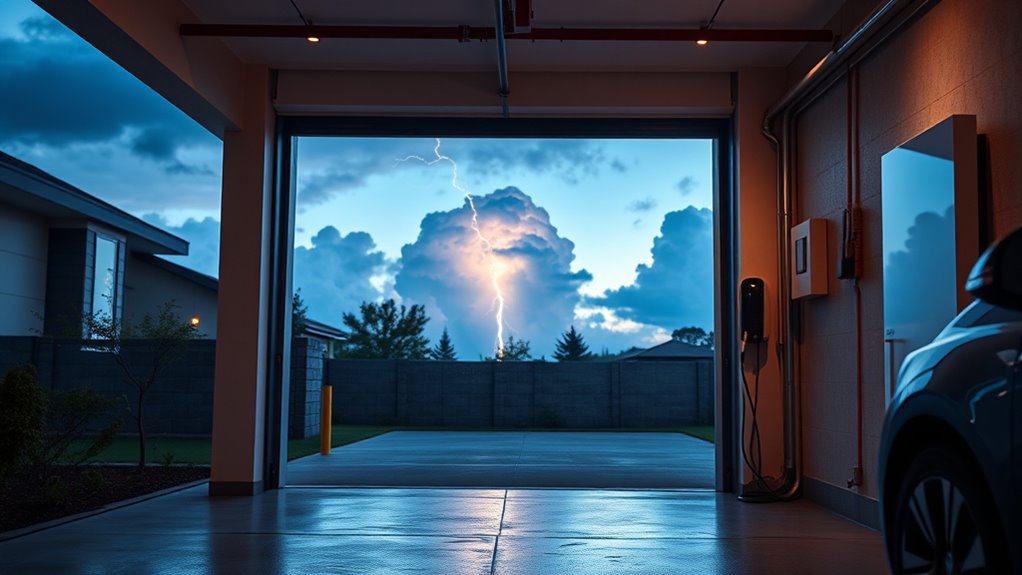
For a U.S. home EV charger, surge protection is a sensible and often code-required layer of protection, but it is not the same as a complete lightning-protection system. The current NEC requires a listed surge-protective device (SPD) for services supplying dwelling units, subject to the code edition adopted by your local authority. A Type 1 or Type 2 SPD at the service equipment can protect the home and EV charger from transient overvoltage, while a coordinated Type 2 SPD near a remote subpanel or detached-garage charger may provide additional protection. Proper grounding, bonding, outdoor-rated equipment, and professional installation are just as important.
Key Takeaways
- A panel SPD can reduce damage from lightning-induced and utility-switching surges, but it cannot make a charger immune to a direct lightning strike.
- For U.S. dwelling services covered by the current NEC, surge protection is required at the service; local jurisdictions may be using an earlier NEC edition or local amendments.
- Use an SPD that is listed for the application and correctly matched to the electrical system, installation point, available fault current, and environment.
- A second SPD can make sense at a detached garage, feeder panel, or other remote charging location when coordinated with the service-level device.
- Grounding and bonding must provide an effective fault-current path back to the electrical source; the earth alone is not an effective ground-fault current path.
Do EV Chargers Need Lightning Protection?
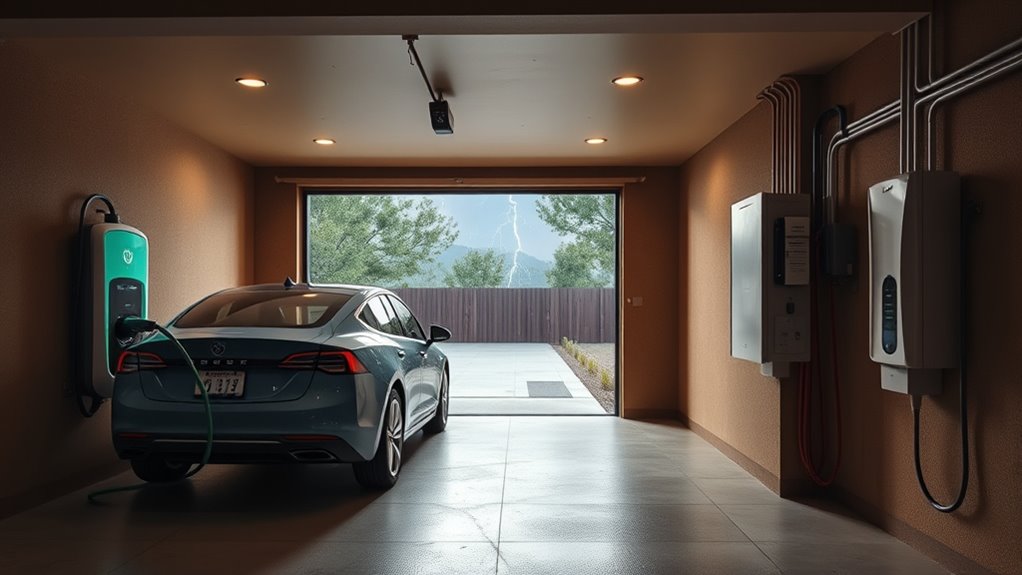
Most home EV chargers do not need a separate building lightning-protection system simply because they are installed outdoors. What they do benefit from is surge protection that limits short-duration overvoltage caused by nearby lightning, utility switching, or other electrical disturbances.
In the United States, the distinction matters. The NEC surge requirement for dwelling services is a service-level electrical rule; it is not a special rule that applies only to outdoor EV chargers. If a building has significant lightning exposure or already uses an external lightning-protection system, an engineer or qualified lightning-protection professional can determine whether additional measures designed to standards such as NFPA 780 are appropriate.
An SPD also does not replace the EV charger’s required branch-circuit protection, equipment grounding conductor, ground-fault protection, or the charger’s own listed safety features. These protections address different hazards and should work together.
How Lightning and Surges Can Damage EV Chargers
A direct lightning strike can cause severe physical and electrical damage that is beyond what a typical panel SPD is designed to stop. More commonly, a nearby lightning event can create a transient overvoltage on utility wiring or other conductive paths connected to the property.
EVSE contains control electronics, contactors, sensors, networking hardware, and other components that can be damaged by a sufficiently large transient. Utility switching and some large electrical loads can also create smaller transient events.
| Damage path | Possible effect on an EV charger |
|---|---|
| Direct lightning strike | Severe damage to wiring, enclosure, electronics, or connected equipment |
| Nearby lightning event | Transient overvoltage can enter through power or conductive communication wiring |
| Utility or load switching | Can create shorter, lower-energy transients that stress electronic components |
| Poor SPD installation | Long leads, wrong ratings, or poor coordination can reduce protection performance |
A correctly selected and installed SPD limits transient voltage by diverting or limiting surge current. It reduces risk; it does not guarantee that the charger or vehicle will survive every lightning event.
Where to Install Surge Protection
For a U.S. home, the first protection point is normally the service equipment. A supplementary SPD may also be useful at a feeder panel or subpanel that supplies a remote charger, especially when the charger is in a detached garage or far from the service equipment.
The exact arrangement must follow the locally adopted electrical code, the SPD instructions, the panel manufacturer’s requirements, and the EV charger’s installation manual.
Main Service Panel
The current NEC requires services supplying dwelling units to have a listed SPD. The device may be integral to the service equipment or installed in the permitted location specified by the applicable code. A Type 1 SPD can be suitable in locations permitted for Type 1 equipment, while a Type 2 SPD is installed on the load side of the service disconnect.
Do not choose an SPD only by a large surge-current number on the package. The system voltage, configuration, short-circuit current rating (SCCR), maximum continuous operating voltage (MCOV), voltage protection rating (VPR), nominal discharge current rating, enclosure/environmental rating, and installation location all matter.
Connection conductors should be kept as short and direct as the device instructions allow. Extra conductor length and unnecessary bends add impedance and can reduce surge-protection performance.
Charger Circuit Panel
If the EV charger is supplied from a subpanel, particularly one in a detached structure or at the end of a long feeder, a coordinated Type 2 SPD at that panel can add a second layer of protection. It should be selected for the actual electrical system and installed according to its listing and manufacturer instructions.
Do not copy a breaker size or SPD model from another installation. The required connection method depends on the specific SPD, panel, circuit configuration, and manufacturer’s instructions. A licensed electrician should confirm compatibility and code compliance.
Data Line Protection
If the charger uses a conductive communication cable, such as Ethernet that runs outdoors or between structures, that path may also need surge protection appropriate to the communication system. Install any data-line protection where it is called for by the equipment manufacturer or the site’s lightning/surge design.
A charger that communicates only by Wi-Fi or cellular service does not have an external conductive data cable that needs a separate Ethernet SPD. Never add an unapproved device to a charger’s communication port simply because it is labeled as a surge protector.
How to Choose the Right SPD
Choose an SPD by its listing, electrical ratings, installation location, and coordination with the rest of the system—not by one headline number. For U.S. installations, look for equipment listed to the applicable surge-protection standard and follow the current code and manufacturer instructions.
| Selection factor | What to verify |
|---|---|
| SPD type | Type 1 or Type 2 as permitted for the intended installation point |
| System match | Voltage, phase, wiring configuration, and MCOV match the electrical system |
| Protection ratings | VPR, nominal discharge current, and SCCR are suitable for the application |
| Environment | Enclosure and temperature ratings are suitable for indoor or outdoor conditions |
| Installation | Connection method, overcurrent protection if required, and lead lengths follow the instructions |
| Status indication | Indicator or monitoring method lets you identify when protection is no longer functional |
If the home already has a service-level SPD, do not assume that adding another device automatically improves protection. Additional SPDs should be coordinated so each device is used in a location and configuration it is designed for.
How Grounding and Bonding Protect Chargers
Grounding and bonding are essential, but their job is often described incorrectly. During a ground fault, the equipment grounding and bonding path is intended to provide a low-impedance path back to the electrical source so the protective device can operate. The earth by itself is not considered an effective ground-fault current path.
The grounding electrode system still has an important role in the overall electrical installation and in lightning/surge protection. The EV charger must be connected exactly as required by its listing and installation instructions, including the equipment grounding conductor and any required bonding.
Loose terminals, corrosion, damaged conductors, or improper bonding can compromise safety and surge performance. Inspection and corrective work inside electrical panels should be performed by a qualified electrician.
Best Practices for Outdoor EV Chargers
Outdoor EVSE should be listed or rated for the environment in which it is installed and mounted according to the manufacturer’s instructions. Rain, standing water, sunlight, physical impact, and cable strain can all affect a poorly planned installation.
Use the charger’s specified wiring method and outdoor-rated fittings, raceways, receptacles, enclosures, and connectors where applicable. Do not place an ordinary household plug-in surge strip in a high-current EV charging circuit.
Weatherproof Mounting Tips
- Use an installation location and mounting surface permitted by the charger manufacturer.
- Keep the connector and cable away from standing water, traffic paths, sharp edges, and places where a vehicle can crush them.
- Use weatherproof or weather-resistant electrical equipment where required for the location.
- Seal penetrations and fittings using methods approved for the wiring system and enclosure.
- Inspect the cable, connector, enclosure, mounting hardware, and visible wiring for damage or deterioration.
Grounding and Surge Defense
A strong outdoor installation combines several layers instead of relying on a single device:
- Maintain the required equipment grounding and bonding path.
- Provide the service-level SPD required by the locally adopted code.
- Consider a coordinated Type 2 SPD at a remote feeder panel or subpanel when the installation design calls for it.
- Use an EV charger and electrical equipment rated for the outdoor environment.
- Follow the EVSE manufacturer instructions and local inspection requirements.
If the property has an external lightning-protection system, or if the charger is unusually exposed, have the surge and lightning protection reviewed as one coordinated design rather than adding devices independently.
What Lightning and Surge Protection Costs
There is no reliable one-price estimate for adding surge or lightning protection to a home EV charging installation. The cost depends on the existing service equipment, available panel space, SPD type, local labor rates, whether a subpanel is involved, outdoor wiring conditions, and whether grounding or other electrical defects must be corrected.
A panel SPD is a much smaller project than a professionally designed building lightning-protection system. If you are comparing quotes, ask the electrician to identify the exact SPD, its ratings, where it will be installed, whether additional overcurrent protection is required by the manufacturer, and whether the work includes permit or inspection fees.
Choose surge protection by electrical compatibility and installation quality, not by the lowest hardware price or the largest marketing number.
Frequently Asked Questions
Do I Need Surge Protection on My Home EV Charger?
For a U.S. dwelling, the service may already be required to have an SPD under the locally adopted NEC. Even where a dedicated charger-level SPD is not required, service-level surge protection is a practical way to reduce the risk of transient damage to the EV charger and other connected equipment. Check the code edition enforced by your local authority and the charger’s installation manual.
What Is the Best Way to Protect Your House From Lightning?
Surge protection is only one part of lightning risk reduction. A complete building lightning-protection system can include air terminals, conductors, bonding, grounding electrodes, and coordinated SPDs designed and installed to an applicable lightning-protection standard. A panel SPD alone should not be described as full direct-strike protection.
How to Protect a Home EV Charger?
Use a correctly installed service-level SPD, maintain proper grounding and bonding, follow the charger manufacturer’s branch-circuit requirements, and use equipment suitable for the installation environment. A remote charger supplied through a detached-garage or feeder panel may benefit from additional coordinated surge protection.
Can I Use a Plug-In Surge Protector With an EV Charger?
Do not use an ordinary household surge strip, extension cord, or other unapproved adapter as surge protection for a Level 2 EV charger. The EVSE must be connected using the wiring method and receptacle or hardwired connection allowed by its listing and installation instructions.
What Can I Do About EV Charger Constantly Getting Interrupted at Home?
Repeated charging interruptions are not proof of a surge problem. Check the charger’s fault code or app message first, then consider supply-voltage problems, loose or overheating connections, breaker or receptacle issues, load-management settings, network problems, or a charger fault. If the cause is not obvious from the manufacturer’s troubleshooting guide, stop using damaged equipment and have a qualified electrician inspect the circuit.
Conclusion
A home EV charger benefits from surge protection, but the protection should be described accurately. A service-level Type 1 or Type 2 SPD can reduce transient overvoltage reaching the charger, while a second coordinated SPD may be useful at a remote subpanel or detached garage. Neither replaces correct grounding, bonding, branch-circuit protection, weather-rated installation, or a complete lightning-protection system where one is warranted.
Safety note: Electrical panels and EV charging circuits can contain lethal voltages. Have service-panel, SPD, grounding, bonding, and EVSE wiring work performed by a qualified electrician and approved under the electrical code enforced in your jurisdiction.
”’
# count words and images
plain2=re.sub(r’<[^>]+>