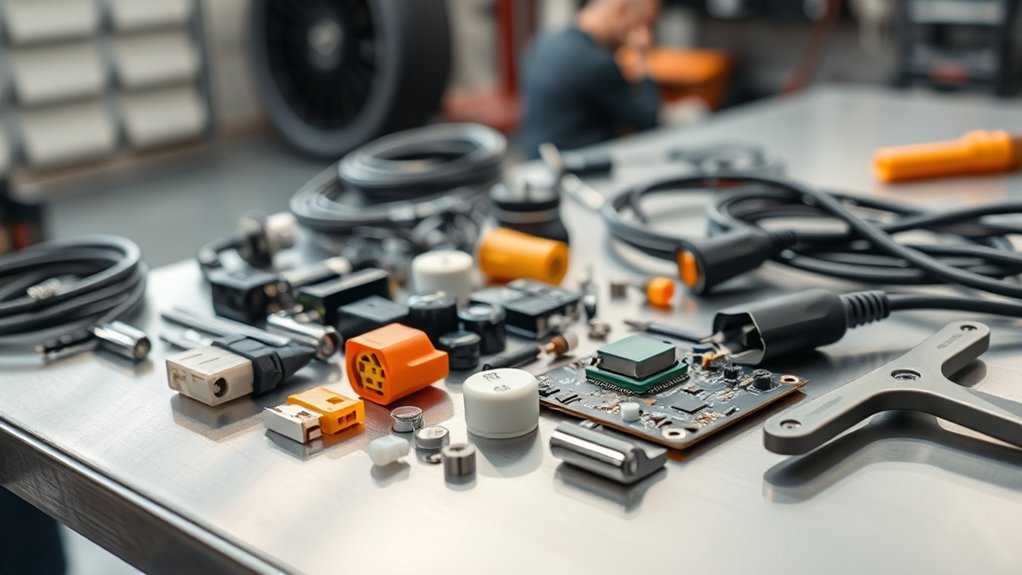
If you own an EV charger, the parts most likely to need attention are the cable, plug, connector, wall-mount hardware, holster, weather seals, and software settings. Heat, fraying, nuisance breaker trips, charging interruptions, corrosion, or error lights can signal a problem. Some visual checks and cleaning are safe for owners, but internal electrical repairs should be handled by the manufacturer, an authorized service provider, or a licensed electrician.
Quick Answer
Replace EV charger parts when you see cracked insulation, exposed wire, bent pins, a loose plug, corrosion, repeated charging faults, or unusual heat. Buy model-approved parts from the charger maker or an authorized supplier. Do not open a hardwired charger or replace internal components unless you are qualified to work on electrical equipment.
Key Takeaways
- The cable, connector, plug, holster, wall bracket, weather seals, and app/firmware settings are the first places to check when charging becomes unreliable.
- Stop using the charger if the cable is frayed, the plug is hot, the connector is cracked, you smell burning, or the breaker trips repeatedly.
- Use parts that match your charger model, amperage rating, connector type, and installation style.
- Cleaning and visual inspection are owner-friendly. Hardwired repairs, internal contactors, circuit boards, breakers, and ground-fault issues are pro-level work.
- J3400/NACS is now the SAE-published charging standard adopted by most new North American EVs, so confirm whether your vehicle uses a native port, J1772/CCS, or an approved adapter.
At a Glance
| Time Required | 10–15 minutes for a monthly visual check; repair time varies by part, charger model, and electrician availability. |
| Difficulty | Easy for cleaning and inspection; advanced for wiring, breaker, ground-fault, or internal charger repairs. |
| Tools Needed | Flashlight, dry microfiber cloth, charger manual, charger app, and model number. Electrical tools should be used only by qualified workers. |
| Cost | Cleaning is usually free. Replacement holsters, brackets, cables, adapters, and service visits vary by brand, amperage, warranty, and installation type. |
Recognizing When Your EV Charger Needs Repairs
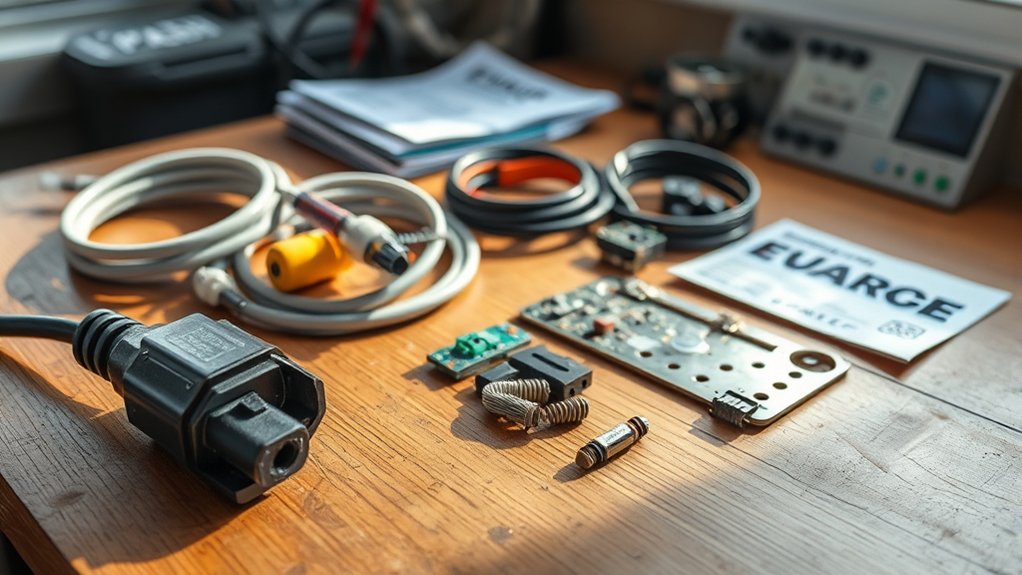
Recognizing when your EV charger needs repairs helps you avoid slow charging, nuisance shutdowns, and electrical hazards. The biggest warning signs are inconsistent charging, failure to power on, frequent circuit breaker trips, hot plugs, burning smells, error lights, app fault messages, or a connector that no longer locks into the vehicle inlet.
Inspect the charging cable and connectors for visible wear, fraying, cracking, exposed copper, crushed insulation, bent pins, loose strain relief, damaged latches, dirt, moisture, or corrosion. A connector should fit firmly, release cleanly, and stay dry when stored.
Also check how the charger behaves during a session. If it starts normally but slows down, stops, or restarts, the cause may be heat, a vehicle setting, a charger setting, Wi-Fi/app communication, a ground-fault event, a weak receptacle, or a circuit that is overloaded for the selected amperage.
Warning: Stop using the charger if you see exposed wire, melted plastic, scorch marks, a hot plug, repeated breaker trips, water inside the connector, or a burning smell. Do not keep resetting the breaker. Unplug if safe, stop charging, and call a qualified electrician or the charger manufacturer.
Essential EV Charger Replacement Parts to Check
EV charger replacement parts are not one-size-fits-all. Before buying anything, confirm the charger brand, model number, connector type, amperage rating, plug or hardwired configuration, warranty status, and vehicle compatibility. Your home unit is technically called electric vehicle supply equipment (EVSE) — for most Level 1 and Level 2 setups, it delivers and safely controls AC power, while the actual battery charger that converts that power to DC lives inside the vehicle.
| Part | What to Check | Who Should Handle It |
| Charging cable | Fraying, cuts, crushed insulation, stiff spots, heat, or loose strain relief. | Owner can inspect. Replacement should follow manufacturer instructions and may require service. |
| Connector handle | Cracks, bent pins, corrosion, latch failure, poor fit, or moisture. | Owner can clean dry surfaces. Damaged connectors need approved replacement. |
| Plug or receptacle | Loose fit, discoloration, heat, arcing marks, or damaged blades. | Licensed electrician, especially for 240-volt receptacles or hardwired units. |
| Mount, holster, and cable hanger | Loose screws, cracked plastic, poor connector storage, or cable strain. | Owner-friendly if no wiring is exposed and the charger remains securely mounted. |
| Weather seals and covers | Brittle gaskets, missing caps, water intrusion, or sun-damaged covers. | Owner can inspect. Use only manufacturer-approved replacement pieces. |
| Internal parts | Contactor faults, circuit board failure, ground-fault errors, relay chatter, or burned components. | Manufacturer, authorized repair provider, or licensed electrician only. |
For secure installation, make sure the charger is mounted firmly, the cable is stored without sharp bends, and the connector is protected from dirt and rain when not in use. Outdoor chargers should be outdoor-rated and installed according to local code, the product manual, and permit requirements.
Outdoor-rated units are also labeled with a NEMA enclosure rating — commonly NEMA 3R for rain and dust resistance, or NEMA 4/4X for fully weathertight, corrosion-resistant environments such as coastal areas or wash-down zones. Match the rating to where the charger is actually mounted, and never substitute an indoor-rated unit outdoors, even temporarily or under a makeshift cover.
EV Charger Cables: When to Replace Yours
You should replace or service an EV charger cable when it shows signs of wear, no longer charges reliably, gets unusually warm, or no longer matches your vehicle and charger setup. The cable carries continuous electrical load for long sessions, so small damage can become serious.
Signs of Wear
The cable carries the highest continuous load of any charger component, so check its full length during every inspection — not just the connector end.
| Signs of Wear | Action Needed |
| Visible fraying, cuts, cracking, or exposed wiring | Stop using the charger and replace the cable through the manufacturer or a qualified service provider. |
| Cable, plug, or connector feels unusually warm | Stop charging, lower amperage only if the manual allows it, and have the setup checked. |
| Corroded, dirty, bent, or wet connector pins | Clean only dry exterior surfaces. Replace damaged connectors. |
| Charging speed drops or charging starts and stops | Check vehicle settings, charger settings, app faults, cable heat, and circuit limits before replacing parts. |
Performance Issues
As charging efficiency drops, do not assume the cable is always the cause. Work through the easy checks first:
- Vehicle settings: Make sure the vehicle has not limited the charging current or set a departure schedule.
- Charger app: Check for error codes, firmware updates, Wi-Fi problems, load-sharing limits, or utility demand-response settings.
- Cable heat: Look for warmth at the connector, plug, or receptacle. Heat at one point often means resistance or a loose connection.
- Connector fit: Make sure the handle clicks into place and does not sag, wiggle, or unlock during charging.
- Breaker trips: A breaker that trips more than once needs diagnosis. Do not keep resetting it.
Pro Tip: Store the cable loosely on a hanger instead of wrapping it tightly around the charger. Tight coils and sharp bends can add strain and trap heat during long charging sessions.
Compatibility Concerns
When choosing replacement cables, compatibility matters more than price. Match the cable to the charger model, output rating, connector type, installation type, and region.
In North America, many AC Level 1 and Level 2 chargers use the J1772 connector. DC fast charging historically used CCS or CHAdeMO, but SAE International has now published J3400 (NACS) as an open industry standard, and most EVs sold for the 2025 and 2026 model years ship with a native NACS port. CHAdeMO is now largely limited to older Japanese imports, so confirm whether your vehicle uses a native inlet, J1772/CCS, or a manufacturer-approved adapter.
Avoid no-name adapters, damaged extension-style accessories, or parts with unclear ratings. A cable or adapter should be rated for the current, voltage, connector type, and environment where you will use it.
Why Connectors Matter in Your Charging Setup
Connectors create the physical and electrical link between the charger and the vehicle. A good connector fits firmly, resists moisture, communicates properly with the vehicle, and does not overheat during a full charging session.
- Connector type: Confirm whether your setup uses J1772, CCS, the now-standardized J3400/NACS, CHAdeMO, or a vehicle-specific adapter.
- Condition: Look for bent pins, cracked housings, damaged latches, moisture, dirt, corrosion, or scorch marks.
- Fit: The connector should seat fully and release normally. If you have to push, lift, wiggle, or force it, stop and inspect it.
- Storage: Keep the connector in its holster when not in use. Do not leave it on the ground where water, grit, and impact can damage it.
Investing in reliable connectors protects both your charger and your vehicle’s charge port. If a connector is visibly damaged, replace it with an approved part rather than trying to tape, bend, file, or force it back into service.
What You Need to Know About Internal Charger Parts
Internal charger parts control power flow, protection, communication, and temperature. These parts are not normal DIY replacement items because they sit inside electrical equipment that may be hardwired and code-regulated.
Common Internal Components
Depending on the charger model, internal components may include:
- Power electronics: Manage power delivery and communication with the vehicle.
- Contactor or relay: Opens and closes the power path during a charging session.
- Circuit boards: Control firmware, safety checks, app communication, and status lights.
- Ground-fault protection: Helps detect leakage current and shut down charging when a fault is detected.
- Temperature sensors: Help the charger reduce output or stop if heat rises beyond safe limits.
- Enclosure seals: Help keep moisture and dust away from live parts in outdoor-rated equipment.
If you hear clicking, buzzing, relay chatter, or see internal fault codes, stop using the charger and follow the manufacturer’s troubleshooting path. Opening the enclosure can void the warranty and expose dangerous voltage.
Replacement Cable Options
Replacement cable options vary by charger design. Some wall units have a field-replaceable cable assembly, while others require factory service or full charger replacement. Portable cordsets may not be repairable at all. Brands such as Tesla, ChargePoint, Wallbox, Grizzl-E, and Emporia vary in this regard — check your specific model’s support page or manual to confirm whether the cable is a customer-installable part.
Before ordering, confirm these details:
- Brand and exact model number
- Hardwired or plug-in design
- Maximum output amperage
- Connector type, such as J1772 or J3400/NACS
- Indoor or outdoor rating
- Warranty and service policy
Do not downgrade cable quality to save money. The cable must be rated for the charger’s output and environment. A cable that is too small, poorly built, or not safety certified can overheat.
Electrical Code, GFCI Protection, and Recalls
Home EV charger installations in the U.S. fall under NEC Article 625, which sets requirements for dedicated branch circuits, ground-fault (GFCI) protection, and accessible disconnects for charging equipment. Requirements have been updated across recent code cycles — including new allowances for multiple chargers to share a circuit under an approved energy management system — so ask your electrician which NEC edition and local amendments apply before assuming a repair or upgrade is code-compliant.
It’s also worth checking whether your charger model has an open safety recall. Recalls on EV charging equipment are tracked by the U.S. Consumer Product Safety Commission, and manufacturers often push recall or safety notices through the charger’s app. Registering your charger with the manufacturer after installation makes it easier to receive firmware updates and recall alerts directly.
Maintenance and Troubleshooting Tips
To keep your EV charger operating reliably, follow a simple monthly check:
- Inspect the full cable for cuts, cracks, crushed areas, or stiff spots.
- Look inside the connector for dirt, moisture, corrosion, bent pins, or a broken latch.
- Wipe exterior plastic with a dry microfiber cloth. Do not spray liquid into the connector.
- Check that the wall mount, holster, and cable hanger are secure.
- Review the charger app for fault codes, firmware updates, and charging-current settings.
- Confirm the charging area stays dry, ventilated, and clear of clutter.
- Check the manufacturer’s site or CPSC.gov for any open safety recalls on your model.
- Watch for recurring heat, slow charging, or breaker trips.
If you experience frequent breaker trips, do not treat the breaker as the problem by default. The charger setting, receptacle, wiring, breaker size, loose connection, or internal charger fault may need diagnosis.
Charger Safety Compliance
Safety compliance matters because EV charging is a long-duration electrical load. Choose equipment that is listed or certified by a recognized testing lab, such as UL, ETL/Intertek, or CSA. ENERGY STAR certified EV chargers are also tested for safety by a nationally recognized testing laboratory and can reduce standby energy use compared with non-certified models.
For outdoor chargers, use equipment rated for outdoor installation and follow the manufacturer’s mounting instructions. Home installations should comply with local code, permit rules, and the charger manual. A licensed electrician can confirm whether your panel, wiring, breaker, receptacle, and load calculation support the charger’s selected amperage.
Note: A safety logo printed in an online listing is not enough. Confirm that the charger itself carries a valid certification mark and that the model appears in the manufacturer’s official documentation or certified product listing.
Cost Considerations: Repair vs. Replacement
When deciding between repairing or replacing your EV charger, compare the part cost, labor cost, warranty status, charger age, safety certification, feature set, and installation condition. Avoid relying on universal repair-price estimates because costs vary widely by brand, location, wiring, permit requirements, and whether the charger is plug-in or hardwired.
| Choose Repair When | Choose Replacement When |
| The charger is newer, under warranty, and the damaged part is approved for replacement. | The charger is out of support, repeatedly faults, or needs a costly internal repair. |
| The issue is limited to a holster, faceplate, cable hanger, mounting hardware, or approved cable assembly. | The enclosure is cracked, water entered the unit, internal components are burned, or safety certification is uncertain. |
| The charger still meets your vehicle’s charging speed and connector needs. | You need smart features, load management, a different connector, better outdoor rating, or future EV compatibility. |
For U.S. readers, the federal Alternative Fuel Vehicle Refueling Property Credit (Section 30C) covered up to 30% of the cost of qualified EV charging equipment, capped at $1,000 for a home installation, for property placed in service from January 1, 2023, through June 30, 2026. That federal credit has since expired and does not apply to equipment placed in service after that date. Before budgeting for a repair or replacement, check current state incentive programs, utility rebates, and IRS guidance, since many remaining state and utility rebates still require ENERGY STAR certification as a condition of the incentive.
DIY or Hire a Pro: Making the Right Choice
Before you tackle EV charger repairs, decide whether the job is inspection, cleaning, accessory replacement, or electrical repair. Those are very different risk levels.
Safe Owner Checks
Most owners can safely do these tasks with the charger idle and the vehicle unplugged:
- Read the charger app error code and manual.
- Inspect the cable, connector, holster, and wall mount.
- Wipe exterior surfaces with a dry cloth.
- Remove dust or debris from the storage area.
- Confirm the vehicle’s charge limit and schedule settings.
- Check whether the charger has a firmware update.
Jobs for a Licensed Electrician
Hire a licensed electrician or approved service provider for:
- Hardwired charger replacement
- Breaker or panel work
- New 240-volt receptacles
- Loose, hot, or discolored receptacles
- Ground-fault or repeated breaker-trip diagnosis
- Burned wiring, water intrusion, or internal charger faults
- Load calculations and amperage changes beyond the app setting
Complexity of Repair
Simple accessory work is different from internal repair. A broken cable hanger may be a quick replacement. A damaged cable, failed contactor, burned board, or overheated receptacle can affect safety and code compliance.
If the charger is older, unsupported, water-damaged, or repeatedly failing, replacement may be safer and more practical than repeated repairs.
Upgrading Your EV Charger for Future Needs
Upgrading your EV charger may make sense if your current unit charges too slowly, lacks smart scheduling, cannot support your next EV, or uses a connector that no longer fits your plans. Level 2 chargers can reduce charging time compared with a standard 120-volt cordset, but the real speed depends on the charger output, circuit capacity, and vehicle onboard charger.
Smart chargers can help you schedule charging, track energy use, manage load sharing, and use off-peak utility rates when available. Some ENERGY STAR certified chargers are connected, allowing remote monitoring and control. ENERGY STAR also notes that certified EV chargers use less standby energy than non-certified products.
A charger upgrade is not only about speed. Connector compatibility, safety certification, outdoor rating, app support, load management, and serviceability matter just as much.
For future compatibility, know that SAE International has now published J3400 (NACS) as an open industry standard, and most new EVs sold in North America for the 2025 and 2026 model years ship with a native NACS port, while CHAdeMO is increasingly limited to older Japanese imports. A universal-style charger or a manufacturer-approved adapter can bridge older equipment in the meantime, but a native-connector setup avoids adapter compatibility issues long-term. If you expect to add another EV later, ask an electrician about panel capacity, load management, and conduit planning before you buy the charger.
Where to Purchase Replacement Parts for Your EV Charger
Not every seller stocks parts that are actually compatible with or safety-rated for your charger. Start with the safest source, then move down this list only if the part is clearly compatible and safety certified.
- Charger manufacturer: Best for cables, faceplates, holsters, pedestals, mounting kits, adapters, firmware support, and warranty help — brands such as Tesla, ChargePoint, Wallbox, Grizzl-E, and Emporia all handle this differently, so check the model’s own support page first.
- Authorized installer or electrician: Best for hardwired units, replacement circuits, receptacles, breakers, and code-sensitive repairs.
- Utility marketplace: Useful for ENERGY STAR certified chargers and possible rebates or approved product lists.
- Safety-certified retailer: Acceptable only when the exact model, rating, connector, and certification are clear.
- Auto parts store: Useful for basic accessories, but not a substitute for charger-specific electrical parts.
Avoid used cables, unknown adapters, counterfeit certification marks, and parts that do not list voltage, amperage, connector type, and charger compatibility. If the seller cannot confirm the part fits your exact charger model, do not use it.
Frequently Asked Questions
What is the lifespan of an EV charger?
An EV charger can last for years, but there is no single lifespan that applies to every model. Weather exposure, cable handling, installation quality, electrical load, firmware support, and physical damage all affect longevity. Inspect it regularly and replace it when safety, reliability, or compatibility becomes questionable.
What components go in an EV charger?
Common parts include the enclosure, charging cable, connector, plug or hardwired input, contactor, control board, temperature sensors, ground-fault protection, status lights, communication module, wall mount, and cable holster. The exact design depends on the charger brand and model.
What is the 80/20 rule for charging?
The 80/20 rule is a battery-care habit, not a charger-repair rule. It usually means setting a daily charge limit around 80% and avoiding very low battery levels when your vehicle supports that strategy. Follow your vehicle manual because some battery chemistries and trip needs are different.
Why do EV chargers fail so often?
Home EV chargers usually fail because of cable damage, loose or hot receptacles, water intrusion, connector wear, app or firmware issues, overloaded circuits, poor installation, or repeated heat exposure. Public DC fast chargers have more parts and network systems, so they can fail for additional reasons such as payment, communication, screen, or connector faults.
Can I replace an EV charger cable myself?
Only if the charger manufacturer says that cable assembly is owner-replaceable and gives a clear procedure. Many cable replacements require service because the cable connects inside the charger enclosure. Never splice, tape, or patch a charging cable.
Should I repair or replace an older EV charger?
Replace it if it is unsupported, repeatedly faults, lacks safety certification, has internal damage, no longer fits your vehicle, or costs too much to repair. Repair may make sense for a newer unit with warranty support and a clearly replaceable part.
Conclusion
Keeping your EV charger in good shape starts with regular visual checks, clean storage, safe cable handling, and quick action when you see heat, wear, corrosion, or charging faults. Replace damaged parts only with compatible, safety-rated components, confirm your setup meets current electrical code and recall status, and bring in a qualified electrician for wiring, breaker, receptacle, ground-fault, or internal charger problems. With the right maintenance routine, your charger can stay safer, more reliable, and better prepared for your next EV.
Sources
- U.S. DOE Alternative Fuels Data Center: Charging Electric Vehicles at Home — backs home charging, outdoor-rated equipment, permitting, electrician guidance, and installation considerations.
- U.S. DOE Alternative Fuels Data Center: Electric Vehicle Charging Stations — backs charging levels, connector types, J1772, CCS, and charging-speed context.
- SAE International: SAE J3400/2 Standard Announcement — backs the current standardization status of J3400/NACS.
- ENERGY STAR: Electric Vehicle Chargers — backs certified charger safety testing, standby energy savings, smart features, and buyer guidance.
- OSHA: Nationally Recognized Testing Laboratory Program — explains NRTL product safety testing and certification marks.
- IRS: Instructions for Form 8911 — backs the federal EV charging equipment credit’s expiration date of June 30, 2026.
- U.S. Consumer Product Safety Commission: Recalls — backs checking for EV charger safety recalls.
- Tesla Wall Connector Support — manufacturer example for charger output, parts, installation resources, and troubleshooting support.