
For most listed Level 1 and Level 2 home EV chargers, you do not need a dedicated ventilation fan just because the charger is indoors. You do need a safe installation that follows the charger manual, local code, permits, electrical capacity rules, and the equipment’s operating temperature limits. Larger installations, enclosed parking areas, DC fast chargers, and clusters of chargers may need mechanical ventilation or HVAC review to control heat.
Quick Answer
A normal residential EV wall charger usually does not need special ventilation if it is listed for the location and installed as the manufacturer requires. Ventilation becomes important when heat cannot escape, multiple chargers run in one enclosed garage, the unit is high powered, or local code requires a mechanical review.
Key Takeaways
- Most listed residential Level 1 and Level 2 EVSE does not need a dedicated ventilation system, but it must stay within the temperature range in the manual.
- Mechanical ventilation may be needed in tight rooms, hot garages, multifamily parking structures, charger rooms, fleet depots, or DC fast charging areas.
- Do not apply industrial lead-acid battery-room rules to normal lithium-ion passenger EV charging unless that type of battery system is actually present.
- For code compliance, follow NEC Article 625 — ventilation specifically falls under Section 625.52 — plus the product listing, the manufacturer’s instructions, local amendments, and the authority having jurisdiction.
At a Glance
| Time Required | 15 to 30 minutes for a homeowner manual check; longer for a permitted installation or mechanical review. |
| Difficulty | Basic for checking ventilation needs; professional for electrical work, HVAC sizing, and code approval. |
| Tools Needed | EVSE installation manual, product label, permit requirements, thermometer, and a licensed electrician or mechanical engineer when needed. |
| Cost | Often $0 for ventilation changes on a listed home wall charger; project-specific for fans, controls, ducts, or HVAC upgrades. |
What Ventilation Do EV Chargers Need?
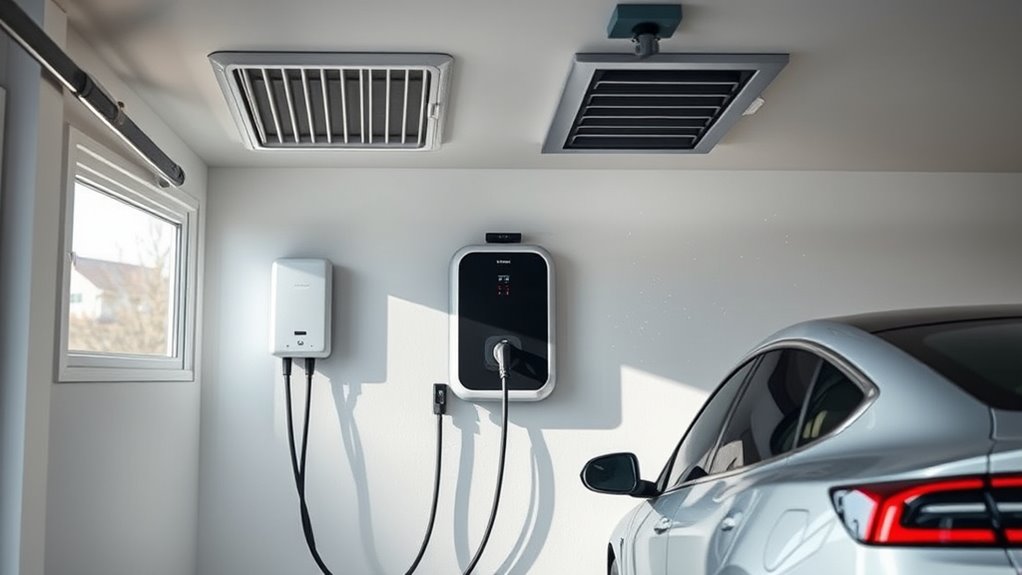
EV chargers need enough airflow around the equipment to keep the charger, cable, plug, and surrounding space within safe operating limits. For a typical home wall connector, that often means normal garage air movement, clear space around the unit, and no storage boxes, rags, solvents, or clutter blocking the charger.
The key point is simple: ventilation is not based on fear. It is based on the charger listing, the manufacturer’s installation instructions, the room temperature, the charger power level, and local code.
For example, the Tesla Gen 3 Wall Connector manual lists an operating temperature range of -22°F to 122°F and states that ventilation is not required for that product. Other chargers may have different limits, so you should always read the manual for your exact model.
That same manual also shows how a listed charger is designed to manage heat on its own instead of depending on a fan: it notes that the unit may automatically begin reducing its charging current if the ambient temperature climbs to around 95°F (35°C), then return to full current once conditions cool. A charger slowing itself down in hot weather is often the equipment protecting itself exactly as designed, not proof that the room needs mechanical ventilation.
Warning: Do not install, move, hardwire, resize breakers, or modify an EV charger circuit unless you are qualified to do electrical work. EV charging equipment is treated as a continuous load and must be installed under the applicable electrical code, permit rules, and manufacturer instructions.
Do Home EV Chargers Need Dedicated Ventilation?
Usually, no. A listed Level 1 cord set or Level 2 wall charger in a normal residential garage usually does not need a separate fan just for charging. The U.S. Department of Energy’s Alternative Fuels Data Center explains that most drivers charge at home with Level 1 or Level 2 equipment and that installations must comply with local and state codes, permits, and NEC Article 625.
That does not mean ventilation never matters. A garage can still get hot enough to make a charger reduce power, shut down, or show a thermal fault. Ventilation also matters when a charger is mounted in a small closet, utility room, enclosed parking bay, or garage with poor airflow.
The best answer is this: dedicated ventilation is product-specific and site-specific. Check the charger manual first, then confirm local code and the actual room conditions.
Quick Decision Table
| Installation | Dedicated ventilation usually needed? | What to check |
| Level 1 charger on a dedicated 120 V circuit | No, in most normal garages | Outlet condition, dedicated circuit, cord rating, heat at plug, and vehicle manual. |
| Single listed Level 2 wall charger in a garage | No, unless the manual or local code requires it | Operating temperature, clearances, circuit sizing, listing, and permit approval. |
| Multiple Level 2 chargers in an enclosed garage | Maybe | Total load, duty cycle, room temperature, exhaust path, make-up air, and HVAC capacity. |
| DC fast charger or fleet charging room | Often needs engineering review | Manufacturer heat-rejection data, equipment room limits, exhaust, cooling, and electrical-room requirements. |
| Industrial lead-acid battery charging area | Yes, when gassing batteries are present | OSHA battery charging rules, hydrogen/fume dispersal, fire protection, and battery-room controls. |
Why EV Charger Ventilation Matters Indoors
Ventilation matters indoors because heat can build up around electrical equipment. EV charging does not create tailpipe exhaust, but the charger, cable, connections, and vehicle charging hardware can all warm up during use. If the space is already hot, poorly ventilated, or packed with equipment, temperatures can climb faster.
Heat can cause nuisance shutdowns, slower charging, thermal derating, and premature wear. In severe cases, heat around a damaged plug, loose connection, overloaded receptacle, or blocked charger can become a fire risk.
Heat Dissipation Needs
Heat control starts with the actual equipment. AC Level 1 charging is low power. AC Level 2 charging is higher power and is common for home garages. The DOE AFDC charging guide says Level 2 equipment commonly uses 240 V or 208 V service, and Level 2 power can range from 2.9 kW to 19.2 kW. DC fast charging is much higher power and can reach up to 500 kW, so heat and equipment-room design become more important.
For one home charger, the manufacturer’s operating range and clearances usually answer the ventilation question. For several chargers in the same enclosed area, you should treat the group as a heat source and ask whether the garage or room can reject that heat.
Battery Gas Vs EVSE Heat
Do not confuse normal EV charging with industrial battery charging. Passenger EVs usually use sealed lithium-ion battery packs and a listed EVSE connection. They do not normally vent hydrogen into your garage during charging.
Industrial storage-battery areas are different. OSHA’s powered industrial truck rule requires adequate ventilation for dispersal of fumes from gassing batteries. That rule is relevant to forklift battery rooms and similar industrial battery charging areas, not a normal home EV wall connector.
Code And Safety Rules
EV charger ventilation is not a guess. You should check four things before you decide whether airflow changes are needed:
- The product manual: Look for ventilation, operating temperature, mounting clearances, enclosure rating, and indoor/outdoor listing.
- The product label: Use listed, safety-certified equipment. ENERGY STAR notes that certified EV chargers are tested for safety by a nationally recognized testing laboratory.
- Local code and permits: Your local authority can amend or interpret code rules. DOE AFDC notes that charging installations must comply with local and state codes and may need permits.
- The real space: A garage in a mild climate is different from a small sealed mechanical room or a hot enclosed parking deck.
Within Article 625, the specific ventilation rule sits in Section 625.52, and it works from the equipment’s listing rather than a blanket rule about indoor spaces. Section 625.52(A) says mechanical ventilation is not required where the EV supply equipment is listed for indoor charging without ventilation, which describes the vast majority of modern lithium-ion passenger EV chargers sold today. Section 625.52(B) applies only where the equipment is specifically listed for charging vehicles that require ventilation — historically, older lead-acid traction-battery vehicles such as some industrial forklifts. Where 625.52(B) does apply, the code calls for both supply and exhaust ventilation, permanently installed and vented directly to the outdoors, sized to the equipment’s listing.
Note: “Ventilation not required” in one charger manual does not automatically apply to every charger. It means that exact product, installed as instructed, does not require a dedicated ventilation system.
What Do Garage Code Rules Require?
Garage code rules depend on your location, the building type, and the equipment. A single-family residential garage is usually reviewed differently from a multifamily parking garage, commercial parking structure, service bay, or fleet depot.
For a home charger, the main code concerns are usually electrical: correct circuit size, continuous-load calculation, grounding, GFCI or built-in protection as required, working clearances, conductor sizing, receptacle or hardwired installation rules, and permits. Ventilation only becomes a charger-specific issue if the manual, listing, local authority, room temperature, or equipment layout makes it one.
For multifamily and commercial garages, the project team should review the broader mechanical code, parking garage ventilation, carbon monoxide controls where combustion vehicles are present, fire protection, electrical-room heat, and EVSE heat load. In California, the 2025 CALGreen cycle (Title 24, Part 11) has been in effect since January 1, 2026, so project teams should confirm compliance with that cycle plus any local amendments through the authority having jurisdiction.
When Is Mechanical Ventilation Necessary?
Mechanical ventilation may be necessary when natural airflow cannot keep the space within safe temperature limits. The trigger is not just “EV charger indoors.” The trigger is heat that cannot leave the space, a product manual that requires airflow, or a code official or engineer who requires mechanical ventilation for the room.
You should ask for a professional review when you have any of these conditions:
- Several Level 2 chargers operating in the same enclosed garage.
- A DC fast charger, fleet charger, or charger cabinet in an equipment room.
- A small utility closet, sealed room, or parking area with little natural airflow.
- Frequent charger thermal faults, derating, or shutdowns during hot weather.
- Ambient temperature near or above the charger’s listed operating range.
- Combustible storage, solvents, vapors, or flammable materials near the charger.
- Industrial battery charging with gassing lead-acid batteries.
Pro Tip: Before adding a fan, check the charger’s fault history, the garage temperature during charging, and the manual’s operating range. A loose connection, overloaded receptacle, or undersized circuit is not fixed by ventilation.
How Do You Size Ventilation for EVSE Heat?
You size EVSE ventilation by calculating the heat that stays in the room, then choosing enough exhaust, make-up air, or cooling to hold the space within the required temperature range. Do not size ventilation from a random percentage or an unsupported online example.
Step 1: Identify The Real Equipment
List every charger, its maximum output, duty cycle, enclosure location, and manual requirements. For AC Level 2 charging, remember that much of the power conversion happens in the vehicle’s onboard charger, while the wall EVSE supplies controlled AC power. For DC fast charging, more conversion equipment may be outside the vehicle, so the charger cabinet can reject more heat.
Step 2: Use Manufacturer Heat Data
For a serious project, use the manufacturer’s published heat-rejection, efficiency, or thermal data. If that data is not available, the engineer can estimate heat from input power, output power, cable losses, charger losses, duty cycle, and room conditions.
A simple planning idea is:
Heat to remove is the power that does not leave the room as useful charging energy. For final sizing, use manufacturer data and an engineer’s load calculation, not a guess.
Step 3: Coordinate Exhaust And Make-Up Air
Exhaust fans only work if replacement air can enter the space. A mechanical design should include airflow paths, make-up air, fan controls, thermostat or sensor logic, noise limits, fire/smoke requirements, and where the exhaust air discharges.
For a home garage, this may be as simple as keeping the charger in open air and avoiding blocked vents. For a multifamily or fleet project, it may require a mechanical engineer, electrical engineer, fire protection review, and plan approval.
Why Indoor EV Charger Listings Matter
Indoor EV charger listings matter because they tell you whether the product has been evaluated for its intended use. A listed charger should be installed only in the way the manufacturer allows. If the product says indoor/outdoor, check the enclosure rating, temperature range, circuit limits, mounting clearances, and whether ventilation is required.
ENERGY STAR advises shoppers to choose certified EV chargers because certified models are safety tested by a nationally recognized testing laboratory. That does not replace a permit or licensed installation, but it helps you avoid unsafe or falsely certified equipment.
A good charger choice starts with three checks:
- Use a charger that is listed or certified for the installation environment.
- Follow the manual exactly, including temperature and mounting limits.
- Have the circuit installed or reviewed by a qualified electrical contractor.
How Does EV Charger Ventilation Work In Multifamily Projects?
In multifamily projects, EV charger ventilation is part of the building’s electrical and mechanical design. One charger may not change the garage temperature much, but many chargers in a partially enclosed garage can add heat at the same time.
The project team should coordinate charger count, power-sharing settings, panel capacity, demand management, ventilation, make-up air, fire protection, and future expansion. The mechanical engineer should review whether existing garage ventilation and HVAC can handle the added heat under peak conditions.
For California projects, the design team should check the requirements under the 2025 CALGreen cycle (in effect since January 1, 2026), local amendments, and utility requirements. Code cycles are updated roughly every three years, so confirm which edition your jurisdiction has actually adopted rather than relying on an older summary.
What Ventilation Mistakes Should You Avoid?
Avoid these common mistakes when planning EV charger ventilation:
- Do not assume every indoor charger needs a fan. Read the manual first.
- Do not ignore heat faults. If the charger derates or shuts down, inspect the installation and temperature conditions.
- Do not block the charger. Leave the equipment open to air and keep storage away from the cable and wall unit.
- Do not use industrial battery-room rules for normal EV charging. Hydrogen ventilation rules apply when gassing batteries are present.
- Do not install non-certified equipment. A cheap charger with unclear certification can create avoidable risk.
- Do not let ventilation hide an electrical problem. A hot plug, warm breaker, or discolored receptacle needs electrical inspection.
How Should The Project Team Coordinate Ventilation?
The project team should coordinate ventilation early, before chargers are purchased and before conduit routes are locked in. Electrical and mechanical decisions affect each other. Power level affects heat. Heat affects fan or HVAC capacity. Fan and duct locations affect fire protection, noise, and space planning.
Use this coordination checklist:
- Confirm charger models, quantities, maximum output, and power-sharing settings.
- Collect manufacturer manuals and heat-rejection or efficiency data.
- Confirm NEC Article 625 requirements, local amendments, permits, and inspection steps.
- Check whether the room or garage has enough airflow and make-up air.
- Review ambient temperature during peak summer charging.
- Plan for future charger expansion if the garage will add more EV spaces later.
- Document assumptions so the owner, installer, and inspector are working from the same plan.
Troubleshooting Heat And Ventilation Problems
If your indoor EV charger seems to be overheating, do not start by cutting holes in the wall. Start with basic checks and bring in a qualified electrician when anything looks unsafe.
- Charger slows down during hot weather: Check the garage temperature and the charger’s operating range.
- Charger shows thermal faults: Review the manual, clear space around the unit, and inspect for blocked airflow.
- Plug or outlet feels hot: Stop using the charger and have the receptacle, plug, wiring, and breaker inspected.
- Breaker trips repeatedly: Do not keep resetting it. Have the circuit inspected for load, GFCI behavior, wiring, and equipment faults.
- Garage gets very hot with several chargers running: Ask a mechanical engineer to review exhaust, make-up air, and total heat load.
- There are fumes, solvents, or flammable vapors nearby: Move hazardous materials away and review the space before charging.
Frequently Asked Questions
Do EV chargers need ventilation?
Most listed residential Level 1 and Level 2 EV chargers do not need a dedicated ventilation system in a normal garage, because NEC Section 625.52(A) does not require mechanical ventilation for equipment that is listed for indoor charging without it. You still need to follow the manufacturer’s manual, keep the charger within its operating temperature range, maintain clear space around it, and comply with local code and permits.
When does an EV charger need mechanical ventilation?
Mechanical ventilation may be needed when the charger manual requires it — NEC Section 625.52(B) applies specifically to equipment listed for vehicles that need ventilation, such as older lead-acid battery vehicles — or when the room is enclosed and hot, multiple chargers run at the same time, the project uses high-power DC charging, or local code officials require a mechanical design. It is also important in industrial battery rooms with gassing batteries.
What is the 80/20 rule for EV charging?
The 80/20 rule is a home-charging habit, not a code requirement: many EV owners do roughly 80 percent of their charging at home overnight and rely on public or workplace charging for the rest. It has nothing to do with ventilation. Whether your installation needs airflow changes depends on the charger’s listing, the room, the temperature, and local code, not this rule of thumb.
What are the NEC requirements for EV chargers?
NEC Article 625 covers many EV charging equipment requirements, including safe installation of electric vehicle power transfer systems. Within Article 625, Section 625.52 is the part that specifically addresses ventilation, and it ties the requirement to the equipment’s listing rather than applying to every indoor installation. Your installation must also follow the product listing, manufacturer instructions, local amendments, permits, and inspection rules. A licensed electrician should verify the circuit and load requirements.
What are the ventilation requirements for a battery charging area?
Industrial battery charging areas can need ventilation for fumes from gassing batteries, especially with lead-acid forklift batteries. That is different from normal passenger EV charging through a listed home EVSE. If gassing batteries are present, follow OSHA rules, fire protection requirements, and the battery manufacturer’s instructions.
Conclusion
Indoor EV charger ventilation is usually simple for a normal home wall charger: use listed equipment, install it correctly, keep it within its temperature limits, and follow local code. Do not assume every garage needs a dedicated exhaust fan. At the same time, do not ignore heat in tight rooms, multifamily garages, fleet depots, or high-power charging areas. The safest path is to match the ventilation plan to the actual charger, the actual room, and the authority having jurisdiction.
Sources
- U.S. Department of Energy AFDC: Electric Vehicle Charging Stations — supports charging levels, Level 1, Level 2, DC fast charging, and EVSE terminology.
- U.S. Department of Energy AFDC: Charging Electric Vehicles at Home — supports home charging, local code, permits, and NEC Article 625 context.
- ENERGY STAR: Electric Vehicle Chargers — supports safety-certified charger guidance and NRTL testing language.
- Tesla Gen 3 Wall Connector Installation Manual — supports manufacturer-specific operating temperature, ventilation, and thermal-derating behavior.
- OSHA 29 CFR 1910.178 — supports industrial battery charging ventilation language for gassing batteries.
- 2025 California Green Building Standards Code, Title 24, Part 11 — supports checking the current, effective CALGreen cycle and local code adoption for California projects.