

EV charging at US airports is no longer just a convenience feature. It now affects passenger parking, rental-car operations, employee commuting, ride-hail staging, shuttle fleets, and airport sustainability plans. The best airport charging programs separate traveler charging from fleet charging, plan early with the local utility, and treat direct charging fees as only one part of the business case.
Quick Answer
EV charging at airports can be worth it when it supports parking revenue, rental-car electrification, employee commuting, ride-hail demand, shuttle fleets, and emissions goals. Direct charging fees alone may not pay for major upgrades, so airports should plan around utility capacity, charger uptime, grants, pricing rules, and long-term fleet needs.
Key Takeaways
- Airport EV charging works best when traveler parking, rental cars, employee lots, shuttles, and ride-hail vehicles are planned as separate use cases.
- Electrical make-ready work, transformer capacity, trenching, switchgear, software, and maintenance can cost more than the chargers themselves.
- Level 2 chargers fit long-term parking and employee lots, while DC fast chargers fit ride-hail, rental-car turnaround, and high-use public charging hubs.
- Federal and state funding can help, but program rules and court decisions can change, so airports should verify current guidance before budgeting.
- Travelers should check connector type, garage access, idle fees, and parking rules before relying on an airport charger.
Understanding EV Charging Revenue at Airports
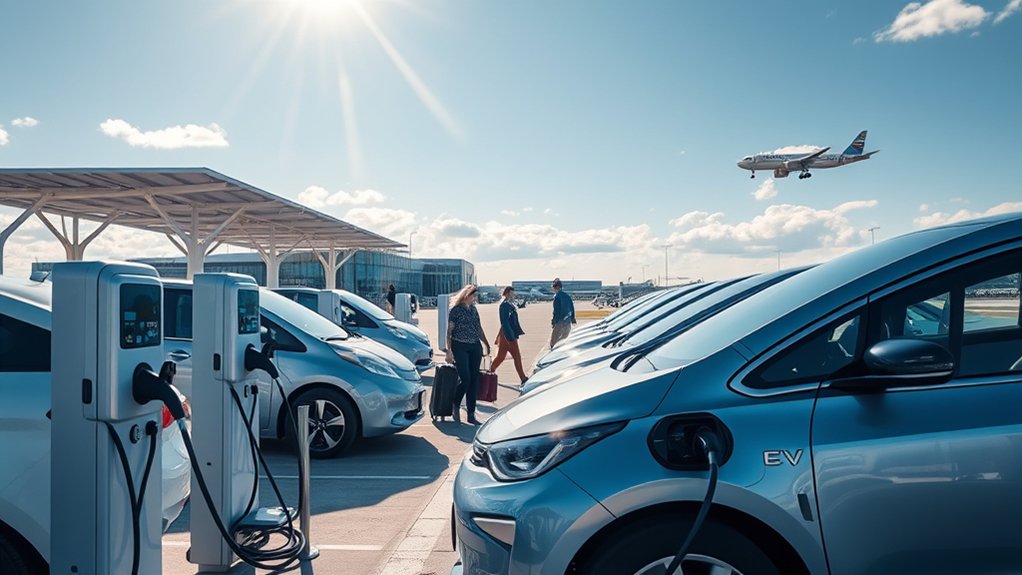
Airport EV charging revenue can come from several places: charging fees, parking fees, idle fees, rental-car contracts, ride-hail charging agreements, employee charging plans, fleet operating savings, and grant funding. The mistake is treating every charger like a stand-alone gas pump. At an airport, the charger often supports a larger parking or ground-transportation system.
For a traveler in long-term parking, a Level 2 charger may deliver enough energy while the car sits for several hours or days. For a ride-hail driver, rental-car operator, or airport shuttle fleet, slow charging may not work. Those users may need DC fast charging, scheduled depot charging, or dedicated fleet charging areas away from passenger garages.
At airports, the strongest EV charging business case often comes from parking value, fleet operations, tenant needs, and emissions compliance, not from per-kWh charging fees alone.
Airport operators should track more than charger revenue. Useful metrics include parking occupancy, average charging session length, charger uptime, cost per installed port, energy cost, demand charges, driver complaints, fleet fuel savings, and whether EV drivers choose that airport because charging is available.
Traveler Charging vs. Airport Fleet Charging
Airport EV charging usually serves two very different groups. Public chargers serve passengers, visitors, ride-hail drivers, and sometimes nearby residents. Fleet chargers serve airport-owned vehicles, shuttles, maintenance vehicles, rental-car companies, taxis, delivery vehicles, and ground-service partners.
Public charging should be easy to find, clearly priced, and compatible with common vehicles. Fleet charging should be predictable, scheduled, and tied to daily route needs. Mixing both groups at the same chargers can create congestion, especially when a rental-car fleet or ride-hail drivers need fast turnaround during peak travel hours.
Note: If you are an EV traveler, always check the airport’s parking page or a live charging app before departure. Airport chargers may be inside paid garages, limited to certain parking products, or temporarily unavailable due to construction.
Analyzing Infrastructure Costs for EV Charging
The visible charger is only one part of the cost. Airports often need electrical panels, conduit, trenching, switchgear, transformers, utility service upgrades, pavement repair, bollards, signs, networking equipment, payment systems, lighting, and accessibility improvements.
Infrastructure Investment Requirements
A small Level 2 installation in an existing garage may be simple if spare electrical capacity already exists nearby. A large DC fast-charging hub can be much more complex because it may require new utility service, transformer upgrades, civil construction, demand-charge planning, and coordination with airport parking operations.
Before ordering chargers, airports should run a load study. The study should estimate present demand, future EV adoption, rental-car electrification, employee charging needs, shuttle schedules, and ride-hail charging demand. The result should guide the number of ports, charger power levels, electrical capacity, and phasing plan.
Utility Interconnection Challenges
Utility coordination should start early. Large charging projects may require a service study, transformer review, design approval, easements, trenching, switchgear lead times, metering changes, and construction scheduling. Depending on the site, those steps can take months or several years.
Managed charging can reduce strain on the system. Instead of letting every vehicle charge at full power at the same time, the airport can use software to limit peak demand, prioritize vehicles that need to leave soon, and shift some charging to lower-cost hours.
Cost Breakdown Analysis
Airport EV charging budgets should include both construction and long-term operating costs. Important line items include:
- Charger hardware and mounting equipment
- Electrical design, permits, utility studies, and inspections
- Panels, switchgear, conduit, trenching, transformers, and meters
- Networking, payment processing, software, and cybersecurity controls
- Accessibility, signs, striping, lighting, and protective bollards
- Maintenance contracts, warranty coverage, replacement parts, and uptime monitoring
- Electricity rates, demand charges, and possible energy-management software
Pro Tip: Build “make-ready” capacity during garage, rental-car, and employee-lot projects. Installing conduit and electrical pathways during construction is usually cheaper than cutting into finished pavement later.
Which Chargers Work Best at Airports?
The right charger depends on dwell time. A traveler parked for three days does not need the same charger as a ride-hail driver who needs to return to service in 30 minutes.
At a Glance
| Best for Long-Term Parking | Level 2 charging, because vehicles sit for many hours or days. |
| Best for Ride-Hail and Rental Cars | DC fast charging or dedicated fleet charging, because vehicles need faster turnaround. |
| Best for Employee Lots | Shared Level 2 charging with workplace rules, time limits, and access control. |
| Biggest Planning Risk | Underestimating electrical upgrades, utility timelines, charger maintenance, and peak-demand costs. |
Level 1 and Level 2 Chargers
Level 1 charging is slow and usually fits only limited fleet or employee use. Level 2 charging is the most practical option for long-term parking, employee lots, and some rental-car staging. It is cheaper than DC fast charging and can work well when the vehicle will sit for several hours.
DC Fast Chargers
DC fast chargers are better for short dwell times. They can support ride-hail drivers, taxis, rental-car turnaround, and public charging near airport entrances. They also require more electrical capacity, more heat management, stronger maintenance support, and better traffic flow than Level 2 chargers.
Fleet and Depot Charging
Airport shuttles, maintenance vehicles, and buses may need depot charging that follows a route schedule. The airport should model when each vehicle returns, how long it can sit, and how much energy it needs for the next shift. This avoids buying more charger power than the fleet actually needs.
Fleet Electrification Mandates for Airports
Airports face growing pressure to reduce ground-transportation emissions. This pressure can come from state rules, city climate plans, airport sustainability goals, concession contracts, rental-car partners, ride-hail policies, and public expectations.
Regulatory Requirements Overview
California is an important example because its Clean Miles Standard applies to transportation network companies operating in the state. The rule sets annual greenhouse gas and electric vehicle miles traveled targets for ride-hailing services, with the final regulation order listing electric vehicle miles traveled targets that reach 90% for 2030 and later years.
This does not mean every airport vehicle must follow that exact target. It does mean airports with heavy ride-hail demand may see more pressure for fast, reliable charging near terminals, staging areas, or nearby commercial hubs.
Benefits of Electrification Initiatives
Airport electrification can reduce tailpipe emissions around terminals, improve the passenger experience, support rental-car and ride-hail partners, and help airports meet climate or clean-air goals. It can also reduce fuel and maintenance costs for certain airport-owned vehicles when routes and charging schedules are well matched.
The benefits are strongest when the airport uses data. Count vehicle trips, dwell times, daily mileage, peak parking periods, charger failures, and energy costs. Then expand charging where the data shows real demand.
How to Navigate Legal and Funding Challenges in Airport Electrification
Airport electrification projects often depend on public funding, utility programs, concession agreements, and long-term capital plans. That means legal and funding risk matters. Federal EV charging programs, including the National Electric Vehicle Infrastructure program, have faced policy changes and litigation, so airports should verify current FHWA and state DOT guidance before relying on reimbursement.
Warning: Do not base an airport charging budget on a grant headline alone. Confirm eligibility, match requirements, reimbursement timing, Buy America or domestic-content rules, utility readiness, and whether the funding is currently open in your state.
Useful funding and planning sources may include the FHWA NEVI program, Charging and Fueling Infrastructure grants, state energy-office programs, utility make-ready incentives, local clean-air grants, and private partnerships with charging networks, rental-car companies, or fleet operators.
Essential Steps for Successful EV Charging Implementation at Airports
A successful airport EV charging project starts with planning, not hardware. Use a phased approach so the first installation solves today’s demand while leaving room for future expansion.
- Map use cases. Separate passenger parking, employee charging, rental-car charging, ride-hail charging, taxi charging, shuttle charging, and airport fleet charging.
- Study dwell time. Match charger speed to how long each user group normally parks.
- Check electrical capacity. Review panels, feeders, transformers, meters, and utility service before choosing charger counts.
- Plan make-ready work. Install conduit, switchgear space, spare capacity, and network pathways for future chargers.
- Choose a pricing policy. Decide whether to charge by kWh, time, session, parking product, or tenant agreement, depending on state rules and the charger network.
- Set parking rules. Use clear signs for EV-only spaces, active-charging-only spaces, time limits, idle fees, and enforcement.
- Require uptime reporting. Track charger availability, failed sessions, payment problems, repair times, and customer complaints.
- Build in accessibility. Include accessible routes, usable charging spaces, proper reach ranges, lighting, and clear signs.
- Secure the network. Treat connected chargers as networked devices that need software updates, access control, data privacy, and vendor accountability.
- Review performance before expanding. Add ports where utilization, wait times, and customer demand support the investment.
What Travelers Should Know Before Using Airport EV Chargers
If you plan to charge while parked at the airport, check four things before you leave home: charger location, connector type, parking access, and fees. Some airport chargers are inside paid garages or premium lots. Others may be in economy lots, employee areas, rental-car zones, or nearby third-party charging hubs.
Do not assume you can stay plugged in for an entire trip without extra charges. Some locations add idle fees after charging stops. Others restrict charging spaces to active charging only. If you will be gone for several days, a Level 2 charger may be enough, but you should still check the airport’s parking rules.
For the best experience, arrive with enough battery to reach an off-airport backup charger. Airport chargers can be full, blocked, down for maintenance, or inaccessible if a garage is closed or full.
Future Trends: Airport Charging Hubs, Fleet Depots, and Managed Charging
The next wave of airport EV charging will likely focus on larger charging hubs, rental-car electrification, ride-hail fast charging, employee charging, and smarter energy management. Some airports may also pair chargers with solar canopies, battery storage, or demand-response programs to reduce peak costs.
Managed charging will become more important as airports add more ports. Instead of building for the worst possible peak, airports can use software to schedule energy, protect critical loads, and prioritize vehicles based on departure time or fleet duty cycle.
Airports should also watch connector changes, especially the rollout of NACS-equipped vehicles and adapters. A good procurement plan should support current vehicles while avoiding equipment that becomes difficult to use or maintain within a few years.
Frequently Asked Questions
Can you trust airport charging stations?
You can trust many airport charging stations, but you should still check live status, connector type, pricing, and recent user reports before relying on one. The best airport charging locations show clear fees, accept simple payment, have good lighting, display support information, and are monitored for uptime.
What is the 80/20 rule for EV charging?
For many EV owners, the 80/20 rule means most charging happens at home, work, or another regular location, while a smaller share happens at public chargers. Airports should still provide charging because travelers, renters, ride-hail drivers, employees, and fleet operators may not have easy home charging during airport trips.
Can I leave my EV plugged in at the airport?
Usually yes, if the airport allows it and you are parked in a valid EV charging space. Check the rules first. Some airports or charging networks charge idle fees after your battery is full, limit how long you can use a charger, or require you to move once charging is complete.
Do I have to take my EV charging cable out at TSA?
A standard EV charging cable usually does not need to be removed from your bag unless a TSA officer asks. Portable lithium-ion power banks are different. They should travel in carry-on baggage, not checked luggage, and airlines may limit capacity or require them to stay visible during use.
Are airport EV chargers free?
Some airport chargers are free, but many charge by kWh, time, session, or parking product. You may also pay the normal airport parking fee. Always check the charger screen, app, or airport parking page before starting a session.
Where should airports install EV chargers first?
The best first locations are usually high-use long-term parking, employee lots, rental-car facilities, shuttle depots, and ride-hail staging areas. Airports should choose sites based on dwell time, utility capacity, user demand, construction cost, and traffic flow.
Conclusion
EV charging at airports can improve passenger service, support fleet electrification, and help reduce ground-transportation emissions. It also requires careful planning because electrical upgrades, utility timelines, charger maintenance, payment rules, and parking operations can shape the real cost. Start with a demand study, match charger speed to dwell time, coordinate early with the utility, and expand in phases. When airports treat charging as part of the full ground-transportation system, the investment is far more likely to work for travelers, fleets, tenants, and the airport’s long-term budget.
Sources
- California Air Resources Board — Clean Miles Standard — backs the ride-hail emissions and zero-emission miles context.
- CARB Final Regulation Order for Clean Miles Standard — backs the 2030+ 90% electric vehicle miles traveled target for covered TNCs.
- California Legislative Information — SB 1014 — backs the statutory basis for California’s Clean Miles Standard and Incentive Program.
- Federal Highway Administration — NEVI Program — supports federal EV charging infrastructure funding context.
- U.S. Department of Energy Alternative Fuels Data Center Station Locator — helps travelers and planners verify public charging locations and connector types.
- FAA PackSafe — Lithium Batteries — supports the safety distinction between EV charging cables and lithium-ion power banks during air travel.