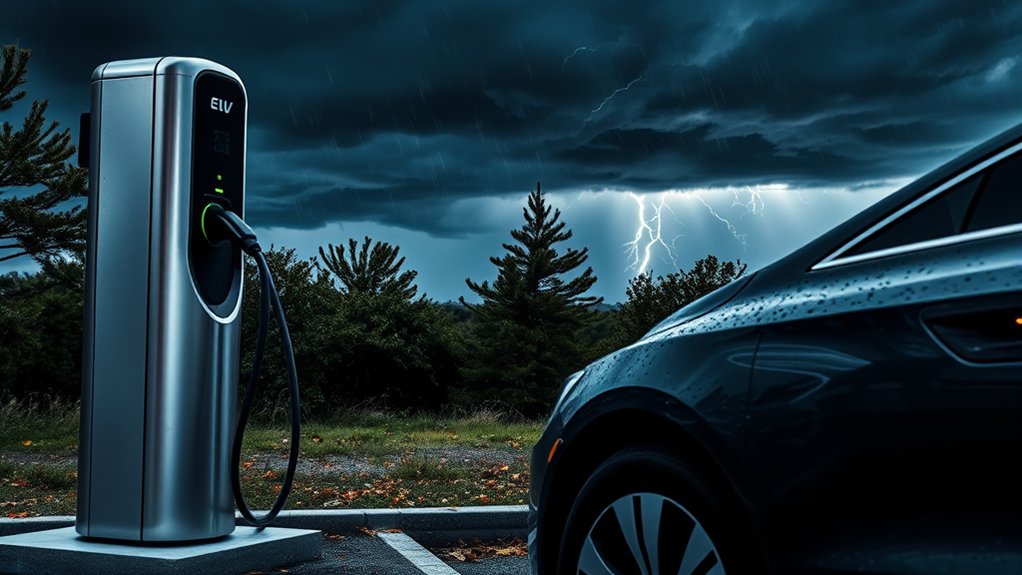
EV hurricane preparedness starts before the first outer rain band arrives. Charge early, choose a safe parking spot, plan more than one charging route, and know whether your specific vehicle can power devices or your home. A well-prepared electric vehicle can help with evacuation, communication, food storage, and medical-device support, but only when you use approved charging and backup-power equipment safely.
Quick Answer
Before a hurricane, charge your EV to 80–100% within 24–48 hours, park on high ground, save offline maps, check charging stations before leaving, and unplug home charging equipment if flooding is possible. After flood exposure, do not drive or charge the EV until it is inspected by a qualified professional.
Key Takeaways
- Charge earlier than you think. Public chargers and home power can both become unavailable as a storm approaches.
- Use 80% for normal daily battery care, but 90–100% can be useful before evacuation or expected outages.
- V2L and V2H backup power only work on compatible EVs with approved equipment. Never improvise a home connection.
- Saltwater or flood exposure is serious. Do not drive, charge, or garage a flooded EV until it has been inspected.
- Plan at least two inland charging options and check station status before you travel.
At a Glance
| Time Required | Start 48 hours before landfall if possible; final charging and app checks should be done 24 hours before evacuation. |
| Difficulty | Easy to moderate, depending on whether you only need charging or also plan to use backup-power equipment. |
| Tools Needed | EV charging cable, charging apps, offline maps, flashlight, emergency kit, tire inflator, extension cord only for approved V2L use, and owner’s manual. |
| Cost | Usually the cost of electricity only. V2H or whole-home backup systems require professional equipment and installation. |
The Importance of Charging Your EV Before a Storm
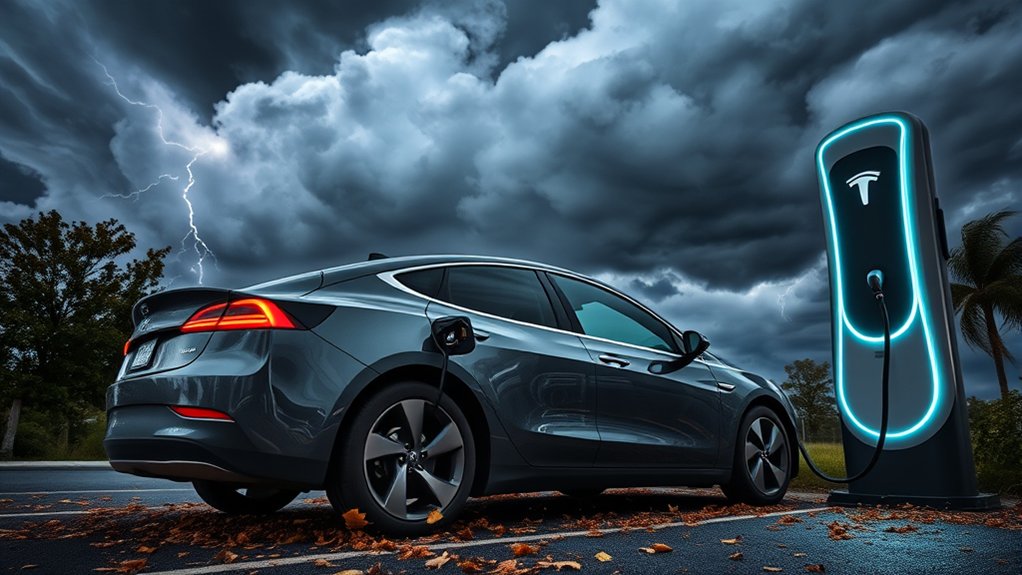
When a hurricane approaches, charging your electric vehicle becomes part of your emergency plan. A higher state of charge gives you more evacuation range, more flexibility if traffic slows, and more reserve power if your vehicle supports device or home backup features.
For everyday driving, many EV owners limit charging to about 80% to reduce battery stress. Before a hurricane, it is reasonable to raise that target to 90–100% if you may need to evacuate, lose power, or run essential devices. Set the higher charge limit early, because Level 1 and Level 2 charging can take hours, and public DC fast chargers may become crowded or unavailable.
A charged EV is not just transportation during hurricane season. On compatible models, it can also become a limited emergency power source for selected essential loads.
Charging equipment and battery size vary by vehicle. The U.S. Department of Energy’s Alternative Fuels Data Center explains that EV charging time depends on battery capacity, state of charge, vehicle limits, and charging equipment. That is why the safest plan is to charge before demand spikes, then keep the vehicle parked safely until you need it.
Understanding EV Power Capabilities for Emergency Use
Some EVs can power small devices, and a smaller number can support home backup loads. These features are useful during outages, but they are not automatic on every EV. Always check your owner’s manual and use only manufacturer-approved equipment.
Check Your EV Battery Size and State of Charge
Many modern battery-electric vehicles store tens of kilowatt-hours of energy, and some larger EVs store 100 kWh or more. Smaller EVs, older models, and plug-in hybrids can have much less usable battery capacity. Battery age, outside temperature, terrain, speed, and climate control also affect real-world range.
Before hurricane season, write down three numbers for your vehicle:
- Your normal range at 80% charge.
- Your estimated evacuation range at 90–100% charge.
- Your vehicle’s approved export-power limit, if it has V2L, V2H, or similar backup-power features.
EV Power Output Options
EV backup power usually falls into three practical categories:
- Vehicle-to-load (V2L): Lets a compatible EV power small devices or appliances through built-in outlets or an approved adapter. This may be enough for a phone, fan, light, laptop, medical device, or refrigerator, depending on the vehicle’s wattage limit.
- Vehicle-to-home (V2H): Lets a compatible EV support selected home circuits through approved bidirectional equipment and professional installation.
- Home backup systems: Some vehicles and chargers can support a critical-load panel or larger home backup setup. For example, Tesla Powershare lists home backup capability for compatible Cybertruck equipment, but the exact result depends on the installation and home energy use.
Note: V2L and V2H numbers are not universal. A small V2L outlet may run a refrigerator, but it may not run a well pump, central air conditioner, or whole-home panel. Check the wattage of each device before plugging it in.
Backup Power Features Explained
Backup power is most helpful when you use it for essential loads instead of trying to run everything in the house. Start with refrigeration, medical equipment, phones, lights, a fan, and internet equipment if service is available. Avoid high-draw appliances unless your vehicle and installed equipment are rated for them.
If you plan to use an EV for home backup, test the setup before hurricane season. Confirm where the backup switch, transfer equipment, or critical-load panel is located. Label the circuits it supports, and make sure everyone in the home knows which devices can be used safely.
Charging Equipment Requirements
Safe charging and safe backup power require the correct equipment. A standard Level 1 cord can be useful when you have time, while Level 2 home charging is much faster. Public DC fast charging can add range quickly, but availability may change during evacuations and power outages.
Warning: Never backfeed your home by plugging an EV, generator, inverter, or extension cord into a household outlet. Improvised connections can injure utility workers, damage your vehicle, and create fire or shock hazards. Use only approved transfer equipment installed by a qualified electrician.
Essential Steps for Preparing Your EV for Hurricane Evacuations
Preparing your EV for a hurricane is easier when you follow a short checklist instead of waiting until warnings become urgent.
- Charge early. Begin charging 24–48 hours before expected landfall. If evacuation is possible, raise the charge limit toward 90–100%.
- Choose the right vehicle. If your household has more than one car, charge the vehicle with the longest range and best cargo space first.
- Update apps and maps. Update your EV navigation, charging apps, and offline maps while your home internet still works.
- Pack charging gear. Bring your mobile connector, adapter set, and any manufacturer-approved V2L adapter.
- Park safely. Move the EV to higher ground, away from storm surge, low garages, large trees, and flood-prone streets.
- Protect the charger. If flooding is possible, unplug the EV and shut off power to vulnerable outdoor charging circuits before water reaches the area.
- Plan your first stop. Know where you will charge inland, not just where chargers appear near the coast.
Do not rely on a single charger. Storm traffic, station outages, long lines, closed roads, and app delays can all change your route. Build your plan around options.
Developing an Effective Charging Strategy
A good charging strategy answers three questions: where you will charge, when you will charge, and how you will confirm the station is working before you arrive.
Prioritize Charging Locations
Start by finding chargers along inland evacuation corridors. Coastal chargers may be more likely to face flooding, power outages, road closures, and heavy demand. If you live in Florida, the FPL EVolution network and app can help locate public stations and check availability. For broader planning, also use your vehicle’s navigation, the DOE station locator, and other charging apps you trust.
- Save at least two fast-charging stops along your route.
- Save one backup Level 2 option near your destination.
- Check whether the station is open to all EVs or limited to a specific network.
- Look for stations near restrooms, food, shelters, hotels, or safe parking.
- Download the route for offline use before the storm affects cell service.
Off-Peak Charging Times
Charge during off-peak hours when possible, especially late at night or early in the morning. This can reduce pressure on the grid and may lower your electricity cost if your utility offers time-of-use rates. More importantly, it helps you avoid the last-minute rush as evacuation orders become more likely.
If you have a home Level 2 charger, schedule charging to finish several hours before you expect to leave. If you use Level 1 charging, start earlier because it adds range slowly.
Monitor Charging Availability
Charging apps are helpful, but they are not perfect during emergencies. Check station status before you leave, again before you commit to a highway exit, and once more if traffic has delayed you. A charger that looked available two hours earlier may be full, offline, blocked, or affected by a power outage.
Pro Tip: Save chargers from more than one network. During evacuation traffic, a slower working charger is better than a fast charger you cannot reach or use.
How to Stay Safe Using Your EV During Floods
Floodwater changes the safety rules for every vehicle, including EVs. Never drive through standing water. You cannot see the road surface, the water may be deeper than it looks, and water intrusion can damage high-voltage components, brakes, bearings, and electronics.
Saltwater exposure deserves extra caution. Saltwater can leave conductive residue and increase the risk of electrical faults even after the water drains away. If your EV has been submerged or exposed to floodwater, do not charge it, drive it, or park it inside a garage until it has been inspected.
Warning: If an EV is flooded, keep people away from it and contact emergency services, the manufacturer, your insurer, or a qualified EV technician. If it is safe and practical, keep the vehicle away from structures, other vehicles, and combustible materials until it is evaluated.
Before flooding reaches your property, unplug the EV and shut off power to vulnerable charging equipment if you can do so safely. Do not touch chargers, cords, outlets, or breaker panels while standing in water.
Smart Evacuation Tactics for EV Owners
EV evacuation planning is about range management. A calm driving style can stretch your battery and reduce charging stops.
- Leave earlier than gas-only traffic peaks. EV chargers may be less crowded before evacuation traffic builds.
- Use eco mode. It can soften acceleration and reduce energy use.
- Drive at steady speeds. High speed drains EV batteries faster than moderate highway driving.
- Precondition while plugged in. Cool the cabin before departure if your home still has power.
- Limit heavy climate-control use. Use seat ventilation, recirculation, and moderate temperature settings when safe.
- Avoid arriving empty. Try to reach each charging stop with a reserve instead of pushing the battery to a very low state of charge.
- Keep charging sessions efficient. During emergencies, charge enough to reach safety, then move your vehicle so others can use the charger.
EV Hurricane Preparedness: Key Considerations for Post-Storm Charging
After the hurricane, do not rush to plug in. First, inspect the vehicle and the charging area. Look for flood lines, debris, damaged cords, burned smells, corrosion, warning lights, or water inside the cabin. If the EV or charger may have been exposed to water, stop and call a professional.
Your home charger may not work if your home has lost power, if the panel was damaged, or if the charger was exposed to water. Public chargers may also be offline, blocked, or inaccessible because of road closures. Check charger status before traveling, and avoid unnecessary charging if emergency crews are still clearing roads.
When public charging is limited, follow basic charging etiquette. Charge only to the level you need to reach your next safe stop, move the vehicle when charging is complete, and avoid using a fast charger as a parking space.
Troubleshooting Common EV Hurricane Problems
| Problem | What to Do |
| Home power is out | Use public chargers only after confirming they are operating. If your EV supports backup power, run only approved loads through approved equipment. |
| Charging station shows available but is blocked | Use your backup charger plan. Do not wait until the battery is critically low before looking for alternatives. |
| EV was exposed to floodwater | Do not drive or charge it. Keep it away from structures if safe, then contact a qualified EV technician, insurer, or manufacturer. |
| Range is dropping faster than expected | Slow down, use eco mode, reduce climate-control load, remove roof cargo if possible, and route to the nearest reliable charger. |
Tips for Used EV Buyers Considering Hurricane Resilience
If you are buying a used EV in a hurricane-prone region, look beyond mileage and paint condition. Flood damage can affect connectors, modules, carpets, seat tracks, charging hardware, and high-voltage components.
- Check the title and history report. Look for flood, salvage, insurance-loss, or branded-title activity.
- Use free VIN tools. The NICB VINCheck tool can help identify some theft and salvage records, but it is not a complete substitute for inspection.
- Ask for service records. Look for battery, charging-port, water-intrusion, or electrical repairs after major storms.
- Inspect for moisture signs. Watch for musty odors, damp carpet, corrosion under seats, silt in hidden areas, fogged lights, or mismatched interior parts.
- Get a battery diagnostic. Ask a dealer or qualified EV shop to check battery health, charging faults, and stored diagnostic trouble codes.
- Inspect the charging port. Corrosion, bent pins, cracked covers, or warning lights can make emergency charging unreliable.
A clean report does not guarantee a flood-free vehicle. If the deal seems unusually cheap after a hurricane, slow down and pay for a proper inspection.
Frequently Asked Questions
Should I charge my EV during a storm?
Avoid charging during active severe weather, flooding, or lightning risk. The safer plan is to charge before the storm arrives, then unplug if flooding or power surges are possible. Never handle charging equipment while standing in water.
What is the 80/20 rule for EV charging?
The 80/20 rule usually means keeping the battery between about 20% and 80% for normal daily use. Before a hurricane, you may temporarily charge above 80% so you have more evacuation range and reserve power.
What drains EV batteries the most during evacuation?
High speeds, hard acceleration, heavy climate-control use, roof cargo, hills, rain, and traffic delays can all reduce range. Drive smoothly, use eco mode, and keep a reserve instead of planning to arrive nearly empty.
What should I do before driving to a public charger?
Check the charger’s live status in your EV navigation or charging app before you leave. Confirm that the station is operating, accessible, compatible with your connector, and not in a flood-prone area.
Can I power my house with my EV after a hurricane?
Only if your EV supports home backup and your home has approved bidirectional charging or transfer equipment. Many EVs cannot power a home panel. Never connect an EV to household wiring through an improvised cord or outlet.
What should I do if my EV was exposed to saltwater?
Do not drive or charge it. Keep people away from the vehicle, move it away from structures only if it is safe to do so, and contact emergency services, the manufacturer, your insurer, or a qualified EV technician for inspection.
Conclusion
EV hurricane preparedness comes down to four habits: charge early, park high, plan backup charging routes, and treat flood exposure seriously. A charged EV can give you range, communication, and limited emergency power, but only when the vehicle, charger, and backup equipment are used correctly. Prepare before the storm, avoid flooded roads and chargers, and get professional help before using any EV that may have been submerged.
Sources
- U.S. Department of Energy Alternative Fuels Data Center — EV charging levels, charging time factors, and station-planning basics.
- FPL EVolution Public Charging — Florida charging network information and app-based charger availability guidance.
- Tesla Powershare — Example of compatible EV home-backup capability and required equipment.
- Associated Press: EVs and saltwater flooding — Hurricane-related EV flood and battery-fire safety concerns.
- National Insurance Crime Bureau VINCheck — Used-vehicle title, salvage, and due-diligence resource.