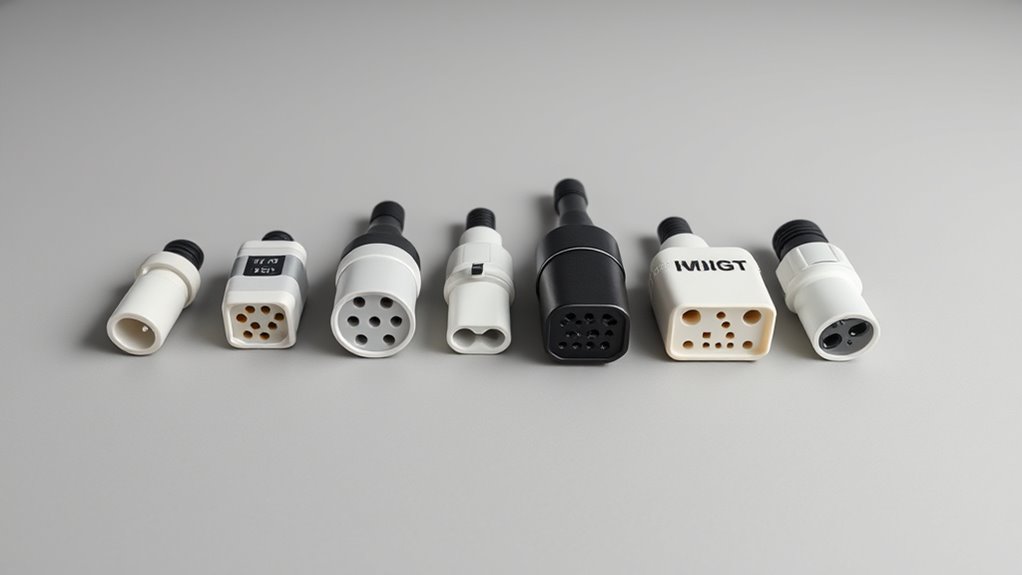
EV charging plug types can look confusing at first, but the choice usually comes down to three things: your vehicle’s charge port, the type of power the station provides, and the region where you drive. Once you know the difference between AC plugs, DC fast-charging plugs, and adapters, it becomes much easier to avoid the wrong station and pick the fastest compatible option.
Quick Answer
The main EV charging plug types are SAE J1772 for North American AC charging, Type 2 for European AC charging, CCS for DC fast charging, NACS/J3400 for Tesla-origin AC and DC charging, CHAdeMO for many older Japanese EVs, and GB/T for China. Match the plug to your vehicle inlet, region, and charging speed.
Key Takeaways
- J1772 and Type 2 are mainly AC charging plugs for daily home, workplace, and public Level 2 charging.
- CCS, NACS/J3400, CHAdeMO, and GB/T are used for DC fast charging, though some also support AC charging through the same inlet.
- Charging speed is not set by the plug alone. The station rating, battery voltage, state of charge, temperature, cable, and vehicle limit all matter.
- Adapters can help during the NACS transition, but you should only use adapters approved by your vehicle maker or charging network.
EV Charging Plug Types Explained
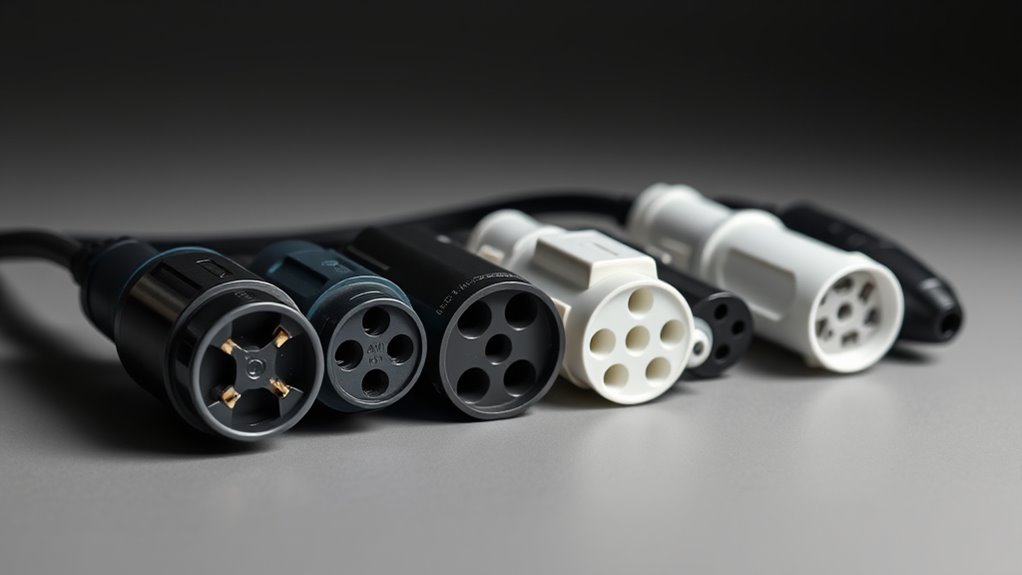
EV charging connectors define how your vehicle receives power from the station. The most important split is AC charging versus DC fast charging.
With AC charging, the station sends alternating current to the vehicle, and the car’s onboard charger converts it to DC for the battery. This is the normal setup for home charging, workplace charging, and most public Level 2 charging. The U.S. Department of Energy’s Alternative Fuels Data Center lists J1772 as the common Level 1 and Level 2 connector and notes that Level 2 units can range from 2.9 to 19.2 kW.
With DC fast charging, the station converts power before it reaches the vehicle and sends DC directly to the battery system. That is why DC fast charging can add range much faster on road trips, but it also depends heavily on the vehicle’s maximum DC charge rate and battery condition.
You’ll see SAE J1772, also called Type 1, on most non-Tesla plug-in vehicles in North America for AC charging. Type 2, often called Mennekes, is the common AC plug across Europe and supports single-phase or three-phase charging. CCS adds two DC pins to either a Type 1 or Type 2 layout, creating CCS1 in North America and CCS2 in Europe and many other markets.
NACS, now standardized through SAE J3400, is the Tesla-origin connector used for both AC and DC charging in North America. Tesla says the North American Charging System offers AC charging and high-power DC capability in a compact connector, while many existing Supercharger sites have commonly delivered up to 250 kW depending on the charger generation and vehicle.
CHAdeMO is a DC fast-charging system used by many older Japanese EVs, especially earlier Nissan Leaf models. GB/T is China’s charging standard family and has separate AC and DC versions. In short, plug choice is not just about shape. It is about region, power type, vehicle compatibility, and the network you can actually use.
EV Charging Plug Types Comparison Chart
| Plug Type | Main Region | Power Type | Best Use | What to Know |
| SAE J1772 / Type 1 | North America, Japan | AC | Home, workplace, and public Level 1 or Level 2 charging | Common on non-Tesla EVs and plug-in hybrids in North America. Level 2 power commonly depends on the circuit and onboard charger. |
| Type 2 / Mennekes | Europe and many global markets outside North America | AC | Daily AC charging, especially three-phase public charging | Often seen at 11 kW or 22 kW in everyday use, though some Type 2 AC setups can support higher outputs. |
| CCS1 / CCS2 | CCS1 in North America; CCS2 in Europe and many other markets | AC through the upper section; DC through added lower pins | Public DC fast charging and road trips | Many public fast chargers are 50 kW to 350 kW, with some newer DC equipment rated higher. Your vehicle may accept less than the station can deliver. |
| NACS / SAE J3400 | North America | AC and DC | Tesla charging, newer North American EVs, and growing public fast-charging access | Originally Tesla’s connector, now standardized as SAE J3400. Adapter support depends on automaker approval and network access. |
| CHAdeMO | Japan; legacy use in North America and Europe | DC | Older Nissan Leaf and some Japanese-market EVs | The standard supports high-power versions, but many real-world CHAdeMO vehicles and stations are much lower power. |
| GB/T | China | AC and DC versions | EVs built for China’s charging network | Older GB/T DC figures are often quoted around 237.5 kW, while newer revisions and ChaoJi development push much higher theoretical power. |
EV Charging Plug Types by Region
Connector choice shifts by market, so the plug you need depends heavily on where you charge. A car that fits perfectly into a European charging routine may need a different inlet or adapter in North America, China, or Japan.
In North America, you’ll commonly see J1772 for AC charging on non-Tesla EVs and plug-in hybrids. CCS1 has been the main non-Tesla DC fast-charging plug, while NACS/J3400 is becoming more important as automakers add native ports or approved adapters for Tesla Supercharger access.
In Europe, Type 2 is the common AC connector, and CCS2 is the standard fast-charging connector at most public DC stations. Tesla vehicles sold in Europe commonly use CCS2 rather than the North American NACS connector.
In Japan, CHAdeMO still matters for many older EVs and domestic charging sites, but CCS and NACS/J3400 are more relevant in other regions. If you drive an older Nissan Leaf, you should confirm CHAdeMO availability before planning a long trip.
In China, GB/T is the key standard family for AC and DC charging. China’s charging network is large, but the connector standard is not the same as the plugs used by most North American or European vehicles.
Note: A plug adapter may solve the physical fit, but it does not automatically unlock every charging network, payment system, voltage range, or fast-charging protocol. Always check your vehicle manual, charging app, and adapter approval before relying on one.
J1772, Type 2, and NACS
J1772, Type 2, and NACS/J3400 are the plugs you are most likely to think about for everyday charging. They are smaller and easier to handle than many DC fast-charging connectors because daily charging usually does not require the same current as highway fast charging.
You’ll use J1772 in North America for Level 1 and Level 2 AC charging. It works with a 120-volt Level 1 cord or a 208- to 240-volt Level 2 station. It is common on non-Tesla EVs and plug-in hybrids, and Tesla vehicles can often use J1772 Level 2 stations with the correct adapter.
Type 2 is common across Europe because it supports single-phase and three-phase AC charging. In everyday public charging, you will often see 11 kW or 22 kW Type 2 stations, although real speed still depends on the vehicle’s onboard charger.
NACS, now known in standards language as SAE J3400, is different because the same compact connector handles AC and DC charging. That means a vehicle with a NACS/J3400 inlet can use one physical port for home charging and compatible fast charging, as long as the charger, vehicle, and network support the session.
The biggest current change is the North American transition. Many non-Tesla EVs built with CCS1 ports can use Tesla Superchargers only with an approved adapter and software support. Newer EVs are increasingly expected to arrive with native NACS/J3400 ports, but older CCS vehicles will remain on the road for years.
CCS, CHAdeMO, and GB/T
Power standards shape fast charging, and CCS, CHAdeMO, and GB/T define three major DC fast-charging paths. These connectors matter most when you need to recover range quickly on a highway stop.
CCS stands for Combined Charging System. It combines the AC connector area with two larger DC pins below it. In North America, CCS1 builds on the J1772 shape. In Europe, CCS2 builds on the Type 2 shape. That design lets one vehicle inlet handle AC charging and DC fast charging without a second separate fast-charge port.
CHAdeMO is a dedicated DC fast-charging connector. It was important for early Japanese EVs and still supports bidirectional charging in some setups, but it has lost ground in many markets. If your EV has CHAdeMO, station availability can be more limited, especially in areas where newer public stations focus on CCS or NACS/J3400.
GB/T serves China’s EV market. It includes AC and DC connector standards that differ from North American and European plugs. Older GB/T DC discussions often cite 237.5 kW, but newer high-power revisions and ChaoJi development are pushing far higher theoretical power. In real use, the vehicle and station still decide the speed.
A 350 kW or 500 kW charger does not guarantee your EV will charge at that speed. The vehicle’s battery voltage, charge curve, temperature, and state of charge can lower the actual power.
How to Choose the Right Charging Plug
To choose the right charging plug, start with your vehicle’s charge port. Look at your owner’s manual, the label near the inlet, or your vehicle’s charging app. Then match that inlet to the station connector and the type of charging you need.
- For overnight home charging: focus on AC compatibility. In North America, that usually means J1772 or NACS/J3400. In Europe, it usually means Type 2.
- For road trips: focus on DC fast-charging access. Your vehicle may use CCS1, CCS2, NACS/J3400, CHAdeMO, or GB/T depending on region and model.
- For plug-in hybrids: many PHEVs only support AC charging, so a DC fast-charging plug may not matter.
- For used EVs: check connector type before buying. Older CHAdeMO vehicles may need more route planning than newer CCS or NACS/J3400 models.
- For adapters: confirm that the adapter is approved for your exact vehicle and charging network.
Warning: Do not use a cracked, wet, overheated, recalled, uncertified, or loose-fitting adapter or connector. Never stack adapters unless the vehicle maker and charging network clearly allow it.
You’ll get the best results when your connector choice aligns with vehicle specs, daily range needs, local infrastructure, and public fast-charging access. The right plug saves time, but the right charging plan saves frustration.
Common Mistakes When Comparing EV Plugs
The first mistake is treating the plug as the only speed limit. A charger may be rated for high power, but your car may accept much less, especially when the battery is cold, nearly full, or built on a lower-voltage architecture.
The second mistake is assuming all stations with the same connector work the same way. Payment app requirements, network membership, broken hardware, cable length, parking layout, and charger sharing can all affect the session.
The third mistake is buying an adapter without checking approval. Some adapters are meant only for AC charging. Others are designed for DC fast charging. They are not interchangeable, and using the wrong one can stop the session or create a safety risk.
Pro Tip: Before a long drive, filter your charging app by connector type, charging speed, network access, and recent check-ins. A compatible plug is only useful if the charger is available and working.
Frequently Asked Questions
Which plug types support vehicle-to-grid functionality?
The plug alone does not guarantee vehicle-to-grid support. You need a vehicle, charger, software platform, utility program, and local rules that allow bidirectional power flow. CHAdeMO has long supported some V2G setups, while newer CCS and NACS/J3400 systems may support bidirectional features when the vehicle and charger use compatible communication standards.
Are adapters safe for everyday EV charging use?
Adapters can be safe when they are rated for the charging type, approved for your vehicle, and used exactly as directed. Do not use cheap unknown adapters, damaged adapters, wet connectors, or adapters that feel loose. Also check whether the adapter is for AC charging, DC fast charging, or both.
How often do connector standards change globally?
Physical connector standards change slowly because vehicles and charging stations stay in service for many years. The bigger changes usually happen in waves, such as the North American move toward NACS/J3400, Europe’s use of Type 2 and CCS2, and China’s GB/T updates. Adapters often bridge the transition period.
Do weather conditions affect EV plug performance?
Yes. Rain, snow, ice, road salt, dust, and extreme heat can affect connector handling and charging reliability. Modern EV connectors are designed for outdoor use, but you should keep the plug off the ground, avoid forcing an iced connector, and stop charging if you notice melting, burning smells, or a loose connection.
Can home chargers use multiple connector types?
Yes, but most home chargers are sold with one connector type, such as J1772, NACS/J3400, or Type 2 depending on region. Some owners use an approved adapter for a second vehicle. If you share one charger between different EVs, make sure the connector, circuit size, amperage setting, and adapter are safe for both vehicles.
Is NACS the same as SAE J3400?
NACS was Tesla’s North American Charging System name for its compact AC/DC connector. SAE J3400 is the standardized version of that connector system. In everyday shopping and charging apps, you may still see both names used, but J3400 is the standards-based name to look for as adoption grows.
Does a faster plug always mean faster charging?
No. Charging speed is limited by the lowest-capable part of the system. A high-power connector and station cannot override your vehicle’s battery limit, charge curve, voltage platform, battery temperature, or current state of charge. Fast charging is usually quickest from a low to mid battery percentage, then slows as the battery fills.
Conclusion
You can now compare the main EV charging plug types by region, power type, and compatibility. J1772 and Type 2 cover most daily AC charging, while CCS, NACS/J3400, CHAdeMO, and GB/T shape the fast-charging experience. Before you plug in, check your vehicle inlet, station connector, adapter approval, and charging app. That simple check helps you charge faster, avoid dead-end stations, and plan trips with more confidence.
Sources
- U.S. Department of Energy Alternative Fuels Data Center: Electric Vehicle Charging Stations — charging levels, J1772, CCS, CHAdeMO, J3400/NACS, and DC fast-charging guidance.
- Tesla: Opening the North American Charging System — NACS background, AC/DC support, and SAE J3400 update.
- SAE International: J3400 Recommended Practice — standards reference for the North American Charging System connector.
- CHAdeMO Association — official organization for CHAdeMO fast-charging standards and development.
- European Union Regulation 2023/1804 on alternative fuels infrastructure — European public charging infrastructure framework.