
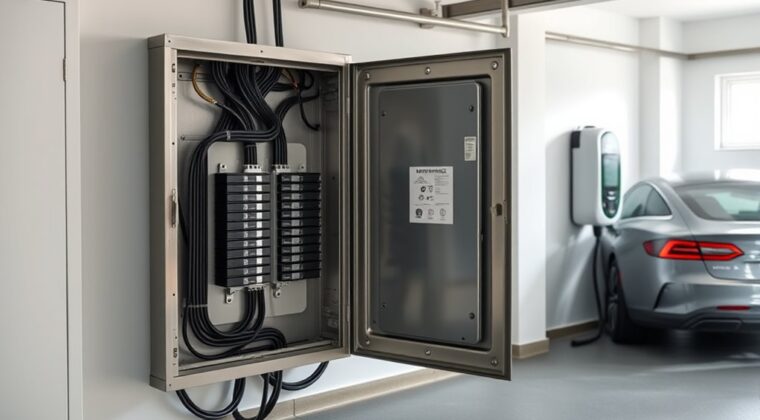
You need an electrical panel that can support the EV charger’s continuous load plus the rest of your home’s demand. For many homes, a 200 amp service gives the cleanest path for a Level 2 charger. A 100 amp panel may still work with a lower-output charger, smart load management, or careful load scheduling, but only after a proper load calculation. A 60 amp panel usually cannot support a standard Level 2 charger without major limits or an upgrade.
Quick Answer
Most homes need either a 200 amp panel or a verified 100 amp panel with spare load capacity for Level 2 EV charging. A licensed electrician should run a load calculation, check breaker space, size the circuit for continuous load, and confirm local permit rules before installation.
Key Takeaways
- A 200 amp panel is the easiest fit for most Level 2 EV charger installs, especially in homes with electric HVAC, dryers, ranges, or future electrification plans.
- A 100 amp panel may work, but usually only with a lower-output charger, smart load management, or enough spare capacity after a load calculation.
- EV charging is treated as a continuous load, so the breaker and wiring must be sized above the charger’s output current.
- A full panel does not always mean a service upgrade, but tandem breakers and subpanels do not create more service capacity by themselves.
At a Glance
| Time Required | 30 to 90 minutes for a basic electrical assessment; several hours to a full day or more for installation, depending on wiring distance, permits, and panel work. |
| Difficulty | High. Panel work, breaker sizing, conductor sizing, permits, and inspection should be handled by a licensed electrician. |
| Tools Needed | Load calculation, panel schedule, charger specifications, permit requirements, correctly sized breaker, conductors, raceway, and safety-certified EV charging equipment. |
| Cost | Varies widely. A short dedicated circuit costs less than a long wiring run, smart load management, subpanel work, or a full service upgrade. |
Warning: Do not guess on EV charger breaker size or panel capacity. EV charger installation can require permits, inspection, load calculations, and code-compliant wiring. Hire a licensed electrician or have one verify the design before the charger is energized.
What Size Panel Do You Need for EV Charging?
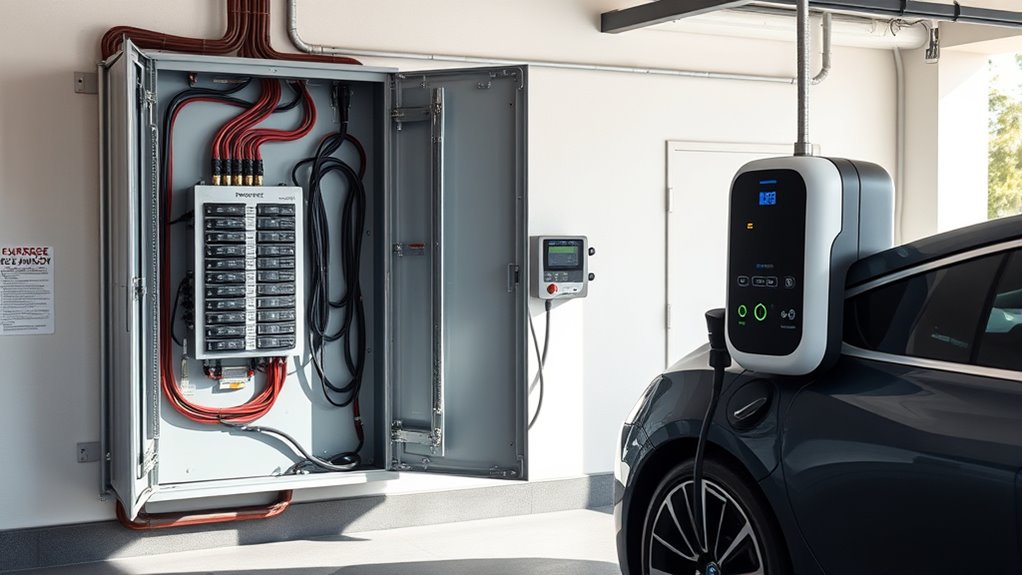
For most Level 2 EV charger installs, a 200 amp electrical panel is the most flexible choice. It usually leaves room for the charger, HVAC, laundry, kitchen appliances, lighting, and future electrical upgrades.
A 100 amp panel can sometimes support a Level 2 charger, but not automatically. It depends on your existing loads, the charger output setting, the panel’s condition, breaker space, local code, and whether you use load management.
A 60 amp panel is usually too limited for a standard Level 2 charger. It may support Level 1 charging or a very low-amperage Level 2 setup only if a licensed electrician confirms the load calculation and local code approval.
The panel size alone does not decide the answer. The real question is how much spare capacity remains after the home’s existing loads and the charger’s continuous load are counted.
The U.S. Department of Energy’s Alternative Fuels Data Center notes that electricians can tell homeowners whether their home has enough electrical capacity for vehicle charging. It also explains that EV charging infrastructure is considered a continuous load under the National Electrical Code.
How Do EV Charger Amps Affect Your Panel?
EV charger amperage affects both charging speed and panel demand. A higher-output charger can refill the battery faster, but it also needs a larger breaker, larger conductors, and more available service capacity.
Level 2 charging uses 240 volt service in typical residential installations. The DOE AFDC charging equipment guide says Level 2 equipment can range from 2.9 to 19.2 kW, and many residential Level 2 chargers operate at up to 30 amps on a dedicated 40 amp circuit.
| EVSE Output | Typical Minimum Circuit | Approx. Power at 240 V | Panel Impact |
| 16 amps | 20 amp circuit | 3.8 kW | Often the easiest Level 2 option for tight panels. |
| 24 amps | 30 amp circuit | 5.8 kW | Useful compromise for some 100 amp panels. |
| 32 amps | 40 amp circuit | 7.7 kW | Common home Level 2 setup, but still needs load capacity. |
| 40 amps | 50 amp circuit | 9.6 kW | May be too much for many 100 amp panels without load management. |
| 48 amps | 60 amp circuit | 11.5 kW | Best suited to panels with strong spare capacity, often 200 amps. |
| 80 amps | 100 amp circuit | 19.2 kW | High-output Level 2 charging that usually requires large service capacity. |
The key rule is simple: the circuit is usually larger than the charger’s output because EV charging runs for hours. For example, a 32 amp EVSE commonly uses a 40 amp circuit, and a 40 amp EVSE commonly uses a 50 amp circuit.
Note: Connector type does not decide panel size. J1772, J3400/NACS, and adapters affect plug compatibility, but the electrical panel is sized around voltage, output amperage, continuous load, breaker size, and the home’s available capacity.
Can a 100 Amp Panel Handle EV Charging?
Yes, a 100 amp panel can sometimes handle EV charging, but the charger output may need to be limited. A 100 amp service that already supports electric heat, central air, electric cooking, electric drying, or a hot tub may not have enough spare capacity for a full-size Level 2 charger.
A 100 amp panel is more likely to work when:
- The home has gas heat, gas cooking, or fewer large electric appliances.
- The EV charger is set to 16, 24, or 32 amps instead of 40 or 48 amps.
- A smart load management device reduces charger output when the home is using heavy loads.
- The electrician’s load calculation shows enough remaining service capacity.
- The panel has safe physical breaker space and is in good condition.
You should not assume that “100 amps” means you can add any 40 or 50 amp EV circuit. The electrician needs to compare the panel rating, existing loads, calculated demand, charger output, and local code requirements.
Pro Tip: If your 100 amp panel is tight, ask about a charger with adjustable amperage. A 24 amp or 32 amp setting may still provide useful overnight charging while reducing the chance that you need a full service upgrade.
When Does a 200 Amp Panel Make Sense?
A 200 amp panel makes sense when you want Level 2 charging without constantly working around other household loads. It also gives you more room for future electrical upgrades.
Choose or plan for 200 amp service when your home has several large loads, such as:
- Electric range or wall oven
- Electric dryer
- Central air conditioning
- Heat pump or electric resistance heat
- Electric water heater
- Hot tub, pool equipment, or workshop tools
- Solar, battery storage, or a second EV charger
Heavy Appliance Homes
A home with multiple heavy electric appliances can push a 100 amp service close to its practical limit. Adding a Level 2 charger on top of those loads may cause nuisance trips, overheating concerns, or a failed inspection if the load calculation does not pass.
A 200 amp panel gives the electrician more room to add a dedicated EV circuit while keeping the rest of the home usable during charging.
Level 2 Headroom
Headroom matters because EV charging often runs for many hours. A 40 amp or 48 amp charger output can be convenient, but it places a large continuous load on the electrical system.
With a 200 amp panel, you are less likely to choose between charging speed and normal home use. You may still need a load calculation, permit, correctly sized conductors, and inspection, but the service is more likely to support the added circuit.
Future Electrical Upgrades
A 200 amp panel also helps if you plan to add a heat pump, induction range, electric water heater, solar battery, workshop circuit, or second EV. Upgrading once can be less disruptive than adding small fixes one at a time.
The DOE AFDC procurement and installation guidance notes that installation costs vary based on wiring, site conditions, required electrical upgrades, labor, permitting, and other project details. That is why planning for future loads early can save rework later.
How Do Electricians Check EV Load?
Electricians check EV load by comparing the home’s electrical service rating with the calculated demand from existing loads and the proposed charger. They do not just look for an empty breaker slot.
Load Calculation Basics
A proper load calculation usually includes:
- The main service size, such as 60, 100, 150, or 200 amps.
- General lighting and receptacle loads.
- Fixed appliances, such as range, dryer, water heater, dishwasher, disposal, and HVAC.
- Heating and cooling demand.
- The EV charger’s continuous load.
- Any demand factors allowed by the applicable electrical code.
- Future loads you plan to add soon.
The electrician then confirms whether the existing service can support the new charger, whether the charger output should be reduced, or whether a load management system or service upgrade is needed.
Panel Capacity Check
The panel capacity check is separate from the load calculation. It focuses on the actual hardware. The electrician checks for:
- Available breaker spaces
- Whether tandem breakers are allowed by the panel label
- Panel age and condition
- Signs of overheating, corrosion, or water intrusion
- Correct grounding and bonding
- Safe routing distance from the panel to the charger
- Indoor or outdoor charger location requirements
- Permit and inspection requirements
The Seattle Department of Construction and Inspections EV charger permit tip recommends evaluating your electrical service before installing charging equipment and notes that electrical permits are required for EV charger installations in that jurisdiction.
What Are the Best Workarounds for a Full Panel?
A full panel does not always mean you need a full service upgrade. The right workaround depends on whether your problem is breaker space, load capacity, or both.
- Smart load management: An EV energy management system can reduce or pause charging when the home is using too much power. This can help some 100 amp services support Level 2 charging safely.
- Adjustable charger output: Many chargers can be set to a lower output, such as 16, 24, or 32 amps, if the panel cannot support a larger circuit.
- Listed circuit-sharing devices: Some installations use an approved load-sharing device for compatible loads, such as an EV charger and dryer, so both do not draw full power at the same time.
- Tandem breakers: Tandem breakers can free spaces only if the panel label allows them. They do not increase total service capacity.
- Subpanel: A subpanel can add breaker spaces, but it does not increase the main service size. It helps only when the main service and feeder can support the added load.
- Service upgrade: If the load calculation fails or the panel is old, damaged, overloaded, or too small, upgrading the service may be the safest long-term fix.
Note: Empty breaker slots do not prove that your home can support an EV charger. A panel can have open spaces and still fail the load calculation.
Should You Hardwire or Use a Plug-In EV Charger?
Both options can work, but the choice affects cost, code requirements, charging output, and future flexibility.
A hardwired charger is often preferred for higher-output Level 2 charging, outdoor installations, and cleaner long-term setups. It can reduce receptacle wear and may allow higher current depending on the charger and local code.
A plug-in charger can be easier to replace or take with you, but the outlet, breaker, wiring, enclosure, and GFCI requirements must still match the charger and local code. A common plug does not make the installation casual or DIY-safe.
Whichever style you choose, use safety-certified equipment. ENERGY STAR warns that not all EV chargers sold online or in stores are safety certified, and says ENERGY STAR certified chargers are tested by a nationally recognized testing laboratory.
Frequently Asked Questions
What size electrical panel do I need for an EV charger?
Many homes use a 200 amp panel for the easiest Level 2 EV charger installation. A 100 amp panel can sometimes work with a lower-output charger or load management, but only after a load calculation. A 60 amp panel is usually too small for standard Level 2 charging.
Do I need a 200 amp panel for an EV charger?
Not always. You may not need a 200 amp panel if your 100 amp service has enough spare capacity, your charger output is limited, or a smart load management device is approved. You are more likely to need 200 amps if your home has several large electric appliances or you want faster Level 2 charging.
Can a 100 amp service handle a Level 2 EV charger?
Yes, in some homes. A 100 amp service is more likely to handle Level 2 charging when the charger is set to 16, 24, or 32 amps and the home has modest existing electrical loads. A licensed electrician must confirm this with a load calculation.
Is 100 amp service enough for a 1500 sq ft house with an EV?
It depends more on appliances than square footage. A 1500 sq ft house with gas heat and gas cooking may have enough capacity for a limited Level 2 charger. The same size home with electric heat, electric cooking, central air, and an electric dryer may need load management or a service upgrade.
What is the 80/20 rule for EV charging?
For EV charger circuits, the common 80% idea means a continuous load should not exceed 80% of a standard breaker rating. That is why a 32 amp EVSE commonly uses a 40 amp circuit, and a 40 amp EVSE commonly uses a 50 amp circuit. It is not a substitute for a full service load calculation.
Will adding a subpanel let me install an EV charger?
A subpanel can add breaker spaces, but it does not increase the home’s main service capacity. It helps only when the main panel, feeder, and service have enough capacity for the EV charger load.
Conclusion
If you’re sizing a home panel for an EV charger, focus on available service capacity, not just the panel label or the charger’s advertised amps. A 200 amp panel is the most flexible option for many Level 2 installs. A 100 amp panel can work in the right home, especially with a lower charger setting or smart load management. A 60 amp panel usually needs an upgrade or a very limited charging setup.
Before buying the charger, have an electrician run a load calculation, check breaker space, verify the panel condition, confirm permit rules, and match the charger output to the circuit. That one step can prevent nuisance trips, failed inspections, overheated wiring, and an expensive redo.
Sources
- U.S. DOE Alternative Fuels Data Center: Electric Vehicle Charging Stations — supports Level 1, Level 2, DC fast charging, Level 2 voltage, amperage, and power ranges.
- U.S. DOE Alternative Fuels Data Center: Charging Electric Vehicles at Home — supports home charging options, electrician capacity checks, and NEC continuous-load guidance.
- ENERGY STAR: Electric Vehicle Chargers — supports safety-certified charger guidance, Level 1 vs Level 2 buying guidance, and smart charger features.
- Seattle Department of Construction and Inspections: EV Charger Permit Tip — supports service-capacity checks, permit requirements, and licensed-contractor guidance.
- U.S. DOE Alternative Fuels Data Center: Procurement and Installation for EV Charging Infrastructure — supports installation planning, cost variability, utility coordination, permitting, and future expansion planning.