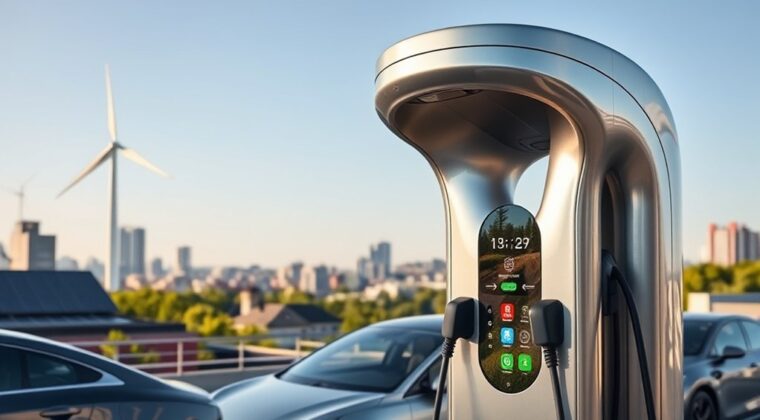
Most EV charging stations are powered by the local electricity grid, the same broad power system that supplies homes, businesses, and streetlights. The electricity may come from natural gas, coal, nuclear, wind, solar, hydropower, or other sources, depending on the region and time of day. Some charging sites also add on-site solar panels, battery storage, or renewable energy contracts, but the grid is still the main power source for most public and home charging.
Quick Answer
EV charging stations usually get power from the local electric grid. The station then safely delivers that electricity to your vehicle as AC power for Level 1 or Level 2 charging, or as DC power for fast charging. Solar, wind, and battery storage can support charging, but they do not power every station directly.
Key Takeaways
- Most EV charging stations draw electricity from the local grid, so the power mix depends on your area.
- Level 1 and Level 2 charging use AC power, while DC fast charging sends DC power directly to the battery.
- Renewable energy may come from the grid, on-site solar, battery storage, or renewable energy contracts.
- Charging speed depends on charger power, vehicle limits, battery temperature, and state of charge.
- The cleanest way to understand local charging emissions is to check your regional electricity mix.
What Is an EV Charging Station and How Does It Function?
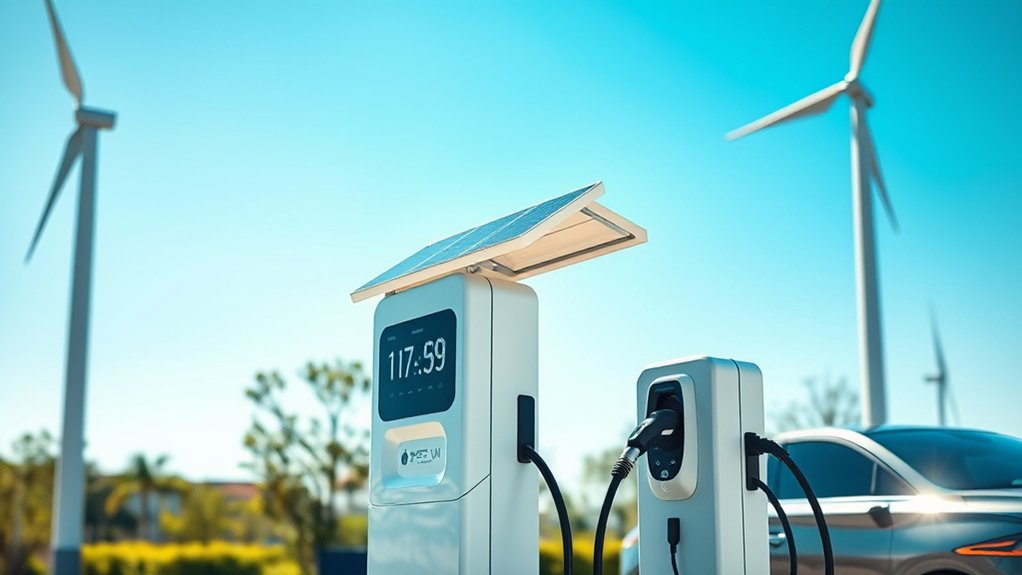
An EV charging station, also called Electric Vehicle Supply Equipment (EVSE), is the connection point between an electricity source and your electric vehicle. It does more than pass power through a cable. It communicates with the vehicle, checks that the connection is safe, limits current when needed, and stops or reduces charging if the vehicle or station detects a problem.
The power path depends on the type of charger:
- AC charging: Level 1 and Level 2 equipment supply alternating current (AC). Your vehicle’s onboard charger converts that AC into direct current (DC), because the battery stores energy as DC.
- DC fast charging: The charging station converts grid AC into DC inside the charging equipment, then sends DC power directly to the battery. This bypasses much of the vehicle’s onboard AC charger and allows much faster charging.
Modern stations also handle user authentication, payment, network communication, safety checks, and charging-session data. A networked charger may use an app, RFID card, credit card reader, or plug-and-charge system to start the session.
Warning: Do not use a charging cable, connector, adapter, or outlet that looks burned, cracked, loose, wet, or damaged. High-power charging equipment should be installed and serviced by qualified electrical professionals.
Where Do EV Charging Stations Get Their Power?
EV charging stations usually get power from the local electric grid. In the United States, that grid power comes from a mix of sources. According to the U.S. Energy Information Administration, 2025 U.S. utility-scale electricity generation came mainly from natural gas, renewables, nuclear, and coal.
| Power source | How it relates to EV charging |
|---|---|
| Grid electricity | The main source for most home, workplace, and public charging stations. |
| On-site solar | Can offset some charging demand, especially when paired with battery storage, but it may not cover all station use. |
| Battery storage | Stores grid or renewable electricity, helps reduce peak demand charges, and can support high-power charging. |
| Renewable energy contracts | A site may buy renewable energy or renewable credits even when the physical electrons come through the grid. |
| Backup generators | Used at some sites for resilience, but they are not the normal power source for most EV charging. |
The exact environmental impact of charging depends on your local grid. The U.S. Environmental Protection Agency’s eGRID database tracks emissions, generation, resource mix, and other attributes for U.S. electric power. That matters because an EV charged in a region with more wind, solar, hydro, or nuclear power will usually have lower charging-related emissions than an EV charged in a region that relies more heavily on fossil fuels.
Understanding the Different Levels of EV Charging
EV charging is commonly grouped into Level 1, Level 2, and DC fast charging. Many drivers call DC fast charging “Level 3,” but “DC fast charging” is the clearer term because formal standards distinguish AC and DC charging in more detail.
| Charging type | Typical power | Typical use | Approximate speed |
|---|---|---|---|
| Level 1 AC | 120 volts, about 1.9 kW | Home outlet charging and low daily mileage | About 5 miles of range per hour |
| Level 2 AC | 208-240 volts, about 2.9-19.2 kW | Home, workplace, hotel, retail, and public charging | About 25 miles of range per hour |
| DC fast charging | Often 50-350 kW, with some installed equipment up to 500 kW | Highway corridors, travel stops, fleets, and quick public top-ups | About 100-200+ miles in 30 minutes, depending on vehicle and conditions |
The U.S. Department of Energy’s Alternative Fuels Data Center notes that charging time varies by battery size, state of charge, charger output, vehicle limits, and other conditions. That is why two vehicles plugged into the same station may charge at different speeds.
Level 1 Charging
Level 1 charging uses a standard 120-volt AC outlet. It is slow, but it can work well for drivers who travel short distances each day or leave the vehicle parked overnight. It is not ideal for heavy daily driving unless the vehicle has plenty of parked time.
Level 2 Charging
Level 2 charging uses 208-volt or 240-volt AC service. It is the most common practical choice for home charging and is also widely used at workplaces, apartments, hotels, shopping centers, and public parking lots. For many EV owners, Level 2 charging is fast enough to refill daily driving needs overnight.
DC Fast Charging
DC fast charging is designed for quick stops, road trips, commercial fleets, and public charging locations where drivers do not want to wait for hours. It requires more electrical infrastructure than Level 1 or Level 2 charging, and charging speed usually slows as the battery gets closer to full.
Pro Tip: For road trips, look at both the charger’s rated kW and your EV’s maximum DC charging rate. A 350 kW charger will not make a vehicle charge at 350 kW if the vehicle cannot accept that much power.
How AC and DC Charging Differ in Power Delivery
The biggest difference between AC and DC charging is where the AC-to-DC conversion happens.
AC Charging Advantages
With AC charging, the charging station supplies AC power and the vehicle’s onboard charger converts it to DC for the battery. This approach is slower than DC fast charging, but it is less expensive to install, easier to use at home, and gentle enough for long parked sessions.
AC charging is best for:
- Overnight charging at home
- Workplace charging during the day
- Apartment and condo charging
- Hotels and long-stay parking
- Drivers who do not need a quick road-trip refill
DC Charging Benefits
With DC fast charging, the station does the AC-to-DC conversion and sends DC power directly to the battery. This allows much faster charging, but it requires larger electrical service, more cooling, more expensive hardware, and stronger grid planning.
DC fast charging is best for:
- Highway travel stops
- Fast public charging in cities
- Commercial fleet depots
- Ride-share and delivery vehicles
- Drivers who need a quick top-up away from home
Why Charging Speed Slows Down During a Session
EV charging does not stay at peak speed from empty to full. Most EVs charge fastest when the battery is warm and at a lower or middle state of charge. Charging often slows above roughly 70-80% to protect the battery and manage heat.
Charging speed can be affected by:
- Battery state of charge: A lower battery usually accepts power faster than a nearly full battery.
- Battery temperature: Very cold or very hot batteries may charge more slowly.
- Vehicle charge limit: Each EV has its own maximum AC and DC charging rate.
- Station power: A low-power station cannot deliver more than its rated output.
- Shared power: Some stations split available power between multiple vehicles.
- Grid or site limits: A site may reduce power during peak demand or equipment constraints.
Key Technologies in EV Charging Stations
EV charging stations combine electrical hardware, safety controls, software, payment systems, and network communication. The most important technologies include:
- Connectors and cables: The connector must match the vehicle inlet or an approved adapter. Common connector families include J1772, CCS, CHAdeMO, and SAE J3400/NACS, depending on the vehicle and region.
- Charging controller: The controller manages communication between the vehicle and charger so power flows safely.
- Power electronics: DC fast chargers use large power-conversion equipment to turn grid AC into DC for the battery.
- Thermal management: High-power chargers may use air or liquid cooling to manage heat.
- Networking software: Networked stations can report status, handle payments, manage pricing, and send maintenance alerts.
- Smart charging: A site can shift or limit charging based on grid demand, electricity prices, or available renewable energy.
Open communication standards also matter. The Open Charge Point Protocol is used between charging stations and charging management systems to support interoperability, smart charging, security features, and newer functions such as bidirectional energy flow support.
How Renewable Energy Powers EV Charging
Renewable energy can power EV charging in several ways, but not every station with “green” branding is directly powered by solar panels above the charger. The clean energy may come through the grid, from on-site generation, from stored energy, or from renewable energy purchasing.
| Renewable setup | How it works | What to know |
|---|---|---|
| Grid renewable energy | The station uses grid electricity, and part of the local grid mix comes from wind, solar, hydro, geothermal, biomass, or other sources. | The cleaner the local grid, the cleaner the charging session tends to be. |
| On-site solar canopy | Solar panels generate electricity at the charging site. | Solar can offset station use, but high-power chargers often need more power than panels alone can provide at all times. |
| Battery storage | A battery stores electricity from solar or the grid, then releases it when vehicles charge. | Storage can reduce peak demand and help a site support faster chargers. |
| Renewable energy purchases | The operator buys renewable electricity, renewable energy certificates, or a power purchase agreement. | This supports renewable generation, but the physical power still flows through the grid. |
Note: Charging during a sunny or windy period does not guarantee that your exact electrons came from solar or wind. Grid electricity is mixed, so the best practical measure is the regional power mix and the station operator’s energy-sourcing policy.
User Authentication and Payment in Charging Stations
Public charging stations need a way to identify the user, start the charging session, and calculate the bill. Depending on the network and location, you may see several access and payment options.
- Mobile apps: Many networks let you start charging through an account-based app.
- RFID cards: Some stations use a membership card or key fob.
- Credit or debit cards: More public stations now support card readers or contactless payment.
- QR codes: Some stations let you scan a code and pay through a web page.
- Plug and charge: Compatible vehicles and chargers can authenticate automatically after the cable is connected.
Pricing can also vary. A station may bill by kilowatt-hour (kWh), by minute, by session, through a subscription plan, through an idle fee after charging ends, or through a separate parking fee. In the European Union, Regulation (EU) 2023/1804, applicable since April 13, 2024, includes requirements related to payment options, price transparency, user information, non-discriminatory practices, and smart recharging for publicly available alternative fuel infrastructure.
Smart Charging, Grid Management, and V2G
Smart charging helps charging stations use electricity more efficiently. Instead of every vehicle charging at full power the moment it plugs in, a smart system can adjust charging based on electricity price, site demand, transformer capacity, grid conditions, or renewable energy availability.
Common smart-charging uses include:
- Load balancing: Distributing available power across several chargers.
- Time-of-use charging: Charging more when electricity is cheaper or cleaner.
- Demand response: Reducing charging power during grid stress or expensive peak periods.
- Fleet scheduling: Prioritizing vehicles that need to leave first.
- Vehicle-to-grid: Allowing compatible EVs to send stored energy back to a building or grid when supported by the vehicle, charger, utility program, and local rules.
Vehicle-to-grid, often shortened to V2G, is promising but not universal. It requires compatible hardware, software, utility approval, and a business case that makes sense for the driver or fleet.
Future Innovations in EV Charging
EV charging technology is still changing quickly. The biggest improvements are focused on speed, reliability, grid integration, and easier payment.
The next stage of EV charging is not only about faster chargers. It is also about smarter sites that balance vehicles, batteries, solar power, and local grid limits.
Important developments include:
- Megawatt Charging System: MCS is being developed for medium- and heavy-duty electric vehicles, with DC charging capability up to 3.75 MW.
- Better charger reliability: Operators are improving uptime monitoring, remote diagnostics, and repair response.
- Wireless charging: Inductive charging can transfer electricity without a plug, though it is still more common in pilots, fleets, or specialty applications than everyday public charging.
- Battery-buffered charging: A station battery can help provide fast charging even where grid capacity is limited.
- More open standards: Communication standards can reduce vendor lock-in and make charging networks easier to manage.
- Better payment access: More stations are moving toward easier card, app, roaming, or automatic authentication.
Why Knowing Charging Station Power Sources Matters
Knowing where EV charging power comes from helps you make better choices about cost, convenience, and environmental impact. It also explains why two charging sessions can have different carbon footprints even if the vehicle is the same.
- Environmental impact: Charging from a cleaner regional grid usually means lower charging-related emissions.
- Cost: Electricity prices, demand charges, idle fees, and parking fees can change the real cost of a session.
- Charging speed: A site with stronger electrical infrastructure can support higher-power charging.
- Reliability: Stations with good grid planning, monitoring, and maintenance are more likely to work when you arrive.
- Policy and planning: Cities, utilities, and businesses need to understand power demand before installing large charging hubs.
For most drivers, the practical takeaway is simple: use Level 2 charging when you can park for a while, use DC fast charging when you need speed, and check your local electricity mix if emissions are a major part of your EV decision.
Frequently Asked Questions
How do EV charging stations get their power?
Most EV charging stations get power from the local electric grid. Some sites also use solar panels, battery storage, renewable energy contracts, or backup power systems, but grid electricity remains the main source for most home and public charging.
Are EV charging stations powered by solar panels?
Some are partly powered by on-site solar, but most stations are connected to the grid. Solar panels can offset part of the energy used, especially with battery storage, but high-power charging often needs more electricity than a small solar canopy can provide at all times.
What drains an EV battery the most?
High speeds, hard acceleration, heating and air conditioning, cold weather, heavy loads, underinflated tires, and steep terrain can reduce EV range. Battery age and poor charging habits can also affect available range over time.
What kind of charger does the Hyundai Kona Electric use?
It depends on the market and model year. In North America, many Kona Electric models use J1772 for AC charging and CCS1 for DC fast charging. In Europe and many other regions, Type 2 is common for AC charging and CCS Combo 2 is common for DC fast charging. Always check the charge port and owner’s manual for your exact vehicle.
Is EV charging actually cheaper than gas?
Often, yes, especially when charging at home during lower-cost electricity periods. Public DC fast charging can cost much more than home charging, so the answer depends on local electricity rates, gasoline prices, vehicle efficiency, charging fees, and how often you use fast chargers.
Does DC fast charging use dirtier electricity than Level 2 charging?
Not automatically. The emissions depend mostly on the electricity source, not the plug type. However, DC fast charging draws more power at once, so station operators may use battery storage, demand management, or grid upgrades to reduce stress on the local electrical system.
Conclusion
EV charging stations are powered mainly by the electric grid, but the full answer includes much more than plugging into a power line. The station must manage AC or DC power delivery, vehicle communication, safety checks, billing, and sometimes smart charging. Renewable energy can lower the footprint of EV charging, especially when the local grid is cleaner or when a site uses solar, battery storage, or renewable energy purchasing. For drivers, the best approach is to match the charger to the need: Level 1 for slow backup charging, Level 2 for everyday use, and DC fast charging for quick stops and long trips.
Sources
- U.S. Department of Energy Alternative Fuels Data Center — charging levels, AC Level 1, AC Level 2, DC fast charging, connector terminology, MCS, and inductive charging.
- U.S. Energy Information Administration — U.S. electricity generation sources and 2025 grid mix.
- U.S. Environmental Protection Agency: Electric Vehicle Myths — EV emissions, grid-related charging emissions, and energy-efficiency context.
- U.S. Environmental Protection Agency eGRID — regional electric power emissions, generation, and resource-mix data.
- Open Charge Alliance — OCPP, smart charging, interoperability, and OCPP 2.1 updates.
- European Commission: Alternative Fuels Infrastructure — Regulation (EU) 2023/1804, payment options, price transparency, and smart recharging provisions.