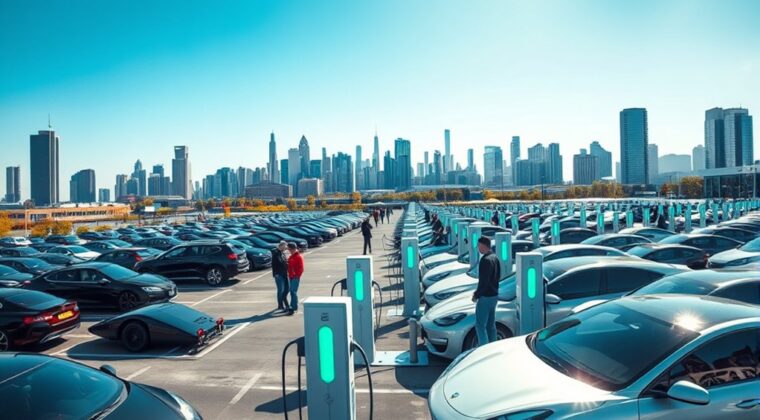
As of September 8, 2026, the U.S. Department of Energy’s Alternative Fuels Data Center lists 81,506 available public EV charging station locations and 255,443 public charging ports in the United States. A station location is a physical site, while a charging port can charge one vehicle at a time. AFDC’s broader total, which also includes private non-residential charging, listed 86,916 available locations and 284,621 ports as of September 7, 2026. Residential home charging is not included.
Last updated: September 8, 2026. Unless a section says otherwise, the counts below refer to available public charging infrastructure in DOE AFDC data.
Quick Answer
As of September 8, 2026, the U.S. had 81,506 available public EV charging station locations and 255,443 public charging ports listed by the DOE Alternative Fuels Data Center. California leads by a wide margin, followed by New York, Massachusetts, Florida, and Texas by public station locations.
Key Takeaways
- The U.S. has 81,506 available public EV charging station locations and 255,443 public charging ports in DOE AFDC data.
- California has the largest public network, with 19,802 station locations and 66,678 ports.
- AFDC lists 179,340 public Level 2 ports and 75,392 public DC fast ports.
- The five leading states contain about 46.7% of all listed public U.S. EV charging station locations.
- Station counts change often, so use live network or charging-app data before a long drive.
How Many Public EV Charging Stations Are in the U.S. Right Now?
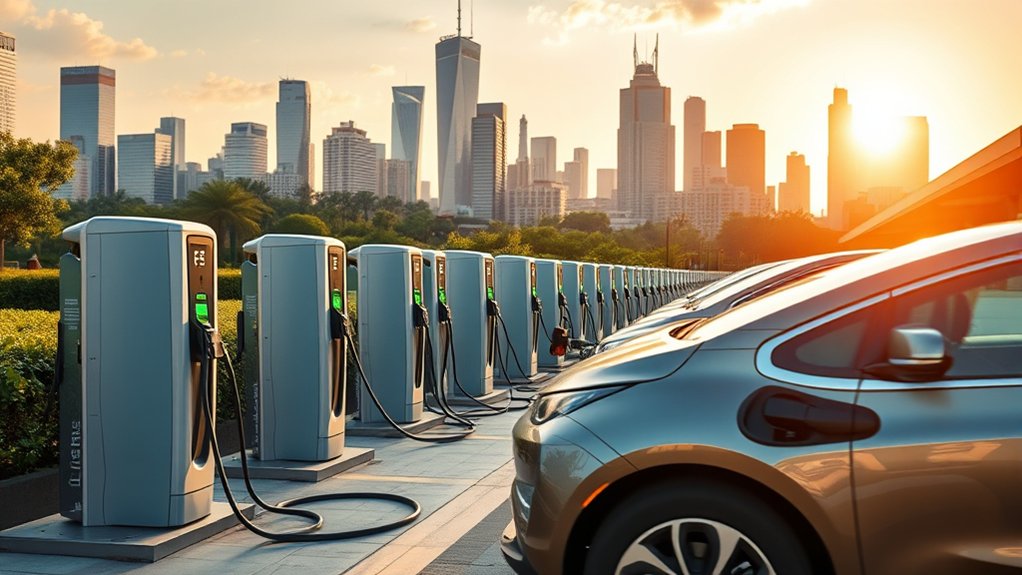
The latest available-public DOE AFDC count shows 81,506 EV charging station locations and 255,443 charging ports across the United States. These two numbers measure different parts of the same network:
- Station location: the physical place where charging is available, such as a parking lot, hotel, workplace, highway stop, or shopping center.
- Charging port: the equipment position that can charge one vehicle at a time.
- Connector: the plug that goes into the vehicle. One port may have more than one connector, but it normally charges only one vehicle at a time.
The clearest way to describe the public U.S. network is 81,506 charging station locations and 255,443 charging ports, not simply “255,443 charging stations.”
This distinction matters when you plan a trip. A location with two ports can normally serve two vehicles at once. A site with eight ports can serve more drivers at the same time even though both places count as one station location.
Public vs. Total AFDC Counts
Different EV charging totals can all be correct if they use different access filters. The 81,506-location and 255,443-port figures on this page use AFDC’s available public filter. AFDC’s broader public-plus-private non-residential total listed 86,916 available station locations and 284,621 ports as of September 7, 2026. Neither figure includes residential home charging infrastructure.
Note: EV charging counts change frequently as networks add, repair, replace, or temporarily close equipment. Check live station status before relying on one location during a road trip. You can also use PlugShare to find EV chargers on trips.
EV Charging Stations by State
Public EV charging is not spread evenly across the country. As of September 8, 2026, California, New York, Massachusetts, Florida, and Texas have the most available public station locations in DOE AFDC data.
| Rank | State | Public Station Locations | Public Charging Ports |
| 1 | California | 19,802 | 66,678 |
| 2 | New York | 5,616 | 21,526 |
| 3 | Massachusetts | 4,523 | 11,693 |
| 4 | Florida | 4,363 | 15,006 |
| 5 | Texas | 3,746 | 12,534 |
These five states contain 38,050 of the nation’s 81,506 available public EV charging station locations, or about 46.7%. California alone accounts for about 24.3% of the national location total. Station-location rank and port-count rank are not always the same: a state can have fewer sites but more ports at each site.
How Should You Compare EV Charging Access by City?
State totals do not tell you which city will be easiest for your specific EV. For city-level charging, compare the infrastructure you can actually use rather than the raw number of map pins.
- Connector compatibility: Check whether the site supports your vehicle or an automaker-approved adapter.
- Charging speed: Look for DC fast charging when you need a short stop and Level 2 charging when the vehicle can remain parked for several hours.
- Ports per site: More compatible ports usually give you more alternatives if one is occupied.
- Access: Check parking rules, operating hours, payment requirements, and whether the charger is open to the public.
- Live status: Review current network status or recent driver reports instead of assuming every mapped charger is operating.
Pro Tip: For a road trip, compare chargers along the route rather than choosing a city only by its total number of ports. A city with many Level 2 chargers may still be less convenient for a quick highway stop than a smaller city with several high-power DC fast-charging sites.
Types of EV Charging Stations Across the U.S.
DOE AFDC lists 699 available public Level 1 ports, 179,340 Level 2 ports, and 75,392 DC fast ports as of September 8, 2026. Level 2 represents about 70.2% of the listed public port total, while DC fast charging represents about 29.5%. AFDC notes that its overall port total also includes legacy chargers, so the modern charging-level subtotals do not exactly equal the headline total.
Level 1 Charging
Level 1 charging uses 120-volt AC power. It is uncommon in current public charging data and is much slower than Level 2 or DC fast charging. It is more relevant to overnight or long-duration charging than to a quick road-trip stop.
Level 2 Charging
Level 2 charging is the largest part of the public U.S. network by port count. It commonly uses 208-volt or 240-volt AC service and suits places where a vehicle remains parked for a longer period, including hotels, offices, apartments, campuses, garages, and shopping areas.
DC Fast Charging
The United States has 75,392 available public DC fast-charging ports in current AFDC data. DC fast charging is the main public option for quick road-trip stops. Charging speed varies with charger power, vehicle limits, battery temperature, battery size, and state of charge, but DOE guidance notes that DC fast charging can add roughly 100 to 200 or more miles of range in about 30 minutes under suitable conditions.
EV Charging Connectors: CCS, CHAdeMO, and J3400/NACS
Before you choose a station, make sure your vehicle can use the connector listed by the charging network or app. The main light-duty connector families you are likely to encounter in the U.S. include:
- CCS1: The Combined Charging System connector used for DC fast charging by many EV models.
- CHAdeMO: An older DC fast-charging connector still used by some vehicles, particularly some older Japanese EVs.
- SAE J3400/NACS: The standardized North American Charging System connector family based on the NACS design originally developed by Tesla. J3400 can support both AC and DC charging.
If your vehicle has a different inlet from the charging station’s connector, you may be able to use an automaker-approved adapter. Adapter support, charging speed, software access, and network eligibility vary by vehicle, so follow your vehicle manufacturer’s current instructions.
Warning: Do not assume a station will work just because it appears nearby. Confirm connector compatibility, charging speed, live status, pricing, parking access, and whether the site is open to the public.
Who Operates the Largest EV Charging Networks?
Network-size comparisons require care because AFDC rows do not all cover the same geography. In the current AFDC charging-network table, ChargePoint lists 90,054 ports across Canada and the United States, while Tesla Supercharger lists 40,965 across Canada and the United States. Electrify America lists 6,112 ports in the United States, and EVgo lists 5,260 in the United States.
Because some rows combine Canada and U.S. infrastructure while others are U.S.-only, those figures should not be treated as a strict like-for-like ranking of U.S. networks. Import dates also differ between networks.
For a driver, raw network size matters less than whether the network has compatible, sufficiently fast, available chargers where you travel. Compare location, connector support, charger power, live status, price, and access. If you use Blink, see this guide on how to use a Blink EV charging station.
How Many EV Charging Ports Could the U.S. Need by 2030?
The National Renewable Energy Laboratory’s 2030 National Charging Network study is a charging-infrastructure needs assessment, not a prediction that exactly 28 million ports will exist. Under its mid-adoption scenario of 33 million plug-in electric vehicles, the study estimated that a national network of about 28 million ports could be needed by 2030.
That scenario includes about 26.8 million privately accessible Level 1 and Level 2 ports at single-family homes, multifamily properties, and workplaces; about 1 million publicly accessible Level 2 ports; and 182,000 publicly accessible fast-charging ports. Most of the projected infrastructure is therefore private charging, while public fast charging remains especially important for road trips, drivers without dependable home charging, and high-mileage use.
Is It Cheaper to Charge an EV or Buy Gas?
Home charging is often cheaper per mile than gasoline, but the right comparison depends on your actual electricity price, EV efficiency, gasoline price, and gasoline-vehicle fuel economy. Public charging can cost substantially more than home charging, especially when DC fast-charging prices or idle fees are high.
You can compare the two without relying on a national average:
- EV energy cost per mile: electricity price per kWh × vehicle energy use in kWh per mile.
- Gasoline fuel cost per mile: gasoline price per gallon ÷ vehicle miles per gallon.
That calculation lets you insert your own utility rate, charging-network price, vehicle efficiency, fuel price, and MPG instead of relying on an average that may not match where you drive.
Essential Tips for Using EV Charging Stations
- Plan around ports, not just stations. A site with more compatible ports gives you more chances to find an available charging position.
- Filter by charging speed. Use Level 2 for longer stops and DC fast charging when time matters on a road trip.
- Check connector type before you drive there. Confirm that the station supports your EV or an approved adapter.
- Check live status and recent driver reports. A listed charger may be occupied, blocked, offline, or restricted by parking rules.
- Have a backup stop. Identify another compatible charger, especially on rural routes or where charging sites are widely spaced.
- Do not automatically fast-charge to 100%. Many EVs reduce fast-charging power at higher states of charge, often around the upper part of the battery range. If you do not need the extra energy to reach your next stop, leaving sooner can reduce total travel time.
Frequently Asked Questions
How many public EV chargers are there in the USA?
The DOE AFDC lists 81,506 available public EV charging station locations and 255,443 public charging ports in the United States as of September 8, 2026. A charging port is the more useful capacity measure because one port can charge one vehicle at a time.
What is the difference between an EV charging station, port, and connector?
A station location is the physical site where charging is available. A charging port can charge one vehicle at a time. A connector is the plug that connects the charger to the vehicle, and one port may offer more than one connector option.
How many DC fast charging ports are there in the U.S.?
DOE AFDC lists 75,392 available public DC fast-charging ports in the United States as of September 8, 2026. That is about 29.5% of the listed public charging-port total.
Which state has the most EV charging stations?
California has the most available public EV charging infrastructure in current DOE AFDC data, with 19,802 public station locations and 66,678 public charging ports as of September 8, 2026.
Is it cheaper to charge an EV or buy gas?
Home charging is often cheaper per mile than gasoline, but the answer depends on electricity prices, EV efficiency, gasoline prices, and the comparison vehicle’s MPG. Public DC fast charging can cost considerably more than home charging.
How many EVs will be on the road in 2030?
NREL’s charging-infrastructure study uses a mid-adoption planning scenario of 33 million plug-in electric vehicles in 2030. It is a scenario for estimating charging needs, not a guarantee that exactly 33 million vehicles will be on the road.
Who has the largest EV charging network in the U.S.?
AFDC’s network table shows ChargePoint with the highest listed overall port count, but that row combines Canada and the United States. Tesla Supercharger’s AFDC row also covers both countries, while some other network rows are U.S.-only, so the table should not be used as a strict U.S.-only ranking without adjusting for geographic scope.
Do all EVs use the same charging plug?
No. U.S. EVs may use CCS1, CHAdeMO, or SAE J3400/NACS for DC fast charging, depending on the vehicle. Adapter support also varies, so check the vehicle manufacturer’s current compatibility instructions before choosing a charger.
Conclusion
As of September 8, 2026, the United States has 81,506 available public EV charging station locations and 255,443 public charging ports in DOE AFDC data. California has the largest public network, Level 2 remains the dominant charging level by port count, and the country now has 75,392 available public DC fast-charging ports. Before a trip, confirm your connector or approved adapter, check live station status, and keep a compatible backup charger on your route.
Sources
- U.S. Department of Energy Alternative Fuels Data Center: Alternative Fueling Station Counts by State — available public U.S. station, port, state, Level 1, Level 2, and DC fast-charging counts.
- U.S. Department of Energy Alternative Fuels Data Center: Electric Vehicle Charging Stations — charging terminology, charging levels, connector types, and charging-speed guidance.
- U.S. Department of Energy Alternative Fuels Data Center: Electric Vehicle Charging Networks — charging-network data, import dates, geographic coverage, and listed port counts by network.
- National Renewable Energy Laboratory: The 2030 National Charging Network — 2030 charging-infrastructure needs under U.S. light-duty EV adoption scenarios.
- FuelEconomy.gov: All-Electric Vehicles — EV efficiency, range, recharge time, and operating-cost context.
- SAE International: J3400/2 — Connectors and Inlets for the North American Charging System — current SAE J3400/NACS connector and inlet standard.