
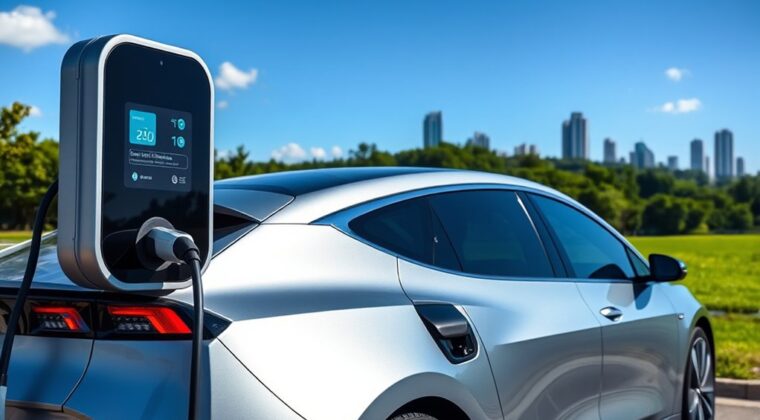
Charging an electric vehicle in the U.S. does not have one fixed price. Your cost depends on your electricity rate, how efficient your EV is, how many miles you drive, where you charge, and whether the charger adds fees. As a simple rule, home charging is usually the cheapest option, while DC fast charging is usually the most expensive because you pay for speed and convenience.
Quick Answer
At the latest U.S. residential average of 18.83 cents per kWh, charging a 72 kWh EV battery costs about $13.56 before charging losses, or about $15 with a 10% loss cushion. Driving 1,000 miles at 3.5 miles per kWh costs about $54 to $60 at home.
Key Takeaways
- Home charging is usually the lowest-cost option because you pay your residential electricity rate instead of a public-network price.
- Use this formula: monthly miles ÷ miles per kWh ÷ charging efficiency × electricity rate.
- Public charging can cost more because station pricing may include time-of-use rates, session fees, taxes, membership differences, and idle fees.
- State electricity rates vary widely, so the same 72 kWh charge can cost under $10 in some lower-rate states and more than $35 in Hawaii when charging losses are included.
- Federal charger tax-credit eligibility changed after June 30, 2026, so check current IRS, state, and utility programs before planning a new installation.
How Much Does It Cost to Charge an EV in the US?
Using the U.S. Energy Information Administration’s April 2026 residential electricity average of 18.83 cents per kWh, a 72 kWh battery costs about $13.56 to fill before charging losses. If you add a 10% home-charging loss cushion, the billed electricity cost is closer to $15.06.
That does not mean every driver pays the same amount. A compact, efficient EV may use about 25 kWh to drive 100 miles, while a large electric truck or SUV may use much more. Your local utility rate also matters. A driver in North Dakota pays far less per kWh than a driver in Hawaii, based on the latest EIA residential-rate table.
At the April 2026 U.S. residential average, an EV that gets 3.5 miles per kWh costs about $5.38 per 100 miles before charging losses, or about $5.98 with a 10% home-charging loss cushion.
Understanding EV Charging Methods and Costs
The three common charging options are Level 1, Level 2, and DC fast charging. The U.S. Department of Energy’s Alternative Fuels Data Center explains that charging time depends on battery size, state of charge, vehicle limits, charger output, and electrical service.
| Charging Type | Typical Use | Speed Guide | Cost Pattern |
|---|---|---|---|
| Level 1 | Standard 120 V outlet, light daily driving, backup charging | About 5 miles of range per hour | Usually home electricity rate |
| Level 2 | Home overnight charging, workplace charging, public destination charging | About 25 miles of range per hour, depending on equipment | Home rate at home; posted public rate away from home |
| DC fast charging | Road trips and quick stops | Often about 100 to 200+ miles in 30 minutes | Usually higher than home charging |
For cost planning, remember that your car does not always receive every kWh your utility bills. Some energy is lost as heat during charging. A rough 10% home-charging loss cushion is a practical estimate for quick math, though the real loss depends on the charger, vehicle, temperature, and battery state of charge.
Note: Most owners do not charge from 0% to 100% every day. Daily charging is often a smaller top-up, such as 40% to 80%, so your usual charging session may cost much less than a full-battery example.
How to Calculate Your Monthly Charging Expenses
Use your own driving and utility rate for the most accurate estimate. Your electric bill shows your actual price per kWh. If your bill includes delivery charges, riders, taxes, or time-of-use pricing, use the total effective rate for the hours when you charge.
Monthly charging cost formula:
Monthly miles ÷ EV efficiency ÷ charging efficiency × electricity price = monthly charging cost
Here is a simple example:
- You drive 1,000 miles per month.
- Your EV averages 3.5 miles per kWh.
- Your home charging efficiency estimate is 90%, or 0.90.
- Your electricity rate is 18.83 cents per kWh.
The math is: 1,000 ÷ 3.5 ÷ 0.90 × $0.1883 = about $59.78 per month.
If you ignore charging losses for a quick lower estimate, the same example is about $53.80. That is why the cleanest answer is a range, not one fixed monthly number.
Home vs. Public Charging Costs
Home charging usually wins on cost because you pay your residential electricity rate. Public charging can be useful when you are traveling, commuting, or living without a dedicated charger, but the posted price may reflect network costs, real estate, demand charges, payment processing, maintenance, and charging speed.
| Scenario | Example Rate | 72 kWh Battery Cost Before Losses | Best Use |
|---|---|---|---|
| Home charging at U.S. average residential rate | $0.1883/kWh | $13.56 | Daily charging and overnight top-ups |
| Public Level 2 example | $0.28/kWh | $20.16 | Work, errands, apartments, hotels |
| Public DC fast-charging example | $0.53/kWh | $38.16 | Road trips and quick charging stops |
Public charging prices are not universal. Electrify America says DC fast-charging pricing can depend on location, plan, vehicle power level, time of use, and the energy delivered. Some stations may also add idle fees after charging ends, so always check the app or charger screen before starting a session.
Pro Tip: Before a road trip, compare fast-charging networks in the route-planning app and check whether a membership plan lowers the per-kWh price enough to beat the monthly fee.
State-by-State Breakdown of EV Charging Costs
Electricity rates vary by state, so the same EV can cost very different amounts to charge depending on where you live. The table below uses EIA April 2026 residential electricity prices and a 72 kWh battery example.
| State / Area | Residential Rate | 72 kWh Charge Before Losses | With 10% Loss Cushion |
|---|---|---|---|
| U.S. total | 18.83 cents/kWh | $13.56 | $15.06 |
| North Dakota | 12.35 cents/kWh | $8.89 | $9.88 |
| Texas | 16.99 cents/kWh | $12.23 | $13.59 |
| Florida | 15.38 cents/kWh | $11.07 | $12.30 |
| California | 35.25 cents/kWh | $25.38 | $28.20 |
| Massachusetts | 29.45 cents/kWh | $21.20 | $23.56 |
| Alaska | 27.35 cents/kWh | $19.69 | $21.88 |
| Hawaii | 46.62 cents/kWh | $33.57 | $37.30 |
Use these numbers as examples, not a substitute for your own bill. Your personal rate may differ from the state average because of your utility, plan type, delivery charges, taxes, solar credits, or time-of-use schedule.
How Regional Electricity Rates Affect EV Charging Costs
Regional electricity rates affect every mile you drive on home charging. At 3.5 miles per kWh, the U.S. residential average of 18.83 cents per kWh equals about 5.38 cents per mile before charging losses. In Hawaii, using 46.62 cents per kWh, the same EV would cost about 13.32 cents per mile before losses.
Time-of-use rates can matter as much as state averages. Some utilities charge less overnight and more during late afternoon or early evening. If your utility offers an EV plan, compare the lower overnight rate against any higher daytime rate before switching.
Note: If you have solar, a home battery, or net metering, your real charging cost may depend on when you charge and how your utility values exported power.
Key Factors That Affect Charging Time and Costs
Your EV charging bill is shaped by more than the price printed on your electric bill. The biggest factors are:
- Battery size: A 100 kWh battery costs more to fill than a 60 kWh battery at the same rate.
- Vehicle efficiency: An EV that gets 4.0 miles per kWh costs less per mile than one that gets 2.5 miles per kWh.
- Charging losses: Wall power is slightly higher than the energy that reaches the battery.
- Local electricity rate: State averages help, but your utility bill is the best source.
- Charging level: Level 1 and Level 2 home charging often cost less, while DC fast charging usually costs more.
- Public charger fees: Some sessions include taxes, idle fees, session fees, or different prices for members and guests.
- Temperature: Cold weather can reduce efficiency and increase energy use for cabin and battery heating.
Charging speed also changes during a session. Your vehicle, charger, battery temperature, and current state of charge all affect how quickly power flows into the battery.
How Do EV Charging Costs Compare to Gasoline?
EVs often cost less per mile than gasoline vehicles when charged at home, but the exact savings depend on your electricity rate, gasoline price, EV efficiency, and gas-car MPG.
Using the U.S. residential electricity average of $0.1883/kWh, an EV that gets 3.5 miles per kWh costs about $5.38 per 100 miles before charging losses, or about $5.98 with a 10% loss cushion. Using the EIA U.S. regular gasoline price of $3.777/gallon from July 6, 2026, a 30 mpg gasoline vehicle costs about $12.59 per 100 miles.
| Vehicle Example | Assumption | Cost per 100 Miles |
|---|---|---|
| EV at home, before charging losses | 3.5 miles/kWh and $0.1883/kWh | About $5.38 |
| EV at home, with 10% loss cushion | 3.5 miles/kWh, 90% charging efficiency, $0.1883/kWh | About $5.98 |
| Gasoline vehicle | 30 mpg and $3.777/gallon | About $12.59 |
FuelEconomy.gov also notes that EVs convert over 77% of electrical energy from the grid to power at the wheels, while gasoline vehicles convert about 12% to 30% of the energy in gasoline to wheel power. That efficiency advantage is one reason EVs can be cheaper per mile, especially when charged at home.
What’s Next for EV Charging? Trends and Innovations
EV charging is changing quickly. DC fast chargers are becoming more powerful, vehicles are gaining better route planning, and public networks are shifting toward real-time pricing and time-of-use rates. Connector access is also changing as more automakers move toward the J3400 connector, also known as NACS.
The AFDC notes that DC fast-charging equipment can provide up to 500 kW, though actual charging power varies by vehicle and battery state of charge. It also notes that inductive wireless charging exists in some applications, while high-powered wireless charging remains an area of research.
For owners, the most useful near-term changes are practical: better charger availability, clearer pricing in apps, improved payment options, faster road-trip charging, and more smart chargers that can schedule charging when electricity is cheaper.
How to Reduce Your EV Charging Expenses
You can reduce EV charging expenses by controlling when, where, and how you charge. The best strategy is usually to do most charging at home during lower-rate hours and save DC fast charging for road trips or urgent top-ups.
Time Your Charging Wisely
If your utility offers time-of-use pricing, schedule charging during the cheapest overnight window. Many EVs and Level 2 home chargers let you set a start time in the vehicle screen or charger app.
- Check your electric bill for your real per-kWh rate.
- Compare standard billing against an EV-specific utility plan.
- Use the vehicle or charger schedule to avoid peak-rate hours.
- Precondition the cabin while plugged in when possible, especially in cold weather.
Explore Subscription Plans
Public charging subscriptions can help if you fast charge often, but they are not always worth it for occasional use. Compare the monthly fee against your expected savings per session. Also check whether the lower rate applies only to certain stations, times, or power levels.
Utilize Incentives and Rebates
The federal Alternative Fuel Vehicle Refueling Property Credit applied to qualifying property placed in service at an eligible main home from January 1, 2023, through June 30, 2026, with a 30% credit up to $1,000 per item for individuals. Since that date has passed, check the IRS guidance, your state energy office, and your utility before assuming a new charger installation still qualifies for a federal, state, or local incentive.
Warning: Do not plug an EV charger into a dryer outlet or use an adapter unless a licensed electrician verifies the outlet, breaker, wire size, plug type, EVSE rating, and local code compliance. EV charging is a long continuous load, and a worn or mismatched outlet can overheat.
Frequently Asked Questions
How much does it cost to charge an electric car to 100%?
Multiply the usable battery size by your electricity rate. At the April 2026 U.S. residential average of $0.1883/kWh, a 72 kWh battery costs about $13.56 before charging losses, or about $15.06 with a 10% home-charging loss cushion. Public charging can cost more, depending on the posted rate and fees.
How much does EV charging cost per month?
For 1,000 miles per month, an EV that averages 3.5 miles per kWh costs about $54 at the national residential average before charging losses, or about $60 with a 10% loss cushion. Your real monthly cost may be lower or higher based on your mileage, EV efficiency, and utility rate.
What happens to electric cars after 8 years?
After 8 years, many EVs are still usable, but the battery may have less range than when new. Battery life depends on climate, mileage, charging habits, and vehicle design. FuelEconomy.gov notes that EV batteries are designed for extended life and may last longer in moderate climates than in severe climates.
Can I use my dryer outlet to charge my EV?
Sometimes, but only if the circuit and equipment are properly matched. A dryer outlet was not always installed for repeated EV charging loads. Have a licensed electrician inspect the outlet, breaker, wiring, grounding, plug type, and charger rating before using it. For many homes, a hardwired Level 2 charger on a dedicated circuit is the safer long-term setup.
Is EV charging actually cheaper than gas?
Home EV charging is often cheaper per mile than gasoline. Using $0.1883/kWh and 3.5 miles per kWh, an EV costs about $5.98 per 100 miles with a 10% loss cushion. A 30 mpg gasoline vehicle at $3.777 per gallon costs about $12.59 per 100 miles. Fast public charging can narrow the savings.
Is DC fast charging bad for saving money?
DC fast charging is convenient for road trips, but it usually costs more than home charging. Use it when speed matters, then do most daily charging at home or at lower-cost Level 2 stations when possible.
Conclusion
EV charging costs are easiest to understand when you use your own numbers. Check your utility rate, estimate your monthly miles, divide by your EV’s miles per kWh, and add a charging-loss cushion. At the current U.S. residential average, many drivers pay far less per mile at home than they would for gasoline, but public fast charging, high-rate states, and peak-hour pricing can change the math. For the lowest cost, charge at home when rates are low, compare public network pricing before trips, and verify any charger incentives before you install new equipment.
Sources
- U.S. Energy Information Administration, Electric Power Monthly Table 5.6.A — current residential electricity prices by state and U.S. total.
- U.S. Department of Energy Alternative Fuels Data Center, Electric Vehicle Charging Stations — charging levels, speeds, connector notes, and equipment guidance.
- Internal Revenue Service, Alternative Fuel Vehicle Refueling Property Credit — eligibility rules, June 30, 2026 placed-in-service deadline, and credit amounts.
- FuelEconomy.gov, All-Electric Vehicles — EV efficiency, battery-life context, and gasoline vehicle efficiency comparison.
- U.S. Energy Information Administration, Gasoline and Diesel Fuel Update — current U.S. regular gasoline price used for EV vs. gas examples.
- Electrify America Pricing and Plans — public fast-charging pricing variables, time-of-use pricing, and idle-fee notes.