
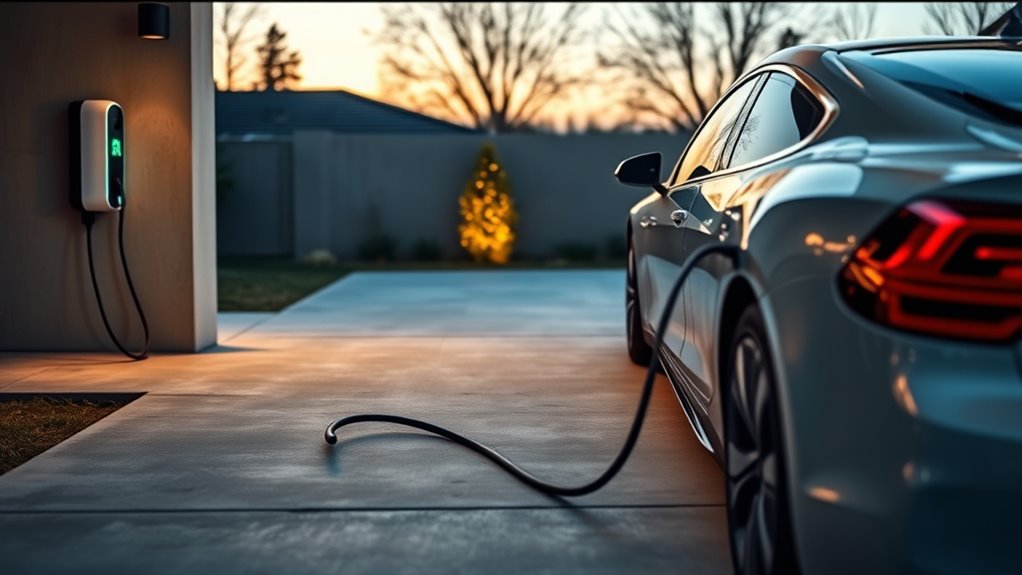
Choosing the right EV charging cable length starts with one simple job: measure the real path from your charger to your EV’s charge port, not just the shortest line across the garage. Your parking angle, charger height, cable route, connector type, and future vehicle plans all affect the length you need. A cable that is too short creates strain, while a cable that is much too long can become messy, heavy, and easier to trip over.
Quick Answer
Measure from the charger holster to the EV charge port along the actual cable route, including corners, wall clearance, and parking offset. Then add about 1 to 2 meters, or 3 to 6 feet, of slack so the connector reaches without pulling tight.
Key Takeaways
- Measure the cable path your charger will actually use, not an ideal straight line.
- Add 1 to 2 meters, or 3 to 6 feet, of slack to avoid strain at the charge port.
- Check connector type and current rating, especially if you use a detachable cable.
- Do not choose the longest cable by default; extra length can add weight, clutter, and trip risk.
- Plan for a future EV or a second parking position if your garage layout may change.
At a Glance
| Time Required | 10 to 20 minutes |
| Difficulty | Easy |
| Tools Needed | Tape measure, masking tape or chalk, notepad, and your EV’s charge-port location |
| Cost | Free if you already have a tape measure |
How to Measure EV Charging Cable Length
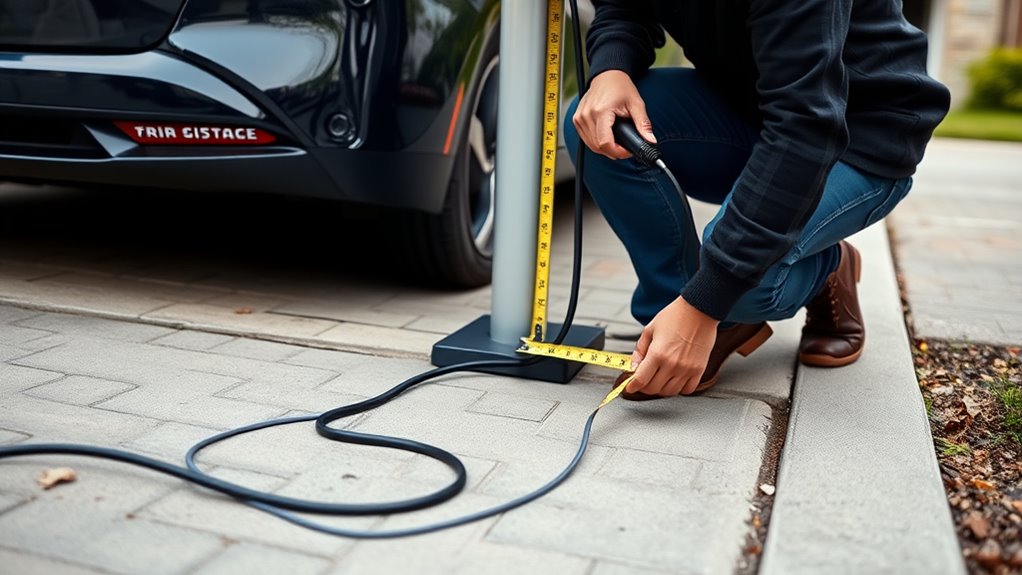
To measure EV charging cable length accurately, park your EV where it normally sits and find the charge port. Then measure from the charger’s cable holster, not just from the wall box body, to the port along the route the cable will follow.
Follow the cable path around anything that changes the route, such as a garage wall, workbench, step, storage bin, curb, or parked second vehicle. If the charger is not installed yet, mark the planned mounting point on the wall with tape and measure from that spot.
- Park the EV in its normal position.
- Measure from the charger handle or holster to the vehicle charge port.
- Follow the real cable path instead of stretching the tape in the air.
- Repeat the measurement nose-in, rear-in, or off-center if you use more than one parking position.
- Add 1 to 2 meters, or 3 to 6 feet, of slack.
- Compare the final number with available cable lengths and charger options.
Charging speed should not be the main reason you choose a longer cable. For safe charging, the important electrical detail is whether the cable, connector, and charger are rated for the current your EVSE can deliver. The U.S. Department of Energy’s Alternative Fuels Data Center explains that Level 2 charging power varies by equipment, vehicle onboard charger capacity, and electrical service.
Measure the Distance to Your Charge Port
Start with the exact distance from your EV charger to the charging port. Do not estimate by eye. A short cable may look fine until the vehicle is parked a few inches off-center, the garage door track blocks the route, or the connector has to bend around a bumper.
Record the distance in both meters and feet. This makes it easier to compare detachable cable options, tethered wall chargers, and manufacturer specs. Many detachable AC cables are sold in meter lengths, while many North American tethered home chargers are sold with fixed cable lengths in feet. For example, Tesla lists a 24-foot cable on its Universal Wall Connector.
Your parking orientation matters. A front-left charge port, rear-left charge port, front-right charge port, or rear-center charge port can completely change the reach you need. If you may buy a different EV later, measure for the farthest realistic port location, not only the vehicle you own today.
Pro Tip: Before buying a charger, use a rope or garden hose cut to the cable length you are considering. Route it from the charger spot to the charge port. If it pulls tight, crosses a walkway, or drags across the paint, choose a better mounting point or a longer cable.
Add Slack for Safer Charging
Once you know the direct route, add 1 to 2 meters, or 3 to 6 feet, of slack. That extra length gives the cable a relaxed curve instead of pulling against the charge port.
- It reduces strain on the connector and vehicle inlet.
- It gives you room if the car is parked slightly forward, backward, or off-center.
- It helps the cable lie on the ground or wall hook without sharp bends.
- It makes the charger easier to share between two parking spaces or two EVs.
Warning: Do not force a connector to reach by stretching the cable tight. If the cable is under tension, move the vehicle, remount the charger if possible, or choose equipment with a longer rated cable.
Slack should not become clutter. After you add a safe margin, plan where the extra cable will sit when charging and where it will hang when not in use. A wall hook, cable dock, or reel designed for EV charging can help keep the area clean.
In a field study of public DC fast chargers, 4.9% of evaluated EVSE connectors could not charge because the cable was too short to reach the vehicle inlet. Measuring at home helps you avoid the same reach problem before installation.
Choose the Right EV Cable Length
The right cable length depends on your charger type, parking layout, and region. A 5-meter EV cable may work well for a compact garage with a side-mounted charger and a nearby charge port. A longer cable may be better if the charger serves two vehicles, reaches across the front of the car, or must work with different port locations.
| Charging Layout | Typical Cable Choice | Best Use |
| Charger beside the charge port | About 5 meters or 16 feet may be enough | Single EV, consistent parking position |
| Charger near the front or rear wall | 6 to 7.5 meters or about 20 to 25 feet | Different charge-port positions or imperfect parking |
| Two parking spaces from one charger | Longest rated option from the charger maker | Shared driveway, two EVs, or future vehicle changes |
| Tight garage with foot traffic | Shortest length that reaches with slack | Lower trip risk and easier storage |
If you use a tethered charger, the cable is permanently attached to the unit, so choose the charger location and cable length together. If you use an untethered charger, you can often choose a separate cable, but it must match your vehicle connector, charger socket, and current rating.
Check Connector Type and Current Rating
Length is only one part of the cable choice. You also need the right connector and current rating. In North America, many older and current non-Tesla EVs use J1772 for AC charging and CCS1 for DC fast charging, while newer vehicles are moving toward SAE J3400, also known as the North American Charging System. In Europe and many other markets, Type 2 is common for AC charging, often with CCS2 for DC fast charging.
If you are buying a detachable cable, check these details before you buy:
- Connector at the charger: Make sure it matches the charger socket or wall unit.
- Connector at the vehicle: Make sure it matches your EV’s charge inlet.
- Current rating: A 32A charger needs a cable rated for that current or higher.
- Phase support: In Type 2 markets, check whether you need single-phase or three-phase charging.
- Weather rating: For outdoor use, use equipment rated for outdoor charging and follow the manufacturer’s instructions.
Note: A longer cable will not make your EV charge faster. Charging speed is limited by the charger output, electrical circuit, onboard charger, battery state of charge, temperature, and vehicle limits.
Avoid Common EV Charging Cable Length Mistakes
Even after you pick a practical EV cable length, small mistakes can create daily frustration. The biggest mistake is measuring an empty garage instead of measuring with the vehicle parked where it will actually charge.
- Guessing the distance: Use a tape measure, rope, or hose to test the route.
- Ignoring parking offset: Measure the way you park on a normal day, not the perfect position.
- Forgetting a second EV: A future vehicle may have a charge port on the opposite side.
- Buying too much length: Extra cable can become heavy, messy, and easier to trip over.
- Buying too little length: A tight cable can stress the connector and charge port.
- Skipping cable storage: Plan a hook, dock, or wall route before the charger is installed.
Do not run the cable where people must step over it every day. If the only route crosses a walkway, look for a different charger location, a safer wall-mounted cable path, or a professionally planned installation.
What If Your Cable Is Too Short?
If your EV charging cable is too short, do not pull it tight or improvise with random extension leads. First, try the simple fixes: reverse into the parking space, move the car a few inches closer, or use a different charger holster position if the manufacturer allows it.
If that does not solve the problem, consider these safer options:
- Choose a charger model with a longer manufacturer-rated cable.
- Use a properly rated detachable cable if your charger is untethered.
- Have a qualified electrician move the charger to a better location.
- Add a second charger if one cable cannot safely serve two parking spaces.
For high-current EV charging, the safest fix is usually better charger placement or a properly rated cable, not a workaround. If you are unsure, follow the EVSE manufacturer’s manual and consult a licensed electrician.
Plan Cable Storage and Daily Use
A good cable length should be easy to live with. After charging, the cable should return to a hook, dock, reel, or holster without dragging through dirt or lying across a walkway. This keeps the connector cleaner and reduces wear on the cable jacket.
For outdoor chargers, keep the connector off the ground when not in use. Avoid sharp bends, crushed cable sections, and tight coils during charging. A cable that looks neat but is wound tightly while carrying current may trap heat, so follow the storage instructions from your charger maker.
Also think about snow, rain, driveway slope, garage doors, and kids’ bikes or tools near the charging area. These details sound small, but they decide whether your charging setup feels smooth every day or annoying every night.
Frequently Asked Questions
How long should my EV charging cable be?
Your EV charging cable should be long enough to reach from the charger to the charge port along the real cable route, plus 1 to 2 meters, or 3 to 6 feet, of slack. Many home setups work with about 5 to 7.5 meters, or 16 to 25 feet, but the right length depends on your charger location, parking position, and vehicle port location.
Is a longer EV charging cable always better?
No. A longer cable can help if you charge two vehicles or park in different positions, but too much extra length adds weight, clutter, and trip risk. Choose the shortest manufacturer-rated cable that reaches comfortably with safe slack.
What EV charger does Volvo recommend?
Volvo charger and cable choice depends on the exact model, market, and model year. Do not choose by brand name alone. Check your Volvo owner’s manual for connector type, AC charging limit, and approved adapters. In Type 2 markets, a Type 2 cable may be common. In North America, connector compatibility may involve J1772, CCS1, or J3400/NACS depending on the vehicle and adapter support.
What is the 80/20 rule for EV charging?
The 80/20 rule usually refers to charging habits or battery care, not cable length. Many EV owners use it as a reminder to charge to about 80% for daily use and avoid regularly running the battery very low, unless their vehicle manual says otherwise. It does not tell you how long your charging cable should be.
What kind of charger does the Hyundai Kona Electric use?
The Hyundai Kona Electric charger connection depends on the market and model year. In many European-style markets, Type 2 AC and CCS2 DC fast charging are common. In North America, many Kona Electric models use J1772 for AC and CCS1 for DC fast charging, while Hyundai’s newer North American EV strategy includes J3400/NACS adoption. Always check your vehicle manual, charge-port label, and Hyundai-approved adapter guidance.
Can I use an EV charging extension cable?
Avoid improvised extension setups unless the charger maker and vehicle maker clearly approve the exact accessory for your equipment. EV charging uses high current for long periods, so the safer fix is usually a better charger location or a properly rated cable from the charger or vehicle manufacturer.
Conclusion
The right EV charging cable length is the shortest length that reaches your charge port comfortably, follows a safe route, and gives you enough slack for everyday parking. Measure the real path, add 1 to 2 meters or 3 to 6 feet, check connector and current rating, and plan how the cable will store when not in use. A little extra measuring now can prevent strain, clutter, and expensive changes later.
Sources
- U.S. Department of Energy Alternative Fuels Data Center — EV charging levels, connector terminology, Level 2 home charging, CCS, and J3400/NACS context.
- Tesla Universal Wall Connector — manufacturer example of a 24-foot tethered home charging cable.
- SAE J3400 Recommended Practice — North American Charging System standard reference.
- Reliability of Open Public Electric Vehicle Direct Current Fast Chargers — study noting that short cables prevented some evaluated public DC fast-charger connectors from reaching vehicle inlets.