

Sharing a home EV charger with a neighbour can work well, but only if you agree on the boring details before the first plug-in. Set a written schedule, price charging by actual kWh where possible, define access rules, and decide what happens when someone is late, low on battery, or away from home. The goal is simple: both households get reliable charging without guesswork, resentment, or surprise bills.
Quick Answer
To share a home EV charger fairly, use a shared calendar, bill by kWh used, rotate peak-time slots, set clear access rules, and write down safety, payment, overstay, and emergency-charging terms. Review the arrangement monthly and update the rate whenever your electricity tariff changes.
Key Takeaways
- Charge by actual energy used whenever possible: kWh used × your electricity rate.
- Use a shared calendar or charger app so both households can see booked charging windows.
- Rotate evening, overnight, and morning slots so one person does not always get the easiest times.
- Check safety, parking, insurance, landlord, freeholder, or council rules before giving regular access.
- Put the agreement in writing, then review usage, payments, and problems at least once a month.
At a Glance
| Time Required | 30–60 minutes to agree rules, plus a short monthly review |
| Difficulty | Easy if both households agree on schedule, access, and payment rules upfront |
| Tools Needed | Shared calendar, charger app or kWh log, written agreement, payment app or bank transfer record |
| Cost | Usually the kWh used multiplied by your tariff, plus any small agreed access or maintenance fee |
How to Share a Home EV Charger Fairly
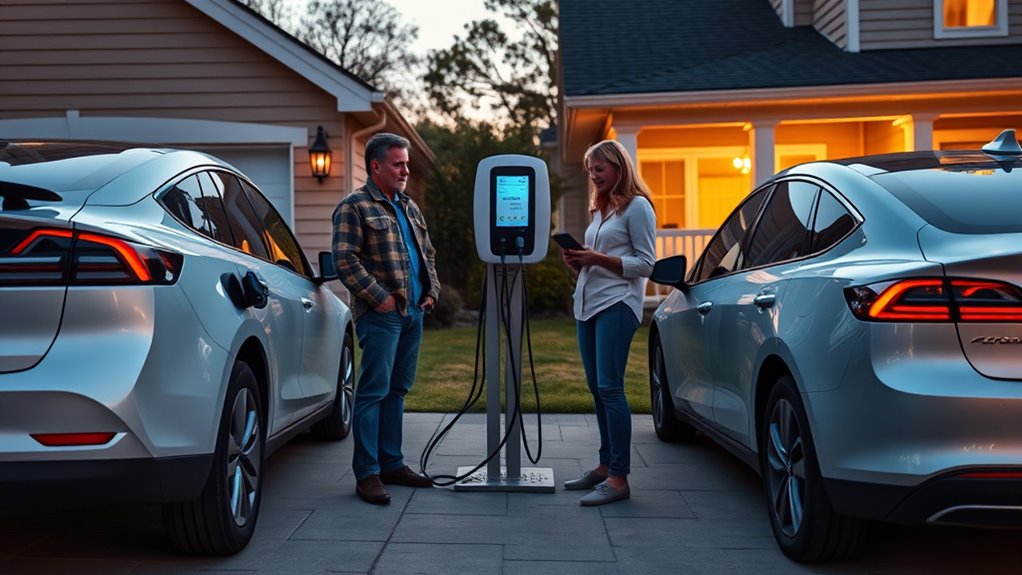
To share a home EV charger fairly, start with a clear charging schedule so both households know when the charger is available. A shared calendar, spreadsheet, or charger app prevents most conflicts because every charging session has a visible start time, finish time, and owner.
Next, compare your driving patterns. One neighbour may need a short top-up after school runs, while the other may need a longer overnight charge before commuting. Once you know the real demand, you can assign fixed time windows, rotate peak slots, and leave a few open blocks for urgent use.
Cost sharing should be based on electricity used, not rough guesses. The fairest method is:
Charging cost = kWh used × your electricity unit rate, plus any agreed access or maintenance fee.
For example, if a session uses 30 kWh and your tariff is 26.11p per kWh, the electricity cost is about £7.83. Your real rate may be lower on an EV tariff or higher on a different payment method, so use the rate shown on your bill. Ofgem publishes current electricity unit rates and standing charges, but your own supplier bill is the best source for your exact tariff.
Note: Do not charge your neighbour based only on the national average. Use your actual tariff, including peak and off-peak rates if you have time-of-use pricing.
Write a Simple Charger Sharing Agreement
A friendly verbal agreement can fall apart when bills rise, someone overstays, or both cars need charging at the same time. Write down the terms in plain language and share a copy with both households.
Your agreement should cover:
- Who can use the charger and which vehicles are allowed.
- Normal charging days and hours.
- Maximum session length.
- How kWh use will be measured.
- The price per kWh and when it gets reviewed.
- Payment deadline and method.
- Rules for cancellations, overstays, no-shows, and emergency charging.
- Who to contact if the charger, cable, app, or parking space is unavailable.
- Safety rules for cables, parking, weather, children, pets, and access.
Keep the agreement short enough that both households will actually follow it. A one-page note is usually better than a long contract no one reads.
Set a Charging Schedule That Works
You should agree on fixed time windows for charging so both of you know exactly when the charger is available. Rotate the most useful slots and leave some flexibility for real life.
Agree On Time Windows
A clear weekly charging schedule helps both neighbours avoid overlap. You can assign charging blocks such as 6 p.m. to 10 p.m., 10 p.m. to 6 a.m., and 6 a.m. to 8 a.m., then rotate those windows each week.
Put the schedule in a shared calendar app where both households can check availability, request swaps, and update changes. Add a maximum session length so one person does not leave a fully charged car plugged in for hours while the other person waits.
When possible, plan longer sessions during off-peak periods. Energy Saving Trust notes that charging at home is often cheaper than using petrol or diesel, and EV or time-of-use tariffs can lower charging costs further. Check Energy Saving Trust’s EV charging guidance for current cost context.
Rotate Peak Charging Slots
Peak charging slots are usually the easiest times: early evening after work, overnight before a commute, or early morning before school runs. Rotate those slots so one household does not always get the best access.
A simple rotation might look like this:
- Week 1: Household A gets Monday, Wednesday, and Friday evening priority.
- Week 2: Household B gets Monday, Wednesday, and Friday evening priority.
- Both weeks: Either household can request an emergency swap if battery level is low and the next journey is essential.
Review the schedule monthly. Commutes, shift work, school runs, and vehicle use can change, so the fairest system is one you can adjust without an argument.
Decide Who Pays for Charging Costs
You should agree on a fair rate before anyone plugs in. The cleanest approach is per-kWh billing because it charges each household for the energy it actually uses.
Set a Fair Rate
Start with the electricity unit rate on the host’s bill. If the charger uses a time-of-use tariff, use the correct peak or off-peak rate for that session. If the host pays a fixed standing charge anyway, you may decide not to include it in each session. If both households agree that the charger owner should recover wear, app costs, or access inconvenience, add a small fixed access fee and write it down.
Use this simple example:
- Session energy used: 42 kWh.
- Electricity rate: 26.11p per kWh.
- Electricity cost: 42 × £0.2611 = £10.97.
- Optional agreed access fee: £1.00.
- Total payment: £11.97.
If the tariff changes, update the rate before the next billing period. Ofgem reviews the price cap every three months, but your exact tariff may change on a different schedule, especially if you are on a fixed or EV-specific plan.
Measure kWh Use Clearly
To avoid disputes, choose one measurement method and stick with it. Good options include:
- A charger app that logs kWh by session.
- A charger with user profiles, RFID cards, or app-based access records.
- The vehicle app’s energy-added record, if both of you agree it is reliable enough.
- A photo of the charger or meter reading before and after the session, if your setup supports that.
Avoid billing by time alone unless the charger cannot report kWh. Charging speed changes as the battery fills, so two four-hour sessions may not use the same amount of electricity.
Pro Tip: Keep a monthly log with date, driver, start time, end time, kWh used, tariff, and amount paid. A simple shared spreadsheet is enough.
Set Access Rules and Boundaries
Clear access rules keep EV charging predictable and fair. Define the days and hours each neighbour can use the charger, where the car should be parked, and who is allowed to handle the cable or app controls.
Useful access rules include:
- Book every charging session in the shared calendar before plugging in.
- Move the car within 15–30 minutes after the agreed finish time.
- Do not unplug the other vehicle unless both households have agreed on that rule.
- Keep the driveway, gate, garage, or charging area clear.
- Do not share app logins, PINs, RFID cards, or access codes with guests unless the owner agrees.
- Report charger faults, cable damage, failed sessions, or payment issues the same day.
If the charger supports user profiles, RFID cards, scheduled access, or app approvals, use them. Access controls make sharing easier because each driver’s session can be tracked separately.
Check Safety, Permissions, and Liability
Before you share a home EV charger regularly, make sure the setup is safe and allowed. The charger should be installed and maintained according to the manufacturer’s instructions, local electrical rules, and installer guidance. Do not improvise with unsafe extension leads, damaged cables, or cable routes that create a trip hazard.
Warning: Do not run a charging cable across a public pavement, shared path, or neighbour’s land unless your council, landlord, freeholder, insurer, and installer confirm it is allowed and safe.
If you rent, live in a flat, share a driveway, or need a cross-pavement charging solution, check permission before making the arrangement permanent. GOV.UK lists current chargepoint grant schemes, including grants for eligible renters, flat owners, landlords, and some households with on-street parking. Review GOV.UK’s electric vehicle chargepoint grant guidance if installation costs or eligibility matter.
You should also ask your home insurer whether regular paid charger access changes your cover. A casual neighbour arrangement is not the same as operating a public charging business, but money, repeated access, and third-party use can still raise liability questions.
Follow Simple Charging Etiquette at Home
Good etiquette keeps the arrangement calm. Communicate before plugging in, confirm the expected finish time, and update the other household if plans change.
Follow these simple rules:
- Do not overstay a booked slot.
- Leave the cable neatly stored after use.
- Do not block access to bins, garages, doors, gates, or other vehicles.
- Keep children and pets away from the charging area.
- Tell the other household immediately if charging fails.
- Give priority to urgent travel only when it is genuinely needed.
When urgency differs, agree on a priority rule. For example, the driver with the lower battery and the earliest essential journey gets first access, but the missed slot must be replaced later in the week.
Handle Overstays, Cancellations, and Disputes
Small problems become big problems when there is no rule for them. Decide what happens if someone cancels late, forgets to move the car, misses payment, or books more slots than agreed.
A fair system might include:
- At least two hours’ notice for non-urgent cancellations.
- A 15-minute grace period after a session ends.
- A small credit or make-up slot if one person repeatedly loses access.
- Payment within seven days of the monthly charging log.
- A pause on new bookings if payments are overdue.
- A monthly check-in to adjust rates, time windows, and rules.
If the same issue keeps coming up, fix the rule rather than arguing about the person. The arrangement should feel useful to both households, not like a favour that slowly turns into a burden.
Share a Home EV Charger With an App
A charger app or sharing platform can simplify booking, access, billing, and usage records. Some systems let you set available hours, approve sessions, apply a price, and track kWh automatically.
Before relying on an app, check these points:
- Can it separate each user’s charging sessions?
- Does it show kWh used, start time, end time, and failed sessions?
- Can you restrict access by PIN, RFID card, user account, or approved booking?
- Does it handle payments, or do you still need bank transfer records?
- What fees, tax, privacy, or insurance issues apply if you charge money through a platform?
An app can reduce admin, but it does not replace a clear agreement. You still need rules for parking, safety, cancellations, emergency charging, and what happens if the app is down.
Frequently Asked Questions
Can I share my EV charger with my neighbour?
Yes, you can usually share your EV charger if the installation is safe, access is allowed, and both households agree on schedule, payment, parking, and responsibility. Check your charger warranty, home insurance, landlord or freeholder rules, and any council restrictions if the cable crosses shared or public space.
How much should I charge someone to use my home EV charger?
The fairest price is the kWh used multiplied by your electricity unit rate. For example, 30 kWh at 26.11p per kWh costs about £7.83. If you add an access, maintenance, or platform fee, agree it in writing before charging starts.
Is it okay to share a charger without an app?
Yes, but you need another way to track bookings, kWh use, and payments. A shared calendar plus a simple monthly spreadsheet can work if both households update it consistently. An app is easier when you want user-level access control and automatic session logs.
What is the 80/20 rule for EV charging?
The 80/20 rule is a common rule of thumb, not a legal rule. It often means most charging happens at home while some charging happens elsewhere. It can also refer to keeping many EV batteries between roughly 20% and 80% for everyday use, depending on the vehicle maker’s guidance.
How do I stop other people from using my EV charger?
Use app access controls, a PIN, RFID cards, scheduled charging, a lockable charger, or a lockable isolator if your installer recommends one. Also make the rule clear in writing: only approved vehicles and approved users can charge.
Should I include the standing charge in my neighbour’s EV charging bill?
Usually, you would not include the full standing charge because the household pays it even without the EV session. If both households agree that regular charger access should contribute to fixed costs, use a small monthly access fee instead of hiding it in the per-kWh price.
Conclusion
If you share a home EV charger with your neighbour, treat it like shared infrastructure. Agree on the schedule, track kWh use, set a fair rate, control access, and write down the rules before problems start. A charger app can help, but the real solution is clear communication, safe use, and a monthly review that keeps the arrangement fair for both households.
Sources
- Ofgem — Energy price cap unit rates and standing charges — backs current electricity unit-rate guidance and the need to check tariff changes.
- Ofgem — Energy price cap and standing charges explained — explains that the price cap applies to unit rates and standing charges, not total bills.
- Energy Saving Trust — Electric vehicles — supports home charging cost context and EV tariff savings.
- GOV.UK — Electric vehicle chargepoint grants — supports current grant and eligibility information for renters, flat owners, landlords, and on-street parking situations.
- The Electric Vehicles (Smart Charge Points) Regulations 2021 — supports the importance of smart chargepoint functionality and compliant domestic charging equipment.