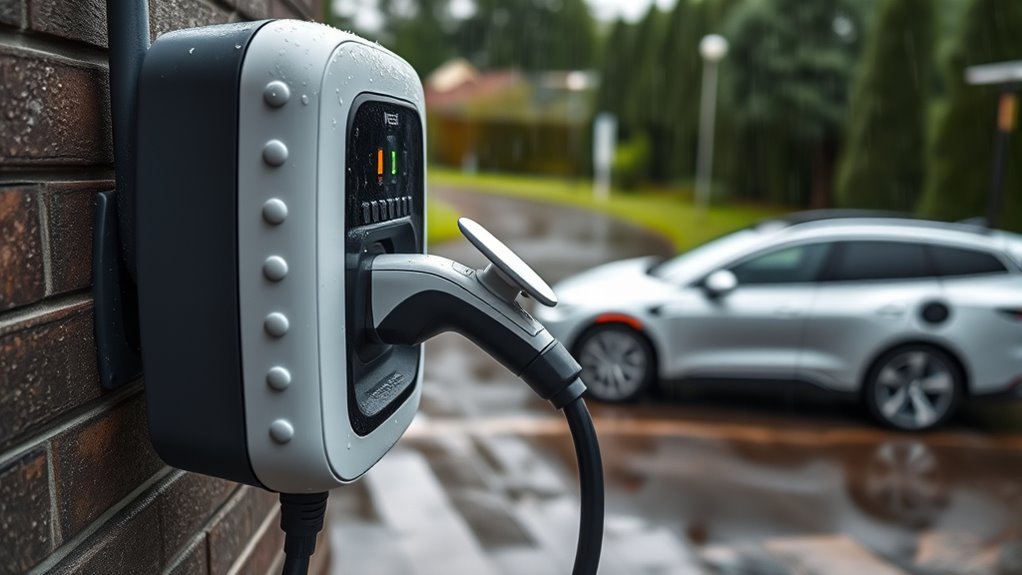
An EV charger’s IP rating tells you how well the charger enclosure resists dust, touch hazards, splashing water, rain, and water jets. It is one part of choosing a safe, reliable charger, but it is not the only one. You still need the right electrical listing, correct installation, good cable management, and a rating that matches the site.
Quick Answer
For most indoor garages, IP44 or IP54 is usually enough. For exposed outdoor EV chargers, look for IP65 or IP66, or the manufacturer’s equivalent outdoor enclosure rating. Use IP67 only where temporary immersion or flooding is a real risk, and always verify the charger’s manual, safety listing, and local electrical code.
Key Takeaways
- IP44 fits dry or sheltered indoor locations with light splash exposure.
- IP54 adds better dust protection and works well for many garages, carports, and semi-sheltered installs.
- IP65 or IP66 is the safer target for fully exposed outdoor chargers facing rain, dust, or hose spray.
- IP67 is for temporary immersion risk, not a default upgrade for every site.
- An IP rating does not replace electrical safety certification, impact protection, corrosion resistance, or proper installation.
What Is an IP Rating for EV Chargers?
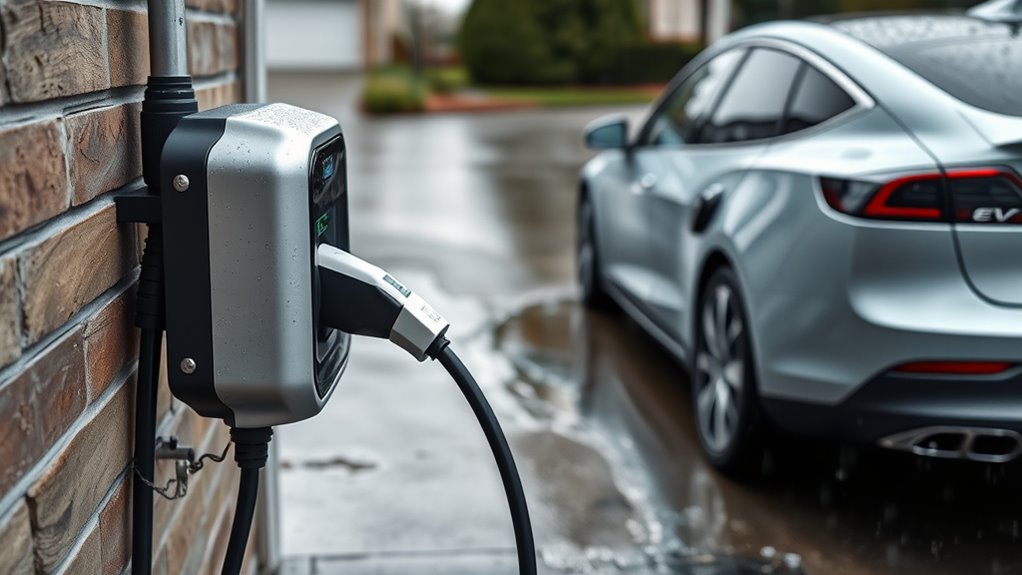
An IP rating, or Ingress Protection rating, grades how well an electrical enclosure blocks solid objects and liquids. The International Electrotechnical Commission explains that IP ratings are used to rate the resistance of electrical and electronic enclosures against dust and liquids.
The code has two main numbers. The first number rates protection against solid objects and dust from 0 to 6. The second number rates protection against water from 0 to 9 under IEC 60529. Some vehicle-specific or related standards use “K” suffixes, but you should not read “9K” as the normal second-digit scale for every EV charger.
For example, an IP65 charger enclosure is dust-tight and protected against water jets. An IP67 enclosure is dust-tight and tested for temporary immersion. That does not automatically mean it is also tested for strong water jets unless the product lists both ratings or the manual says so.
Note: IP ratings apply to the tested enclosure or component in the tested condition. The charger body, connector, cable gland, plug, holster, and any removable cover may have different protection limits.
Which IP Rating Do You Need?
You need to match the EV charger IP rating to the installation environment. A clean indoor garage does not need the same sealing as a charger mounted on an exposed post in a rainy parking lot. The goal is enough protection for the real exposure without creating unnecessary heat, cost, or maintenance issues.
The U.S. Department of Energy’s Alternative Fuels Data Center recommends considering weather impacts, codes, permits, inspection needs, electrical contractors, utility coordination, and maintenance when planning EV charging infrastructure. The IP rating should be part of that larger site plan.
Warning: Do not choose an EV charger by IP rating alone. Use equipment with a recognized safety listing, follow the manufacturer’s installation manual, obtain required permits, and use a qualified electrician where local rules or the charger design require it.
Indoor Vs Outdoor Needs
Indoor EV chargers usually need moderate ingress protection. In a dry garage, IP44 may be enough because the charger mainly needs protection from touch, small objects, and splashes. In a dusty garage, shared parking area, workshop, or carport, IP54 is often a better fit because it adds stronger dust protection.
Outdoor EV chargers face rain, windblown dust, sprinkler spray, snow, ice, UV exposure, insects, and temperature swings. For a fully exposed outdoor location, IP65 or IP66 is usually a stronger target because these ratings are dust-tight and tested against water jets. If the charger may be temporarily submerged during flooding, IP67 may be worth specifying.
For North American products, you may see a NEMA enclosure type instead of an IP rating. NEMA and IP ratings are not identical systems, so check the manufacturer’s manual rather than assuming a direct one-to-one match.
Balancing Protection And Cooling
More sealing is not always better. A tightly sealed enclosure can limit airflow and make thermal management harder, especially during long charging sessions, high ambient temperatures, or direct sun exposure. That is why the best charger is not always the one with the highest IP number. It is the one that matches both the weather exposure and the charger’s cooling design.
- Higher IP ratings can reduce dust and water intrusion.
- More sealing can make heat harder to remove if the design depends on airflow.
- Manufacturer instructions matter because clearance, shade, mounting height, and orientation can affect cooling.
- High-power chargers may need more active cooling than small home Level 2 units.
Pro Tip: If two chargers have similar IP ratings, compare their allowed operating temperature range, required clearances, cable storage, warranty terms, and safety certifications before choosing.
Matching Rating To Environment
The right rating depends on what the charger faces day to day. For indoor installs, IP44 or IP54 usually covers light dust and splashes. For semi-outdoor installs, such as a carport or sheltered wall, IP54, IP55, or IP65 may make sense depending on wind-driven rain and dust. For exposed outdoor chargers, IP65 or IP66 is a better target.
For flood-prone sites, IP67 can help with temporary immersion risk, but it does not make the whole electrical installation flood-proof. Flooding can also affect conduit, wiring, pedestals, upstream panels, disconnects, and ground-fault protection. If flooding is possible, choose the site and mounting height carefully and follow local electrical rules.
IP44 vs IP54 vs IP65 vs IP67
When you compare IP44, IP54, IP65, and IP67, focus on the two digits. The first digit is dust and object protection. The second digit is water protection.
| Rating | What It Means | Best Fit |
| IP44 | Protected against objects over 1 mm and splashing water. | Dry indoor garages or sheltered spaces. |
| IP54 | Dust-protected and splash-resistant. | Garages, carports, workshops, and semi-sheltered installs. |
| IP55 | Dust-protected and protected against water jets. | Sheltered outdoor walls with occasional hose spray or wind-driven rain. |
| IP65 | Dust-tight and protected against water jets. | Most exposed outdoor home and commercial locations. |
| IP66 | Dust-tight and protected against powerful water jets. | Harsh outdoor sites, washdown zones, and very wet climates. |
| IP67 | Dust-tight and tested for temporary immersion. | Flood-risk areas or temporary immersion risk, if the rest of the installation is designed for it. |
You should select the lowest rating that safely covers the site exposure. Overbuilding every charger can add cost, weight, and heat-management challenges without improving the real-world installation.
Why Higher IP Ratings Can Hurt Cooling
Higher IP ratings, especially sealed designs such as IP66 and IP67, can make cooling more difficult if the charger depends on passive airflow. EV chargers contain electronics that create heat during operation. If heat cannot escape, internal temperatures can rise and stress components.
This does not mean high-IP chargers are bad. A well-designed IP66 charger can still manage heat through metal housings, heat sinks, internal layout, temperature sensors, or active cooling. The point is that sealing and cooling must be designed together.
A higher IP rating protects against more ingress, but it does not automatically mean better charger reliability. Installation quality, cooling, connectors, maintenance, and safety certification still matter.
How IP Ratings Affect Safety and Lifespan
Because ingress protection affects how well an EV charger withstands its environment, the right IP rating can support both safety and service life. Moisture and dust can contribute to corrosion, nuisance faults, insulation problems, connector wear, and electronic failures.
- Better sealing can reduce moisture and dust intrusion.
- Correct water protection helps in rain, snow, sprinkler spray, and washdown exposure.
- Dust protection matters in workshops, desert regions, construction areas, and unpaved lots.
- Regular inspection catches cracked covers, damaged seals, loose cable glands, and worn connector holsters before they become bigger problems.
Still, IP rating is only one reliability factor. Public charger failures can come from payment systems, screens, broken connectors, network issues, short cables, software faults, and poor maintenance. The AFDC operation and maintenance guidance recommends periodic checks, clean equipment, secure cable storage, warranty planning, repair response targets, and uptime requirements.
What EV Charger Makers Use
EV charger makers do not all use one baseline IP rating. Tesla, ABB, Alpitronic, ChargePoint, Wallbox, Enphase, and other brands publish model-specific enclosure ratings in manuals or datasheets. Some products list an IP rating. Others use a NEMA enclosure type, especially in North America.
When you compare models, check the exact charger version, not just the brand. A residential wall charger, a portable cord set, a pedestal Level 2 charger, and a DC fast charger can have different enclosure designs and different environmental ratings.
Look for these details in the manual or datasheet:
- IP rating or NEMA enclosure type.
- Indoor, outdoor, wet-location, or damp-location suitability.
- Operating temperature range.
- Required mounting orientation and clearances.
- Connector, plug, holster, and cable storage instructions.
- Safety certification from a recognized testing laboratory.
ENERGY STAR notes that certified EV chargers are tested for safety by a nationally recognized testing laboratory. That matters because a high IP rating is not a substitute for electrical safety certification.
Choose the Right IP Rating by Location
Use the location first, then choose the rating. This keeps the installation practical, safe, and easier to maintain.
| Location | Suggested Rating Target | Extra Checks |
| Dry private garage | IP44 or IP54 | Dust, splash exposure, ventilation, circuit capacity. |
| Workshop or dusty garage | IP54 or higher | Grinding dust, insects, cable storage, cleaning schedule. |
| Carport or covered driveway | IP54, IP55, or IP65 | Wind-driven rain, snow drift, sunlight, mounting height. |
| Fully exposed home wall | IP65 or IP66 | Rain, hose spray, temperature range, required clearances. |
| Public parking lot | IP65 or IP66 | Impact rating, vandal resistance, cable reach, payment/network maintenance. |
| Coastal area | IP65 or IP66, plus corrosion resistance | Salt spray, stainless hardware, coated enclosure, manufacturer corrosion testing. |
| Flood-risk location | IP67 only if temporary immersion is expected | Mounting height, flood elevation, conduit, disconnects, inspection after flooding. |
For public charging stations, also check IK impact protection. IP ratings address dust and water ingress. IK ratings address mechanical impact. A charger in a public parking lot may need both strong ingress protection and impact-resistant hardware.
Common IP Rating Mistakes to Avoid
A common mistake is under-specifying the charger for outdoor exposure. If the charger faces direct rain, windblown dust, sprinklers, or hose spray, a low indoor-style rating can shorten service life and raise maintenance needs.
Another mistake is assuming the highest number is always best. A sealed charger still needs heat control, correct mounting, safe wiring, and a clean connector storage system. If the charger overheats, trips, or derates because it cannot shed heat, the higher IP rating has not solved the real problem.
Also avoid these mistakes:
- Assuming IP means waterproof. IP ratings are test classifications, not a blanket promise that water can never cause damage.
- Ignoring the connector. A charger body rating does not automatically cover the connector when it is dropped, cracked, dirty, or left uncapped.
- Confusing IP with corrosion resistance. Coastal salt air can attack screws, brackets, terminals, and coatings even when the enclosure keeps water out.
- Ignoring impact protection. IP does not measure vandal resistance or vehicle impact risk.
- Skipping maintenance. Damaged gaskets, loose glands, cracked covers, and dirty holsters can reduce protection over time.
Inspection and Maintenance Tips
Good maintenance helps the IP rating keep doing its job. Inspect the charger after major storms, snow events, flooding, construction dust, washdown, or visible damage.
- Check the enclosure for cracks, loose covers, missing screws, or warped plastic.
- Look for damaged gaskets, loose cable glands, and signs of water staining.
- Keep the connector off the ground and stored in its holster.
- Do not pressure-wash the charger unless the manual clearly allows it.
- Clean dirt and dust with the method approved by the manufacturer.
- Stop using the charger and call a qualified technician if you see corrosion, burning, repeated faults, exposed conductors, or water inside the unit.
Frequently Asked Questions
Can IP ratings protect chargers from salt spray near the coast?
Only partly. A higher IP rating can help keep water and dust out, but it does not automatically prove salt-spray or corrosion resistance. For coastal installs, look for corrosion-resistant enclosure materials, coated hardware, sealed cable entries, and manufacturer documentation for salt-fog or corrosion testing.
Do IP ratings change for indoor versus outdoor charger installations?
Yes. Indoor chargers in clean garages often need less ingress protection than outdoor chargers exposed to rain, dust, snow, and hose spray. IP44 or IP54 may suit many indoor installs, while exposed outdoor chargers often call for IP65, IP66, or an equivalent outdoor-rated enclosure listed by the manufacturer.
Can an EV charger still overheat with a high IP rating?
Yes. A high IP rating protects against ingress, not heat buildup. A sealed charger still needs proper thermal design, correct installation clearances, suitable ambient temperature limits, and clean airflow or heat-transfer paths. Always follow the charger’s mounting and spacing instructions.
Are waterproof cable connectors included in the charger’s IP rating?
Not automatically. The charger body, cable connector, plug, socket, cable gland, and holster may have separate ratings or may be tested only in certain positions. Check the manual for connector storage, capped versus uncapped ratings, and whether the rating applies while the connector is plugged in, stored, or exposed.
Does a higher IP rating increase EV charger maintenance costs?
Not always. A higher IP rating can lower moisture and dust problems, but it can also add cost or cooling complexity. Maintenance cost depends on the charger design, location, cable handling, warranty, inspection schedule, network support, and how quickly faults are repaired.
Conclusion
In choosing an EV charger, match the IP rating to the real installation site instead of chasing the highest number by default. IP44 or IP54 can be enough indoors, IP65 or IP66 is usually better for exposed outdoor locations, and IP67 should be reserved for temporary immersion risk. Then confirm safety certification, local-code compliance, connector protection, cooling requirements, corrosion resistance, and maintenance needs. That balanced approach gives you better safety, fewer avoidable faults, and longer charger life.
Sources
- International Electrotechnical Commission: IP ratings — supports what IP ratings mean and how the two numerals work.
- U.S. Department of Energy AFDC: Electric Vehicle Charging Stations — supports EV charging equipment terminology and charger-selection context.
- U.S. Department of Energy AFDC: Procurement and Installation for EV Charging Infrastructure — supports site planning, weather impacts, permitting, codes, and contractor guidance.
- U.S. Department of Energy AFDC: Operation and Maintenance for EV Charging Infrastructure — supports maintenance, repair planning, cable care, and uptime considerations.
- ENERGY STAR: Electric Vehicle Chargers — supports safety certification, qualified electrical evaluation, and charger buying guidance.