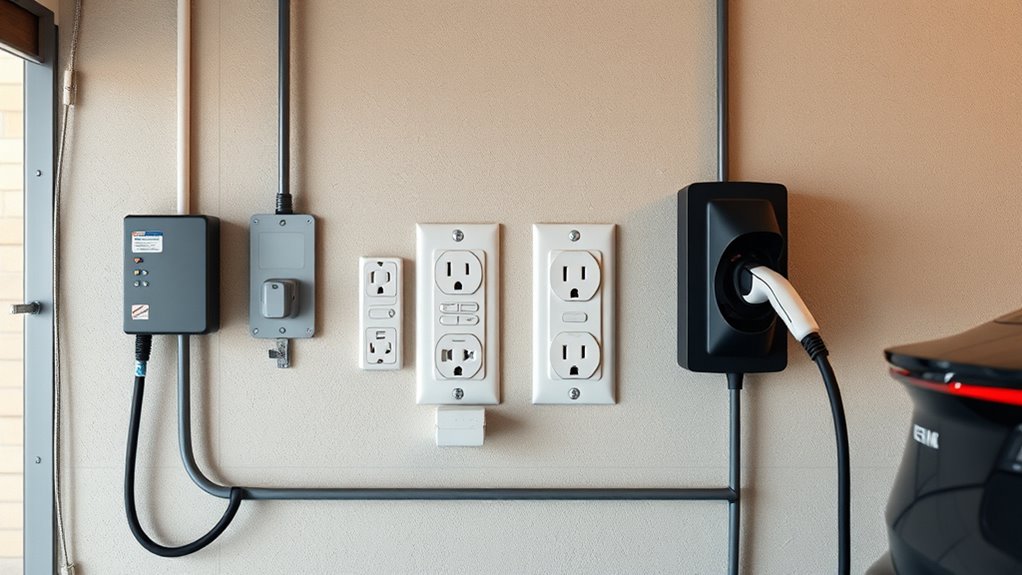
For home EV charging, the best NEMA outlet is the one that matches your EVSE plug, breaker size, wire run, panel capacity, and future charging plans. A NEMA 14-50 is the more flexible choice because it includes a neutral, while a NEMA 6-50 is a simpler 240V-only option that may cost less to install. Neither outlet is automatically faster by itself. Your actual charging speed depends on the EVSE output, circuit rating, vehicle onboard charger, and continuous-load limits.
Quick Answer
Choose a NEMA 14-50 if you want the widest plug-in charger compatibility and a neutral for other 120V/240V uses. Choose a NEMA 6-50 if your EVSE supports it and you want a dedicated 240V-only charging circuit with simpler wiring. For the fastest and cleanest long-term setup, hardwiring the charger is often better than either outlet.
Key Takeaways
- A NEMA 14-50 has two hot wires, a neutral, and a ground, so it is more flexible for EV chargers, RVs, ranges, and other mixed-voltage equipment.
- A NEMA 6-50 has two hot wires and a ground, so it is a good 240V-only EV charging outlet when your EVSE plug matches it.
- A 50A outlet does not mean 50A continuous EV charging. Many plug-in EVSE units run at 32A or 40A on a 50A breaker.
- A NEMA 14-30 dryer outlet can work only if the EVSE and adapter are rated correctly and the charge rate is limited to the circuit.
- Have a licensed electrician check the panel load, breaker, wire size, GFCI rules, receptacle grade, permit, and inspection requirements before installation.
At a Glance
| Best All-Around Outlet | NEMA 14-50 for broad plug-in charger and appliance compatibility |
| Lowest-Wire-Count Option | NEMA 6-50 for a 240V-only EVSE that does not need a neutral |
| Common Plug-In Output | Usually 32A or 40A on a 50A circuit, depending on the EVSE |
| Best Long-Term Setup | Hardwired Level 2 EVSE when you want fewer plug/receptacle heat points and higher supported output |
NEMA 14-50 Vs 6-50 for EV Charging
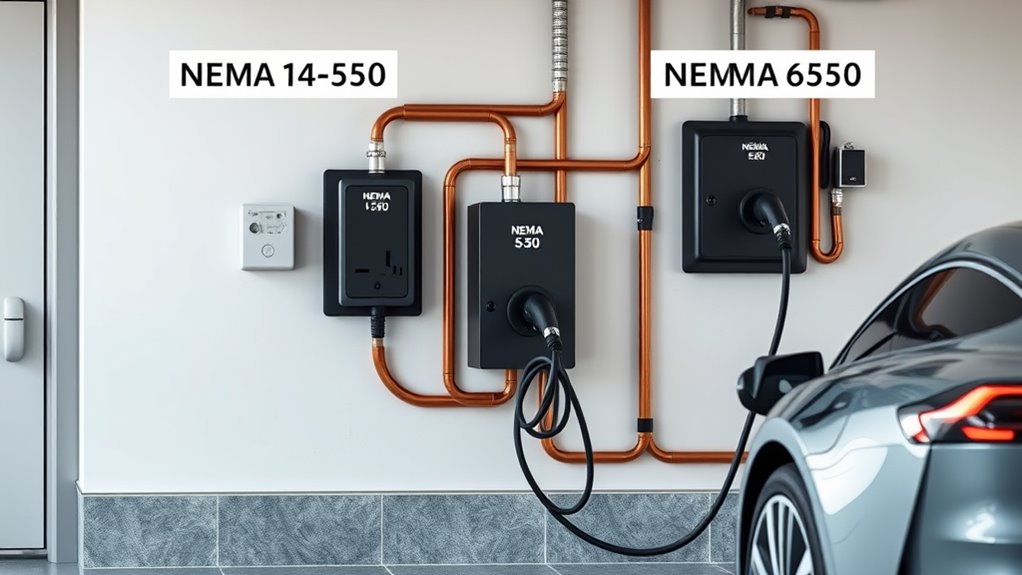
When you compare a NEMA 14-50 with a NEMA 6-50 for EV charging, the main difference is the neutral wire. A 14-50 has two hot conductors, one neutral, and one ground. A 6-50 has two hot conductors and one ground, with no neutral.
That neutral makes the 14-50 more flexible. It can serve equipment that needs both 120V and 240V power, such as some RV and range-style loads. For EV charging, though, most Level 2 plug-in EVSE units use the 240V hot-to-hot connection, so the neutral does not usually make the EV charge faster.
A NEMA 6-50 is still a strong EV charging choice when the charger has a 6-50 plug. It is common on welding-style 240V circuits and can support Level 2 charging when installed on the correct dedicated circuit. Its advantage is simplicity: fewer conductors and no neutral.
Note: The vehicle connector, such as J1772, NACS, or SAE J3400, is separate from the wall plug. The wall plug feeds the EVSE. The EVSE then communicates with the car and limits current based on the charger, circuit, and vehicle.
| Feature | NEMA 14-50 | NEMA 6-50 |
|---|---|---|
| Conductors | Two hots, neutral, ground | Two hots, ground |
| Voltage use | 120V/240V capable when wired to a split-phase system | 240V only |
| EV charging speed | Depends on EVSE and circuit, not the receptacle alone | Often similar to 14-50 when EVSE output is the same |
| Best use | Flexible home charging, RV-style compatibility, future equipment changes | Dedicated 240V EV charging when the EVSE plug matches |
| Main drawback | Extra neutral conductor can add cost | Less flexible for non-EV uses |
Why NEMA 6-50 Can Lower Install Costs
If you are focused on lowering the upfront cost of an EV charging installation, the NEMA 6-50 can have a wiring advantage over the 14-50. It normally needs two hot conductors and a ground, so it avoids the neutral conductor required by a NEMA 14-50.
That can matter most on long wire runs, detached garages, conduit installations, or jobs where copper cost and conduit fill affect the price. The savings are not guaranteed, though. Your final cost depends on the distance from the panel, conductor type, breaker type, GFCI requirements, permit fees, wall repair, receptacle grade, and local labor rates.
| Cost Driver | NEMA 6-50 Effect |
|---|---|
| Copper conductors | May reduce material cost because no neutral is needed |
| Conduit fill | May allow simpler routing on some installations |
| Labor | May be lower if the run is simpler and terminations are easier |
| Future flexibility | Lower than 14-50 because the outlet cannot serve loads needing a neutral |
For a dedicated EV charger with a 6-50 plug, this simpler setup can be practical. If you may later use the outlet for an RV, range-style appliance, or charger that comes with a 14-50 plug, the 14-50 may be worth the higher installation cost.
Match Your EVSE Plug Type First
Before choosing a receptacle, check the plug on your EVSE. Some plug-in Level 2 chargers come with a NEMA 14-50 plug. Others use NEMA 6-50, 14-30, 6-20, or a brand-specific adapter system. You should not install an outlet first and hope the charger fits later.
Your vehicle inlet also matters, but in a different way. A J1772, NACS, or SAE J3400 vehicle connector is on the car side of the charging cable. The NEMA plug is on the wall side of a plug-in EVSE. Adapters can help in some cases, but they must be listed, rated for the circuit, and approved by the EVSE or vehicle maker.
Warning: Do not use a random NEMA adapter, undersized extension cord, worn dryer outlet, or loose receptacle for EV charging. EV charging is a long continuous load, so a weak connection can overheat even if it seems fine with lighter equipment.
If your EVSE uses a NEMA 14-50 plug, install a matching 14-50 receptacle or choose the hardwired version if the manufacturer offers one. If your EVSE uses a NEMA 6-50 plug, a 6-50 receptacle can be clean and efficient. If you are buying a new charger anyway, compare the hardwired model before committing to any plug type.
Charging Speed Depends on the EVSE, Not Just the Outlet
A NEMA outlet is only part of the charging system. Your charging speed depends on four things: the circuit rating, the EVSE output setting, the car’s onboard AC charger limit, and the battery’s state of charge.
A 50A receptacle on a 50A breaker does not mean the car may pull 50A continuously. EV charging is treated as a continuous load, so the usable charging current is lower than the breaker rating. Many 50A plug-in setups are limited to 40A continuous, and some mobile connectors are limited to 32A even on a 50A outlet.
A 50A EV charging circuit commonly supports up to 40A continuous EVSE output, while some manufacturer mobile connectors limit 14-50 and 6-50 charging to 32A.
| Outlet / Setup | Typical Breaker | Common EVSE Output | Best For |
|---|---|---|---|
| NEMA 14-50 | 50A | 32A or 40A, depending on EVSE | Flexible plug-in Level 2 charging |
| NEMA 6-50 | 50A | 32A or 40A, depending on EVSE | Dedicated 240V-only charging |
| NEMA 14-30 | 30A | Up to 24A when supported | Overnight charging from a suitable dryer circuit |
| Hardwired EVSE | Varies by EVSE and load calculation | Often 40A, 48A, or higher where allowed | Permanent home charging with fewer plug heat points |
For many drivers, the difference between 32A and 40A is not a daily problem. If your car sits overnight, either can recover a normal commute. If you drive long distances every day, have a large battery, or share the charger between multiple EVs, the extra power from a properly sized hardwired setup may matter.
Dedicated Circuits and EV-Rated Outlets
Because EV charging places a sustained load on your electrical system, a Level 2 EVSE should use a dedicated circuit. That means the charger is not sharing the circuit with a dryer, welder, freezer, garage tools, lighting, or general receptacles.
A dedicated circuit helps prevent nuisance trips, overheating, and overloaded wiring. It also makes the installation easier to inspect and troubleshoot. The electrician should size the breaker, conductor, conduit, receptacle, box, torque settings, GFCI protection, and EVSE output according to the charger instructions and local code.
| Item | Why It Matters | What to Check |
|---|---|---|
| Dedicated circuit | Prevents shared-load overheating and trips | No other outlets or appliances on the circuit |
| Load calculation | Confirms the service and panel can handle the added load | Service size, major appliances, HVAC, existing loads |
| GFCI protection | Often required for garage/outdoor receptacle installations | Local NEC adoption and EVSE instructions |
| Receptacle grade | Poor contact tension can create heat under long loads | Industrial-grade or EV-rated device where appropriate |
| Permit and inspection | Protects you, the home, and future resale documentation | Local authority having jurisdiction requirements |
For plug-in EV charging, do not treat the receptacle like a normal convenience outlet. EV charging can run for hours at high current. A small installation mistake, weak connection, or loose terminal can become a heat problem over time.
When NEMA 14-50 Is the Better Choice
You should choose a NEMA 14-50 when you want the most flexible plug-in home charging option. It is widely supported by Level 2 EVSE makers, common on portable charging adapters, and useful beyond EV charging because it includes a neutral.
A 14-50 makes sense if you are not sure which charger you will use in the future, if you may change EV brands, or if you want a receptacle that can also serve compatible RV-style or range-style loads. It is also a common default recommendation because many buyers recognize the plug.
The tradeoff is cost. A 14-50 normally requires an extra conductor compared with a 6-50, and the neutral must be properly sized and terminated even if your EVSE does not use it for charging.
Higher Power Flexibility
A NEMA 14-50 gives you flexibility, but it does not automatically give you more charging power than a NEMA 6-50 on the same breaker and EVSE output. The outlet can be installed on a 50A circuit, yet the EVSE still sets the safe charging current.
For example, some mobile connector systems use a 50A breaker but limit output to 32A. Other plug-in Level 2 chargers may support 40A on a 50A circuit. Higher outputs usually require hardwiring and a properly sized circuit.
- Use 14-50 for compatibility when your charger plug is 14-50 or you want broader future options.
- Use 6-50 for simplicity when your charger plug is 6-50 and the circuit is dedicated to EV charging.
- Use hardwired EVSE when you want a permanent setup with fewer plug/receptacle heat points.
Future-Proof Charging Plans
If you are planning for future EVs, bigger batteries, or multiple drivers, focus on the whole charging system, not only the outlet. The most future-ready plan starts with a load calculation and asks whether your panel can support the charging speed you want.
A NEMA 14-50 is more future-friendly than a 6-50 for plug compatibility because it includes a neutral and is more common among portable EVSE options. A hardwired charger may be more future-friendly than both if you want higher output, cleaner installation, and fewer concerns about worn receptacle contacts.
Also remember that vehicle connectors are changing. Many North American EVs are moving toward NACS/SAE J3400, but that does not remove the need to size your home circuit correctly. The wall-side choice still comes down to plug-in NEMA outlet versus hardwired EVSE.
When NEMA 6-50 Is the Better Choice
A NEMA 6-50 is the better choice when your EVSE already has a 6-50 plug and you know the circuit will be used only for 240V charging. It avoids the neutral conductor, which can simplify the job and may reduce cost on longer runs.
It is also a practical option when you are replacing or reusing a suitable 240V circuit, such as a former welder outlet, after an electrician confirms the breaker, wire, grounding, box, receptacle condition, GFCI requirements, and EVSE output setting.
The drawback is flexibility. If your next charger has a 14-50 plug, you should not force the mismatch with a cheap adapter. You would either need the correct listed adapter, a new EVSE cord/plug option approved by the manufacturer, or a receptacle change by an electrician.
Hardwired Vs Plug-In EV Charging
A plug-in EVSE is convenient because you can unplug the unit, replace it more easily, or move it if you relocate. It also lets you use portable chargers that support several manufacturer adapters.
A hardwired EVSE is usually cleaner for a permanent home setup. It removes the receptacle and plug connection as a heat point, may avoid some nuisance GFCI issues depending on the equipment and local code, and can support higher output when the panel and wiring are sized for it.
Pro Tip: If you are installing new wiring and the charger will stay in one place, price both options. A hardwired EVSE can cost a little more upfront but may be the better long-term charging setup.
| Setup | Pros | Cons |
|---|---|---|
| Plug-in NEMA 14-50 | Broad compatibility, easy EVSE replacement, common plug type | Needs neutral, receptacle can wear, usually limited to plug-in output |
| Plug-in NEMA 6-50 | Simpler 240V circuit, may reduce conductor cost | Less common for some EVSE models, no neutral |
| Hardwired EVSE | Fewer heat points, cleaner permanent setup, may support higher output | Less portable, electrician needed for replacement or relocation |
Charging From a NEMA 14-30 Dryer Outlet
A NEMA 14-30 dryer outlet can be a practical EV charging source if the outlet, wiring, breaker, and EVSE are all rated for the job. It supplies 240V on a 30A circuit, so the maximum continuous EV charging output is typically limited to 24A.
That can still be enough for overnight charging. Depending on the car and efficiency, a 24A Level 2 setup may recover a normal commute while you sleep. It is not as fast as a 40A Level 2 charger, but it can be a useful lower-cost option when a suitable dryer circuit is already in the right location.
A NEMA 14-30 outlet can support overnight EV charging when the EVSE is limited to the circuit rating, but it should not be shared with the dryer at the same time.
- Verify compatibility: your EVSE must support the 14-30 plug or an approved 14-30 adapter.
- Limit current: set the EVSE at or below the safe continuous output for the circuit, often 24A on a 30A breaker.
- Inspect the outlet: replace worn, loose, heat-damaged, or old receptacles before using them for EV charging.
- Avoid sharing loads: do not run the dryer and EV charger on the same circuit at the same time.
If the dryer outlet is far from the parking spot, do not solve the distance problem with a light-duty extension cord. Ask an electrician about a properly located new circuit, a listed EVSE solution, or a hardwired charger.
Panel Capacity and Load Calculation
A 200A electrical service is often enough for a house with one EV charger, but it is not automatic. Large HVAC equipment, electric heat, electric water heating, pool equipment, workshops, second kitchens, and other major loads can change the calculation.
Your electrician should perform a load calculation before adding a high-power Level 2 EVSE. If the panel is tight, you may still have options. A lower-amp charger, a 24A dryer-style circuit, a smart load management device, or a charger with adjustable output can sometimes avoid a full service upgrade.
The safest approach is to decide how much range you really need overnight. Many drivers do not need the maximum possible charging output. A correctly sized slower Level 2 setup is usually better than an oversized circuit that strains the panel or fails inspection.
Frequently Asked Questions
What size outlet for EV charging?
For many plug-in Level 2 home chargers, a NEMA 14-50 on a dedicated 50A circuit is the most common choice. A NEMA 6-50 can work just as well when your EVSE has a 6-50 plug. A NEMA 14-30 dryer outlet can work for lower-power charging when the EVSE is limited to the circuit. The outlet should always match the EVSE plug, breaker, wire size, and local code.
What is the 80/20 rule for EV charging?
For electrical circuits, people often use “80% rule” to mean that a continuous EV charging load should not exceed 80% of the breaker rating. For example, a 50A circuit commonly supports up to 40A continuous EVSE output, and a 30A circuit commonly supports up to 24A. For battery care, “80/20” can also mean keeping daily battery charge roughly between 20% and 80%, but that is a separate battery-management topic.
Is 200 amps enough for a house with an EV charger?
A 200A service is often enough for one EV charger, but you should not assume it. The answer depends on the home’s existing electrical loads and the charger output you want. A licensed electrician can perform a load calculation and may recommend a lower-amp charger, load management, or a panel/service upgrade if needed.
What size wire for 50 amp Romex for a 50 amp car charger?
Many 50A indoor NM-B cable installations use 6 AWG copper, but the correct wire size depends on conductor type, temperature rating, terminals, distance, voltage drop, raceway, local code, and the EVSE nameplate. A NEMA 14-50 circuit generally needs two hots, neutral, and ground. A NEMA 6-50 circuit generally needs two hots and ground. Have the electrician size the conductors for the actual installation, not just the receptacle name.
Is NEMA 14-50 faster than NEMA 6-50?
Not by itself. If both outlets are on properly installed 50A circuits and the EVSE output is the same, charging speed can be the same. The 14-50 is more flexible because it has a neutral. The 6-50 is simpler because it is 240V only.
Should I install a NEMA outlet or hardwire my EV charger?
Install a NEMA outlet if you need portability or your charger is designed as a plug-in unit. Hardwire the charger if you want a permanent setup, fewer plug/receptacle heat points, and possibly higher output where your panel and wiring allow it. Many homeowners choose hardwired EVSE for a long-term garage installation.
Conclusion
Choosing between a NEMA 14-50 and a NEMA 6-50 comes down to flexibility, cost, and the EVSE you plan to use. A NEMA 14-50 is usually the safer all-around recommendation when you want broad compatibility and a neutral for future equipment. A NEMA 6-50 is a smart dedicated 240V charging choice when your charger plug matches and you want simpler wiring.
Do not choose by outlet size alone. Match the receptacle to the EVSE plug, set the charger output correctly, use a dedicated circuit, confirm panel capacity, and follow local electrical code. For a permanent setup, compare both plug-in options against a hardwired EVSE before you spend money on the installation.
Sources
- U.S. Department of Energy Alternative Fuels Data Center: Electric Vehicle Charging Stations — backs Level 1, Level 2, connector, charging-power, and NEC Article 625 context.
- Tesla Mobile Connector Support — backs example NEMA 14-50, 6-50, and 14-30 adapter outputs.
- Tesla Gen 2 NEMA Adapters — backs household outlet adapter compatibility and estimated charging miles per hour.
- NEMA ANSI/NEMA WD 6 Wiring Devices Dimensional Specifications — backs NEMA plug and receptacle configuration standards.
- NFPA 70 National Electrical Code — backs the need to follow current electrical code, local adoption, and inspection requirements.