
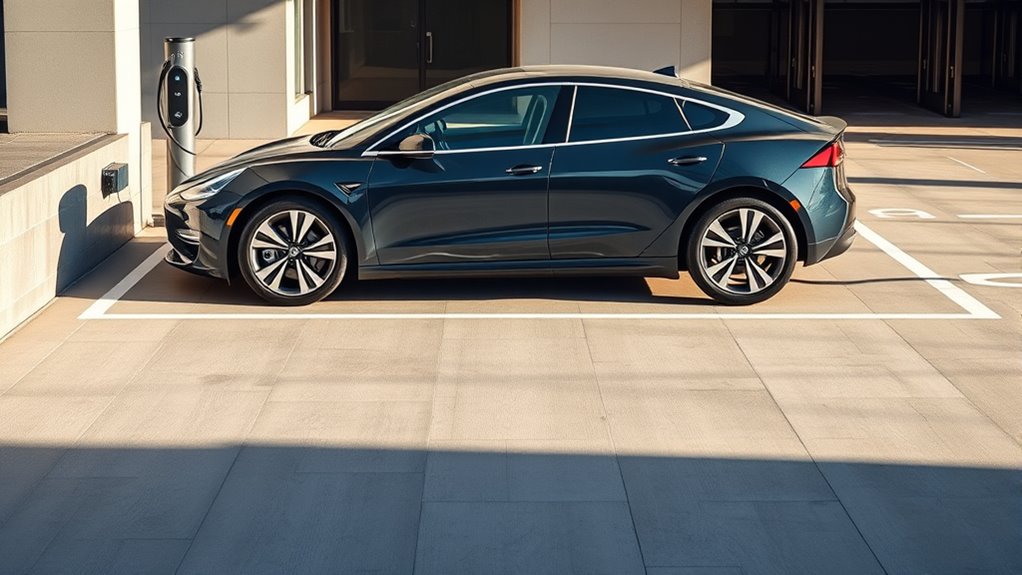
You can plan a basic passenger-car EV charging space around a 9-foot by 18-foot stall, but that is only the starting point. The final layout depends on the charger type, local parking code, accessibility rules, cable reach, bollards, electrical equipment, and vehicle movement around the charger.
Quick Answer
For a standard EV charging space, start with about 9 feet wide by 18 feet long. For an accessible EV charging space with mobility features, the U.S. Access Board recommends at least 11 feet wide by 20 feet long, plus a 5-foot access aisle. DC fast chargers often need more room for cabinets, bollards, cable reach, and queueing.
Key Takeaways
- A 9-foot by 18-foot stall is a common planning baseline for a standard passenger EV space, not a universal code rule.
- Accessible EV charging spaces need more room than standard parking because drivers may need to move around the vehicle with the charging connector.
- Accessible mobility-feature spaces should be nearly level, with slopes no steeper than 1:48 where accessibility standards apply.
- Level 2 chargers usually fit within normal parking layouts, while DC fast chargers need extra space for power cabinets, bollards, and vehicle circulation.
- Always confirm your local building, zoning, electrical, fire, and accessibility rules before striping or installing equipment.
At a Glance
| Time Required | 1–3 hours for a rough layout review; longer for engineered plans, permits, utility coordination, and construction. |
| Difficulty | Moderate for layout planning; advanced when accessibility, electrical service, trenching, and DC fast charging equipment are involved. |
| Tools Needed | Site plan, tape measure or laser measure, charger cut sheet, utility data, local code checklist, and accessibility route review. |
| Cost | Low for striping changes only; much higher for trenching, panel upgrades, transformers, bollards, networking, and DC fast charger hardware. |
How Big Is an EV Charging Space?
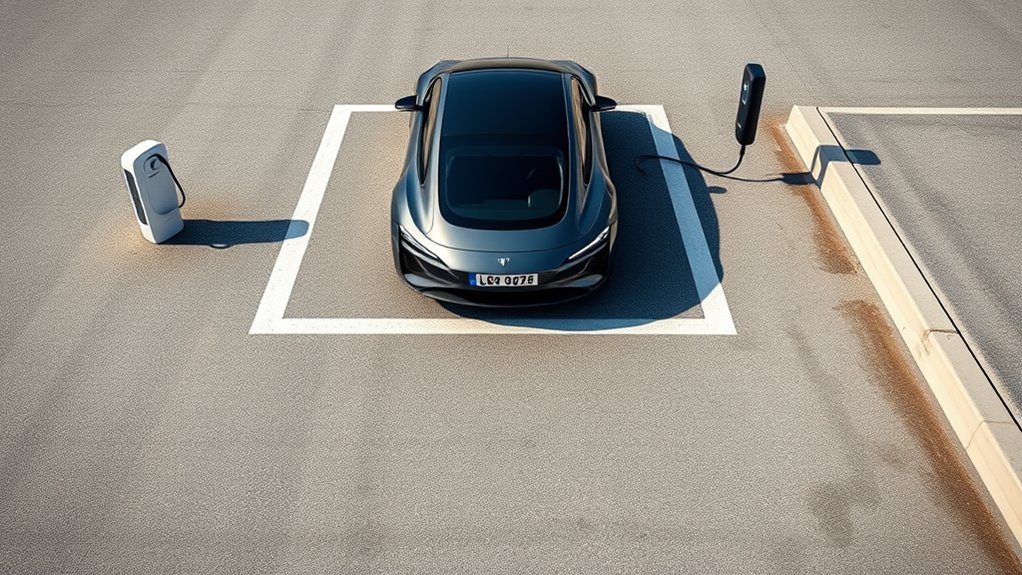
A standard EV charging space for a passenger vehicle is often planned at about 9 feet wide by 18 feet long. That size fits many cars and small SUVs, but it does not automatically make the space code-compliant. You still need room for the charger, cable movement, wheel stops, bollards, signs, door swing, and safe pedestrian travel.
For wider vehicles, angled parking, high-turnover public sites, or chargers with short cables, a 10-foot by 20-foot stall may work better. DC fast charging sites often need even more total area because the charger cabinet, power cabinet, transformer, protective bollards, and queueing space may sit outside the painted stall.
Note: Treat 9 feet by 18 feet as a planning baseline, not a legal shortcut. Local zoning, building, accessibility, fire, and electrical rules control the final design.
| Space Type | Practical Planning Size | Best Use |
| Standard passenger EV space | About 9 ft × 18 ft, or larger if local code requires | Workplaces, apartments, retail lots, and light-duty Level 2 charging |
| Accessible mobility-feature EV space | At least 11 ft × 20 ft plus a 5 ft access aisle, based on U.S. Access Board guidance | Public or shared chargers where users with mobility devices need independent access |
| Pull-through EV charging lane | At least 16 ft wide is recommended for pull-through charging layouts | Trailers, fleet vehicles, larger EVs, and highway charging sites |
| DC fast charging bay | Stall size plus extra area for cabinets, bollards, transformer access, cable reach, and queueing | Travel centers, public fast charging hubs, and high-demand commercial sites |
EV Parking Requirements by Lot Size
Your required number of EV spaces depends on the code adopted where the project is built. Some places use a percentage of total parking. Others use tables based on occupancy, building type, or lot size. Some codes separate EV-capable, EV-ready, EVSE-installed, and accessible EV charging spaces.
Do not assume one national lot-size table applies everywhere. A 40-space apartment lot, a 100-space office lot, and a 200-space retail lot may fall under different rules depending on the state, city, code cycle, and whether the project is new construction, an alteration, or a federally funded charging site.
Warning: EV charging layout mistakes can trigger permit delays, re-striping, accessibility complaints, or electrical redesign. Confirm the adopted code and local amendments before ordering equipment or pouring concrete.
Lot Size Thresholds
Use your total parking count as the starting point, then apply the local requirement. A good review process looks like this:
- Count all parking spaces on the site after any restriping or construction changes.
- Identify the building use, such as multifamily, workplace, retail, hotel, school, or public facility.
- Check whether the code requires EV-capable, EV-ready, or EVSE-installed spaces.
- Check how many spaces need accessible mobility features.
- Round up where the code requires whole-space rounding.
- Confirm whether EV spaces count toward the minimum parking count.
If your local rule says 5% of a 100-space lot must be EV-ready, you would plan 5 EV-ready spaces. If the same code also says a percentage must be accessible, round that accessible count up as required. This is only an example; your local rule may use a different percentage, threshold, or definition.
Required EV Space Counts
When you calculate the required EV space count, separate the space count from the charger count. One dual-port charger may serve two parking spaces, but one port normally charges only one vehicle at a time. For public charging sites, that difference matters because drivers care about available charging ports, not just painted stalls.
For federally funded public charging projects covered by 23 CFR Part 680, the rules can be more specific. Corridor-serving DC fast charging stations must have at least four network-connected DCFC ports and must be able to charge at least four EVs at the same time. Those federal rules also include payment, uptime, access, data, and ADA-related requirements.
EV Make-Ready vs. Charger Space Sizes
EV make-ready spaces are spaces prepared for future charging. They may include electrical panel capacity, raceway, conduit, junction boxes, or wiring, depending on the code definition. A charger space has installed EVSE ready for use.
The painted stall should be planned so a make-ready space can later become a working charger space without tearing up the site. That means you should think beyond the parking rectangle and plan for charger placement, cable reach, wheel stops, bollards, signage, accessible route connections, and electrical service access.
- Keep future charger equipment out of pedestrian paths and access aisles.
- Leave enough clearance for charger maintenance and cabinet doors.
- Place conduit so it does not force the charger into a bad position later.
- Check whether future accessible conversion will require a wider stall or access aisle.
- Plan for snow storage, drainage, lighting, and trip hazards if the site is outdoors.
Pro Tip: Put charger cut sheets on the site plan early. The cable length, connector height, cabinet door swing, bollard spacing, and required service clearance can change the layout before the first stripe is painted.
Accessible EV Charging Space Sizes
Accessible EV charging needs more room than a standard parking space because the user may need to exit the vehicle, move around the vehicle, reach the charger, handle the connector, and plug into a charge port that may be on the front, rear, driver side, or passenger side of the EV.
The U.S. Access Board recommends that EV charging spaces with accessible mobility features provide a vehicle charging space at least 11 feet wide and 20 feet long, plus an adjoining access aisle at least 5 feet wide. State and local codes can set their own scoping requirements for how many accessible charging spaces are required.
Accessible Route Requirements
Accessible EV charging spaces must connect to an accessible route where ADA, ABA, state, or local accessibility standards apply. The route should connect the access aisle, charger controls, payment area, and any building or facility served by the charging station.
- Keep the access aisle connected to the charger’s clear floor or ground space.
- Do not block the access aisle with bollards, wheel stops, curbs, cable slack, signs, or snow storage.
- Keep accessible surfaces firm, stable, slip-resistant, and nearly level.
- Hold slopes and cross slopes to 1:48 maximum where accessibility standards apply.
- Place operable parts within accessible reach ranges.
Minimum Space Dimensions
For accessible mobility-feature EV spaces, use the 11-foot by 20-foot vehicle space plus a 5-foot access aisle as the practical federal guidance baseline. A shared access aisle may work in some layouts, but the charger position and cable reach must still allow both vehicles to charge without blocking movement.
Do not simply convert an existing accessible parking space into an EV charging space without checking the full parking count. Removing or restricting an accessible parking space can reduce overall site accessibility below the required minimum. If you convert one, you may need to add an accessible parking space elsewhere.
Aisle Width, Slope, and Clearance Rules
Aisle width, slope, and clearance rules affect how the charging area works in real life. A stall can look large enough on paper but still fail if the cable cannot reach, the door cannot open, the user cannot reach the screen, or another vehicle blocks the turning path.
For standard EV parking, drive-aisle width depends on your local parking code, stall angle, one-way or two-way traffic, and fire access needs. For accessible EV charging, the access aisle must stay clear and connect to the accessible route and charger controls.
- Keep accessible charging spaces and access aisles as level as possible, with slope no steeper than 1:48 where required.
- Keep charger controls, payment hardware, and connector holsters reachable from a clear floor or ground space.
- Use bollards to protect equipment, but do not place them inside the access aisle or required clear floor space.
- Check turning movement for large EVs, vans, and vehicles that need to back into the charger.
- Leave enough service clearance around electrical cabinets and transformers.
- Provide lighting so users can read the screen, find the connector, and move safely at night.
What Codes Govern EV Parking?
No single code answers every EV parking layout question. Most projects need to satisfy several layers of rules:
- Local zoning and parking code: stall dimensions, drive aisles, setbacks, landscaping, signage, and minimum parking counts.
- Building and accessibility codes: accessible routes, slopes, reach ranges, access aisles, and the number of accessible spaces.
- Electrical code: circuit sizing, overcurrent protection, disconnects, grounding, raceways, load calculations, and EVSE installation requirements.
- Fire and life safety review: emergency access, equipment protection, clearances, and site circulation.
- Utility requirements: service capacity, transformer placement, metering, trenching, and demand charges.
- Federal requirements: projects using NEVI or other Title 23 funds must follow 23 CFR Part 680, including requirements for ports, power, uptime, payment access, data sharing, and ADA compliance.
In California, EV charging projects may also need to satisfy the California Building Code, CALGreen, local amendments, and Chapter 11B accessibility provisions. In other states, the controlling rule may come from the International Building Code, a statewide EV-readiness law, or a municipal ordinance.
Planning for Level 2 and DC Fast Chargers
Level 2 charging is easier to fit into ordinary parking lots because the charger is usually smaller and can be pedestal-mounted or wall-mounted. Under federal NEVI definitions, AC Level 2 operates on a 208-volt to 240-volt circuit. For a workplace, apartment, hotel, or retail lot, a standard 9-foot by 18-foot stall may work if the charger, cable, and accessible route are placed correctly.
DC fast charging needs more room. The charger may include a large dispenser, power cabinet, switchgear, transformer, bollards, cooling clearance, and service access. DCFC cables can also be shorter and heavier, so the stall orientation must match common vehicle charge-port locations.
- Use wider spaces where drivers may need to back in or pull through.
- Plan queueing so waiting vehicles do not block drive aisles or accessible routes.
- Keep power cabinets outside pedestrian paths and protected from vehicle impact.
- Coordinate transformer and utility equipment before final striping.
- Check whether the site needs trailer-friendly pull-through charging.
For federally funded corridor DCFC sites, the station must generally support at least four charging ports, simultaneous charging for four EVs, at least 150 kW per DCFC port for corridor-serving sites, accessible payment methods, and an average annual uptime greater than 97% per charging port.
How to Check Your EV Charging Space Before Installation
Before installation, walk the site with the charger cut sheet, a tape measure, and a marked-up plan. Check the painted stall, the equipment location, and the path a driver will actually use.
- Measure the stall: Confirm width, length, wheel-stop position, and door clearance.
- Check charger reach: Make sure the cable can reach front, rear, driver-side, and passenger-side charge ports where practical.
- Review the accessible route: Keep the route continuous, level, and free of bollards, curbs, signs, and cable slack.
- Place equipment safely: Leave service clearance for cabinets, panels, transformers, and disconnects.
- Protect the charger: Add bollards or curbs where needed without blocking access aisles or clear floor space.
- Confirm electrical capacity: Verify panel capacity, load management, conduit route, utility service, and permit requirements.
- Plan signs and markings: Make the charging-only use clear without creating confusion around accessible EV spaces.
Common EV Charging Layout Mistakes
Most EV charging layout problems come from treating the charger like a simple parking accessory. It is not. The driver needs space to park, exit, reach the charger, handle the cable, start payment, and leave without conflict.
- Using only the stall size: The charger, cabinet, bollards, and cable path need their own space.
- Blocking the access aisle: Bollards, wheel stops, signs, and cable slack can make an accessible space unusable.
- Ignoring charge-port locations: EV charge ports vary by make and model, so cable reach matters.
- Creating steep accessible spaces: A sloped stall or aisle can make transfers unsafe.
- Removing accessible parking: Converting accessible parking to charging can reduce required parking access if not replaced correctly.
- Forgetting maintenance clearance: Cabinets and transformers need room for technicians to work safely.
- Underplanning DCFC queueing: Waiting vehicles can block drive aisles, accessible routes, or fire lanes.
Frequently Asked Questions
How much space is required for an EV charging station?
For a standard passenger-vehicle EV charging space, start around 9 feet by 18 feet. For an accessible EV charging space with mobility features, plan at least 11 feet by 20 feet plus a 5-foot access aisle, then add room for the charger, bollards, cabinet clearance, and the accessible route.
What is the 80/20 rule for EV charging?
The 80/20 rule usually refers to battery charging habits, not parking-space dimensions. Many EV drivers charge from about 20% to 80% during daily use or fast charging to reduce wait time and battery stress. Do not use the 80/20 rule as a code requirement for station layout.
What size outlet do you need to charge an electric car?
Level 1 charging uses a standard 120-volt household-type circuit. Level 2 charging commonly uses 208–240 volts. DC fast charging is not just a simple wall outlet; it uses dedicated high-power equipment connected to commercial electrical service, often with utility upgrades and engineered plans.
What size should a parking space be?
A common passenger-car parking stall is about 9 feet wide by 18 feet long, but local parking codes may require different dimensions. EV charging spaces may also need added room for the charger, access aisle, bollards, signs, and cable movement.
Is a 9-foot by 18-foot stall enough for DC fast charging?
Sometimes, but do not assume it is enough. DC fast charging often needs extra space for cabinets, transformers, protective bollards, cable reach, cooling clearance, technician access, and vehicle queueing. Pull-through or trailer-friendly sites need a larger layout.
Do accessible EV charging spaces have to be reserved only for disabled drivers?
That depends on state or local code and signage rules. The U.S. Access Board notes that some accessible EV charging spaces may use a “use last” approach rather than being reserved only for disability placard holders, but local rules can require different signage or restrictions.
Conclusion
When you plan an EV charging space, start with the vehicle stall, but do not stop there. A standard passenger EV space is often planned around 9 feet by 18 feet, while accessible EV charging spaces need more room for independent use. DC fast charging can require a larger site envelope because of cabinets, transformers, bollards, cable reach, and queueing.
The U.S. public charging network is growing fast. The U.S. Department of Energy’s Alternative Fuels Data Center listed 81,187 public electric station locations and 253,002 public charging ports as of July 8, 2026. That growth makes good layout even more important. A charger is only useful when the space around it is safe, reachable, code-compliant, and easy to use.
Sources
- U.S. Access Board: Design Recommendations for Accessible Electric Vehicle Charging Stations — accessible EV charging space width, length, access aisle, routes, slopes, and charger usability.
- 23 CFR Part 680: National Electric Vehicle Infrastructure Standards and Requirements — NEVI-funded charger port, power, payment, uptime, data, and ADA-related requirements.
- U.S. Department of Energy Alternative Fuels Data Center: Alternative Fueling Station Counts by State — current public electric station and charging port counts.
- eCFR: AC Level 2 and DCFC Definitions — federal definitions for AC Level 2 and DC fast charging in covered projects.