
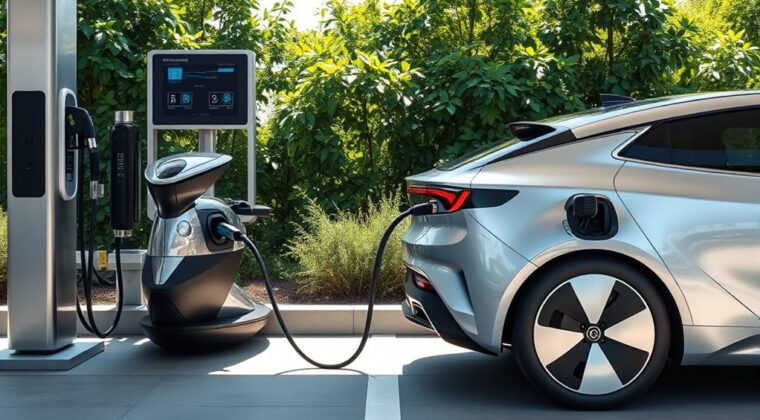
When you compare a plug-in hybrid electric vehicle (PHEV) with a fully electric vehicle (EV), the biggest charging difference is battery size. A PHEV has a smaller battery plus a gasoline engine, so it usually costs less and takes less time to fully charge. An EV has a much larger battery, so a full charge costs more, but it gives you much more electric-only range and no tailpipe emissions while driving.
Quick Answer
Choose a PHEV if you want short electric commutes with gasoline backup for road trips. Choose an EV if you can charge at home or nearby and want the lowest tailpipe emissions, less routine maintenance, and longer all-electric driving. Charging cost depends on battery size, electricity rate, and charger type.
Key Takeaways
- A PHEV usually charges faster at home because its battery is smaller, but it still burns gasoline after the electric range is used.
- An EV costs more to fully charge because the battery is larger, but each electric mile is often cheaper than gasoline driving.
- EVs have zero tailpipe emissions, while PHEVs have zero tailpipe emissions only when operating in electric mode.
- The best choice depends on your commute, home charging access, public charging access, road-trip habits, and local electricity prices.
Understanding Plug-In Hybrids and Electric Vehicles
A plug-in hybrid electric vehicle, or PHEV, uses a rechargeable battery, an electric motor, and a gasoline engine. According to the U.S. Department of Energy’s Alternative Fuels Data Center, current PHEVs can often drive about 15 to 60-plus miles on electricity before the gasoline engine takes over.
A fully electric vehicle, often called an EV or BEV, runs only on electricity. FuelEconomy.gov explains that EVs are powered by rechargeable battery packs and emit no tailpipe pollutants, although emissions from electricity generation vary by region.
A PHEV is best viewed as an electric car for short trips and a hybrid for long trips. An EV is best viewed as a fully electric car that depends on charging instead of gasoline.
Key Charging Differences Between PHEVs and EVs
The main charging difference is simple: PHEVs have smaller batteries, while EVs have larger batteries. That affects charge time, full-charge cost, road-trip planning, and how much you rely on public charging.
| Feature | PHEV | EV |
|---|---|---|
| Power source | Battery plus gasoline engine | Battery only |
| Typical electric range | Often about 15 to 60-plus miles, depending on model | Often 100-plus miles, with many models over 200 miles and some over 400 miles |
| Home charging | Usually practical on Level 1 or Level 2 because the battery is smaller | Best with Level 2 home charging for overnight use |
| Public fast charging | Limited; only some PHEVs support DC fast charging | Common on modern EVs, but speed depends on the car and charger |
| Tailpipe emissions | None in electric mode; gasoline emissions in hybrid mode | None while driving |
| Best fit | Drivers with short commutes, limited charging access, or frequent long trips | Drivers with reliable charging access who want full electric driving |
How Much Will Charging Cost You?
The cleanest way to estimate charging cost is to use this formula:
Battery energy added in kWh × your electricity price per kWh = charging cost before charging losses.
For example, if you add 18 kWh to a PHEV battery and your home electricity rate is $0.18 per kWh, the basic energy cost is about $3.24 before small charging losses. If you add 75 kWh to an EV battery at the same rate, the basic energy cost is about $13.50 before losses.
Note: Public DC fast charging usually costs more than home charging. Some networks charge by kWh, some by minute, and some add session or idle fees. Always check the app price before plugging in.
Charging Cost Comparison
A PHEV often costs less for a full charge because its battery is much smaller. That does not always mean it is cheaper overall. If you rarely plug it in, you will buy more gasoline and lose much of the PHEV’s electric-driving advantage.
An EV costs more for a full charge because the battery is larger, but it also travels much farther on that charge. For daily driving, an EV can be cheaper per mile than a gasoline vehicle when you charge at home at a reasonable electricity rate.
Home Charging Expenses
Home charging is usually the most convenient and predictable option. The Department of Energy notes that most EV owners do most of their charging at home, often with Level 1 or Level 2 equipment. Level 1 uses a standard 120-volt outlet, while Level 2 uses 240 volts in many homes.
Level 1 can work well for many PHEVs because they have smaller batteries. For a full EV, Level 1 may be too slow if you drive a lot each day. Level 2 is usually the better home setup for EV owners because it can add far more range overnight.
Public Charging Rates
Public charging matters more for EVs than PHEVs. A PHEV can keep driving on gasoline after the battery is depleted, but an EV needs a working charger on longer trips.
The Alternative Fuels Data Center explains that charging time varies by battery size, state of charge, vehicle charger capacity, charger output, and electrical service. DC fast charging can be much quicker than Level 2, but the fastest rate usually occurs below about 80% battery charge and only if the vehicle can accept that power.
When to Choose a PHEV vs. an EV: Evaluating Your Driving Needs
Start with your normal week, not the rare road trip. Your daily commute, parking situation, and charging access matter more than a single advertised range number.
- Choose a PHEV if your daily driving is short: If most of your trips fit inside the vehicle’s electric range, you can do much of your week on electricity and still have gasoline backup.
- Choose a PHEV if public charging is weak near you: You can still refuel quickly at gas stations when charging is unavailable.
- Choose an EV if you can charge at home: Home Level 2 charging makes EV ownership much easier because you can start most days with a useful charge.
- Choose an EV if you want the cleanest tailpipe result: EVs produce no tailpipe emissions while driving, which helps local air quality.
- Choose an EV if you want less routine maintenance: EVs do not need oil changes, spark plugs, exhaust repairs, or many engine-related services.
Pro Tip: If you can charge at home and your usual daily driving is under 40 miles, both options can work. The tie-breaker is your long-trip comfort: choose a PHEV if you want gasoline backup, or an EV if you are comfortable planning charging stops.
Charging Time: How Long?
Charging time depends on three things: the battery size, the power of the charger, and how much charge the battery already has. This is why a small PHEV battery may fill overnight from a regular outlet, while a large EV battery may need Level 2 charging for practical daily use.
Charging Speed Comparison
Level 1 charging uses a standard 120-volt household outlet. It is slow, but it may be enough for a PHEV or for an EV driver who only needs to replace a small amount of range each day.
Level 2 charging uses higher-power AC charging. The Department of Energy says Level 2 commonly uses 240 volts in homes and 208 volts in commercial settings, with power levels ranging from 2.9 to 19.2 kW. This is the usual overnight home-charging choice for many EV owners.
DC fast charging is the fastest public option for compatible vehicles. It is mainly useful for road trips, quick top-ups, and fleet use. Most fully electric vehicles support some form of DC fast charging, but many PHEVs do not.
Home Charging Options
For a PHEV, a standard outlet may be enough if you plug in every night. A Level 2 charger can still be helpful if you want faster turnaround between trips.
For an EV, Level 2 home charging is usually the better long-term setup. It can add enough range overnight for most daily driving, and it lets you avoid relying on public chargers for routine use.
Warning: Do not run EV charging through damaged outlets, loose extension cords, or overloaded circuits. Use manufacturer-approved charging equipment and have a qualified electrician evaluate any new 240-volt circuit.
Environmental Impact of PHEVs vs. EVs: Emissions and Sustainability
EVs have the strongest local air-quality advantage because they produce zero tailpipe emissions. The U.S. Environmental Protection Agency notes that EVs typically have a smaller carbon footprint than gasoline cars, even when electricity generation is considered, but the exact benefit depends on the local power mix.
PHEVs can also reduce emissions when you charge them often and drive in electric mode. The problem is that a PHEV’s benefits drop when you stop plugging it in. Once it runs in gasoline mode, it produces tailpipe emissions like other combustion vehicles, though often with better fuel economy than a non-hybrid vehicle.
Battery production also matters. EVs may have higher manufacturing emissions than comparable gasoline vehicles because of the battery, but EPA explains that lifetime greenhouse gas emissions are typically lower than those from an average gasoline-powered vehicle. Cleaner electricity and better battery recycling can improve that advantage over time.
What Happens if You Never Plug In a PHEV?
If you never plug in a PHEV, it works more like a regular hybrid with extra battery weight. You can still drive it, but you lose the main reason to buy a plug-in hybrid: electric miles.
That means your fuel savings may shrink, your gasoline use may rise, and your emissions benefit may be much lower than expected. If you know you will almost never plug in, a regular hybrid or a fully electric vehicle with reliable charging access may be a better fit.
Battery Life and Long-Term Ownership
Both PHEVs and EVs use high-voltage battery packs designed for long service life. Range can slowly decline over time, especially with age, heat, frequent fast charging, and high mileage. That does not mean the battery automatically fails after a certain year.
EPA notes that EV battery replacements due to failure are uncommon in recent data. For used vehicles, check the battery warranty, current range estimate, charging history if available, and whether the vehicle has had any battery-related recalls or software updates.
Frequently Asked Questions
What is the main disadvantage of a plug-in hybrid?
The main disadvantage is complexity. A PHEV has both electric-drive parts and gasoline-engine parts, so it may need more types of maintenance than an EV. It also only delivers its best fuel savings and lowest emissions when you plug it in regularly.
What is better, a plug-in hybrid or an EV?
An EV is usually better if you have reliable charging access and want full electric driving with no tailpipe emissions. A PHEV is usually better if you want electric driving for short trips but still need gasoline backup for long trips or areas with limited charging.
What happens to electric cars after 8 years?
Most EVs do not suddenly stop working after 8 years. The battery may lose some range over time, but failure is not automatic. Before buying a used EV, review the battery warranty, remaining range, service history, and any battery-health report available from the vehicle or dealer.
What happens if you never plug in a plug-in hybrid?
It will still drive, but it will behave more like a regular hybrid. You will miss most of the electric-driving savings, and your gasoline use will be higher than it would be if you charged the battery regularly.
Is public charging important for a PHEV?
Public charging can help, but it is usually less critical for a PHEV than for an EV because a PHEV can continue on gasoline. Most PHEV owners get the most value by charging at home or work and using gasoline only when needed.
Do EVs really have zero emissions?
EVs have zero tailpipe emissions while driving. They can still be linked to upstream emissions from electricity generation and battery production. The overall carbon footprint depends on the local grid, vehicle efficiency, battery size, and how long the vehicle is used.
Conclusion
A PHEV is the flexible choice if you want electric driving for daily trips but still want gasoline backup. An EV is the cleaner tailpipe choice if you can charge reliably and want to stop using gasoline altogether. For most buyers, the right answer comes down to three questions: Can you charge at home, how far do you drive each day, and how often do you take long trips?
Compare real charging costs with your local electricity rate instead of relying on one fixed number. Then match the vehicle to your routine. A plugged-in PHEV can be very efficient for short daily drives, while an EV can be simpler, cleaner at the tailpipe, and cheaper per mile when home charging is available.
Sources
- U.S. Department of Energy Alternative Fuels Data Center: Plug-In Hybrid Electric Vehicles — backs up PHEV operation, electric range, and need for regular charging.
- U.S. Department of Energy Alternative Fuels Data Center: Electric Vehicle Charging Stations — backs up Level 1, Level 2, DC fast charging, connector types, and charge-time variables.
- FuelEconomy.gov: All-Electric Vehicles — backs up EV operation, range context, energy efficiency, and tailpipe-emissions wording.
- U.S. Environmental Protection Agency: Electric Vehicle Myths — backs up lifecycle emissions, grid-emissions nuance, public charging access, and battery reliability context.