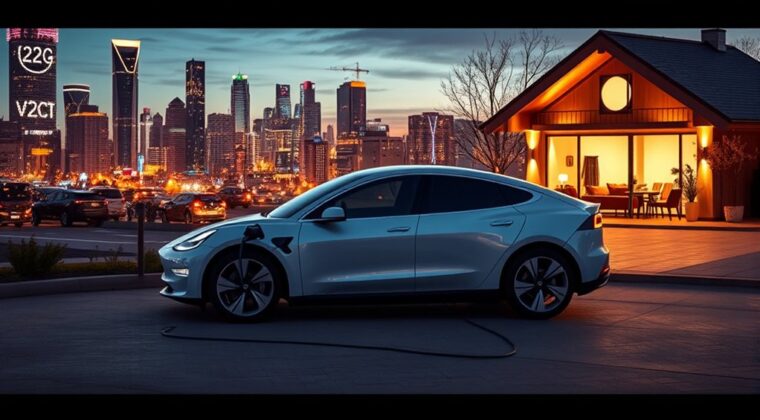
V2G and V2H are two different ways to use bidirectional EV charging. Both let electricity move out of an electric vehicle battery, but they send that power to different places. V2G sends energy to the electric grid through an approved utility program, while V2H sends energy to your home for backup power or daily energy management.
Quick Answer
V2G means vehicle-to-grid: your EV can export power to the utility grid when allowed by your charger, vehicle, and utility program. V2H means vehicle-to-home: your EV powers your house during an outage or peak-rate period through approved home backup equipment.
Key Takeaways
- V2G supports the grid and may earn bill credits or payments where utility programs exist.
- V2H supports your home by using your EV as a backup power source during outages or high-rate periods.
- A normal one-way Level 2 charger is not enough for whole-home backup. You need a compatible EV, bidirectional charger, transfer or isolation equipment, and professional installation.
- V2L, V2H, and V2G are not the same. V2L powers small devices from outlets; V2H powers home circuits; V2G exports to the utility grid.
- Battery impact depends on depth of discharge, temperature, cycle frequency, software controls, and warranty terms.
What Is Bidirectional Charging and Why Does It Matter?
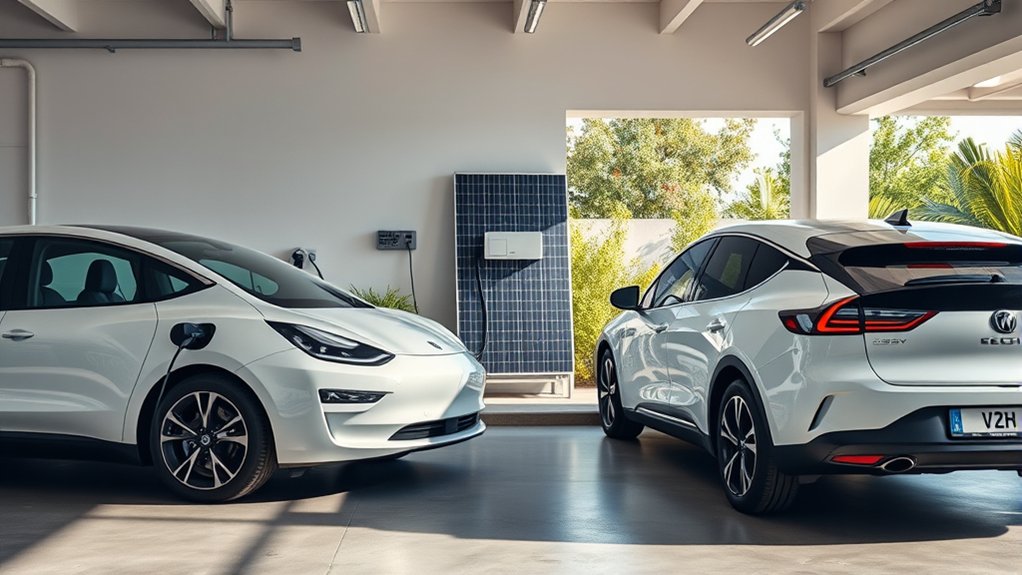
Bidirectional charging lets electricity flow both into and out of an EV battery. In normal charging, power moves from the grid or your solar system into the vehicle. With a bidirectional setup, the EV can also send stored power back out through approved equipment.
That outbound power can serve several uses:
- V2L: Vehicle-to-load powers tools, camping gear, small appliances, or outlets.
- V2H: Vehicle-to-home powers selected home circuits or the whole home through backup equipment.
- V2B: Vehicle-to-building supports a commercial building.
- V2G: Vehicle-to-grid exports energy to the utility grid through an approved program.
Note: A vehicle can be marketed as “bidirectional” without supporting every use case. Always confirm the exact model year, trim, charger, home hardware, software version, and utility rules before assuming an EV can do V2G or V2H.
V2G vs V2H at a Glance
| Feature | V2G | V2H |
| Full Name | Vehicle-to-grid | Vehicle-to-home |
| Power Goes To | The electric grid | Your home circuits |
| Main Benefit | Grid support and possible utility credits | Backup power and home energy control |
| Key Requirement | Utility enrollment, metering, approved charger, and interconnection rules | Home backup hardware, isolation/transfer equipment, and compatible EV |
| Best For | Drivers in areas with active V2G or grid-support programs | Homeowners who want backup power during outages |
What Is V2G Technology?
V2G lets your EV send stored electricity back to the grid. This can help utilities balance demand, reduce strain during peak hours, and absorb more renewable energy when managed at scale.
In a V2G setup, your EV does not simply dump power into the grid whenever it is plugged in. A utility, aggregator, or energy platform usually controls when discharge happens, how much energy can be used, and how much battery reserve must remain for driving.
Key Features of V2G
- Requires a bidirectional-capable EV and charger.
- Usually requires utility approval, metering, and program enrollment.
- May include minimum battery reserve settings so you still have driving range.
- Can support peak shaving, demand response, or grid-support programs.
- May provide bill credits or payments, but only where programs exist.
Benefits for Grid Stability
V2G can help the grid because EVs often sit parked for long periods with unused battery capacity. If many vehicles are connected and managed together, they can act like a flexible energy resource.
This matters most during evening peaks, heat waves, storm recovery, and periods when renewable output changes quickly. V2G can also reduce the need for some short-term fossil-fuel peaker generation, depending on the local grid mix and program design.
Financial Incentives for Owners
V2G can produce value for drivers, but the value is not guaranteed. Your return depends on your utility, rate plan, local energy prices, program rules, battery reserve settings, charger cost, and how often your EV is available while plugged in.
Instead of expecting a fixed yearly income, look for specific program terms. Some programs may offer bill credits, event payments, lower charging rates, or compensation for exported energy.
Pro Tip: Before joining a V2G program, ask whether compensation accounts for battery wear, whether you can set a minimum state of charge, and whether participation affects your vehicle or battery warranty.
How Can V2H Power Your Home?
V2H sends power from your EV battery to your home. During a blackout, a properly installed V2H system can disconnect your home from the grid and supply power to selected circuits or, in some systems, the whole house.
V2H is different from plugging an appliance into a truck outlet. A whole-home V2H system needs approved hardware to manage power flow safely. For example, Tesla Powershare says Cybertruck can provide home backup power through Powershare equipment, while GM Energy pairs its PowerShift Charger with a V2H Enablement Kit for compatible GM EVs.
V2H is best understood as a home backup system that uses your EV battery instead of a fixed wall battery.
How Long Can V2H Power a Home?
Runtime depends on battery size, starting state of charge, inverter output, weather, and what you power. A home running only a refrigerator, lights, internet equipment, and a few outlets may last much longer than a home running central air conditioning, electric heat, an oven, and a water heater.
The U.S. Energy Information Administration reports that the average U.S. residential electric-utility customer purchased about 10,791 kWh in 2022, or about 899 kWh per month. Tesla also uses an estimate of 30 kWh per day for an average U.S. home in its Powershare backup explanation. That means a large EV battery can often support essential loads for several days, but whole-home runtime can be much shorter if heavy appliances are used.
V2H vs Generator or Home Battery
Compared with a gasoline generator, V2H can be quieter and does not create tailpipe emissions at your home. Compared with a fixed home battery, an EV usually stores far more energy. The tradeoff is that your backup battery is also your transportation, so you need to protect enough charge for driving.
Warning: Never backfeed a home from an EV outlet, extension cord, or improvised wiring. V2H systems must isolate your home from the grid during an outage and must be installed according to local code, permitting rules, and utility requirements.
Key Differences Between V2G and V2H
Energy Flow Direction
The biggest difference is where the electricity goes. In V2G, power flows from the EV to the electric grid. In V2H, power flows from the EV to your home.
That one difference changes the entire setup. V2G needs utility coordination because your EV is interacting with public grid infrastructure. V2H focuses on your home, so the key issues are safe backup wiring, load control, and battery reserve.
Usage and Application Differences
Choose V2G if your main goal is to support the grid, participate in a utility program, and possibly earn credits. Choose V2H if your main goal is outage protection or using stored energy at home during expensive peak-rate hours.
Some systems may eventually support both, but most homeowners should think of V2G and V2H as different use cases with different approval paths.
V2G: Benefits for the Grid and Your Wallet
V2G can turn parked EVs into distributed energy resources. When many vehicles are connected, their combined battery capacity can help reduce peak demand and support the grid during stress events.
For drivers, the possible benefits include:
- Bill credits or payments: Some programs compensate drivers for sharing energy or reducing demand.
- Lower charging costs: Time-of-use rates may reward charging during off-peak hours.
- Better use of renewable energy: EVs can charge when solar or wind output is high and discharge when demand rises.
- Grid resilience: Managed EV batteries can support local energy reliability when programs are designed well.
The practical limit is availability. V2G is still not universal in the United States. You need the right vehicle, charger, software, utility program, and interconnection approval.
Advantages of V2H for Emergency Power and Savings
V2H gives you more direct control than V2G because the benefit is inside your home. During an outage, a V2H system can keep essential circuits running without relying on a portable generator.
V2H can also help with daily savings if you have time-of-use rates. You may charge the EV when power is cheaper and use some stored energy at home when rates are higher. If you have solar panels, V2H may help you use more of your own solar energy, depending on your system design and utility rules.
The best V2H use cases include:
- Homes with frequent power outages.
- Homes with solar panels and high evening electricity rates.
- Drivers who park at home for long stretches.
- Households that want backup power but do not want a fuel-burning generator.
EVs With V2G, V2H, and V2L Capabilities
Bidirectional features vary by model year, market, trim, charger, and software. Do not assume an EV supports V2G or V2H just because it has a large battery.
- Tesla Cybertruck: Tesla Powershare supports home backup with compatible equipment and may support grid programs in certain areas.
- GM EVs: GM Energy lists V2H-capable vehicles and requires the GM Energy PowerShift Charger plus V2H Enablement Kit for home backup.
- Nissan LEAF: The 2026 Nissan LEAF lists Vehicle-to-Load technology with up to 1,500 watts of output. That is useful for small loads, but it is not the same as a whole-home V2H system.
- Older CHAdeMO-based systems: Some older Nissan LEAF vehicles have been used in V2G trials with compatible bidirectional chargers, but availability depends on charger certification, local approval, and program support.
Note: V2L is often confused with V2H. V2L may run a refrigerator, tool, or small appliance from an outlet. V2H is a home backup system that powers home circuits through approved electrical equipment.
Challenges of V2G and V2H
Regulatory and Standardization Issues
V2G depends heavily on utility rules. Even if your vehicle and charger can export power, your utility must allow that export and define how it is measured, controlled, and compensated.
Standards and communication protocols also matter. Interoperability between vehicles, chargers, home energy systems, and utilities is improving, but it is not seamless everywhere yet.
Battery Degradation Concerns
Bidirectional charging adds battery use, and extra cycling can affect battery health. The amount of impact depends on battery chemistry, depth of discharge, temperature, charging speed, software controls, and how often the system discharges energy.
You can reduce risk by setting a minimum reserve, avoiding deep daily discharges, keeping the vehicle in a moderate state-of-charge range when possible, and checking whether your warranty covers V2H or V2G use.
Infrastructure and Cost Barriers
V2H and V2G usually require more than a charger. You may need a bidirectional charger, gateway, transfer switch or isolation device, meter upgrades, panel work, permits, utility approval, and an installer trained on the specific system.
The U.S. Department of Energy Alternative Fuels Data Center notes that charging equipment installations must follow local and state codes and may require permits. For bidirectional systems, that code and utility review is even more important because power can flow out of the vehicle.
Costs, Incentives, and Savings
The cost of V2H or V2G depends on your vehicle, charger, electrical panel, permit process, and utility program. A simple V2L adapter can be relatively inexpensive, but a whole-home V2H setup can cost much more because it involves home electrical integration.
Possible savings can come from:
- Using stored EV energy during peak-rate hours.
- Charging during off-peak periods.
- Keeping essential loads running during outages.
- Reducing generator fuel costs.
- Joining a V2G or grid-support program where one is available.
Incentives may exist through federal, state, local, manufacturer, or utility programs, but they change often. Check your utility, state energy office, charger manufacturer, and vehicle manufacturer before buying equipment.
How to Get Started With V2G or V2H
Use this checklist before you buy equipment:
- Confirm the use case. Decide whether you need V2L, V2H, V2G, or a system that may support more than one mode.
- Verify your EV. Check the exact model year, trim, battery, software version, and owner manual.
- Verify the charger. Make sure the charger is bidirectional and approved for your vehicle.
- Check utility rules. Ask whether your utility allows export, grid support, or home backup interconnection.
- Plan home loads. Decide whether you need whole-home backup or only critical circuits such as refrigerator, lights, internet, outlets, and medical devices.
- Review your panel. Ask a licensed electrician whether your electrical panel and service can support the system.
- Protect driving range. Set a minimum battery reserve so backup or grid events do not leave you without enough range.
- Review warranty terms. Confirm whether bidirectional use is covered by the vehicle, charger, and installation warranties.
Pro Tip: Ask the installer for a written load plan. It should show which circuits can run, how much power the system can deliver, and what happens when large loads like air conditioning, electric heat, or an oven turn on.
Future of V2G and V2H Technologies
V2G and V2H are likely to become more common as more EVs support bidirectional power and as utilities build programs for flexible energy resources. Home energy systems are also becoming more connected, combining EVs, solar panels, home batteries, smart panels, and utility rate signals.
The biggest changes to watch are better interoperability, lower equipment costs, clearer utility compensation, stronger battery warranty terms, and more vehicles that support both home backup and grid services.
For now, the best approach is practical: buy for the feature you can use today, not only for a future feature that may depend on software updates, utility approval, or unavailable hardware.
Frequently Asked Questions
What is the main difference between V2G and V2H?
V2G sends power from your EV to the electric grid through an approved utility or grid-support program. V2H sends power from your EV to your home through backup equipment that safely isolates your home from the grid during an outage.
Can I use V2G and V2H at the same time?
Most residential systems prioritize one mode at a time. Your system may support home backup, grid support, or both, but how it switches between them depends on the vehicle, charger, gateway, software, battery reserve settings, and utility rules.
Is V2L the same as V2H?
No. V2L powers small loads through outlets or adapters, such as tools, lights, or appliances. V2H powers home circuits through installed backup equipment. V2L is useful, but it is not a substitute for a code-compliant whole-home backup system.
What equipment do I need for V2H?
You need a V2H-capable EV, a compatible bidirectional charger, home backup hardware such as a gateway or transfer/isolation device, approved wiring, permits where required, and professional installation by a qualified electrician.
Does bidirectional charging damage the EV battery?
It can add wear because it uses extra charge and discharge cycles. The real effect depends on depth of discharge, temperature, discharge rate, battery chemistry, software controls, and how often you use it. Set a battery reserve and confirm warranty terms before using V2G or V2H often.
How long can an EV power a house with V2H?
It depends on battery size and home energy use. A large EV battery may run essential loads for several days, but whole-home backup time can drop quickly if you use air conditioning, electric heat, an oven, water heater, or other high-draw appliances.
Can I earn money with V2G?
Possibly, but only where a utility, aggregator, or manufacturer program supports it. Payments and credits vary by location, rate plan, event frequency, energy prices, battery reserve settings, and program rules.
Should I choose V2G or V2H?
Choose V2H if your main goal is home backup power. Choose V2G if your utility offers a clear program and you want to support the grid for credits or payments. Many homeowners should start by solving their backup-power needs first, then consider V2G if it becomes available locally.
Conclusion
V2G and V2H both use your EV battery as more than transportation, but they solve different problems. V2G is about grid support and possible utility compensation. V2H is about home backup power, outage resilience, and better control over household energy use.
For most homeowners, V2H is the easier benefit to understand because it directly protects your home during an outage. V2G can be valuable too, but only when your vehicle, charger, utility, and local rules all support it. Before investing, confirm the equipment, warranty, installation cost, permit needs, and real program terms for your address.
Sources
- U.S. Energy Information Administration — average U.S. household electricity use for backup runtime context.
- U.S. Department of Energy Alternative Fuels Data Center — home charging installation, permitting, and code compliance guidance.
- Tesla Powershare Support — Cybertruck home backup, grid support, and required Powershare equipment.
- GM Energy V2H Bundle — GM Energy PowerShift Charger, V2H Enablement Kit, and V2H-capable GM EVs.
- Nissan USA 2026 LEAF Features — Vehicle-to-Load output and accessory information.
- Online Energy Management for Bidirectional EV Charging with Rooftop PV — current research on V2G/V2H optimization, savings, and battery-aging-aware control.