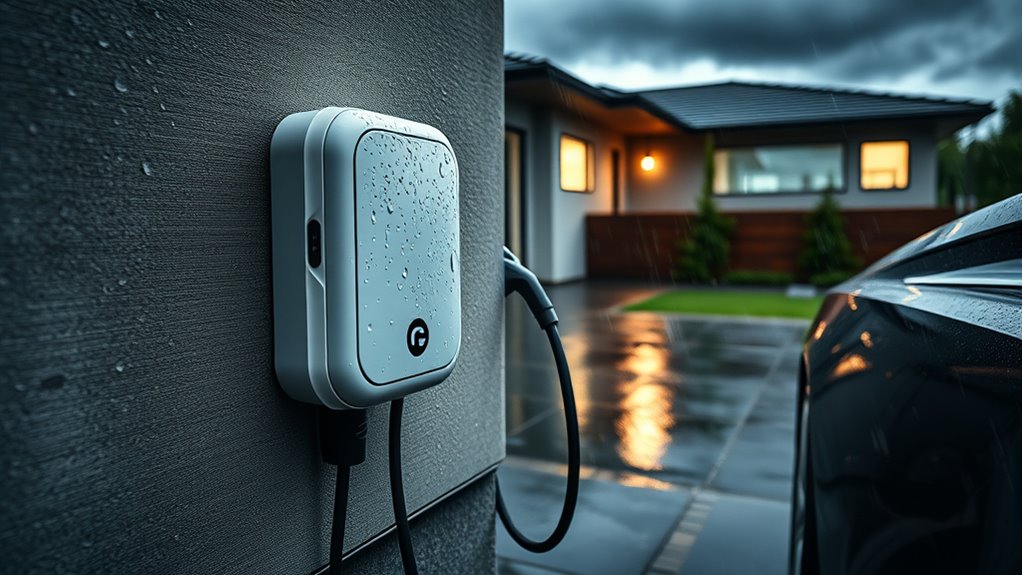
You can charge an EV in normal rain when the charger, cable, connector, socket, and vehicle inlet are designed for outdoor use and are in good condition. The key is not just whether the charger is called weatherproof, but whether it has the right enclosure rating, safe installation, intact seals, and no flood or damage exposure. If the plug, cable, socket, or wall unit looks wet inside, cracked, loose, scorched, or submerged, do not charge until it has been checked.
Quick Answer
EV chargers can be used in light to moderate rain when they are outdoor-rated, properly installed, and undamaged. Look for a weather-resistant enclosure such as IP65 or a suitable NEMA/Type rating, keep plugs and sockets out of standing water, and never charge after flooding, saltwater exposure, or visible cable damage.
Key Takeaways
- Charging in normal rain is usually safe when the EVSE, connector, and installation are rated for outdoor use.
- IP65 means strong dust protection and water-jet resistance, but it does not mean floodproof, saltproof, or damage-proof.
- Stop and inspect before charging if you see cracked plastic, exposed conductors, bent pins, scorch marks, loose sockets, or water inside the connector.
- Floodwater, especially saltwater, is different from rain. Do not charge a flood-exposed EV, cable, socket, or charger until a qualified professional has inspected it.
- For British weather, prioritise sealed enclosures, corrosion-resistant materials, proper drainage, RCD protection, and regular maintenance.
At a Glance
| Time Required | 2 to 5 minutes before each wet-weather charging session |
| Difficulty | Easy visual check; electrical faults need a qualified installer or electrician |
| Tools Needed | Your eyes, dry hands, vehicle manual, charger manual, and access to the charger rating label |
| Cost | Free for a visual check; professional inspection costs vary by location and installation |
Can You Charge an EV in the Rain?
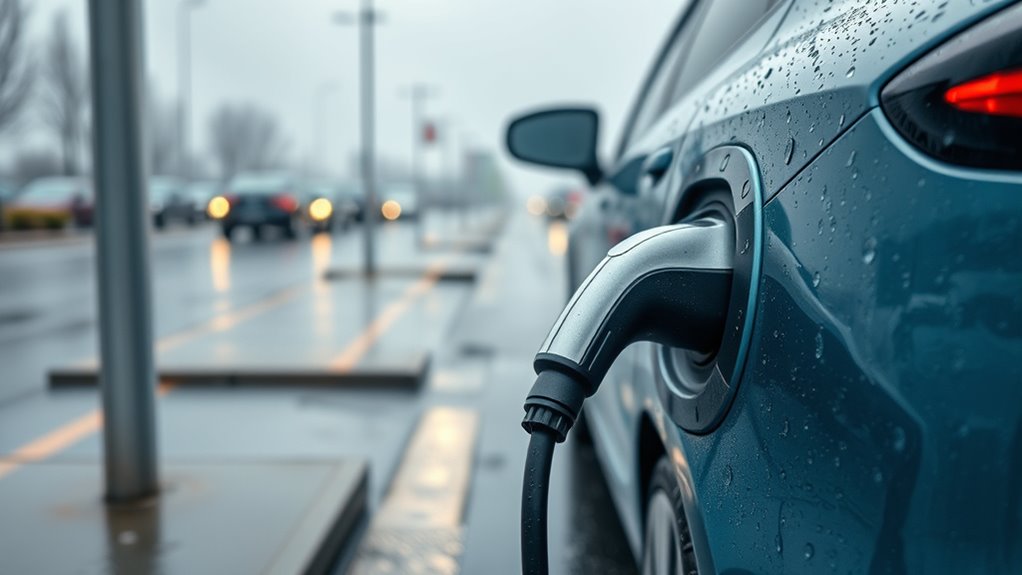
Yes, you can usually charge an EV in light to moderate rain because proper EV charging equipment is built with protective housings, safety signaling, and ground-fault protection. Public chargers and home wallboxes are designed so the power transfer does not begin until the vehicle and charger complete their safety checks.
Normal rain should not stop EV charging when the charger is outdoor-rated, professionally installed, and free from visible damage.
You still need to check the charging cable, connector, socket, and vehicle charge port before you plug in. Rain on the outside of a rated connector is not the same as water inside the plug, exposed wiring, a cracked casing, or a socket lying in a puddle.
Portable 3-pin charging leads need extra care. The control box may be weather-resistant, but the household plug and socket should stay dry, supported, and away from standing water. For regular outdoor charging, a dedicated EV wallbox or outdoor-rated socket is safer than relying on a domestic extension lead.
Warning: Do not charge during flooding, after saltwater exposure, or when water has entered the charger, socket, connector, or vehicle charge port. Keep away from damaged equipment and arrange a professional inspection before using it again.
Wet-Weather Charging Safety Checklist
Before charging in rain, take a short look at the whole setup. A few seconds of inspection can prevent avoidable faults and help you catch weather damage early.
- Check the cable jacket: Do not use it if you see cuts, crushed sections, exposed wires, swelling, or heat damage.
- Check the connector: Look for bent pins, mud, corrosion, cracks, missing covers, or water trapped inside.
- Check the socket or wallbox: Avoid loose faceplates, broken lids, scorch marks, buzzing, or a tripped RCD/GFCI.
- Check the ground: Keep the plug, control box, and cable connections out of puddles and flowing water.
- Check your hands: Dry your hands before handling the plug, especially with portable charging leads.
- Check the vehicle port: Make sure the flap, seal, and inlet are clean and not packed with water, ice, or grit.
Pro Tip: Fit the connector fully until it locks, then let the vehicle and charger start the session. A loose connector can cause charging errors even when the weather is not the main problem.
What IP Ratings Mean for EV Chargers
IP ratings tell you how well an electrical enclosure resists dust and liquid intrusion. The first digit covers solid-particle protection. The second digit covers water protection. For example, IP65 means the enclosure is dust-tight and protected against water jets from normal test directions.
That does not make the charger “waterproof” in every real-world condition. IP65 does not mean the unit can be submerged, blasted by a pressure washer at close range, left in floodwater, or ignored after damage. It also does not prove the installation meets local electrical rules.
| Rating | What it usually means | Best use |
|---|---|---|
| IP54 | Limited dust protection and splash resistance | Sheltered locations, depending on manufacturer approval |
| IP55 | Dust-protected and protected against water jets | Outdoor units with some shelter |
| IP65 | Dust-tight and protected against water jets | Common benchmark for outdoor EV charger enclosures |
| IP66 | Dust-tight and protected against stronger water jets | More exposed sites with wind-driven rain |
| IP67/IP68 | Immersion protection under defined test conditions | Special cases only; still not a reason to charge in floodwater |
Why EV Charger Weatherproofing Is More Than IP65
Even when an EV charger carries an IP65 rating, long-term weatherproofing depends on more than water and dust resistance. The enclosure rating is only one part of the system.
You also need corrosion-resistant materials, reliable gaskets, protected cable entries, drain-aware mounting, UV-stable plastics, proper earthing, RCD protection, and a listed or certified EVSE design. A charger can have a strong enclosure rating and still fail early if it is poorly installed, mounted where water collects, or exposed to salt air without suitable corrosion protection.
For exposed sites, look for a unit that states outdoor use clearly in the manual. In North America, also check for a suitable NEMA/Type enclosure rating and safety listing. In the UK and Europe, check the manufacturer’s installation manual, product declaration, and installer guidance for outdoor mounting, RCD requirements, and cable routing.
Note: IP ratings, NEMA/Type ratings, and EVSE safety listings answer different questions. IP focuses on dust and liquid ingress. NEMA/Type ratings may include broader environmental conditions. Safety listings address electrical safety requirements for the charging equipment.
Why Charger Electronics Belong Indoors
The most sensitive parts of a charger are the electronics that manage communication, current control, protection, monitoring, and fault detection. These components last longer when they are protected from condensation, thermal cycling, UV exposure, and corrosive air.
Some outdoor charger designs place the user interface and connector outdoors while keeping more sensitive control hardware inside a sealed compartment or protected indoor cabinet. That separation can reduce moisture stress and make maintenance easier, especially in exposed car parks or coastal areas.
For home installations, the best approach is usually simple: mount the wallbox where it has drainage, airflow, and some protection from direct impact. Avoid placing it where gutter overflow, pressure washing, road spray, or snow piles can hit it directly.
How Weather Affects EV Chargers
Weather affects EV chargers in different ways. Rain is only one concern. Outdoor units also face humidity, frost, heat, UV, wind, dust, road salt, and accidental impact.
| Weather factor | Possible effect | What to do |
|---|---|---|
| Rain and snow | Water can reach seals, covers, and cable entries | Use an outdoor-rated unit and keep connectors out of standing water |
| Humidity | Condensation and corrosion can build over time | Inspect contacts, covers, and screws regularly |
| Cold and frost | Ice can stiffen cables and block covers or latches | Do not force frozen parts; clear ice gently and follow the manual |
| Heat and sun | UV exposure and high temperatures can age plastics and seals | Choose UV-stable materials and avoid unnecessary direct heat where possible |
| Wind and debris | Dust, leaves, and grit can collect around ports and housings | Keep the area clean and make sure the plug holster drains properly |
| Salt air and road grit | Corrosion can attack metal parts and fixings | Use corrosion-resistant materials and rinse nearby salt deposits carefully without pressure-washing the charger |
Weather can also affect the vehicle. Cold weather can reduce driving range and slow fast charging because the battery and cabin need more heat. Hot weather can also reduce efficiency when the battery cooling system and air conditioning are working hard. These effects vary by model, battery temperature, route, tyres, speed, and climate-control use.
Which Materials Last Best Outdoors
You should prioritise materials that resist corrosion, UV damage, impact, and long-term seal failure. The best outdoor charger is not always the thickest or heaviest unit. It is the one whose enclosure, cable, plug holster, cover, fixings, and seals are all designed for the conditions where you will install it.
Weatherproof Metals
For outdoor EV charger housings and posts, common durable choices include powder-coated steel, stainless steel, aluminium, and zinc-aluminium-magnesium coated steel. Aluminium resists corrosion well and keeps weight down. Stainless steel can work well in harsh environments when the correct grade is used. Coated steels can provide strong structure and corrosion resistance when the coating remains intact.
| Material | Main benefit | Watch for |
|---|---|---|
| Aluminium | Good corrosion resistance and low weight | Impact dents and coating damage |
| Stainless steel | Strong corrosion resistance when the right grade is used | Tea staining or surface corrosion in coastal areas if neglected |
| Powder-coated steel | Strong and cost-effective | Rust where chips, scratches, or cut edges expose bare metal |
| Zinc-aluminium-magnesium coated steel | Good protection for exposed outdoor metalwork | Compatibility with the charger maker’s coating and warranty requirements |
UV-Resistant Finishes
Material choice matters even more when sunlight is constant. UV exposure can fade plastics, weaken covers, and age seals before the charger fails electrically.
Look for UV-stable plastics, durable powder coating, stainless or coated fixings, and a plug holster that does not become brittle in sun or frost. Small details matter. A strong wallbox can still become annoying to use if the cable hook cracks, the cover warps, or the connector cap no longer closes.
- Polyester powder coatings help reduce fading and surface breakdown.
- UV-stable plastics help covers, buttons, and holsters keep their shape.
- Corrosion-resistant fixings help prevent rust streaks and loose mounting points.
What Impact Ratings Say About EV Charger Durability
When you evaluate an EV charger’s durability, the IK rating tells you how well the enclosure resists mechanical impact. This is separate from the IP rating. IP is about ingress protection. IK is about impact protection.
An IK10 enclosure is commonly used as a strong impact benchmark because it is rated for 20 joules of impact energy. It is useful for public sites, shared parking areas, driveways with tight vehicle movement, and exposed commercial installations.
Understanding IK Ratings
IK ratings run from low impact protection to high impact protection. IK10 is very strong and widely used in product specifications, but it is no longer accurate to call it the absolute highest possible IK code because IK11 exists in the updated scale.
- IK00 to IK06: limited impact resistance for sheltered or low-risk sites.
- IK07 to IK09: moderate to strong protection for more demanding settings.
- IK10: very strong protection and a common target for exposed chargers.
- IK11: higher impact level in the updated scale, but less commonly seen in everyday EV charger marketing.
A higher IK rating can reduce damage from accidental bumps, vandalism, falling objects, and vehicle-adjacent knocks. It does not make a charger indestructible. If an enclosure is hit hard enough to crack, shift, or expose a cable entry, stop using it until it has been inspected.
Impact Protection in Practice
Impact protection matters most where people park close to the charger, where children may pull on cables, where shopping trolleys or bins move nearby, or where a public charger could be abused. For a private driveway, IK08 or IK10 may be enough depending on the mounting position. For a public or commercial charger, IK10 is often a better target.
You should still inspect seals and covers after impact. A wallbox can look mostly intact while a gasket, hinge, cable gland, or mounting screw has been weakened. That kind of damage can reduce weather resistance long before the charger stops working.
How to Choose an EV Charger for British Weather
To choose an EV charger for British weather, prioritise a unit that is clearly approved by the manufacturer for outdoor installation. Britain’s rain, wind, frost, coastal salt air, road grit, and freeze-thaw cycles can expose weak housings quickly.
Prioritise outdoor approval, proper installation, sealed cable entries, corrosion-resistant parts, and a suitable IP or enclosure rating.
For most exposed outdoor home installations, look for at least IP65 or the manufacturer’s recommended equivalent. In sheltered areas, a lower rating may be acceptable only if the manual allows it. In harsher coastal or commercial settings, consider stronger corrosion resistance, a robust enclosure, and better impact protection.
- Confirm outdoor approval: The manual should state that the charger can be installed outdoors.
- Check ingress protection: Look for a suitable IP rating, commonly IP65 or better for exposed outdoor units.
- Check impact protection: Consider IK08 to IK10 for areas where the charger may be bumped.
- Check corrosion resistance: Coastal homes and road-salt areas need better materials and fixings.
- Check electrical protection: Use the RCD, earthing, and circuit protection required by local rules and the charger maker.
- Check cable storage: The connector should sit in a holster that drains and shields the pins.
- Check installer credentials: A qualified EV charger installer should handle hardwired outdoor installations.
You’ll protect uptime, reduce failure risk, and make wet-weather charging less stressful when the charger is matched to the site instead of chosen by price alone.
When You Should Not Charge in Wet Weather
Rain alone is not the main danger. Damage, submersion, bad installation, and exposed conductors are the problems to avoid.
- Do not charge if the charger, socket, plug, or cable has been submerged.
- Do not charge if floodwater has reached the vehicle battery area, charge port, cable, wallbox, or outlet.
- Do not charge if the connector pins are wet inside, muddy, corroded, bent, or damaged.
- Do not charge if the wallbox cover is cracked, loose, or missing.
- Do not charge if the cable is cut, crushed, swollen, hot, or showing exposed conductors.
- Do not charge through a household extension lead in rain.
- Do not charge during severe storms if lightning, flooding, or power instability is present.
- Do not keep resetting a breaker, RCD, or GFCI that trips during charging. Treat repeated trips as a fault.
If you are unsure, stop. Contact the charger manufacturer, your installer, roadside assistance, or a qualified electrician before using the equipment again.
Outdoor Charger Maintenance
Weatherproofing is not a one-time feature. Seals, covers, coatings, and fixings age. A quick maintenance routine helps the charger stay safe and reliable.
| When | What to check |
|---|---|
| Before charging in rain | Cable, connector, socket, standing water, warning lights, and visible damage |
| Monthly | Casing, cable hook, plug holster, seals, screws, and signs of corrosion |
| Seasonally | Leaves, grit, salt deposits, frost damage, UV fading, and drainage around the charger |
| After a storm or impact | Cracks, loose mounting, water marks, tripped protection, and damaged cable entries |
| Annually or as recommended | Professional inspection for hardwired outdoor chargers, especially in exposed locations |
Clean gently. Use a dry or slightly damp cloth on the outside when the charger is not in use. Do not spray the unit with a pressure washer unless the manufacturer clearly allows it.
Frequently Asked Questions
What is the 80/20 rule for EV charging?
The 80/20 rule usually means using slower home or workplace charging for most daily needs and public rapid charging for longer trips. Some drivers also use “80%” as a daily battery target because many EVs charge slower above 80% and high states of charge can add battery stress over time. Always follow your vehicle manual because some LFP-battery EVs may recommend regular 100% charging for calibration.
Should I charge my EV to 100% in winter?
Charge to 100% in winter when you need the extra range, but avoid leaving many EVs sitting at 100% for long periods unless your manufacturer recommends it. Cold weather can reduce range and slow fast charging, so precondition the cabin and battery while plugged in when your car supports it.
What is the resistance of an EV charger?
Electrical resistance is different from weather resistance. In normal conversation, people often mean how well the charger resists rain, dust, corrosion, and impact. For that, check the IP rating, IK rating, NEMA/Type rating if relevant, safety listing, material quality, and installation manual.
What drains an EV battery the most in bad weather?
Cold weather often has the biggest effect because the battery is less efficient and the cabin heater uses extra energy. High speed, soft tyres, headwinds, roof boxes, aggressive driving, and heavy climate-control use can also reduce range. In hot weather, battery cooling and air conditioning can increase energy use.
Is IP65 enough for an outdoor EV charger?
IP65 is a common outdoor benchmark because it indicates dust-tight construction and water-jet resistance. It is not the only thing to check. You also need manufacturer approval for outdoor installation, safe circuit protection, proper cable entry, corrosion-resistant materials, and a location that avoids flooding and direct impact.
Can I use a public EV charger if the connector is lying in a puddle?
Avoid using a connector that has been lying in deep water, mud, snow slush, or road salt. Check for damage, trapped water, corrosion, and bent pins. If the connector looks unsafe, report the charger through the network app or site operator and use another station.
Conclusion
EV chargers can handle normal outdoor weather when they are rated, installed, and maintained correctly. For rain, the practical rule is simple: a sound outdoor-rated charger is usually fine, but damaged or submerged equipment is not. Check the cable, connector, socket, enclosure, and ground conditions before charging.
For British weather, choose more than a basic “weatherproof” label. Look for a suitable IP rating, strong impact resistance, corrosion-resistant materials, safe electrical protection, good drainage, and clear outdoor approval from the manufacturer. Match the charger to rain, frost, wind, salt air, and daily use, and you’ll keep charging safely and reliably through the seasons.
Sources
- International Electrotechnical Commission: IP ratings — explains ingress protection ratings for dust and liquid resistance.
- SAE J1772 Electric Vehicle Conductive Charge Coupler — supports EV charging coupler safety and communication context.
- SAE J3400 NACS Electric Vehicle Coupler — supports current North American charging connector context.
- IEC 62262 impact protection standard — supports IK impact-rating guidance for electrical enclosures.
- AP/Edmunds winter EV guidance — supports cold-weather range and charging-performance guidance.
- Associated Press report on saltwater-flooded EV risk — supports flood and saltwater safety warnings.