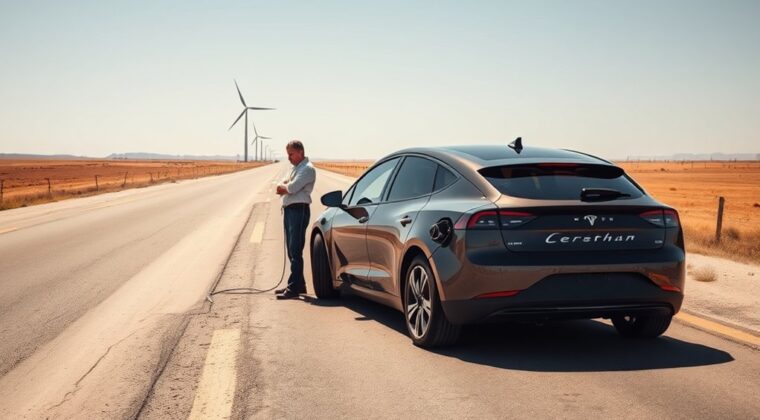
If your EV runs out of charge, the car will usually warn you first, reduce power as the battery gets very low, and then stop driving when it can no longer protect the traction battery. The safest response is to pull over early, turn on your hazards, share your exact location, and request EV-capable roadside assistance instead of trying to tow or push the car without checking the owner’s manual.
Quick Answer
When an EV runs out of charge, it usually gives low-battery warnings, may enter a reduced-power mode, and eventually stops. Pull over before it dies, switch on hazard lights, stay clear of traffic, and call roadside assistance for mobile charging or EV-safe transport to a compatible charger.
Key Takeaways
- Most EVs warn you before the battery is fully depleted, but the timing and wording vary by model.
- Low-power mode, often called turtle or tortoise mode, limits speed and acceleration so you can reach a safer place.
- Do not rely on extra miles after the display shows 0 miles of range. Any reserve is unpredictable.
- Ask for EV-capable recovery. Some EVs need a flatbed, while others require wheel dollies or a specific transport mode.
- For battery health, avoid making deep discharges a habit and plan to charge before the battery drops very low.
At a Glance
| Time Required | 5 to 10 minutes to get safe and call for help; charging or recovery time depends on location, charger speed, and vehicle condition. |
| Difficulty | Easy if you act early; more difficult and risky if the vehicle stops in traffic. |
| Tools Needed | Phone, navigation app, roadside assistance contact, charging-station app, owner’s manual, and hazard lights. |
| Cost | Mobile charging, towing, and roadside recovery costs vary by provider, membership plan, distance, and charger availability. |
What to Expect When Your EV Runs Out of Charge?
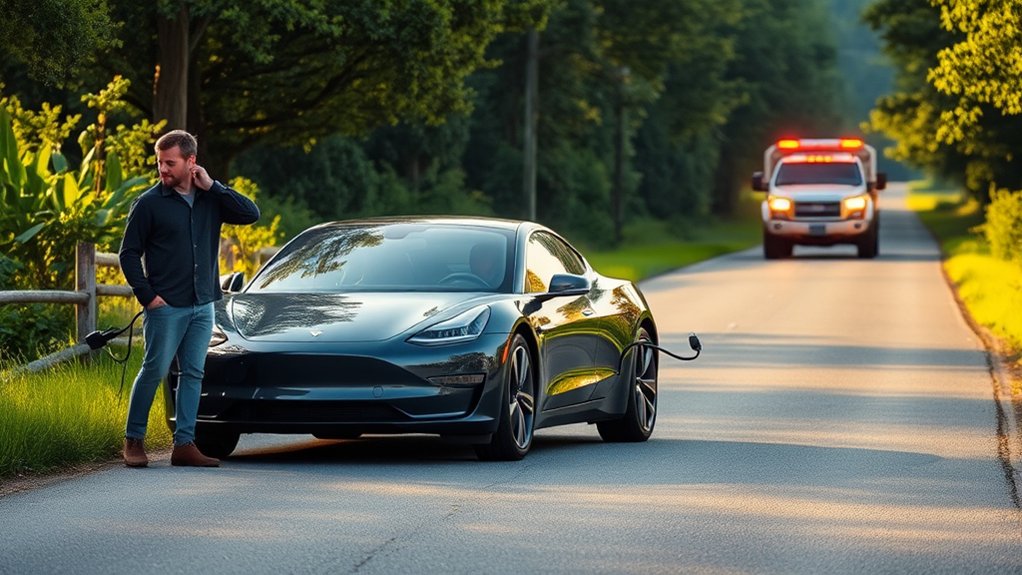
When your EV runs low on charge, it usually does not shut down without warning. You will normally see low-battery alerts, reduced range estimates, navigation suggestions for nearby chargers, and stronger warnings as the battery gets closer to empty. The exact alerts depend on the EV model, software, battery temperature, and driving conditions.
As the battery reaches a critically low state, your EV may enter a reduced-power mode. Some drivers call this turtle mode, tortoise mode, limp mode, or low-power mode. In this state, acceleration may feel weak, top speed may be limited, and non-essential comfort features may be reduced so the car can preserve enough energy for basic control systems.
If the traction battery can no longer support driving, the vehicle will stop. At that point, you should treat the situation like any other roadside breakdown, with one EV-specific difference: recovery must follow the vehicle manufacturer’s towing instructions.
Warning: Do not keep driving in a live traffic lane just because the EV still creeps forward. Pull over at the first safe place. A few more yards are not worth the risk of being stranded where other drivers cannot avoid you.
How to Safely Pull Over When You’re Out of Power
If your EV shows very low range or enters reduced-power mode, your first goal is safety, not finding the perfect charger. Take these steps as soon as you can do so safely:
- Move to the right shoulder, a parking lot, a rest area, or another safe area away from moving traffic.
- Choose a flat, dry spot if possible, and avoid soft shoulders, sand, mud, or deep snow.
- Turn on your hazard lights before the vehicle fully stops.
- Shift to Park, engage the parking brake, and keep the vehicle secure.
- Use mile markers, exit numbers, road signs, GPS coordinates, or a map pin to record your exact location.
- If you exit the vehicle, leave from the side away from traffic and move behind a barrier only when it is safe.
Once you are stopped, avoid standing beside the vehicle in traffic. If the shoulder is narrow or visibility is poor, call emergency services if you are in immediate danger.
What to Do Right After Your EV Stops
After your EV stops, stay calm and work through the basics. First, confirm the vehicle is in Park, the parking brake is engaged, and the hazard lights are on. Then use your phone or vehicle system to share your precise location with roadside assistance.
When you call for help, tell the dispatcher:
- Your EV make, model, and year.
- Your battery percentage or displayed range before the vehicle stopped.
- Whether the vehicle is blocking traffic or sitting on a shoulder.
- Whether the 12-volt system is still working.
- Whether you need mobile charging, transport to a charging station, or a tow to your home or service center.
- That the vehicle needs EV-safe recovery according to the owner’s manual.
Pro Tip: Before your battery reaches 0%, take a screenshot of your location, battery level, nearby exits, and the nearest charger. That information helps roadside assistance reach you faster.
What Not to Do When Your EV Is Dead
A dead EV can feel simple to move, but the wrong recovery method can damage the drivetrain or create a traffic hazard. Avoid these mistakes:
- Do not push the vehicle unless the owner’s manual allows it and the car can be placed in the correct neutral or tow mode.
- Do not flat-tow the EV with its driven wheels rolling unless the manufacturer clearly permits it.
- Do not let a standard tow truck drag the vehicle by two wheels without confirming the correct recovery method.
- Do not open, touch, or tamper with orange high-voltage cables or battery components.
- Do not assume a household extension cord or random outlet is safe for emergency charging.
- Do not leave the vehicle unlocked or unattended in an unsafe area unless emergency conditions require you to move away.
What Is Tortoise Mode in Your EV?
Tortoise mode is a low-power safety mode that some EVs use when the battery is very low. It is named after the turtle or tortoise icon that may appear on the dashboard in certain models. Other EVs may use different wording, icons, or warnings.
In tortoise mode, you may notice:
- Reduced acceleration: The car may respond slowly when you press the accelerator.
- Lower top speed: The EV may limit speed so it can conserve the remaining charge.
- Comfort-feature limits: Cabin heat, air conditioning, or other non-essential loads may be reduced.
- Urgent charging prompts: The vehicle may direct you to nearby compatible chargers.
Tortoise mode is not extra range you can count on. It is a warning that you need to exit traffic and charge as soon as possible.
Recovery Options: Towing and Roadside Assistance for EVs
If your EV is completely out of charge, the best recovery option depends on where you are, what roadside services are available, and what your owner’s manual allows. In many cases, you will need one of these options:
- Mobile EV charging: Some roadside providers can deliver enough charge to help you reach a nearby station.
- Flatbed transport: A flatbed keeps all four wheels off the road and is often the safest general request when you are unsure.
- Wheel lift with dollies or freewheeling equipment: Some providers use specialized gear for EVs that cannot be flat-towed.
- Transport to a charger, home, or service center: If no mobile charging is available, towing to a compatible charger is usually the next step.
Always mention that the vehicle is an EV. Many electric vehicles have specific tow mode, transport mode, or neutral-hold instructions. If the 12-volt battery is also dead, the doors, shifter, charge port, parking brake, or touchscreen may not work normally until the 12-volt system is restored.
Note: The large traction battery moves the car, but the smaller 12-volt battery often powers locks, computers, screens, relays, and safety systems. A completely stranded EV may need 12-volt support before it can be shifted, charged, or transported.
The Risks of Draining Your EV Battery
Reaching a very low state of charge once is not usually a disaster, but making it a habit is not good practice. Deep discharges add stress, reduce your safety margin, and can make charging slower or more complicated once you finally reach a charger.
Battery Health Impact
Most modern EV battery packs are protected by battery-management software, so the displayed 0% does not always mean every cell is literally empty. Even so, regularly running the battery very low can increase stress on the pack and may leave the vehicle with too little energy to manage temperature, electronics, and charging preparation.
For day-to-day use, many EV owners aim to stay within a moderate charging range and avoid frequent deep discharges. Lithium-ion batteries do not need full discharges to prevent a memory effect. In fact, partial charging and partial discharging are generally easier on lithium-ion cells than repeated full-depth cycles. For battery-care background, see Battery University’s guide to prolonging lithium-based batteries.
Limited Range After Depletion
Some EVs may still move briefly after the range display reaches 0 miles, but you should not rely on that. Any remaining reserve depends on the model, battery temperature, speed, elevation, HVAC use, wind, tire pressure, payload, and software limits.
The safer rule is simple: once the car gives a low-battery warning, plan the nearest safe charging stop. Once it enters reduced-power mode, stop searching for the ideal station and focus on getting out of traffic safely.
Safety Concerns While Stranded
Running out of charge is not only inconvenient. It can create real safety problems if the vehicle stops on a highway shoulder, in extreme heat or cold, at night, or in a low-visibility area.
- Collision risk: A stopped vehicle near moving traffic is dangerous, especially at night or in bad weather.
- Weather exposure: A depleted EV may not provide normal heating or cooling for long.
- Communication risk: If your phone battery is low, it may be harder to share your location or coordinate help.
- Recovery risk: The wrong tow method can damage the vehicle or delay the recovery.
Tips to Avoid Running Out of EV Charge
The easiest EV emergency is the one you prevent. Build a charging buffer into your routine instead of planning to arrive with the battery nearly empty.
- Start looking for a charger before the battery drops below 20% on unfamiliar trips.
- Use the vehicle’s built-in route planner when available, because it can factor in battery state and charger compatibility.
- Cross-check public chargers with apps such as PlugShare, ChargePoint, or the U.S. Department of Energy Alternative Fueling Station Locator.
- Check charger speed, connector type, access hours, user reports, and recent check-ins before you commit to a stop.
- Slow down on highways if range is dropping faster than expected.
- Use Eco mode when appropriate and avoid hard acceleration.
- Keep tires properly inflated and reduce unnecessary cargo weight.
- Precondition the cabin while plugged in before long drives in extreme weather.
Charging Your EV: Where and How
Understanding charging types helps you make better decisions when your battery is low. The U.S. Department of Energy’s Alternative Fuels Data Center explains that charging time depends on battery size, state of charge, vehicle onboard equipment, charger power, and electrical service.
| Charging Type | Typical Use | General Speed |
| Level 1 | 120-volt outlet, emergency or light daily use | About 5 miles of range per charging hour |
| Level 2 | Home, workplace, hotels, public parking | About 25 miles of range per charging hour |
| DC Fast Charging | Road trips and quick recovery stops | About 100 to 200+ miles in 30 minutes, depending on the EV and charger |
Connector compatibility matters too. Many North American EVs use J1772 for Level 1 and Level 2 charging. DC fast charging may use CCS, CHAdeMO, or J3400/NACS, depending on the vehicle and adapter support. Before a trip, save the apps or accounts you need for the networks along your route.
Planning Your EV Trips for Optimal Battery Health
Good trip planning reduces range anxiety and helps protect the battery from repeated deep discharge. The goal is not to stop at every charger. The goal is to arrive at each planned charging stop with a comfortable buffer.
Charging Station Locations
Use more than one source when planning a long route. Your vehicle’s navigation may know your battery state and suggest compatible stops, while charging apps can show user reviews, pricing, access notes, and recent reliability reports.
- Filter for your connector type.
- Check whether the station is public, restricted, or inside a paid parking area.
- Look for recent successful check-ins when available.
- Confirm there is a backup charger within reach.
- Do not plan to arrive at an unknown charger with only 1% or 2% battery left.
Trip Planning Tools
Helpful EV planning tools include the built-in route planner, the AFDC Station Locator, PlugShare, ChargePoint, and network-specific apps for the chargers you plan to use. Some apps can help filter by plug type, charging speed, nearby amenities, payment options, and user feedback.
If your trip crosses rural areas, mountains, severe cold, or high-speed highways, add a larger buffer. Your displayed range can fall faster than expected when conditions are hard on efficiency.
Conditions That Reduce EV Range
Even when your route looks easy on a map, real-world conditions can change energy use. Watch for:
- Cold weather, which can reduce battery efficiency and increase cabin-heating demand.
- Very hot weather, which can increase air-conditioning and battery-cooling loads.
- High highway speeds, which increase aerodynamic drag.
- Long climbs, strong headwinds, roof boxes, trailers, or heavy cargo.
- Low tire pressure or poor tire condition.
- Repeated hard acceleration.
If range starts dropping too quickly, slow down, reduce unnecessary climate loads, choose Eco mode, and head toward the nearest reliable charger.
Frequently Asked Questions
What can I do if my electric car runs out of charge?
Pull over safely, turn on hazard lights, secure the vehicle, share your exact location, and call roadside assistance. Ask for EV-capable help, which may include mobile charging or transport to a compatible charging station.
What happens when an electric car gets to 0 miles?
The car may still have a small protected reserve, but you should not rely on it. Many EVs reduce power before stopping, and once the traction battery can no longer support driving, the vehicle will stop and need charging or recovery.
What is the most stolen EV?
The “most stolen EV” changes by country, insurer, model year, and data source, so a single universal answer is not reliable. If your EV is stranded, focus on safety: lock the car if you leave it, take valuables with you, keep the key or phone key secure, and share the location only with trusted help.
What happens if my electric car battery goes to zero?
If the high-voltage traction battery reaches a very low state of charge, the vehicle may stop driving and may need charging before it can move again. If the 12-volt battery is also low, some electronic functions may not work until the 12-volt system is supported.
Can roadside assistance charge an EV?
Some roadside providers offer mobile EV charging, but it is not available everywhere. In many areas, the provider may transport the vehicle to a charging station, your home, or a service center instead.
Can you jump-start an EV that ran out of charge?
A jump start may help the 12-volt system wake up, unlock, shift, or open the charge port, but it will not recharge the main traction battery enough to drive. Follow the owner’s manual before connecting any jump pack or cables.
Is it bad to let an EV battery reach 0%?
Doing it once may not ruin the battery, because EV battery-management systems include protections. Still, frequent deep discharges are not ideal. For daily use, try to charge before the battery gets very low and avoid making 0% arrivals part of your routine.
Conclusion
Running out of charge in an EV is usually preventable, but it can still happen. The important steps are simple: pay attention to warnings, pull over before the car loses power, turn on hazards, share your exact location, and request EV-capable roadside assistance. For future trips, plan charging stops with a buffer, verify charger compatibility, and avoid repeated deep discharges. With a little preparation, you can handle a low-battery emergency safely and keep your EV ready for the next drive.
Sources
- U.S. Department of Energy Alternative Fuels Data Center — Electric Vehicle Charging Stations — charging levels, connector types, and charging-speed ranges.
- U.S. Department of Energy Alternative Fueling Station Locator — finding public EV charging stations.
- ChargePoint App — charging-station search, navigation, payment, and charger details.
- PlugShare — EV charging location search and route-planning support.
- Battery University — How to Prolong Lithium-based Batteries — lithium-ion battery care, partial discharge, depth of discharge, and memory-effect clarification.