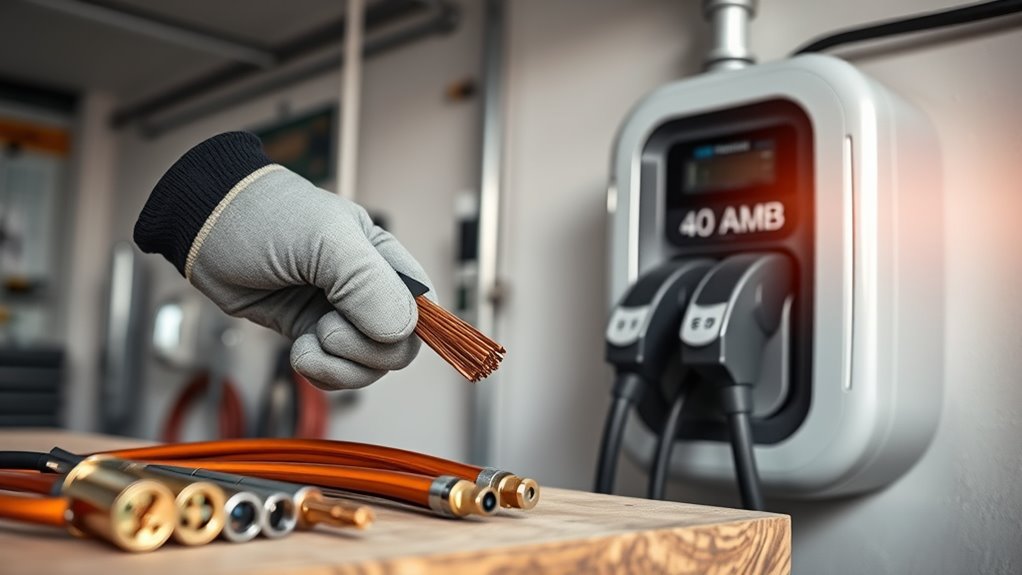
For a 40 amp EV charger, the safest common wiring answer is 6 AWG copper on a dedicated 50 amp circuit. That sizing works well for many residential Level 2 installations because EV charging is a continuous load under NEC 625.41, and continuous-load branch circuits must be sized at no less than 125% of the load per NEC 210.19(A)(1). Still, the exact wire you can use depends on the charger manual, wiring method, conductor insulation, terminal temperature rating, derating, local code, and inspection rules.
Last updated: [VERIFY: insert actual publish date of this revision]
Quick Answer
Use 6 AWG copper for a typical 40 amp EV charger on a 50 amp double-pole breaker. 6 AWG copper is rated for 65 amps at the 75°C column of NEC Table 310.16, giving a solid margin above the 50 amp requirement. In some conduit-only, 75°C-rated installs, 8 AWG copper THHN/THWN-2 (rated 50A at 75°C) may be allowed, but #6 copper is the safer standard recommendation for residential work.
Key Takeaways
- A 40 amp EV charger normally needs a 50 amp dedicated circuit because EV charging is treated as a continuous load under NEC 625.41 and 210.19(A)(1).
- 6 AWG copper is the best general answer, especially for NM-B cable, long runs, or when you want a conservative code path.
- THHN alone is not enough wording for outdoors; outdoor conduit runs need wet-location-rated conductors such as THWN-2.
- Most hardwired EV chargers need two hot conductors and an equipment grounding conductor, not always a neutral.
- NEC 625.54 requires GFCI protection on any receptacle installed for EV charging, indoors or outdoors — not just outdoor installs.
- Always verify the charger manual, panel capacity, local code, permit rules, and final inspection requirements before buying materials.
At a Glance
| Typical Circuit | 240V, dedicated 50 amp double-pole breaker for 40 amp charger output |
| Common Wire Size | 6 AWG copper conductors, plus a properly sized equipment grounding conductor |
| Difficulty | Advanced electrical work; should be handled by a licensed electrician |
| Before Buying Materials | Check charger nameplate, manual, panel capacity, permit rules, conductor type, run length, and local AHJ requirements |
Warning: This article is planning guidance, not a substitute for a permit, inspection, or licensed electrical work. EV charger circuits can overheat or create shock and fire hazards if the breaker, conductor, grounding, GFCI protection, torque, enclosure rating, or load calculation is wrong.
The Right Wire Size for a 40 Amp EV Charger
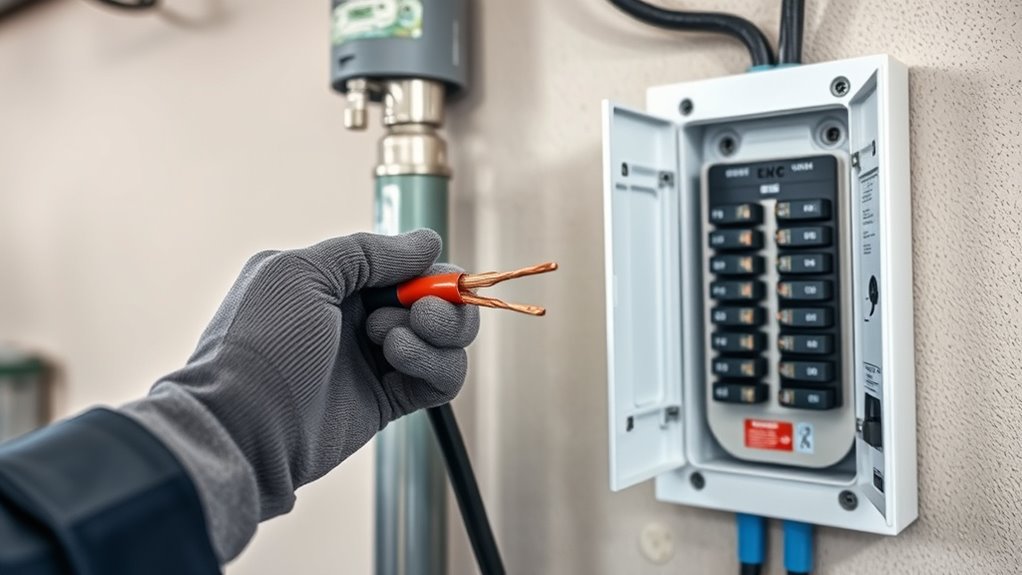
For a 40 amp EV charger, use 6 AWG copper as the safest common recommendation. That size gives a strong margin for a 50 amp branch circuit and avoids many problems caused by temperature-rating limits, cable-type limits, long runs, and local inspection preferences.
The reason is simple: a charger that outputs 40 amps for hours is not treated like a short-use tool. The U.S. Department of Energy’s Alternative Fuels Data Center notes that EV charging infrastructure is considered a continuous load and that NEC Article 625 contains most charging-equipment requirements. For a 40 amp charger, 40 amps × 125% = 50 amps, so the branch circuit is commonly sized at 50 amps.
There is one important nuance. In some hardwired conduit installations, 8 AWG copper THHN/THWN-2 may be allowed on a 50 amp circuit if the conductors, terminals, insulation, ambient temperature, conduit fill, derating, equipment listing, and local code all support the 75°C ampacity (8 AWG copper is rated exactly 50A at 75°C per NEC Table 310.16). Do not assume that exception applies. For many homeowners, 6 AWG copper is the cleaner and safer answer.
Note: The charger manual controls many details. For example, the Tesla Gen 3 Wall Connector manual shows a 50 amp breaker producing 40 amp output and tells installers to size conductors and ground wire according to local electrical code for the selected breaker.
Why a 50 Amp Breaker Is the Standard Match
A 50 amp breaker is the standard match for a 40 amp EV charger because continuous loads are sized at 125% of the maximum current under NEC 625.41 and 210.19(A)(1). Forty amps multiplied by 1.25 equals 50 amps.
This does not mean the charger will draw 50 amps. It means the circuit is sized to carry a 40 amp charging load for long periods without pushing the conductors and breaker to their limit. A properly matched 50 amp breaker also helps reduce nuisance tripping and heat buildup when the charger runs overnight.
Do not treat a 50 amp circuit as a built-in upgrade path for a larger charger. A 48 amp EV charger requires a 60 amp circuit (48A × 1.25 = 60A), and here’s a mistake worth knowing about: 6 AWG copper is rated 65A at the 75°C column of NEC Table 310.16 — technically enough for a 60A breaker — but most breaker and panel lugs rated 100A or less are only listed for 60°C terminations unless specifically marked otherwise (NEC 110.14(C)). At 60°C, 6 AWG copper is only rated for 55A, which is not enough for a 60A breaker. In practice, many 48A installs need 4 AWG copper, not 6 AWG — this is exactly the kind of detail that should be confirmed against the actual breaker and panel markings, not assumed. If you’re weighing the jump from a 40A setup to a 48 amp charger, budget for this wire upgrade before comparing models.
6 AWG vs 8 AWG Copper for a 40 Amp EV Charger
Many people ask whether 8 gauge wire can handle a 40 amp EV charger. The practical answer is: sometimes, but 6 AWG copper is the safer default.
| Wire Option | When It May Fit | Main Caution |
| 6 AWG copper | Best general choice for a 50 amp EV charger circuit, especially with NM-B cable or longer runs | Still must match breaker, terminal ratings, and local code |
| 8 AWG copper THHN/THWN-2 | Possible in some conduit installs where 75°C ratings and derating allow it | Not safe to assume for NM-B, unknown terminals, hot spaces, bundled conductors, or strict local rules |
If you want the least confusing path for a home EV charger, choose 6 AWG copper and have the electrician confirm the full installation method. If the electrician proposes 8 AWG copper, ask which temperature column, terminal rating, derating rules, and local code section support it.
Quick Reference: Wire Size by Charger Amperage
A 40 amp charger isn’t the only common option — here’s how the same 125% continuous-load math plays out across the amperages most residential Level 2 chargers use. Terminal-rating caveats apply at every step, same as the 40A and 48A cases above.
| Charger Output | Breaker (125% rule) | Typical Copper Conductor |
| 16A | 20A | 12 AWG |
| 24A | 30A | 10 AWG |
| 32A | 40A | 8 AWG |
| 40A | 50A | 6 AWG (8 AWG in some conduit-only, 75°C installs) |
| 48A | 60A | 4 AWG (6 AWG only if terminals/equipment are listed for 75°C) |
Every row still needs the same verification: charger nameplate, breaker and equipment terminal temperature rating, wiring method, and local code. See our EV charger amperage guide if you’re still deciding which amperage to buy in the first place.
NM-B vs THHN/THWN-2 for EV Charger Wiring
When you’re wiring a 40 amp EV charger, NM-B and THHN/THWN-2 in conduit serve different environments. The wire size is only one part of the decision.
Use NM-B only where it is allowed, usually in dry indoor residential spaces. NM-B is common in walls and finished garages, but it is not for wet locations. Even when the individual conductors have higher insulation ratings, NM-B ampacity is generally limited by the 60°C column, which is one reason 6 AWG copper is commonly used for a 50 amp EV charger circuit.
Use THHN/THWN-2 copper in conduit for many exposed, garage, basement, or outdoor routes. The important part is the THWN-2 or other wet-location rating. Outdoor conduit is treated as a wet location, so plain “THHN” wording is not enough unless the conductor is also marked for wet locations.
Pro Tip: Many building-wire products are dual-marked THHN/THWN-2. Check the actual printing on the insulation instead of relying on the store label or a receipt description.
Do You Need 6/2 or 6/3 Wire?
Many hardwired Level 2 EV chargers use two hot conductors plus an equipment grounding conductor. In that case, a neutral may not be needed. That is why some hardwired installs use a cable or conduit setup equivalent to two hots and ground.
A NEMA 14-50 receptacle, however, has two hots, a neutral, and a ground. If your installation uses a 14-50 receptacle, the neutral must be installed correctly even if the charger itself does not use it. A NEMA 6-50 receptacle has two hots and a ground, with no neutral, but it must still match the charger plug, local code, and GFCI rules.
One common mistake: don’t reuse an existing NEMA 14-30 dryer outlet for a 40A charger. A 14-30 is rated for 30A, and the wire behind it is almost always sized for 30A, not 40A — it needs its own dedicated 50A circuit, not a shared or repurposed one.
For a hardwired charger, follow the charger manual. For a plug-in charger, match the receptacle type, plug type, breaker size, GFCI requirement, and conductor count. Never install a receptacle simply because it “looks like” an EV outlet.
Hardwired vs Plug-In EV Charger Wiring
A hardwired EV charger is often the cleaner choice for a permanent 40 amp charging setup. It removes the wear point of a receptacle, may simplify some manufacturer requirements, and can reduce issues caused by low-quality 14-50 outlets.
A plug-in charger can be convenient if you need portability, but the receptacle must be high quality, correctly torqued, properly mounted, GFCI protected where required, and rated for the load. A cheap range-style receptacle is not a good match for repeated high-current EV charging. If you’re still comparing models, our 40 amp EV charger picks cover both hardwired and plug-in options.
If the charger manual requires hardwiring for a certain output level, follow the manual. The National Electrical Code also requires listed equipment to be installed according to its instructions.
Does a 70-Foot Run Affect Voltage Drop?
A 70-foot run can add measurable voltage drop, but #6 copper usually keeps voltage drop well within common design targets for a 40 amp EV charger. The exact drop depends on one-way distance, conductor material, temperature, actual charging current, and installation conditions.
For long EV charger runs, ampacity decides whether the wire is safe, while voltage drop decides how efficiently the charger receives power.
| One-Way Run Length | Approx. #6 Copper Drop at 40A / 240V | Planning Note |
| 50 ft | About 1% or less | Usually no upsize needed for voltage drop alone |
| 70 ft | About 1% to 1.5% | Often acceptable with #6 copper |
| 100 ft | About 1.5% to 2% | Check voltage drop before buying wire |
| 150 ft | About 2.5% | Consider #4 copper if you want extra efficiency margin |
Estimates assume 6 AWG stranded copper conductors, a 40A continuous load, 240V single-phase, and standard AC resistance values from NEC Chapter 9, Table 8. Actual drop varies with conduit type, ambient temperature, and conductor stranding — have your electrician calculate the exact figure for your route.
Voltage-drop targets are design guidance, not a replacement for ampacity and overcurrent rules. Your electrician should calculate the actual drop using the real route length and conductor type.
When to Use Conduit or MC Cable
For outdoor 40 amp EV charger runs, use an approved wiring method that protects the conductors from moisture, sunlight, physical damage, and impact. Conduit is the most common choice for outdoor and exposed runs.
Use conduit when the wiring is outdoors, exposed in a garage, routed along a wall, passing through unfinished spaces, or subject to damage. Use conductors marked for the location, such as THWN-2 for wet locations. Use listed fittings and bushings, and size the conduit so the conductors can be pulled without damage.
MC cable can be a valid option in some indoor exposed locations if it is rated for the environment and accepted by local code. It is not automatically the right answer for outdoor EV charging. Always check the cable marking, charger instructions, and local inspection requirements.
- Use conduit for outdoor, exposed, or damage-prone routes.
- Use wet-location-rated conductors in outdoor conduit.
- Use MC cable only where its rating and local code allow it.
- Do not bury or expose cable unless it is specifically rated for that use.
How to Wire an Outdoor EV Charger Safely
To wire an outdoor EV charger safely, the installation must use outdoor-rated equipment, approved wiring methods, weatherproof fittings, correct grounding, and GFCI protection where required. The ENERGY STAR EV charger guide also recommends safety-certified equipment and professional installation for Level 2 chargers.
Outdoor installations can be safe, even in rain, when the equipment is rated for outdoor use and installed correctly. The charger enclosure, conduit, fittings, boxes, covers, strain relief, and receptacle or hardwired connection all need to match the environment.
Outdoor Wiring Methods
For a 40 amp continuous charging load, the common outdoor setup is 6 AWG copper conductors in approved conduit on a 50 amp double-pole breaker. The conductors should be wet-location rated, and the equipment grounding conductor must be sized correctly for the breaker.
Keep the route as direct as possible, but do not sacrifice protection or proper support. Long runs, hot attics, conduit fill, multiple current-carrying conductors, and local amendments can all affect conductor sizing.
- Confirm the charger’s maximum output setting.
- Confirm the breaker size required by the charger manual.
- Choose conductors and conduit that match the location.
- Install a grounding path that meets code and the equipment manual.
- Have the installation permitted and inspected where required.
Weatherproof Protection Measures
Weatherproofing is not only about rain. Outdoor EV charger wiring must handle moisture, UV exposure, temperature swings, and physical impact. Use listed outdoor-rated boxes, watertight fittings, gasketed covers, and proper connector seals.
If the charger uses a receptacle, use the required GFCI protection and an enclosure suitable for the plug and cord arrangement. If the charger is hardwired, seal the conduit entries and follow the manufacturer’s torque specifications for the terminals.
A loose or undertorqued connection can create a high-resistance joint that heats during long charging sessions. That is one reason EV charger terminals should be torqued with the correct tool, not tightened by feel.
Which Code Rules Apply to EV Charger Wiring?
When you wire a 40 amp EV charger, the main code concepts are continuous-load sizing (NEC 625.41, 210.19(A)(1)), dedicated branch-circuit design (625.40), correct conductor ampacity (Table 310.16), grounding (250.122), GFCI protection (625.54), equipment listing, and manufacturer instructions. The locally adopted NEC edition and local amendments decide the final requirements.
The National Electrical Code, NFPA 70, is the main U.S. electrical installation standard, but your city, county, or state may adopt a specific edition and modify it. The authority having jurisdiction, often called the AHJ, has the final say.
NEC Continuous Load Rule
EV charging is treated as a continuous load under NEC 625.41, so the branch circuit is sized at 125% of the charger’s maximum continuous current per 210.19(A)(1). For a 40 amp charger, that means a 50 amp circuit.
- 40 amps × 125% = 50 amps minimum circuit rating.
- Use conductors that are legal for the breaker, wiring method, and temperature rating.
- Set adjustable chargers so the output does not exceed the branch circuit rating.
If the charger can be adjusted from 16 amps to 40 amps, it must be configured correctly during setup. A charger set above the circuit rating can overload the branch circuit.
Dedicated Circuit Requirements
A 40 amp EV charger should be on a dedicated branch circuit per NEC 625.40. Do not share it with lights, tools, garage outlets, freezers, or other appliances. Shared loads can overload the circuit and cause nuisance trips or unsafe heating.
Before installation, the electrician should verify panel capacity and perform a formal NEC load calculation if required by the AHJ. A home with a full panel or limited service capacity — common with older 100A or 125A services — may need load management, a lower charger setting, a subpanel, or a service upgrade. This is a real limiting factor for a meaningful share of homes, so it’s worth confirming before you buy a charger, not after.
GFCI and Grounding
NEC 625.54 requires GFCI protection for personnel on any receptacle installed for EV charging, regardless of whether it’s indoors or outdoors — the receptacle triggers the requirement, not the location. Hardwired EVSE is generally exempt from a separate GFCI breaker only because its UL 2594 listing already includes internal ground-fault protection; check the charger’s listing and installation manual to confirm before assuming that exemption applies to your unit.
The equipment grounding conductor must be run with the circuit conductors and connected to the charger’s grounding terminal. Per NEC Table 250.122, a 50 amp breaker requires a minimum 10 AWG copper equipment grounding conductor (or 8 AWG aluminum/copper-clad aluminum); a 60 amp breaker (for 48A chargers) also uses a 10 AWG copper minimum. If you upsize the circuit conductors for voltage drop, the grounding conductor must be increased proportionally per 250.122(B).
The U.S. Consumer Product Safety Commission’s GFCI fact sheet explains that GFCIs help protect people from electric shock by interrupting current when a ground fault is detected.
What to Check Before You Buy Materials
Before you buy any wire, breaker, conduit, receptacle, or fittings, confirm the EV charger’s nameplate amperage and installation manual. Do not size the circuit from a product listing alone.
Check these items first:
- Charger output: Confirm whether the charger is fixed at 40 amps or adjustable.
- Breaker size: A 40 amp output charger normally needs a 50 amp breaker.
- Panel capacity: Verify spare capacity, not just open breaker spaces.
- Wiring method: Decide between NM-B, conduit with THHN/THWN-2, MC cable, or another approved method.
- Conductor count: Confirm whether the charger or receptacle needs a neutral.
- Run length: Measure the actual route and check voltage drop.
- Location: Choose outdoor-rated equipment and wet-location-rated conductors where needed.
- Terminal rating: Use the correct temperature column and torque values.
- Grounding: Size and route the equipment grounding conductor correctly.
- Permit and inspection: Check with the AHJ before work begins.
Note: Many EV chargers have copper-only terminals. Do not use aluminum conductors unless the charger, lugs, connectors, antioxidant requirements, conductor size, and local code all allow it.
Frequently Asked Questions
What gauge wire for a 40 amp EV charger?
Use 6 AWG copper as the safest common recommendation for a 40 amp EV charger on a 50 amp circuit. In some 75°C-rated conduit installations, 8 AWG copper THHN/THWN-2 may be allowed, but only if the full installation meets code and the charger manual.
Will 12/2 wire carry 40 amps?
No. 12/2 wire is not safe or code-compliant for a 40 amp EV charger. It is far too small for this load and can overheat. A 40 amp EV charger normally needs a 50 amp circuit with much larger conductors.
Can I use 8 gauge wire for a 40 amp EV charger?
Sometimes, but do not assume it. 8 AWG copper THHN/THWN-2 can be possible in certain conduit installs with 75°C-rated terminals and no derating problem. For NM-B cable, long runs, uncertain terminals, or conservative residential installs, 6 AWG copper is the better answer.
How far can 8 gauge wire carry 40 amps?
The safe distance depends on the wiring method, insulation rating, terminal rating, ambient temperature, and voltage drop. Even where 8 AWG copper is allowed by ampacity rules, longer runs may justify upsizing to 6 AWG copper to reduce voltage drop and heat.
What size wire do I need for 240V 40 amp?
For a 240V 40 amp EV charger, use 6 AWG copper as the standard safe recommendation on a 50 amp circuit. The exact wiring method depends on whether the charger is hardwired, plug-in, indoors, outdoors, in conduit, or installed with NM-B cable.
Do I need 6/2 or 6/3 wire for a 40 amp EV charger?
Many hardwired EV chargers need two hot conductors and a ground, so a neutral may not be required. A NEMA 14-50 receptacle does require a neutral, while a NEMA 6-50 does not. Follow the charger manual and local code before choosing 6/2, 6/3, or individual conduit conductors.
Does a 40 amp EV charger need GFCI protection?
Yes, if it uses a receptacle — NEC 625.54 requires GFCI protection for personnel on any receptacle installed for EV charging, indoors or outdoors. Hardwired chargers are typically exempt from a separate GFCI breaker only because their UL 2594 listing already includes internal ground-fault protection; check the manual to confirm.
Can I install a 40 amp EV charger myself?
This is advanced electrical work and should usually be done by a licensed electrician. The job can involve a load calculation, permit, inspection, panel work, GFCI protection, grounding, torque specifications, and outdoor weatherproofing.
Conclusion
For a 40 amp EV charger, the safest common answer is 6 AWG copper on a dedicated 50 amp circuit. That setup matches the continuous-load sizing used for Level 2 EV charging and gives you a strong margin for many residential installs. Still, wire size is not the only decision. Check the charger manual, wiring method, conductor temperature rating, grounding, GFCI rules, panel capacity, voltage drop, permit requirements, and local AHJ guidance before buying materials or starting work. If you haven’t picked a charger yet, our 40 amp EV charger picks are a good next stop.
Sources
- U.S. Department of Energy AFDC: Charging Electric Vehicles at Home — supports home charging, outdoor-rated equipment, continuous-load guidance, NEC Article 625, permits, and electrician guidance.
- ENERGY STAR: Electric Vehicle Chargers — supports Level 2 charger circuit guidance, safety-certified equipment, and licensed-electrician recommendations.
- NFPA 70: National Electrical Code — primary U.S. electrical installation standard referenced for EV charger code compliance, including Article 625, Table 310.16, and Table 250.122.
- Tesla Gen 3 Wall Connector Installation Manual — supports breaker/output examples, copper conductor notes, THWN-2 references, grounding, and outdoor watertight fittings.
- U.S. Consumer Product Safety Commission: GFCI Fact Sheet — supports the role of GFCI protection in reducing shock risk.