
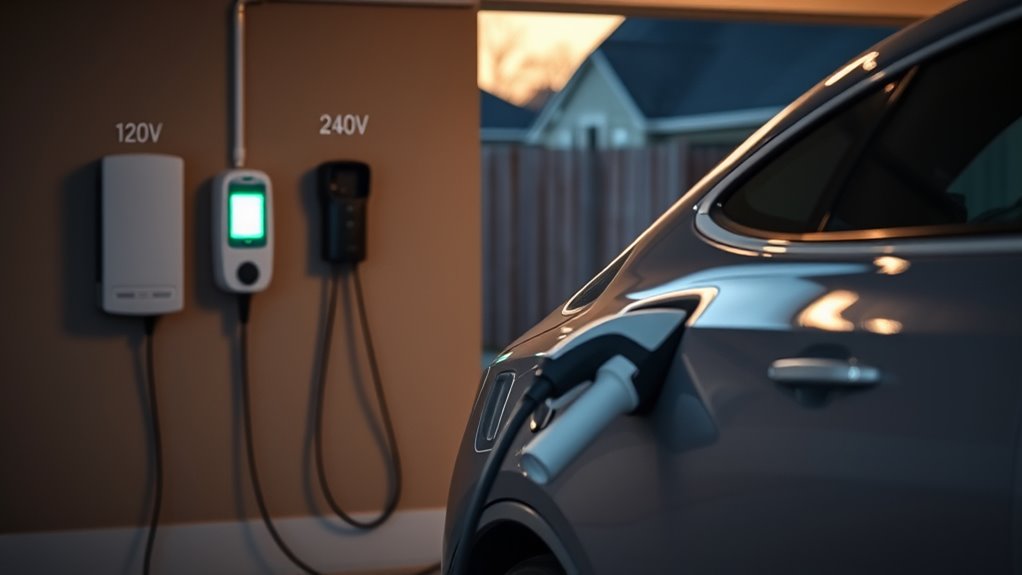
At home, you’ll usually charge your EV with either 120 volts or 240 volts. A standard 120-volt outlet supports Level 1 charging, which is the slowest home option and typically adds about 2 to 5 miles of range per hour. A 240-volt circuit supports Level 2 charging, which is much faster and commonly adds about 10 to 25 miles of range per hour, depending on the charger and vehicle. Your daily mileage, battery size, parking setup, panel capacity, and budget determine which voltage makes the most sense.
Quick Answer
Most home EV chargers use either 120V for Level 1 charging or 240V for Level 2 charging. Level 1 works from a standard household outlet but charges slowly. Level 2 uses a dedicated 240V circuit and is the better fit for longer commutes, larger EV batteries, and overnight full charging.
Key Takeaways
- Level 1 charging uses 120V and is best for short daily driving, plug-in hybrids, or backup charging.
- Level 2 charging uses 240V at most homes and charges several times faster than Level 1.
- Charging speed depends on the charger output, the vehicle’s onboard AC charger, battery size, temperature, and state of charge.
- A Level 2 charger usually needs a dedicated circuit, proper breaker sizing, code-compliant wiring, and a qualified electrician.
- Connector compatibility is changing in North America, so check whether your EV uses J1772, CCS Combo 1, Tesla, or J3400/NACS equipment.
What Voltage Do Home EV Chargers Use?
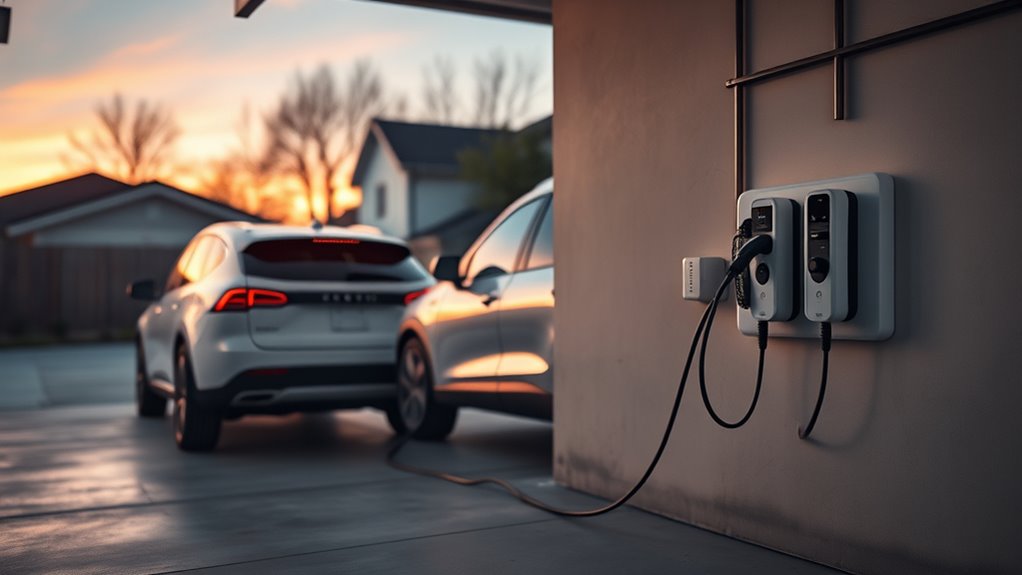
Home EV chargers typically use 120 volts for Level 1 charging or 240 volts for Level 2 charging. In commercial locations, Level 2 equipment may use 208V service, but most single-family home installations are based on 240V service.
A Level 1 charger plugs into a standard household outlet. It is simple and inexpensive, but it charges slowly. A Level 2 charger uses a higher-voltage circuit and delivers more power, so it is much better for drivers who need to recover more range overnight.
| Charging level | Typical home voltage | Typical range added | Best fit |
| Level 1 | 120V | About 2 to 5 miles per hour | Short commutes, plug-in hybrids, backup charging |
| Level 2 | 240V at home; 208V often in commercial settings | About 10 to 25+ miles per hour | Battery EVs, longer commutes, faster overnight charging |
Note: People often say “220V” when talking about home EV charging, but modern North American home Level 2 charging is usually described as 240V. In many workplaces or public garages, Level 2 equipment may run on 208V service instead.
How Level 1 Charging Works
Level 1 charging uses a standard 120V AC household outlet. Most EVs can charge this way with a portable cordset, so you may not need to buy or install a wall charger right away.
The tradeoff is speed. Level 1 usually supplies about 1 to 2 kW of usable charging power and may add only a few miles of range per hour. That can still work well if you park for long stretches and drive modest daily miles.
Level 1 Power Basics
With Level 1, the charging cord plugs into a standard grounded household outlet, often a NEMA 5-15 or NEMA 5-20 receptacle. The charger communicates with the car and limits current so the outlet and circuit are not overloaded.
This setup is simple because it uses existing 120V power. It is also the slowest home charging method. If your car adds about 3 to 5 miles of range per hour, an eight-hour overnight session may recover roughly 24 to 40 miles. That is enough for many short commutes but not ideal if you regularly drain a large battery.
Warning: Do not rely on a worn outlet, loose plug, undersized extension cord, or shared overloaded circuit for EV charging. EV charging is a long continuous load, so the outlet and circuit must be in good condition and rated for the charger.
Overnight Charging Pace
Level 1 charging works best when the car sits for many hours. If you drive less than about 30 to 40 miles a day and can plug in every night, it may cover your routine without a 240V upgrade.
A battery electric vehicle with a large pack may need more than a full day to charge from very low to high on Level 1. A plug-in hybrid usually has a smaller battery, so Level 1 can be much more practical for PHEV owners.
How Level 2 Charging Works
Level 2 charging uses a 240V circuit in most homes. It delivers more power than a normal 120V outlet, so it can recover a large amount of range during a normal overnight parking window.
Many residential Level 2 chargers deliver between about 3.8 kW and 11.5 kW, while some vehicles and EVSE setups can support more. Your actual charging speed depends on both the EV charger and the vehicle’s onboard AC charger. If your car can only accept 7.2 kW on AC power, a higher-rated wall unit will not force it to charge faster.
Level 2 Speed and Power Output
Level 2 can commonly add about 10 to 25 miles of range per hour, and some efficient EVs or higher-output setups may do better. This makes it the most convenient home charging choice for many battery electric vehicles.
Level 2 charging is usually the home sweet spot: fast enough for daily use, practical for overnight charging, and less demanding than DC fast charging.
Level 2 Power Requirements
A Level 2 charger normally needs a dedicated 240V circuit. Depending on charger amperage and local code, that circuit may use a 30A, 40A, 50A, 60A, or larger breaker. A qualified electrician should confirm your panel capacity, wiring size, breaker, grounding, GFCI requirements, permit needs, and whether a load-management device is required.
| Metric | Typical Level 2 value | Why it matters |
| Voltage | 240V at home | Provides faster charging than a 120V outlet |
| Power | About 2.9 to 19.2 kW, depending on equipment | Controls how quickly energy reaches the vehicle |
| Circuit | Dedicated circuit usually required | Reduces overload risk and supports code compliance |
| Connector | J1772 or J3400/NACS in North America | Determines whether you need an adapter |
Plug-In vs Hardwired Level 2 Chargers
A plug-in Level 2 charger uses a high-power receptacle, such as a NEMA 14-50 or similar outlet, if allowed by local code and the charger manufacturer. It can be easier to replace later, but the outlet must be rated for continuous EV charging and installed correctly.
A hardwired Level 2 charger is wired directly to the circuit. It can be cleaner, more secure, and sometimes supports higher amperage. Your electrician can help decide which setup fits your garage, driveway, panel, and local code.
Pro Tip: Choose a safety-certified charger and set the amperage to match the circuit, not just the charger’s maximum rating. A 48A charger, for example, usually needs a larger circuit than a 32A charger.
Connectors for Home EV Charging
Voltage tells you how power reaches the charger, but the connector tells you how the charger plugs into the vehicle. In North America, many non-Tesla EVs use J1772 for Level 1 and Level 2 AC charging. Many of those same vehicles use CCS Combo 1 for DC fast charging.
Tesla vehicles use the Tesla-style connector, now standardized as SAE J3400/NACS. Newer non-Tesla models are also moving toward J3400/NACS in North America, so plug compatibility is in transition. That means a home charger that fits one vehicle may need an adapter for another.
Before buying a charger, check your vehicle’s manual, charge-port type, onboard AC charging limit, and adapter rules. Use only manufacturer-approved or safety-certified adapters, especially for high-power charging.
How Long Home EV Charging Takes
Home EV charging time depends on your charger type, battery size, current battery percentage, temperature, and the vehicle’s AC charging limit. A simple estimate is:
Charging time = energy needed ÷ usable charging power
For example, if you need 30 kWh and your Level 2 setup delivers about 7.2 kW, the session may take a little over 4 hours before normal charging losses and tapering. If you need that same energy from a 120V Level 1 outlet, it can take much longer.
| Charger | Typical result |
| Level 1 | Often adds about 2 to 5 miles of range per hour; best for low daily mileage or PHEVs |
| Level 2 | Often adds about 10 to 25+ miles of range per hour; best for most full battery EVs |
| PHEV charging | May finish in a few hours because the battery is smaller, but exact time varies by model |
| BEV charging | May take several hours on Level 2 or more than a day on Level 1 when starting from very low charge |
You usually do not need to charge from 0% to 100% every night. Most drivers plug in after daily use and top off the energy they used that day. That is why overnight home charging can work even when a full empty-to-full charge would take much longer.
Which Home Charger Fits Your Driving Needs?
Your driving pattern should guide the voltage you choose. If you drive short distances, park near a safe outlet, and can plug in every night, Level 1 may be enough. If you drive more miles, own a full battery EV, share one charger between two EVs, or need faster turnaround, Level 2 is usually worth the upgrade.
- Choose Level 1 if you drive low daily mileage, own a plug-in hybrid, rent your home, or want a backup option with minimal installation.
- Choose Level 2 if you need reliable overnight recovery, have a long commute, own a larger battery EV, or want smart scheduling.
- Check your electrical panel before buying a charger, because the best charger is the one your home can support safely.
When Level 1 Is Enough
Level 1 can be enough if your daily use is predictable and low. It may also work well for a second car that does not leave the house every day. The main question is whether you can replace your average daily miles before the next trip.
When Level 2 Is Worth It
Level 2 is worth it when you want a larger buffer, faster recovery after road trips, or the ability to charge during lower-rate utility windows. It also helps if you live in a cold climate, because winter driving and battery heating can increase energy use.
What Home EV Charging Costs and Requires
Home EV charging cost depends on your local electricity rate and how many kilowatt-hours your car uses. The cleanest formula is:
Charging cost = kWh added × your electricity rate
If your EV needs 12 kWh to recover about 40 miles and your electricity rate is $0.18 per kWh, that session costs about $2.16 before taxes, fees, or charging losses. If your rate is lower, the cost drops. If you live in a high-rate state or charge during peak hours, the cost rises. You can check current electricity price data through the U.S. Energy Information Administration.
| Item | What to check |
| Electricity rate | Your cost per kWh, plus peak/off-peak pricing if your utility offers time-of-use rates |
| Vehicle efficiency | Miles per kWh or kWh per 100 miles from your vehicle display or window sticker |
| Installation | Panel capacity, wiring distance, permits, charger amperage, and electrician labor |
| Charger features | Wi-Fi, scheduling, load management, outdoor rating, cable length, and safety certification |
A smart Level 2 charger can help you schedule charging during lower-cost utility periods, track energy use, and avoid unnecessary peak-hour charging. ENERGY STAR notes that certified EV chargers are tested for safety and can reduce standby energy waste, so certification is worth checking before you buy.
Garage, Driveway, Apartment, and Outdoor Charging
Garage charging is usually the simplest setup because the charger can often be mounted near the panel or near an existing parking space. Driveway charging can also work well, but you need outdoor-rated equipment, weather-safe installation, and a cable route that does not create a trip hazard.
If you live in an apartment, condo, or rental home, check building rules before buying hardware. You may need landlord approval, HOA approval, assigned parking access, or a shared billing plan. In some cases, a portable Level 1 charger may be the easiest starting point until a permanent Level 2 option is approved.
Note: Outdoor charging can be safe when the EVSE is rated for outdoor use and installed correctly. Do not use indoor-only equipment outside or leave plug connections exposed to standing water.
Frequently Asked Questions
Can I plug my EV into a 120V outlet?
Yes, you can plug many EVs into a standard 120V grounded outlet with the proper portable Level 1 charging cord. The outlet and circuit must be in good condition, rated for the load, and not overloaded by other devices. Charging will be slow, but it can work for short daily driving or plug-in hybrids.
Are home EV chargers 220V or 240V?
In the United States and Canada, home Level 2 EV charging is usually described as 240V. Some people casually say 220V, but 240V is the more accurate modern residential term. Commercial Level 2 chargers may use 208V service.
What charger does the Chevrolet Equinox EV use?
Many current North American Chevrolet Equinox EV models use J1772 for Level 1 and Level 2 AC charging and CCS Combo 1 for DC fast charging. GM is also part of the broader J3400/NACS transition, so check your exact model year, owner’s manual, and approved adapter guidance before buying a home charger or road-trip adapter.
What kind of charger does the Hyundai Kona Electric use?
Many North American Hyundai Kona Electric model years use J1772 for Level 1 and Level 2 AC charging and CCS Combo 1 for DC fast charging. Hyundai is also moving some EVs toward J3400/NACS access, so verify your model year and use only Hyundai-approved or safety-certified adapters.
Do I need a Level 2 charger at home?
You may not need Level 2 if you drive short distances and can charge every night on 120V. You should consider Level 2 if you drive more than your Level 1 cord can replace overnight, own a larger battery EV, share a charger, or want to use off-peak electricity rates more easily.
Can I install a 240V EV charger myself?
Most homeowners should use a qualified electrician for a Level 2 charger. A proper installation may require panel evaluation, breaker sizing, wiring, permits, GFCI protection, load calculation, and local code compliance. Incorrect installation can overheat wiring or create a fire risk.
Conclusion
At home, EV charging usually comes down to 120V Level 1 or 240V Level 2. Level 1 is simple and inexpensive, but slow. Level 2 costs more to install, but it can recover far more range overnight and is usually the better fit for full battery EVs, longer commutes, and busy households.
Before you choose, compare your daily miles, available parking, electrical panel capacity, connector type, and local electricity rate. Then choose a safety-certified charger and have any 240V installation checked by a qualified electrician. The right voltage is the one that charges your EV safely, reliably, and fast enough for your real driving routine.
Sources
- U.S. Department of Energy Alternative Fuels Data Center: Charging Electric Vehicles at Home — backs up home charging levels, installation considerations, code compliance, and residential charging guidance.
- U.S. Department of Energy Alternative Fuels Data Center: Electric Vehicle Charging Stations — backs up Level 1, Level 2, DC fast charging, voltage, range-per-hour, power, and connector information.
- ENERGY STAR: Electric Vehicle Chargers — backs up safety-certified charger guidance, Level 1 and Level 2 buying guidance, and efficiency notes.
- U.S. Energy Information Administration: Electric Power Monthly Table 5.6.A — backs up current electricity-rate variability for charging-cost estimates.
- FuelEconomy.gov: All-Electric Vehicles — backs up EV efficiency, recharge-time context, and official EPA/DOE consumer guidance.