
Replace your EV charging cable as soon as it shows cracks, fraying, exposed wiring, bent pins, corrosion, melting, burn marks, or a loose connector fit. Stop using it if charging becomes intermittent, unusually slow, unstable, or if the cable or connector feels hot to hold. A mildly warm cable can be normal, but excess heat, electrical smells, or repeated charging faults are warning signs that the cable may no longer be safe.
Quick Answer
Replace an EV charging cable immediately if the outer jacket is cracked, wires are exposed, pins are bent or corroded, the connector will not latch, charging cuts in and out, or any part feels hot, smells burnt, or looks melted. Do not tape or repair a damaged cable.
Key Takeaways
- Replace the cable right away if you see exposed wire, cracked insulation, burn marks, melted plastic, corrosion, or bent pins.
- Stop charging if the cable or connector becomes hot to hold, smells burnt, or causes repeated charging interruptions.
- A loose plug, weak latch, or unstable charging session can point to worn contacts or internal cable damage.
- Choose a replacement that matches your vehicle, charge port, amperage, voltage, environment, and safety certification needs.
- Inspect the cable before use and store it dry, relaxed, and away from sharp bends, tires, standing water, and direct heat.
At a Glance
| Time Required | 2–5 minutes for a visual check before charging; 10–15 minutes for a deeper inspection after a fault |
| Difficulty | Easy visual inspection; call a qualified electrician if the outlet, breaker, EVSE, or hardwired charger may be involved |
| Tools Needed | Good lighting, dry cloth, owner’s manual, and the charger manufacturer’s instructions |
| Cost | Inspection is free; replacement cost depends on cable type, EVSE design, connector, amperage rating, and installation |
Signs Your EV Charging Cable Is Failing
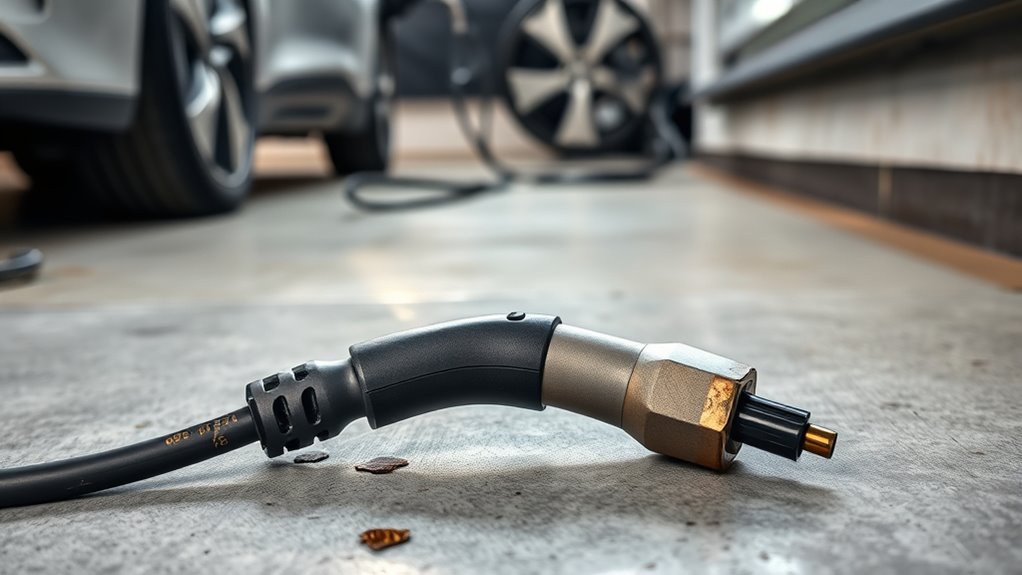
If you notice cracks, fraying, exposed wiring, melted plastic, burn marks, or a loose connector, replace the EV charging cable right away. Damaged insulation can expose conductors, weaken electrical protection, and increase the risk of shock, short circuit, overheating, or fire.
You should inspect the cable before each charging session. Look along the full cable sheath, both strain reliefs, the plug body, the latch, and the connector pins. If the cable does not seat firmly, does not latch, or charging starts and stops unpredictably, an internal fault or worn contact may be developing.
Excess heat is another warning sign. A cable may feel slightly warm during normal charging, especially at higher current, but it should not be hot to hold. Stop charging if you notice a hot connector, soft insulation, a burnt smell, discoloration, arcing marks, or repeated charging errors.
Also check for water, dirt, road salt, or corrosion inside the plug. Contamination can weaken electrical contact and raise resistance, which can create more heat under load.
Warning: Do not tape, splice, straighten, or keep using a cable with exposed wire, melted insulation, or burn marks. Stop charging, unplug only when safe, and replace the damaged equipment.
Visible Damage You Should Never Ignore
Visible damage is the easiest sign to catch, and it is also the sign you should take most seriously. The cable’s outer jacket protects the conductors inside. Once that jacket cracks, splits, melts, or wears through, the cable may no longer be safe even if it still charges the vehicle.
Do not assume a small split is harmless. EV charging can run for hours at a steady load, so weak insulation, poor contact, or internal conductor damage can worsen during a charging session.
Cracked Insulation Signs
Cracked or split insulation means the cable’s protective barrier is failing. Check closely near bends, strain reliefs, connector ends, and any area that gets stepped on, dragged, pinched, or stored tightly coiled.
Replace the cable if you see:
- Cracks, cuts, or splits in the jacket
- Flattened sections from being run over
- Soft, swollen, brittle, or sticky insulation
- Deep abrasions that expose inner layers
- Kinks that do not relax after the cable is laid flat
Even minor damage can spread as the cable flexes and heats during use. If the jacket is no longer intact, replacement is safer than repair.
Exposed Wire Hazards
Exposed wire is an immediate stop-use condition. It can increase the risk of electric shock, short circuit, arcing, and fire. Do not plug the cable into the wall, charger, or vehicle if you can see any conductor or inner insulation layer.
Inspect the full cable for related damage, including kinks, corrosion, hard lumps, flattened sections, or fraying near the connector. These signs can point to deeper internal damage, even when only one area looks worn.
Do not wrap exposed wire with electrical tape and continue charging. Tape does not restore the cable’s original insulation rating, strain relief, weather protection, or safety certification.
Burn Marks, Melting, and Electrical Smells
Burn marks, melted plastic, darkened pins, bubbling insulation, or a sharp electrical smell are serious warning signs. They often point to overheating, poor contact, contamination, internal conductor damage, or a loose connection.
If you notice any of these signs, stop using the cable. Also inspect the vehicle charge port and the wall-side plug or EVSE connection. If the outlet, breaker, hardwired charger, or wall unit shows heat damage, call a qualified electrician before charging again.
Charging Problems Caused by Cable Wear
Cable wear can show up as a charging problem before you see obvious physical damage. If charging becomes intermittent, slow, unstable, or error-prone, check the cable and connectors before blaming the vehicle.
The U.S. Department of Energy’s Alternative Fuels Data Center explains that charging speed depends on the vehicle, charger power level, and equipment involved. That means a single slow session is not always a cable failure, but repeated slow charging with the same cable deserves attention.
Intermittent Charging Failures
Intermittent charging failures can point to internal cable damage, loose terminations, worn connector contacts, corrosion, or poor latch engagement. Treat repeated stop-start charging as a fault, not a nuisance.
Check whether the issue follows the cable. If the same cable causes problems at more than one outlet or charging location, the cable or portable EVSE may be the weak point. If every cable fails at the same outlet or wall charger, the EVSE, receptacle, circuit, or vehicle port may need inspection.
- Stop using the cable if charging cuts out repeatedly.
- Look for error lights or messages on the EVSE and vehicle screen.
- Check whether the connector fully seats and locks.
- Inspect pins for corrosion, pitting, bending, or looseness.
- Contact the charger manufacturer or a qualified technician if the fault repeats.
Loose Connector Contacts
A secure fit is essential for reliable charging. If the connector wiggles heavily, slips out, fails to latch, or the vehicle does not detect it consistently, stop and inspect the plug and port.
Loose contacts can raise electrical resistance. Higher resistance can create heat at the connector, reduce charging performance, or damage the vehicle charge port over time.
- Check for looseness before every session.
- Listen and feel for a firm latch when the connector is inserted.
- Look for bent, recessed, darkened, or corroded pins.
- Never force a connector that will not line up or lock.
- Replace a cable or connector assembly that no longer fits securely.
Overheating During Charging
Although slight warmth can be normal, excessive heat is not. A cable, plug, or connector that is hot to hold can indicate poor electrical contact, internal wire damage, overloading, contamination, or a failing outlet or EVSE.
If the cable feels unusually hot, stop charging and inspect the cable after it cools. Do not keep charging to “see if it happens again” if you also notice smell, melting, discoloration, error messages, or a loose connection.
Keep the cable relaxed during charging. Avoid tight bends, knots, pinching under a garage door, running it under tires, or stretching it across a sharp edge.
When Connectors Need Replacing Too
Even if the cable body looks intact, the connectors may still need replacement. Replace a worn connector if it shows corrosion, bent pins, recessed pins, cracked housing, melted plastic, weak latch action, or physical damage that weakens the electrical connection.
During routine inspections, check both ends of the charging equipment for grime, moisture, road salt, and signs of wear. A connector should insert smoothly and lock firmly. If it feels loose, slips, or will not latch, do not force it.
Inspect EV connectors before each charge. If the fit is loose, the latch does not hold, or the pins look bent, corroded, darkened, or recessed, stop using the cable.
Frequent interruptions, failed recognition, and inconsistent charging can point to connector wear rather than visible cable-body damage. Keep contact areas clean and dry, but do not scrape pins, spray random chemicals into the plug, or use a connector that looks heat-damaged.
- Look for green corrosion, white residue, pitting, or darkened metal.
- Test the latch for a solid click.
- Inspect pins for bending, recession, discoloration, or looseness.
- Check whether the vehicle detects the cable reliably.
- Replace compromised connectors without delay.
Why Your EV Cable Feels Too Hot
An EV cable can feel warm because current is flowing through it for a long period. That alone does not prove the cable is failing. The danger starts when the warmth becomes abnormal, concentrated at one spot, paired with a smell, or linked to charging errors.
| What You Notice | What It May Mean | What To Do |
|---|---|---|
| Cable is mildly warm | Often normal during charging | Keep monitoring; inspect for damage before the next session |
| Cable or connector is hot to hold | Possible poor contact, overload, or internal damage | Stop charging and replace or service the equipment |
| Heat is strongest at the plug or pins | Loose, dirty, worn, or corroded contact | Stop use and inspect the connector, port, and EVSE |
| Burning smell, melting, or discoloration | Heat damage or electrical fault | Replace the cable and check the outlet or wall charger before reuse |
If the cable feels too hot to hold, unplug it only when it is safe to stop charging, then examine the connector, jacket, pins, and surrounding equipment. Do not keep using a cable that shows heat-related wear.
How Long EV Charging Cables Last
There is no single expiration date for every EV charging cable. Many cable assemblies can last for years, but lifespan depends on build quality, current load, daily use, storage, sunlight, water exposure, impact damage, and how often the cable is bent or pulled.
Use age as a reminder to inspect more carefully, not as the only replacement rule. A newer damaged cable should be replaced immediately, while an older cable that is clean, intact, cool during use, and manufacturer-approved may still be serviceable.
Follow the charger manufacturer’s manual for inspection, cleaning, storage, and replacement guidance. The ENERGY STAR EV charger guidance also recommends choosing EV charging equipment that is safety certified by a nationally recognized testing laboratory.
- Inspect before regular use.
- Look for cuts, swelling, soft spots, or cracks.
- Keep connectors clean and dry.
- Store the cable loosely coiled and shaded.
- Replace the cable at the first safety hazard.
Note: A cable does not become safe just because it still charges. Damage, heat, corrosion, or loose contact can make replacement necessary before total failure.
What Shortens EV Cable Lifespan
Frequent charging, rough handling, harsh weather, and poor storage can shorten an EV cable’s lifespan. Repeated flexing can weaken conductors, especially near the connector ends where strain is highest.
Yanking, twisting, sharply bending, or driving over the cable can damage the inside even when the outer jacket looks mostly normal. Extreme heat, freezing conditions, moisture, road salt, and direct sunlight can also age the insulation and connector housing.
Lower-quality or non-certified equipment may degrade faster under stress. To protect the cable, route it cleanly, keep it off sharp edges, avoid pinch points, and store it dry.
- Do not close a garage door on the cable unless the setup is designed for that routing.
- Do not stretch the cable tight between the EVSE and vehicle.
- Do not run the cable through standing water.
- Do not leave the connector on the ground where dirt and moisture can enter.
- Do not use a cable that has been crushed, overheated, or contaminated.
How to Inspect Your EV Charging Cable
Inspect your EV charging cable before use and any time charging feels slower, unstable, or hotter than normal. A careful inspection only takes a few minutes.
- Start with the cable unplugged. Do not inspect exposed or damaged wiring while the cable is energized.
- Check the full jacket. Look for cracks, cuts, fraying, swelling, flattening, kinks, soft spots, or melted areas.
- Inspect both strain reliefs. These are the areas where the cable enters the connector or plug. Replace the cable if the strain relief is split, loose, or pulling away.
- Look inside the connector. Check for bent pins, recessed pins, corrosion, dirt, moisture, pitting, dark marks, or melted plastic.
- Test the fit. The connector should insert smoothly and latch firmly without being forced.
- Watch the first few minutes of charging. Confirm that charging starts normally and does not cycle on and off.
- Check for abnormal heat. After charging has been running for a while, the cable may be warm, but it should not be hot, soft, smelly, or discolored.
- Review charger messages. Repeated EVSE lights, vehicle warnings, or app errors can help identify whether the cable, EVSE, outlet, or vehicle port is involved.
Pro Tip: Take a quick photo of any suspected cable damage. It helps you compare whether cracks, corrosion, or discoloration are getting worse and may help when contacting the manufacturer.
When to Replace Your EV Charging Cable
Replace your EV charging cable as soon as damage or unsafe performance appears. Do not wait for total failure, because a failing cable can also damage the vehicle charge port, outlet, or EVSE.
| Condition | Action | Main Risk |
|---|---|---|
| Exposed wire, cracked insulation, melting, or burn marks | Replace now | Shock, short circuit, overheating, fire |
| Bent, corroded, recessed, or darkened pins | Replace the cable or connector assembly | Poor contact and charge-port damage |
| Loose fit or latch will not hold | Stop use and replace if the connector is worn | Intermittent current flow and heat |
| Charging repeatedly stops, slows, or errors with the same cable | Inspect and replace if the fault follows the cable | Internal conductor or contact fault |
| Cable is only mildly warm and has no damage or errors | Monitor and inspect regularly | Usually low if all equipment is healthy |
If you are unsure whether the cable, portable charger, wall charger, outlet, breaker, or vehicle port is the problem, stop using the suspect equipment and get qualified help. A replacement cable will not solve a damaged receptacle, overloaded circuit, or failing EVSE.
Choosing a Safe Replacement Cable
Choose a replacement cable or EVSE that matches your vehicle and charging setup. Do not buy only by cord length or price. The replacement must match the connector type, voltage, amperage, plug, environment, and manufacturer requirements.
The AFDC home charging guidance notes that outdoor charging equipment can be used safely when it is rated for outdoor use and installed correctly. It also recommends safety-certified equipment and qualified electrical work where installation is needed.
Before buying a replacement, check:
- Connector type: J1772, CCS1, CHAdeMO, SAE J3400/NACS, or a market-specific connector.
- Charging level: Level 1, Level 2, or DC fast charging equipment.
- Current rating: The cable and EVSE must be rated for the circuit and vehicle charging limit.
- Outdoor rating: Use outdoor-rated equipment if the cable will be exposed to weather.
- Safety certification: Look for equipment certified by a nationally recognized testing laboratory.
- Manufacturer approval: Use OEM or manufacturer-approved parts when the charger design requires a specific cable assembly.
Warning: Avoid using household extension cords, damaged adapters, or off-brand connector adapters that are not approved for your vehicle and charger. The wrong adapter or cord can overheat even when charging appears to start normally.
Understanding EV Connector Compatibility
Connector names vary by region, vehicle model year, and charging speed. In North America, many EVs have used J1772 for AC charging and CCS1 for DC fast charging, while some older vehicles use CHAdeMO for DC fast charging. The Joint Office of Energy and Transportation also describes SAE J3400, based on the connector system previously called NACS, as part of the current North American charging transition.
This matters when replacing a cable because the wrong connector may not fit, may charge only with an approved adapter, or may not support the charging level you expect. Always verify your vehicle’s charge port, owner’s manual, charger label, and local market before buying a replacement cable.
Also remember that the cable is only one part of the charging path. A charging problem can come from the EVSE, wall outlet, breaker, adapter, vehicle charge port, onboard charger, or software. If a new cable does not solve repeated faults, the rest of the system needs inspection.
Frequently Asked Questions
How long should an EV charging cable last?
An EV charging cable can last for years, but there is no universal replacement date. Lifespan depends on use, storage, weather exposure, current load, cable quality, and handling. Replace it immediately if you see cracks, exposed wire, corrosion, bent pins, melting, burn marks, loose fit, abnormal heat, or repeated charging faults.
Is it normal for an EV charging cable to get warm?
Mild warmth can be normal during charging, especially during a long Level 2 session. It is not normal for the cable, wall plug, or vehicle connector to be hot to hold, smell burnt, soften, discolor, melt, or cause charging errors. Stop using the equipment if heat feels abnormal.
Can I repair an EV charging cable with electrical tape?
No. Electrical tape does not restore the cable’s original insulation, weather protection, strain relief, heat resistance, or safety certification. If the cable has exposed wire, cracked insulation, melted plastic, or burn marks, replace it instead of repairing it.
What type of charger cable does a Nissan Leaf use?
Many older North American Nissan Leaf models use J1772 for Level 1 and Level 2 AC charging and CHAdeMO for DC fast charging. Connector types can vary by model year and market, and newer North American charging standards are changing, so check the charge-port label and owner’s manual before buying a replacement cable or adapter.
What kind of charger does the Hyundai Kona Electric use?
It depends on the model year and market. North American Kona Electric models have commonly used J1772 for AC charging and CCS1 for DC fast charging, while European models may use Type 2 and CCS2. Newer vehicles may also be affected by the SAE J3400/NACS transition. Always verify your exact vehicle before buying a cable.
What type of charging station works for a RAV4 Prime?
For most home charging, a properly installed Level 2, 240-volt charging station is the practical choice for a RAV4 Prime or RAV4 Plug-in Hybrid. Match the charger to the vehicle’s onboard charging limit, connector type, circuit rating, and installation requirements instead of assuming one amperage fits every setup.
Should I replace the cable or the whole EV charger?
Replace only the cable if the manufacturer designed it as a replaceable part and the wall unit or portable EVSE is otherwise healthy. Replace or service the whole EVSE if the cable is permanently attached, the housing is damaged, the plug overheats, the outlet is scorched, or charging faults continue with a known-good cable.
Conclusion
If your EV charging cable shows cuts, loose connectors, exposed wiring, corrosion, recurring charging faults, melted plastic, burn marks, or excessive heat, replace it before it fails completely. Do not assume minor wear is harmless. Insulation damage and poor contact can create resistance, overheating, and safety risks even when the cable still appears to work.
Inspect the cable regularly, keep it clean and dry, and choose a safety-certified replacement that matches your vehicle and charging setup. When damage is visible or performance drops, replacement is safer than repair.
Sources
- U.S. Department of Energy Alternative Fuels Data Center: Electric Vehicle Charging Stations — charging levels, connector types, and charging-speed context
- U.S. Department of Energy Alternative Fuels Data Center: Home Charging — home charging, outdoor-rated equipment, and safe installation guidance
- ENERGY STAR: EV Chargers — Level 1 and Level 2 charger guidance and safety-certified equipment recommendations
- Joint Office of Energy and Transportation: Charging Connector — CCS, CHAdeMO, SAE J3400/NACS, and connector compatibility background