
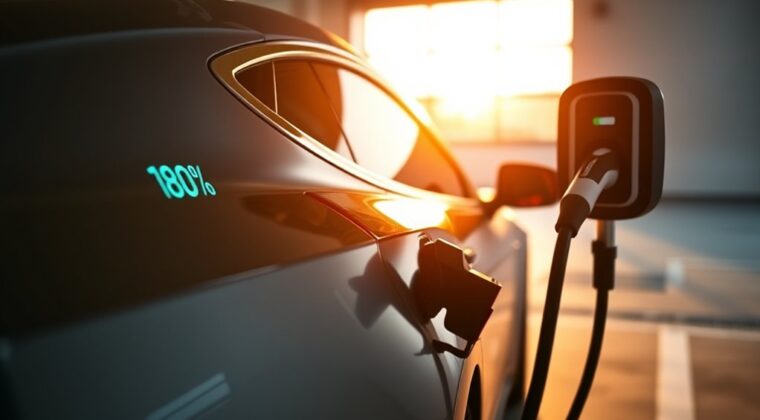
Charging to 80% is often the best daily EV limit because it gives you most of your usable range while reducing time spent in the highest-voltage part of the battery. For many drivers, that means enough range for commuting, errands, and short trips without regularly pushing the pack to 100%. The 80% target is not a strict rule for every EV, though. Battery chemistry, weather, driving distance, and your owner’s manual all matter.
Quick Answer
Charging an EV to 80% is usually best for daily use because it limits high-voltage battery stress, keeps charging sessions shorter, and still leaves enough range for most routines. Use 100% when you need maximum range for a road trip, then return to your normal daily limit afterward.
Key Takeaways
- For many EVs, 80% is the best daily charge target because it balances range, battery care, and charging speed.
- The last 20% often charges much slower because the battery management system tapers power near a high state of charge.
- Use 100% before long trips, but try to time the charge so the car does not sit full for many hours.
- Battery chemistry matters. Some LFP battery models tolerate higher charge limits better than many nickel-based packs.
- Always follow your EV owner’s manual or in-car charging recommendation if it differs from general 80% advice.
Why 80% Is the EV Charging Sweet Spot
For many EVs, 80% works because it sits in a practical middle ground. You get most of the car’s available range, but you avoid spending extra time and battery stress in the highest state-of-charge zone.
Lithium-ion batteries age from many causes, including temperature, time, charge level, charging rate, and depth of discharge. Battery research has found that charge level and temperature are important factors in calendar aging, while depth of discharge and current rate affect cycle aging. You do not need to manage every detail like a battery engineer, but a daily limit around 80% helps reduce one common source of avoidable wear.
That does not mean 81% suddenly damages your battery or that 100% is forbidden. EV batteries are managed by software, cooling systems, and built-in buffers. The point is simple: if you do not need the full range today, there is usually no benefit to keeping the pack full.
Note: Treat 80% as a daily default, not a universal law. Your EV’s battery chemistry and owner’s manual should always come first.
How the 80/20 Rule Protects Battery Health
The 80/20 rule means you try to keep your EV between about 20% and 80% during normal daily use. This avoids frequent deep discharges at the bottom and frequent full charges at the top.
The top of the battery is where cell voltage is highest. Sitting at a high state of charge, especially in hot weather, can speed up calendar aging in lithium-ion cells. Research on NMC-graphite lithium-ion batteries found that lower state of charge and lower working temperature can help prolong battery life during storage.
The lower end matters too. You do not need to panic if your EV drops below 20%, but regularly running the pack very low adds stress and gives you less reserve if plans change. A simple daily rhythm is better: plug in when convenient, set a daily limit, and avoid letting the car sit nearly empty or completely full for long periods.
Warning: Do not store an EV at 100% in hot weather unless the owner’s manual specifically allows it or you need the range soon. Heat plus a high state of charge is harder on many lithium-ion packs.
Check Your EV Battery Type First
Not every EV battery responds the same way. Many EVs use nickel-based lithium-ion chemistries, such as NMC or NCA. These packs usually benefit from a daily charge limit below 100%, often around 70% to 90% depending on the model and your range needs.
Some EVs use LFP, or lithium iron phosphate, batteries. LFP packs are known for strong cycle life and can often tolerate higher charge limits better than many nickel-based packs. Some LFP-equipped vehicles may even recommend charging to 100% periodically so the battery management system can estimate range accurately.
The safest advice is to use your vehicle’s in-car recommendation. If your EV lets you choose a “daily” and “trip” limit, use the daily setting for normal driving and the trip setting only when you need maximum range.
Common Daily Charge Targets
| 70% | Good if your daily driving is short and you want extra battery-care margin. |
| 80% | Best all-around daily target for many EVs because it balances range and battery stress. |
| 90% | Useful if you drive farther each day, but less ideal for long-term parking in hot weather. |
| 100% | Best reserved for road trips, unusual long-distance days, or models whose manual recommends it. |
Why EVs Charge Faster Below 80%
EVs usually charge fastest when the battery is at a lower or middle state of charge. During this part of the session, the battery can accept higher power without pushing cell voltage too close to its upper limit.
After about 80%, the battery management system often reduces charging power. This taper helps control cell voltage, heat, and stress. That is why public fast-charging stops are usually planned around the lower-to-80% range instead of waiting for 100% every time.
Faster Early Charging
Early charging is faster because the pack has more room to accept energy. If your EV is at 20%, it can often take a much higher charging rate than it can at 90%. That is why a public DC fast charger may add miles quickly at first, then slow down as the battery fills.
This does not mean you should regularly run the battery to 0%. It means that, on road trips, charging from a lower percentage to around 70% or 80% is often faster than charging from 80% to 100%.
Slower Final Top-Off
The final top-off can take a surprisingly long time. In many EVs, the last 20% takes a disproportionate amount of the total charging session because the car tapers current to protect the pack.
| Charge Range | Typical Behavior | Best Use |
|---|---|---|
| 10–50% | Often highest charging power | Fastest road-trip stops |
| 50–80% | Power gradually reduces | Useful range buffer |
| 80–100% | Current tapers more | Use before long drives |
Heat and Battery Stress
Charging often slows after about 80% because the battery management system reduces current to control heat and cell voltage. This is normal. The car is protecting the pack, not malfunctioning.
Heat is one reason daily 100% charging is not ideal for many EVs. A battery sitting full in a hot driveway or garage can age faster than one sitting at a moderate charge. If you need 100%, try to finish charging close to departure instead of letting the car sit full overnight.
Pro Tip: On a road trip, it is often faster to make two shorter fast-charging stops from a lower charge level than one long stop where you wait for 100%.
Why 80% Covers Most Daily Driving
An 80% charge does not mean the same number of miles in every EV. It means you get about 80% of that vehicle’s usable range. If your EV is rated for 250 miles, 80% is roughly 200 miles before weather, speed, terrain, and tire choice reduce the real-world number. If your EV is rated for 320 miles, 80% is roughly 256 miles.
For many drivers, that is more than enough for commuting, school runs, errands, and local appointments. You also keep some headroom in the battery, which helps with regenerative braking and avoids the slowest part of the charging curve.
Daily Commute Range
Daily charging works best when it matches your real driving. If you normally drive 25 to 50 miles per day, charging to 80% may give you several days of range in many EVs. If you drive 100 miles or more per day, 80% may still work, but you may need a higher daily limit depending on your model and climate.
Cold weather, highway speed, roof racks, low tire pressure, towing, and steep terrain can reduce range. If your winter commute is tight at 80%, raising the daily limit to 85% or 90% may be more practical than feeling anxious every morning.
Buffer for Errands
A good charge limit should leave room for real life. Errands, detours, school pickup, traffic, and unexpected appointments can add miles. That is why 80% is a better daily target than the lowest possible percentage for many drivers.
| Daily Need | Good Target | Why It Works |
|---|---|---|
| Short commute | 60–80% | Enough range with less high-SOC time |
| Mixed errands and commuting | 80% | Balanced daily buffer |
| Long commute or winter driving | 85–90% | More margin when range drops |
| Road trip departure | 100% | Maximum starting range |
Enough for Most Drivers
The best daily limit is the lowest limit that comfortably covers your normal driving with a reserve. For many people, that is 80%. For light daily use, it may be 70%. For heavy daily use, it may be 90%.
Do not treat the number as a contest. The goal is not to keep the battery as low as possible. The goal is to avoid unnecessary time at 100% while still making the car convenient to use.
When Should You Charge an EV to 100%?
You should charge an EV to 100% when you need maximum range. That usually means a long road trip, a rural route with limited chargers, a winter drive with extra range loss, towing, or a day when you cannot easily stop to charge.
- Set the charge limit to 100% the night before or the morning of your trip.
- Schedule charging so the car reaches 100% close to departure.
- Drive soon after the battery reaches full.
- After the trip, return the daily charge limit to your normal setting.
Occasional 100% charging is normal. EV batteries are designed for real-world use. The habit to avoid is leaving the car full every day when you do not need the range.
Why Staying Below 100% Helps Regenerative Braking
Regenerative braking sends energy back into the battery when you slow down. If the battery is already full, the car has less room to accept that recovered energy. Some EVs reduce regenerative braking at 100%, in cold weather, or when the battery is outside its ideal temperature range.
Charging to 80% leaves more room for recovered energy. That can make the car feel more consistent and efficient during daily driving, especially if you rely on one-pedal driving.
| Charge State | Regenerative Braking Effect |
|---|---|
| 100% | May be limited because the pack has little room for recovered energy |
| 90% | Usually stronger, but still close to the upper range |
| 80% | Good balance of range and regen headroom |
| Below 80% | More headroom, but less remaining driving range |
Best Charging Habits for Long Battery Life
Good EV charging habits are simple. You do not need to micromanage the battery every hour. Use a daily limit, avoid extreme heat when possible, and save 100% for the days when you need it.
- Set a daily charge limit around 80%. Raise or lower it based on your real driving distance.
- Do not let the car sit at 100% longer than needed. Full charges are best timed close to departure.
- Avoid regularly dropping near 0%. Keep a practical reserve for unexpected trips or detours.
- Use DC fast charging when it helps, not as your only routine if home charging is available. Fast charging is convenient, but heat and high charging power can add stress.
- Precondition before fast charging when your EV offers it. A warm battery can charge faster and more smoothly in cold weather.
- Follow the owner’s manual. Model-specific guidance matters more than generic advice.
Home Charging vs. Public Fast Charging
Home Level 2 charging is usually the easiest way to live with an EV. You plug in at night, set the charge limit, and start each day with the range you need. Because AC home charging is slower than DC fast charging, it is usually gentler and creates less heat.
Public DC fast charging is best for road trips, busy days, and emergency range. At a fast charger, stopping around 80% often saves time and helps the next driver use the charger sooner. If you need 100% to reach the next stop, charge to 100%. If you do not, moving on at 70% to 80% is often the better choice.
Common EV Charging Mistakes
Most EV charging mistakes come from treating the battery like a gas tank. You do not have to fill it completely every time. You only need enough range for your next use, plus a safe reserve.
- Charging to 100% every night: Convenient, but unnecessary for many drivers and harder on many packs over time.
- Waiting until 0% to plug in: Adds stress and leaves no buffer for detours.
- Ignoring weather: Cold and heat both affect range, charging speed, and battery behavior.
- Fast charging to 100% at a busy station: Often slow and inconsiderate unless you truly need the range.
- Using one rule for every EV: Battery chemistry and software differ, so always check your manual.
Frequently Asked Questions
Should I charge my EV daily to 80%?
Yes, 80% is a good daily target for many EVs because it gives you useful range while reducing time spent at a high state of charge. If your daily driving is short, 70% may be enough. If your commute is long or winter range is tight, 85% to 90% may be more practical.
Why do people only charge their EV to 80%?
People charge to 80% because it usually balances battery health, range, and charging speed. The battery spends less time in the highest-voltage zone, public fast-charging sessions are shorter, and there is still enough range for most daily driving.
Is it better to charge a Tesla to 70% or 80%?
For many Tesla drivers, 70% is fine if it comfortably covers daily driving, while 80% gives more reserve for errands, weather, and detours. The best setting depends on your model, battery chemistry, and Tesla’s current in-car recommendation. Some LFP-equipped models may have different guidance, so follow the owner’s manual or the charging screen.
What is the optimal percentage to charge an EV?
For daily use, the optimal charge is usually the lowest setting that covers your normal driving with a comfortable reserve. For many EVs, that is about 80%. For long trips, 100% is fine when you need the range and plan to drive soon after charging.
Is charging to 90% bad for an EV?
Charging to 90% is not automatically bad, and many drivers use it when they need extra range. It is simply closer to the high-voltage zone than 80%, so it is not always the best daily setting if 80% already covers your needs.
Should I charge to 100% before every road trip?
Charge to 100% before a road trip when you need the extra range. For best battery care, schedule the charge so it finishes close to your departure time, then return the daily limit to your normal setting after the trip.
Conclusion
Charging to 80% is the best daily habit for many EV owners because it gives you practical range, keeps charging sessions shorter, and reduces time spent at a high state of charge. It is not a hard rule for every vehicle, though. Use 100% when the trip calls for it, adjust for weather and driving distance, and follow your EV’s owner’s manual. Smart charging is not about limiting your freedom. It is about getting the range you need while slowing avoidable battery wear over time.
Sources
- Analysis of Lithium-ion Battery Cells Degradation Based on Different Manufacturers — supports the role of charge level, temperature, current rate, and depth of discharge in battery aging.
- Electrochemical Modeling of Calendar Capacity Loss of NMC-Graphite Lithium Ion Batteries — supports the link between high state of charge, temperature, and calendar aging.
- Pouch Cells With 15% Silicon Calendar-Aged for 4 Years — supports the effect of high state of charge during long storage.
- National Household Travel Survey — official U.S. travel survey resource for daily driving behavior context.
- Tesla Owner’s Manual Library — manufacturer source for model-specific charging guidance and battery-care instructions.