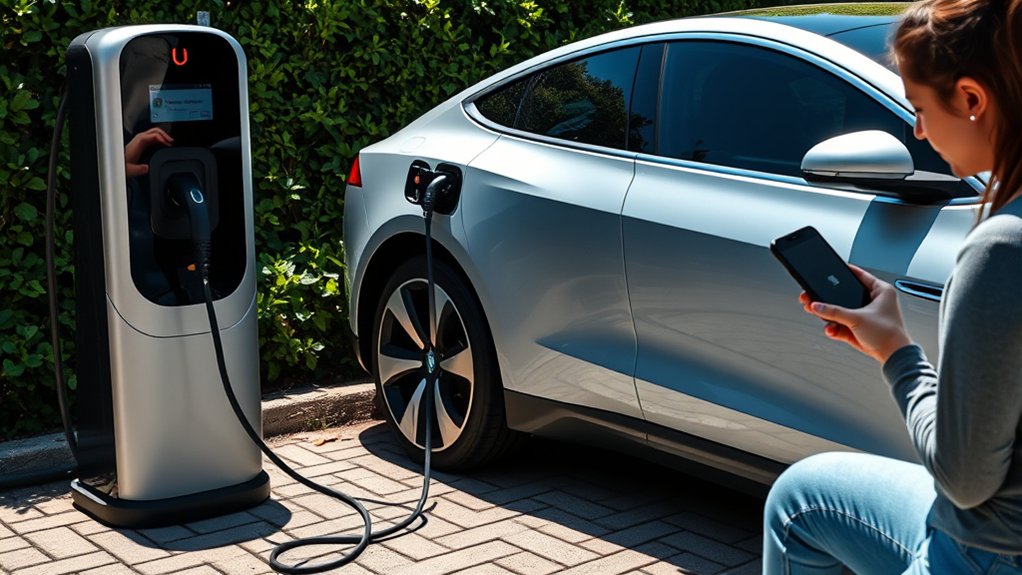
If your EV charging stops mid-session, the cause is usually one of six things: a tripped breaker or MCB, ground-fault protection, low or unstable voltage, heat at the charger or connector, a vehicle battery-management limit, or a communication problem between the car and charging equipment. Start with the safe checks you can do without opening electrical panels: read the charger or vehicle error message, inspect the plug and cable, confirm the charge limit and schedule, and look for heat, moisture, or damage.
Quick Answer
EV charging usually stops mid-session because the charger, breaker, outlet, cable, or vehicle detects a condition it considers unsafe or complete. Check the error code first, then inspect for heat, loose connectors, moisture, breaker trips, charge-limit settings, and scheduled charging. If a breaker trips again, stop charging and call a qualified electrician.
Key Takeaways
- A single stopped session is often caused by a loose connector, app schedule, high battery state of charge, or temporary heat.
- Repeated breaker or MCB trips are a warning sign, not something to keep resetting.
- Ground-fault, moisture, damaged cable, burnt outlet, or hot-plug issues should be handled by a qualified electrician or charger technician.
- Many “early stops” are normal when the car reaches its charge limit or the battery management system reduces current near a high state of charge.
- Newer causes are just as common: a mismatched NACS/CCS adapter, a utility managed-charging program pausing the session, or a low 12-volt accessory battery can all stop charging without showing an obvious fault.
At a Glance
| Time Required | 5–15 minutes for basic checks; longer if an electrician needs to test the circuit |
| Difficulty | Easy for visual checks; professional-only for wiring, breaker, grounding, or live-voltage diagnosis |
| Tools Needed | Charger app, vehicle app, owner’s manual, flashlight, clean dry cloth; multimeter only if you are qualified to use it safely |
| Cost | Free for basic checks; electrician or EVSE service costs vary by fault, charger type, and local rates |
Common Causes of EV Charging Interruptions
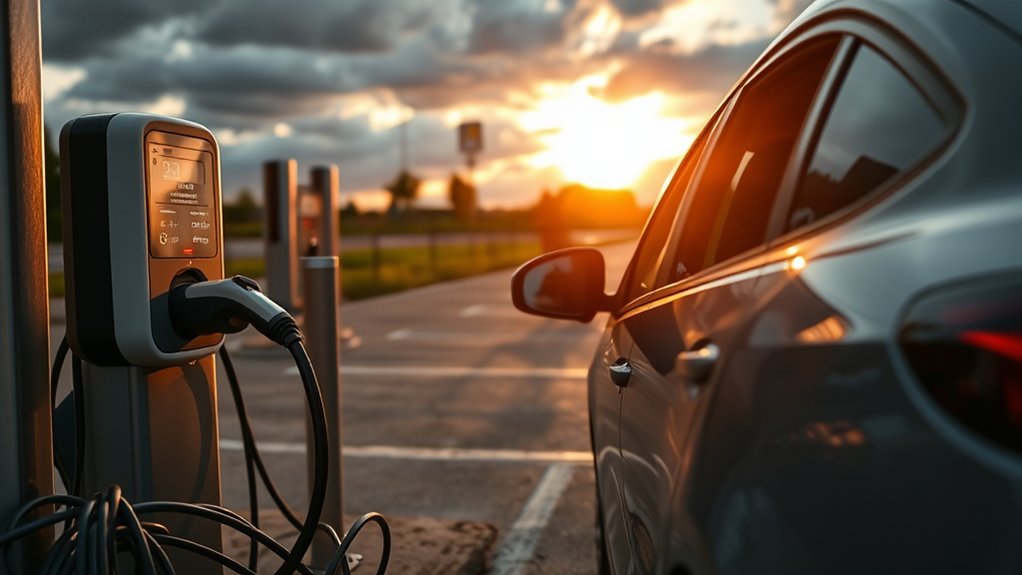
When you plug in your electric vehicle, the charging session depends on the car, the charger, the connector, the branch circuit, and sometimes the charger network. If any part detects a fault or limit, charging may pause or stop.
Common causes include breaker or MCB tripping, ground-fault protection, moisture in the connector, a loose plug, overheating, a vehicle charge limit, scheduled charging, low supply voltage, firmware issues, or a public charging-station fault. The U.S. Department of Energy’s Alternative Fuels Data Center notes that charging time and behavior vary by battery state of charge, battery capacity, charger output, vehicle limits, and electrical service specifications.
- Utility managed charging or demand response: If you’re enrolled in a utility or automaker off-peak or demand-response program, the system can automatically pause or throttle charging during peak grid hours without showing an on-screen fault. Check your utility account or vehicle app for an active managed-charging enrollment before assuming the equipment is broken.
- A weak or dead 12-volt accessory battery: Many EVs use a small 12-volt battery to power the low-voltage electronics that “wake up” the car and complete the handshake with the charger. If that battery is low, the vehicle may fail to start or hold a charging session even though the main traction battery has plenty of range.
For home charging, circuit capacity matters. The Alternative Fuels Data Center explains that charging installations must comply with local and state codes, and that NEC Article 625 covers most EV charging-equipment requirements. It also recommends using qualified electrical contractors and safety-certified equipment.
Warning: Stop charging immediately if the breaker trips again, the plug or outlet feels hot, you smell burning plastic, the connector is wet inside, the cable is cracked, the outlet is discolored, or the charger shows a ground-fault error. Do not keep resetting the breaker. Have the circuit, outlet, breaker, and EVSE checked by a qualified electrician.
Quick Safety Check Before Troubleshooting
Before you assume the charger is broken, do a simple safety check. You should not need to remove covers, open an electrical panel, or touch live wiring.
- Read the message first: Check the vehicle screen, charger app, and charger lights for a fault code or warning.
- Check the charge limit: If your car is set to stop at 70%, 80%, or 90%, the session may have ended normally.
- Check the schedule: Scheduled charging, off-peak charging, or a utility managed-charging program can make a charger appear to stop randomly.
- Inspect the connector: Look for debris, bent pins, water, corrosion, or a latch that is not fully seated.
- Check any adapter: If you’re charging through a NACS-to-CCS or CCS-to-NACS adapter, confirm it’s manufacturer-approved and fully seated on both ends.
- Check for heat: Warm is common during charging; hot, softened, discolored, or burnt-smelling parts are not.
- Look at the breaker: If it tripped, reset it only once if the charger manual allows and there are no signs of heat or damage. If it trips again, stop.
How to Fix Charging Interruptions Effectively
Fixing an EV charging interruption starts with separating normal vehicle behavior from an electrical or charger fault. A car that stops at its target state of charge is working as intended. A charger that stops because the breaker trips, the connector overheats, or the app reports a ground fault needs diagnosis before you use it again.
Basic Troubleshooting Steps
Use this order so you do the safest checks first.
| Step | What to Check | What It Means |
|---|---|---|
| 1 | Vehicle and charger error message | A fault code narrows the issue faster than guessing. |
| 2 | Charge limit and schedule | The car may have stopped because it reached the limit or is waiting for a scheduled time. |
| 3 | Connector seating | A connector that is not fully latched can interrupt communication. |
| 4 | Heat, smell, damage, or moisture | These are stop-use signs that need professional inspection. |
| 5 | Breaker or MCB status | A trip can mean overload, ground fault, damaged wiring, or a failing device. |
| 6 | Try a known-good charger if available | If another charger works, the issue may be your EVSE, outlet, circuit, or station. |
Pro Tip: Take a photo of the charger lights, app error, vehicle message, and breaker position before resetting anything. Fault patterns help the electrician, charger manufacturer, or network support team diagnose the problem faster.
Why Does MCB or Breaker Tripping Stop EV Charging?
A breaker or MCB trips to protect the circuit when it detects a condition outside its rating. That may be an overloaded circuit, a short circuit, a ground-fault condition, heat at a connection, a failing breaker, an undersized circuit, or an EVSE fault.
EV charging is a long continuous load. For many home Level 2 setups, the circuit, breaker, wiring, receptacle, and EVSE settings must match each other. The Alternative Fuels Data Center notes that most residential Level 2 chargers operate at up to 30 amps and require a dedicated 40-amp circuit to comply with NEC Article 625. Higher-amperage chargers may require larger dedicated circuits and hardwired installation, depending on the equipment and local code.
If your breaker trips once, let the system cool, inspect for obvious heat or damage, and follow the charger manual. If it trips again, do not keep trying. Repeated trips mean the protection device is doing its job, and the cause needs to be found.
What to Do If the Breaker Trips
- Stop using shared high-load circuits: Do not run a portable EV charger on the same circuit as heaters, tools, dryers, or other heavy loads.
- Confirm the charger amperage setting: If the EVSE allows current adjustment, it must be set no higher than the circuit is designed to handle.
- Check the receptacle type: A worn or loose receptacle can heat up under continuous load.
- Avoid adapters unless approved: Unlisted or mismatched adapters can create heat and connection problems.
- Call an electrician: Ask them to check wire size, breaker size, torque at terminations, receptacle condition, grounding/bonding, and load capacity.
How to Identify and Fix Ground Faults or Earth Faults
A ground fault, also called an earth fault in many regions, happens when current leaks to ground or the charger detects a safety-ground problem. EVSE units are designed to shut down when they detect unsafe leakage, missing ground continuity, moisture, or related protective-device faults.
Do not rely on a universal “below 1 ohm” or “below 5 ohms” rule for a home EV charger. Grounding, bonding, and earthing requirements depend on your local electrical code, utility system, installation method, charger manual, and test method. A qualified electrician should test the circuit and confirm it meets the correct standard for your location.
Common Ground-Fault Causes
- Moisture inside the plug, inlet, receptacle, junction box, or EVSE housing
- Damaged charging cable insulation
- Corrosion or debris on connector contacts
- Loose or damaged ground connection
- Improperly wired receptacle or EVSE
- Faulty portable cordset, wall charger, or vehicle charge port
Safe Ground-Fault Troubleshooting
Unplug the connector if it is safe to do so, let wet parts dry naturally, and inspect only what you can see without disassembly. Clean exterior dirt with a dry cloth. Do not spray cleaners into the connector, open the charger, or bypass ground-fault protection.
If the charger displays a ground-fault, RCD, GFCI, leakage, or missing-ground warning again, stop using that charger until a qualified electrician or certified EVSE technician inspects it.
Fixing Voltage Fluctuations During Charging
Low or unstable voltage can cause charging to slow, pause, or stop. This can happen during peak household load, hot weather, weak utility supply, long feeder runs, poor connections, or overloaded local distribution equipment.
Engineering research on residential distribution feeders has shown that uncontrolled EV charging can increase peak load and contribute to voltage excursions, particularly on long, lightly loaded circuits. For a homeowner, the practical takeaway is simple: persistent low-voltage warnings should be handled by your utility or electrician, not ignored.
- Reduce other loads: Avoid running large appliances on the same service load window when charging if your panel is close to capacity.
- Use scheduled charging: Charging overnight may reduce load conflicts and heat.
- Check the charger app: Some EVSE apps report under-voltage or supply faults.
- Ask for professional testing: If the issue repeats, have voltage drop, panel capacity, terminations, and utility supply checked.
Note: A multimeter can help a qualified person measure voltage, but testing live electrical equipment is not a beginner task. If you are not trained to do it safely, do not open panels or probe outlets.
Recognizing and Fixing Overheating in EV Chargers
Overheating can stop an EV charging session because the charger, plug, outlet, adapter, cable, or vehicle charge port may reduce current or shut down to protect itself. Heat can come from high current, direct sun, poor ventilation, coiled cables, loose receptacle contacts, corrosion, damaged adapters, or an EVSE installed outside its temperature rating.
Some heat is normal. A plug, cable, or charger should not become too hot to touch, smell burnt, discolor, soften, or leave marks on the outlet or inlet.
How to Reduce Charger Heat
- Uncoil the cable fully during charging so heat is not trapped.
- Keep the wall unit and connector out of direct sun where possible.
- Charge at night or during cooler hours in hot weather.
- Lower the charging amperage in the vehicle or charger app if the equipment and manual allow it.
- Stop using any adapter, plug, or receptacle that becomes hot or discolored.
- Keep connectors clean, dry, and securely latched.
The Alternative Fuels Data Center’s operation and maintenance guidance recommends storing charging cables securely to prevent damage, checking parts periodically, and keeping equipment clean, noting that chargers may need intermittent repairs and troubleshooting over time.
Why Does Your Car’s BMS Stop Charging Early?
Your car’s Battery Management System, or BMS, protects the battery pack. It may stop or slow charging when the battery reaches the target state of charge, when the battery is too hot or too cold, when a cell-voltage limit is reached, or when the car detects a charging fault.
This is not always a problem. If your car is set to charge to 80%, it should stop near 80%. If you are using DC fast charging, the car may charge quickly at low state of charge and then taper as the battery fills. That taper is normal because charging behavior depends on battery state of charge, battery temperature, vehicle limits, and charger output.
Cold weather adds another wrinkle. Lithium-ion cells accept current far more slowly when they’re cold, so a car parked outside on a freezing night may charge at a fraction of its normal rate, or pause briefly while the BMS brings the pack up to a safer temperature before allowing current to flow again. This is a protective measure, not a malfunction, and it resolves as the battery warms from ambient temperature, cabin heat, or an onboard battery heater.
BMS Checks You Can Do
- Check the target charge limit in the vehicle app or infotainment screen.
- Look for scheduled charging, departure-time, or managed-charging settings.
- Check whether the car is limiting charge due to battery temperature.
- Precondition the battery before DC fast charging in cold weather if your vehicle supports it.
- If the car won’t wake up to start charging at all, check the 12-volt accessory battery — a low 12-volt battery can prevent the vehicle from completing the handshake with the charger even when the main battery has range.
- Update vehicle software if the manufacturer recommends it.
- Contact the vehicle maker if the car stops below the set charge limit without an obvious reason.
How to Troubleshoot Communication Issues in EV Charging
EV charging depends on communication between the car and charging equipment. For AC Level 1 and Level 2 charging, standards such as SAE J1772 and IEC 61851 use signaling paths such as Control Pilot and Proximity Pilot to detect connection status, communicate available current, and allow the vehicle and EVSE to start or stop charging. For DC fast charging, the process can also involve higher-level digital communication, network authentication, payment systems, and charger software.
You do not need to test the Control Pilot signal yourself. Instead, focus on the visible causes of communication trouble.
- Connector not fully seated: Unplug, inspect, and plug in firmly until latched.
- Dirty or wet contacts: Stop if moisture is inside the connector. Do not spray liquid cleaners into the plug.
- Vehicle locked or asleep: Wake the vehicle, unlock it, and retry.
- App or payment issue: For public chargers, restart the session from the network app or try a card reader if available.
- Firmware issue: Check charger and vehicle software updates.
- Station fault: Try a different stall or connector if you are at a public station.
NACS (J3400) Adapters and Connector Mismatches
The North American charging connector has been shifting from the legacy CCS/J1772 port to the newer NACS connector, standardized by SAE as J3400. By mid-2026, nearly every major automaker — Ford, GM, Rivian, Hyundai, Kia, Honda, Toyota, Mercedes-Benz, BMW, Volvo, the VW Group, and Stellantis — has committed to NACS, though most vehicles built before 2025 still ship with a CCS1 port and need an adapter to charge at a Tesla-style NACS station.
An adapter is another point of contact that can interrupt the Control Pilot and Proximity Pilot signaling that starts and holds a session, so a loose fit, worn pins, or an unapproved third-party adapter can cause charging to stop or never start. The Joint Office of Energy and Transportation advises using only the adapter provided by your vehicle manufacturer, used as instructed, since not all adapters work with all vehicle and charger combinations.
- Use only manufacturer-approved adapters, not unlisted third-party ones.
- Reseat the adapter fully on both the vehicle and charger ends and confirm it clicks or latches.
- If a station offers both connector types, use your vehicle’s native connector before reaching for an adapter.
- Inspect the adapter for heat, corrosion, or bent pins the same way you’d inspect a cable or plug.
Public Charger vs Home Charger Problems
If charging stops only at one public station, the issue may be the station, connector, payment system, network, or stall. Try another connector or another station before assuming your car has a fault.
If charging stops at home but works elsewhere, focus on your home EVSE, receptacle, breaker, wiring, grounding, charger settings, and panel capacity. If charging stops everywhere, check the vehicle charge port, vehicle software, BMS warnings, and manufacturer support.
Public charging reliability has been improving. The JD Power 2026 U.S. Electric Vehicle Experience Public Charging Study found that failed public charging attempts fell to 12%, the lowest rate recorded since the study began tracking the network in 2021, with the biggest gains at newer DC fast-charging sites. If a public DC fast-charging session fails, the Joint Office of Energy and Transportation’s ChargeX Consortium has found that many common issues can be resolved by simply unplugging the connector and plugging it back in before trying another stall.
A stopped charging session is a clue, not the diagnosis. The fastest fix usually starts with the exact error message from the vehicle, charger app, or station screen.
Preventive Maintenance Tips
Good maintenance reduces random charging stops and helps catch problems before they become safety issues.
- Keep the connector capped or stored when not in use.
- Do not drive over the cable or sharply kink it.
- Uncoil the cable during charging.
- Keep the EVSE clean and clear of clutter.
- Check the cable and connector monthly for cracks, burns, corrosion, or loose parts.
- Inspect any NACS or CCS adapter the same way you inspect the cable — for cracks, corrosion, or loose pins.
- Review charger app alerts and install manufacturer-recommended firmware updates.
- Use only listed, manufacturer-approved adapters and extension methods.
- Have a qualified electrician inspect the EVSE circuit if trips, heat, buzzing, flickering lights, or voltage warnings repeat.
Frequently Asked Questions
Why does my EV keep stopping charging?
Your EV may keep stopping because it reached its charge limit, scheduled or managed charging took over, the connector is loose, the charger overheated, the breaker tripped, ground-fault protection activated, voltage dropped, or the vehicle detected a battery-management limit. Start with the vehicle or charger error message, then inspect the connector, cable, heat, moisture, and breaker status.
How do I reset my EV charger?
Check the charger manual first. Many chargers can be power-cycled from the app, by unplugging a portable unit, or by switching the dedicated breaker off and back on after waiting briefly. Reset it only once if there are no signs of heat, burning smell, water, or damage. If the breaker or charger trips again, stop using it and call a qualified electrician or EVSE technician.
What causes intermittent charging failures in an electric vehicle?
Intermittent charging failures can come from a weak latch, dirty connector, overheated plug, worn receptacle, shared circuit overload, voltage drop, ground-fault protection, charger firmware, vehicle charge settings, battery temperature, or public-station network faults. If the problem follows your car to multiple chargers, check the vehicle. If it happens only at home, check the EVSE and circuit.
Why does my charger randomly stop charging?
A charger that seems to stop randomly may actually be responding to heat, voltage, a loose connector, scheduled charging, a utility rate setting, a current limit, or a safety fault. Check the time it stops, the state of charge, charger temperature, app logs, and error lights. Random stops with breaker trips, heat, or burnt smell need professional inspection.
Is it safe to keep resetting the breaker if my EV charger trips it?
No. A breaker trip can mean overload, ground fault, overheating, damaged wiring, a worn outlet, or a failing charger. Resetting once may be reasonable if the manual allows and there is no damage, but repeated trips are a stop-use warning. Have the circuit and charger inspected before charging again.
Can my EV stop charging because the battery is almost full?
Yes. Many EVs stop at the charge limit you set, such as 80% or 90%. DC fast charging can also slow sharply as the battery fills because the BMS protects the cells from heat, high voltage, and stress. That is normal unless the car stops far below the target or reports a fault.
Why does my EV stop charging when I use a NACS or CCS adapter?
An adapter adds another connection point where the Control Pilot and Proximity Pilot signals that start and hold a charging session can be interrupted. A loose fit, worn pins, or an unapproved third-party adapter is a common cause. Use only the adapter your vehicle manufacturer provides, make sure it’s fully seated on both ends, and use your vehicle’s native connector instead of an adapter whenever a station offers both.
Conclusion
EV charging interruptions are usually caused by a protective limit, not a random glitch. Start with the error message, then check the charge limit, schedule, connector seating, cable and adapter condition, heat, moisture, and breaker status. If the problem is a simple setting, a mismatched adapter, or a loose connector, you may be able to fix it in minutes. If you see repeated breaker trips, ground-fault warnings, hot plugs, burnt smells, damaged cables, or water intrusion, stop charging and get professional help. Safe charging depends on a healthy vehicle, a properly rated EVSE, and a code-compliant electrical circuit.
Sources
- Alternative Fuels Data Center: Charging Electric Vehicles at Home — home charging, qualified electrical contractors, NEC Article 625, and dedicated circuit context
- Alternative Fuels Data Center: Electric Vehicle Charging Stations — EVSE terminology, charging levels, Level 2 circuit sizing, and connector types including NACS/J3400
- Alternative Fuels Data Center: Operation and Maintenance for EV Charging Infrastructure — charger maintenance, cable storage, periodic checks, cleaning, and repairs
- Joint Office of Energy and Transportation: EV Charging Connector and Adapter Compatibility — SAE J3400/NACS standardization and adapter safety guidance
- Joint Office of Energy and Transportation: EV Charging User Experience and Reliability — ChargeX Consortium findings on public DC fast-charging troubleshooting
- JD Power 2026 U.S. Electric Vehicle Experience (EVX) Public Charging Study — current public charging reliability and satisfaction data