
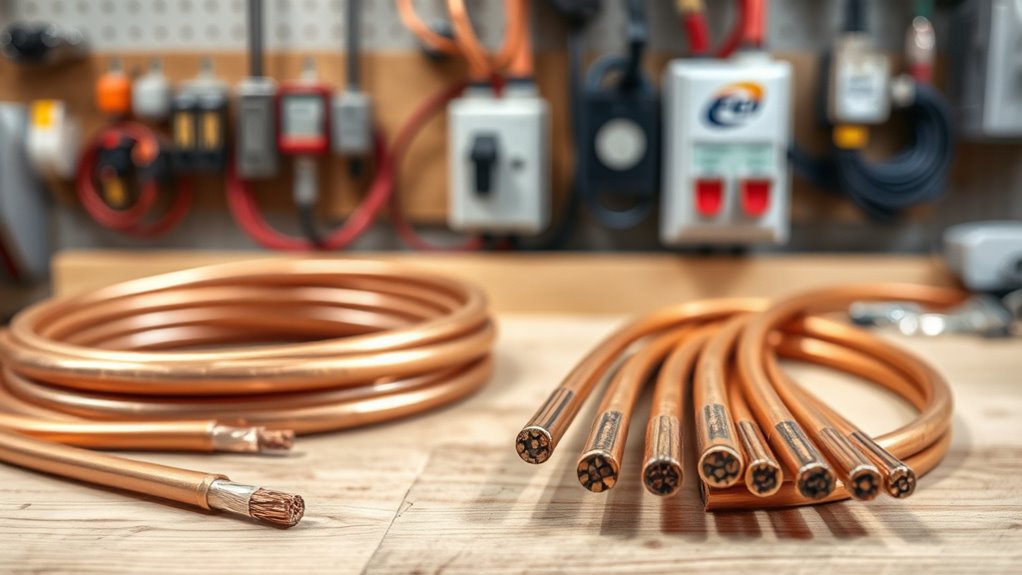
Choosing wire for a 50 amp EV charger gets confusing because “50 amp” can mean two different things: a 50 amp branch circuit or an EVSE that actually outputs 50 amps to the car. Those are not the same. EV charging is treated as a continuous load, so the charger output is normally limited to 80% of the circuit rating unless the equipment and code-approved design say otherwise.
Quick Answer
For a 50 amp EV charger circuit with a NEMA 14-50 receptacle, use wiring sized for a 50A circuit, commonly 6 AWG copper or 4 AWG aluminum where allowed, and set the EVSE to 40A max. For 48A charging, use a 60A circuit. A true 50A output EVSE usually needs a hardwired 70A or 80A circuit per the manual.
Key Takeaways
- A 50A branch circuit normally supports 40A charging output, not 50A output.
- A 48A hardwired EVSE normally needs a 60A breaker and conductors approved for that circuit and terminal temperature.
- A true 50A output charger is usually hardwired and may require a 70A or 80A breaker, depending on the manufacturer.
- GFCI protection isn’t optional for EV charging receptacles — it’s a code requirement, and outdoor or garage installations trigger it even when hardwired.
- EVSE rated above 60A or 150V to ground needs a lockable disconnect within sight of the unit.
- Do not assume aluminum can land directly in the charger. Many EVSE terminals are copper-only.
- Long wire runs need a voltage-drop calculation, not a fixed one-size-fits-all distance rule.
At a Glance
| Time Required | 30–60 minutes for planning and load review; several hours for a licensed installation, depending on panel distance and conduit work. |
| Difficulty | Advanced electrical work. Use a licensed electrician and follow the locally adopted code. |
| Tools Needed | EVSE installation manual, load calculation, voltage-drop calculation, approved breaker, approved conductors, conduit or cable system, torque screwdriver, meter, permits, and inspection. |
| Cost | Most straightforward 50A-circuit installs run roughly $500–$2,500 all-in for hardware and licensed labor in 2026; a panel or service upgrade can add $800–$4,000 or more. The federal 30% home EV-charger tax credit (up to $1,000) expired for equipment placed in service after June 30, 2026, so it no longer offsets new installs. |
Warning: EV charger wiring is high-current electrical work. Do not install or modify the circuit unless you are qualified to do so. A licensed electrician should verify the load calculation, breaker, conductor type, terminal ratings, grounding, permit, and inspection requirements before the charger is energized.
What Size Wire Do You Need for a 50 Amp EV Charger?
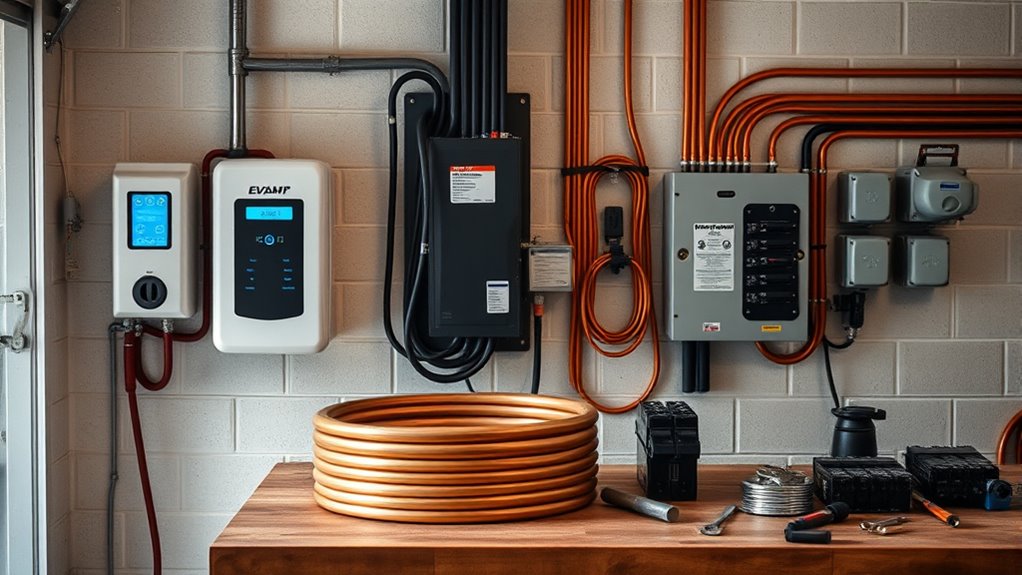
For a 50 amp EV charger circuit, the common starting point is 6 AWG copper or 4 AWG aluminum, but only when that conductor type, insulation, terminal temperature, and installation method are allowed by the charger manual and local code. On a 50A circuit, the EVSE is usually set to 40A maximum output because EV charging is a continuous load.
If you mean a charger that actually outputs 50 amps, do not size it like a 50A receptacle circuit. A true 50A output EVSE generally needs a larger hardwired circuit. ChargePoint Home Flex is hardwire-compatible with breakers from 20A up to 80A and can deliver up to 50A of charging, while plug-in NEMA 6-50 or 14-50 use is restricted to the 40A and 50A circuit settings only. Since 50A of continuous output requires a minimum circuit rating of 62.5A under the 125% rule, that generally rounds up to a 70A breaker in practice, with some installs using 80A.
For many 48A hardwired chargers, a 60A breaker is the normal setup. The Tesla Wall Connector installation guidance confirms 60A breaker sizing for 48A output, and its Gen 3 installation manual specifies copper-only wire terminations, with the wire gauge depending on the breaker’s terminal temperature rating: a minimum of 4 AWG 90°C-rated THWN-2 copper for a 60°C-rated breaker, or a minimum of 6 AWG 90°C-rated THWN-2 copper for a 75°C-rated breaker.
Note: Wire gauge alone is not enough. The electrician must also check insulation rating, copper vs aluminum, terminal temperature, conduit fill, ambient temperature, number of current-carrying conductors, voltage drop, and the EVSE manufacturer’s instructions.
Why Do EV Chargers Use the 125% Rule?
EV chargers use the 125% rule because the load can run for hours at a steady current. In practical terms, that means the continuous charging output is usually limited to 80% of the branch-circuit rating.
The math is simple:
- 32A charging output × 125% = 40A circuit
- 40A charging output × 125% = 50A circuit
- 48A charging output × 125% = 60A circuit
- 50A charging output × 125% = 62.5A minimum circuit rating, which rounds up to a 70A breaker (sometimes 80A), since standard breaker sizes jump from 60A to 70A
The National Electrical Code, NFPA 70, is the model code used for EVSE installation rules in most U.S. jurisdictions, under Article 625. A new edition, the 2026 NEC, has already been published, but code adoption is state- and municipality-driven and lags publication — many jurisdictions still enforce the 2017, 2020, or 2023 edition. Your local authority having jurisdiction may also apply local amendments, so the final answer must come from the locally adopted code, permit office, and charger manual.
A 50A circuit is not the same as 50A charging output. Most plug-in 50A receptacle installations are set to 40A charging.
What Wire Sizes Work for 32A, 40A, 48A, and 50A EVSE?
The safest way to size an EV charger circuit is to start with the EVSE’s maximum charging output, then size the breaker and conductors for continuous load. The table below gives common starting points, not a substitute for a code calculation.
| EVSE Output | Typical Breaker | Common Wire Starting Point | Best Use |
|---|---|---|---|
| 32A | 40A | Often 8 AWG copper when the conductor type and terminals allow | Moderate Level 2 charging |
| 40A | 50A | Commonly 6 AWG copper or 4 AWG aluminum where allowed | NEMA 14-50 or 6-50 plug-in EVSE |
| 48A | 60A | Often 6 AWG copper THHN/THWN-2 with 75°C-rated terminals; 60°C terminals typically require 4 AWG copper | Hardwired high-output charging |
| 50A | Usually 70A or 80A per manufacturer | Must be sized from the EVSE manual and NEC ampacity rules; often larger than 6 AWG copper | Hardwired only for many residential EVSEs |
For a NEMA 14-50 setup, the common answer is simple: a 50A circuit usually means 40A charging. For a hardwired 48A unit, a 60A circuit is common. For a true 50A output unit, read the installation manual before buying wire or a breaker.
How Does Distance Affect EV Charger Wire Size?
Distance matters because every conductor has resistance. As the run from the electrical panel to the charger gets longer, voltage drop increases. That can waste power, add heat, and reduce charging performance.
Do not use one fixed distance, such as 65 feet, as a universal cutoff. A voltage-drop calculation depends on:
- one-way circuit length from panel to charger
- charging current
- copper or aluminum conductor
- conductor size
- 240V residential or 208V commercial service
- temperature and conduit conditions
- the voltage-drop target used by the electrician or inspector
Many electricians aim to keep branch-circuit voltage drop around 3% for good performance, especially on long, continuous EV loads. If the charger is far from the panel, upsizing the conductors may be smart even when the smaller wire meets ampacity rules.
Pro Tip: Ask your electrician to show both calculations: ampacity and voltage drop. Ampacity keeps the wire safe from overheating; voltage drop keeps the charger efficient over the full length of the run.
Should You Hardwire or Use a NEMA 14-50?
A NEMA 14-50 receptacle is popular because it gives you flexibility. You can unplug the EVSE, replace it more easily, or use a portable charger that matches the receptacle. The tradeoff is output. Most NEMA 14-50 EVSE setups are limited to 40A charging on a 50A breaker.
A hardwired EV charger is usually the better choice when you want 48A or higher output. Hardwiring removes the plug and receptacle as heat points, reduces the chance of a loose connection, and may avoid some nuisance tripping issues when the charger already has built-in charging circuit interrupting device (CCID) protection. Some local codes or manufacturers may also prefer or require hardwiring for outdoor or high-output installations.
| Option | Typical Max Output | Main Advantage | Main Caution |
|---|---|---|---|
| NEMA 14-50 receptacle | 40A charging on a 50A circuit | Portable and easy to replace | Needs a high-quality receptacle, correct torque, GFCI protection, and regular heat checks |
| Hardwired EVSE | 48A, 50A, or more if the unit and circuit allow | Best for higher output and fewer connection points | Less portable and must be installed exactly as the manual specifies |
What Breaker, GFCI, and Code Rules Apply Now?
For EV charger wiring, the breaker must protect the conductors and match the EVSE setting. The charger must also be installed as listed, which means the manufacturer’s manual is part of the job. The locally adopted NEC edition and local amendments decide the final code requirements.
| Item | Rule of Thumb | Why It Matters |
|---|---|---|
| Breaker | Size from EVSE output × 125%, then follow the manual | Prevents undersized continuous-load circuits |
| GFCI | Required — not optional — for receptacles installed for EV charging; outdoor and garage installations require it even when hardwired | Reduces shock risk; check whether the EVSE’s built-in ground-fault protection means a separate GFCI breaker isn’t needed or wanted |
| Individual circuit | Each EVSE outlet above roughly 16A/120V needs its own dedicated branch circuit | A shared 240V circuit with other loads isn’t code-compliant for Level 2 charging |
| Grounding | Run an equipment grounding conductor sized for the breaker | Provides a fault path and lets protective devices clear faults |
| Neutral | NEMA 14-50 uses a neutral; many hardwired EVSEs do not | Avoids paying for or omitting a conductor incorrectly |
| Load calculation | Check panel and service capacity before adding the circuit | Prevents overloading the home’s electrical service |
For plug-in setups, use a heavy-duty receptacle rated for continuous EV charging, not the cheapest range receptacle available. Loose terminals and low-grade receptacles can overheat. The electrician should torque every termination to the manufacturer’s specification and install the receptacle in a suitable box with the correct cover for the location.
Do You Need a Disconnect Switch or a Panel Upgrade?
Two things get skipped more often than they should: the disconnect requirement, and honestly checking whether your panel has room.
Under NEC 625.43, any EVSE rated above 60A or above 150V to ground needs its own lockable disconnecting means installed within sight of the unit — this is exactly the situation for a true 50A-output charger on a 70A or 80A breaker. For EVSE rated 60A or less at 150V to ground or less, the branch-circuit breaker itself can serve as the disconnect, as long as it’s within sight of the charger or lockable in the open position. That covers most 32A, 40A, and 48A installs, which is one reason those settings are so common in residential wiring.
Panel capacity is the other gating factor. A 200A service with open breaker slots and moderate existing load can usually absorb a 50A or 60A EV circuit without issue. A fully loaded 100A panel, especially in an older home, often cannot — and no amount of correct wire gauge fixes an undersized service. A licensed electrician settles this with a load calculation under NEC Article 220, not a guess about “spare” breaker slots. If the panel is tight, a load management device, a tandem breaker, a subpanel, or a full service upgrade are the usual paths forward; an electrician can also configure some EVSEs with power sharing so two chargers split one circuit’s capacity instead of requiring two full circuits.
Can You Use Aluminum Wire for an EV Charger?
You can use aluminum conductors only when the whole installation supports aluminum. That means the breaker lug, splice connector, disconnect, subpanel, or transition point must be rated for aluminum, and the EVSE must allow it. Many wall chargers have copper-only terminals, so aluminum cannot simply be landed inside the charger.
If aluminum is used for part of a long run, the electrician may need an approved aluminum-to-copper transition before the EVSE. That transition must be inside an accessible rated enclosure, torqued correctly, and installed with connectors listed for the conductor materials involved.
Common Mistakes to Avoid
- Confusing circuit amps with charging amps: A 50A breaker usually means 40A charging output.
- Using 6 AWG without checking cable type: 6 AWG THHN/THWN-2 in conduit is not the same as every 6 AWG cable assembly.
- Ignoring terminal temperature: 60°C and 75°C terminal ratings can change the required wire size.
- Landing aluminum on copper-only terminals: Always check the EVSE manual before choosing aluminum.
- Skipping the load calculation: A spare breaker space does not prove the panel has enough capacity.
- Buying a cheap NEMA 14-50 receptacle: Continuous EV charging is harder on receptacles than occasional appliance use.
- Forgetting voltage drop: Long runs may need larger conductors even when ampacity looks acceptable.
- Skipping the disconnect on higher-amperage installs: A 70A or 80A hardwired charger needs its own lockable disconnect within sight, not just a breaker in a distant panel.
- Changing the EVSE amperage later: Do not raise the charger setting unless the breaker, wire, and service capacity support it.
Frequently Asked Questions
What size wire should I use for a 50 amp EV charger?
For a 50 amp branch circuit, the common starting point is 6 AWG copper or 4 AWG aluminum where aluminum is allowed. That circuit usually supports 40A charging output. If the EVSE actually outputs 50A, it normally needs a larger hardwired circuit, often 70A or 80A depending on the manufacturer.
Do I need 6 or 8 gauge wire for 50 amp EV charging?
For a 50A branch circuit, 6 AWG copper is the more common answer. 8 AWG copper may be used for some 40A circuits that support 32A charging, but it should not be treated as the default for a 50A EV charger circuit.
Can a NEMA 14-50 charge at 50 amps?
No, not for normal continuous EV charging. A NEMA 14-50 circuit is typically 50A, so the EVSE is normally set to 40A maximum output. For 48A or 50A charging output, use a properly sized hardwired installation.
Can you use 4 AWG copper for a 50 amp EV charger?
Yes. 4 AWG copper is larger than the common minimum for many 50A circuits, so it can reduce voltage drop on long runs and may be required for some higher-output or 60°C-terminal installations. The breaker still must match the circuit and charger manual.
Does an EV charger need a neutral wire?
A NEMA 14-50 receptacle includes a neutral, so that circuit is normally wired with two hots, a neutral, and an equipment grounding conductor. Many hardwired Level 2 EVSEs use only two hots and a ground, but you must follow the charger manual.
Do I need a GFCI breaker for an EV charger?
Yes, in most cases. Code requires GFCI protection for receptacles installed for EV charging, and outdoor or garage locations trigger it independently even for hardwired units. Some manufacturers with built-in ground-fault protection specifically advise against also using a GFCI breaker, since stacking two protection devices can cause nuisance tripping. Confirm the right approach with your electrician and the EVSE manual.
How far can 6 gauge wire run for an EV charger?
There is no single distance limit that works for every installation. The electrician must calculate voltage drop from the actual current, one-way distance, conductor material, voltage, and wire type. Long runs may need 4 AWG copper or another upsized conductor even when 6 AWG meets ampacity.
Does a 50 amp EV charger need a disconnect switch?
If the EVSE is rated above 60A or above 150V to ground, yes — code requires a lockable disconnecting means within sight of the unit. Most 40A and 48A residential installs fall at or under that 60A threshold, so the branch-circuit breaker itself can typically serve as the disconnect instead.
How much does it cost to install a 50 amp EV charger circuit?
A straightforward install with the panel nearby typically runs about $500–$2,500 for hardware and licensed labor. Longer wire runs, outdoor routing, or a panel/service upgrade can push the total to $4,000 or more. The federal 30% tax credit that used to offset up to $1,000 of home charger installation costs expired for equipment placed in service after June 30, 2026.
Conclusion
For a 50 amp EV charger circuit, 6 AWG copper is the usual baseline, and the charger is normally limited to 40A output. For a 48A hardwired charger, plan around a 60A circuit. For a true 50A output EVSE, follow the manufacturer’s manual because the circuit may need a 70A or 80A breaker, larger conductors, and its own lockable disconnect. The right answer depends on load calculation, wire type, terminal ratings, voltage drop, grounding, GFCI rules, panel capacity, permits, and local inspection — and on confirming which NEC edition your jurisdiction actually enforces.
Sources
- NFPA 70, National Electrical Code — EVSE branch-circuit, continuous-load, GFCI, and disconnect rules under Article 625 and 210.8.
- Tesla Wall Connector Installation Support — hardwired Wall Connector setup and manual access.
- Tesla Gen 3 Wall Connector Manual — 48A output on a 60A breaker, copper-only terminations, and terminal-temperature wire sizing.
- ChargePoint Home Flex Installation FAQ — NEMA 14-50/6-50 output limits and hardwire breaker range up to 50A output.
- U.S. Department of Energy Alternative Fuels Data Center — Level 2 charging voltage, current range, and charging equipment overview.
- IRS: Alternative Fuel Vehicle Refueling Property Credit — confirms the Section 30C credit’s termination date of June 30, 2026.