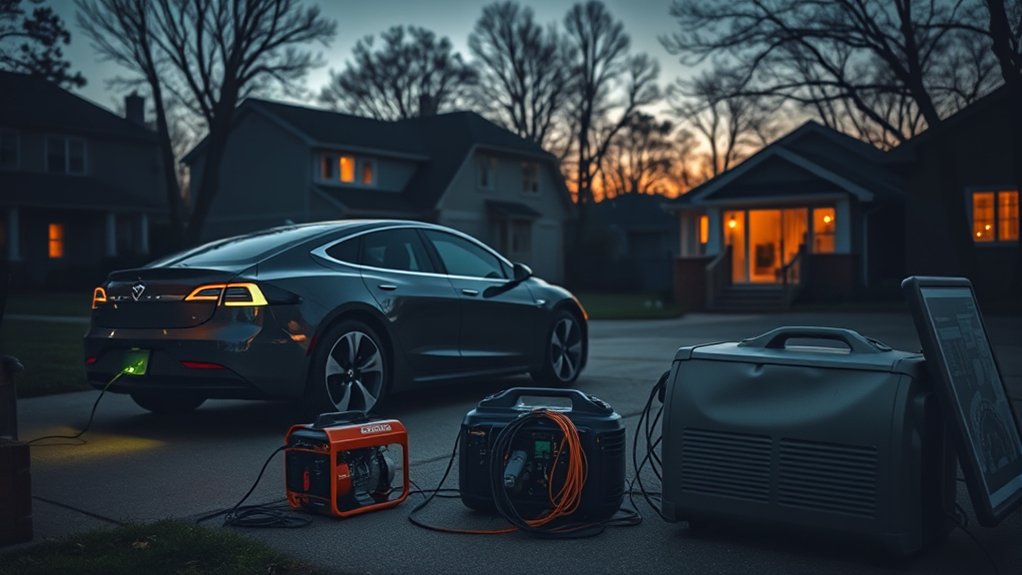
When the power goes out, your electric vehicle can still be useful, but your charging plan needs to be realistic. A home Level 2 charger will not work if your house has no power, and nearby public chargers may be affected by the same outage. The safest plan is to keep enough battery before storms, know which public chargers are outside your outage area, and use backup power only when your equipment is rated for EV charging.
Quick Answer
You can charge an EV during a power outage by driving to a working public charger, using a properly sized inverter generator, using solar-plus-battery backup, or using a vehicle-to-home system if your EV supports it. Never run a generator indoors, and do not connect one to your home without proper transfer equipment.
Key Takeaways
- Keep your EV charged before storms or planned shutoffs; 70% to 90% is a practical emergency target for many drivers.
- Public DC fast chargers are usually the fastest backup option, but you need to confirm live station status before driving there.
- A generator can charge an EV only if it has enough running wattage, proper outlet support, clean power, grounding compatibility, and safe outdoor placement.
- Solar panels alone usually will not power your EV during a grid outage unless the system has battery backup and islanding equipment.
- Vehicle-to-load or vehicle-to-home features can help during outages, but only on EVs and home systems designed for bidirectional power.
At a Glance
| Time Required | 10 to 20 minutes to make an emergency charging plan; charging time ranges from minutes at a DC fast charger to many hours on Level 1 or a small generator. |
| Difficulty | Moderate. Public charging is simple, but generator, transfer-switch, solar battery, and vehicle-to-home setups require careful compatibility checks. |
| Tools Needed | EV app, charging network apps, AFDC station locator, portable EVSE, compatible backup power source, outdoor-rated cords if allowed, carbon monoxide detector, and your vehicle manual. |
| Cost | Free for planning; public charging fees vary; generators, solar batteries, transfer switches, and vehicle-to-home systems can range from hundreds to thousands of dollars. |
How Power Outages Affect Your EV Charging Options
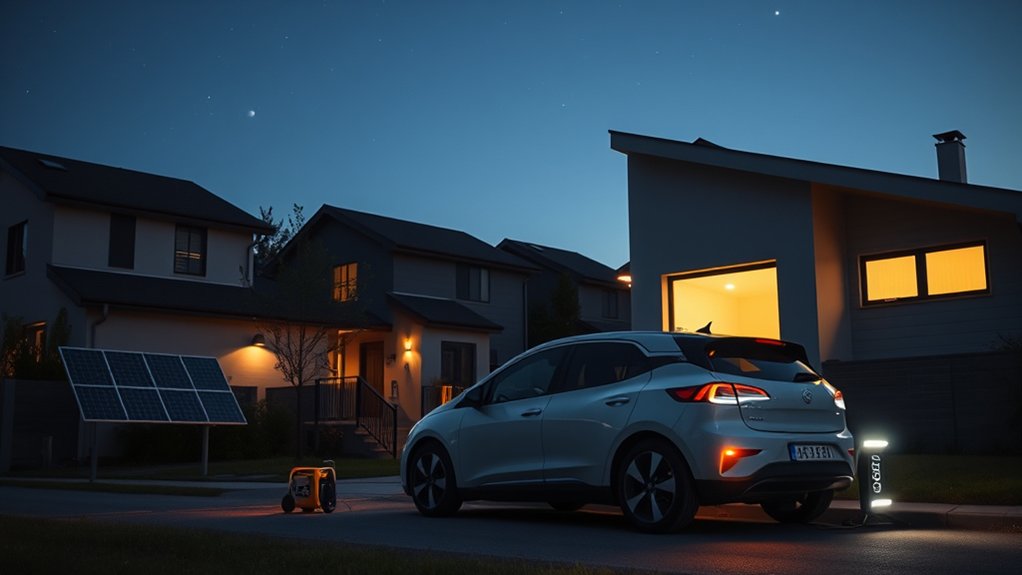
A power outage affects EV charging in a simple way: if the charger cannot get power, your car cannot charge from it. That includes your garage outlet, your wall-mounted Level 2 charger, and public stations connected to the same failed utility circuit.
Most EV owners do most of their charging at home, but outages change the plan. During a short outage, the best answer may be to wait and avoid unnecessary driving. During a longer outage, you need to know how much range you have, which chargers are still working, and whether your home backup system can safely support EV charging.
The U.S. Department of Energy Alternative Fuels Data Center listed 253,000 public electric charging ports in the United States as of July 8, 2026. That network gives EV drivers more backup options than in the past, but a charger is only useful during an outage if it has power, network access, and a connector that fits your vehicle.
Your outage plan should answer three questions before you need it: how much range is in the battery, where the nearest working charger is, and what backup power source is safe for your EV.
What to Check Before You Need Emergency Charging
Start with the basics before storms, wildfire shutoffs, ice events, or hurricane season. Emergency charging is much easier when you prepare before the power fails.
- Keep a useful state of charge: If bad weather is forecast, charge earlier than normal. Many drivers aim for 70% to 90% before a storm, then adjust based on trip needs and the vehicle maker’s battery guidance.
- Save multiple charging apps: Keep your vehicle app, major charging network apps, and a station locator ready on your phone.
- Check connectors: Know whether your EV uses J1772, CCS, CHAdeMO, J3400/NACS, or an adapter.
- Know your daily range need: A 20-mile commute needs a different backup plan than a 120-mile evacuation route.
- Keep your phone charged: Charger status, route planning, and utility alerts may all depend on your phone.
- Know your home electrical limits: If you plan to use a generator, battery, or vehicle-to-home system, confirm the setup before an outage.
Pro Tip: Save at least two charging locations in different directions from your home. A storm, wildfire, flood, or utility shutoff can affect one route while leaving another route open.
Understand Level 1, Level 2, and DC Fast Charging
EV charging speed depends on the charger, your vehicle, battery temperature, and state of charge. The DOE AFDC explains that charging time can range from less than 20 minutes on some DC fast chargers to 20 hours or more on Level 1, depending on the vehicle and equipment.
| Charging Type | Typical Power Source | Best During an Outage | What to Expect |
|---|---|---|---|
| Level 1 | 120-volt outlet | Small top-ups from a safe outlet or compatible generator | Slow, often around a few miles of range per hour. |
| Level 2 | 208-volt or 240-volt circuit | Home backup systems or public stations with power | Much faster than Level 1, but generator and circuit sizing matter. |
| DC Fast Charging | Public high-power station | Fastest option if the station is outside the outage zone | Often adds large amounts of range quickly, but speed drops as the battery fills. |
FuelEconomy.gov notes that many EVs can travel more than 100 miles per charge, while some exceed 200 or 400 miles depending on the model. It also notes that full recharging can take 3 to 12 hours in many cases, and a fast charge to 80% can take about 30 minutes on compatible vehicles and stations.
Finding Nearby Public Charging Stations During Outages
Public charging is often the simplest backup option during a home outage. The key is to look beyond the affected power area, not just the closest station on the map.
Use your vehicle navigation, charging network apps, and the Alternative Fuels Data Center station locator to compare options. Look for live status, recent check-ins, connector type, charging speed, price, and whether the site is near food, restrooms, or shelter.
- Start with DC fast chargers if you need a quick range boost.
- Use Level 2 chargers if you can park for several hours and the outage is not urgent.
- Avoid relying on one station because a charger may be occupied, offline, blocked, or inside the same outage area.
- Keep enough range to leave if the first charger is not working.
- Check payment options before you drive there; some stations require an app, card, or network connection.
Note: A map pin does not guarantee a working charger during a power outage. Check live station status, recent user reports, and your vehicle’s range before leaving.
Evaluate Your Backup Power Options
Your best backup option depends on how long the outage lasts, how much range you need, and what equipment you already own. For many homes, the practical order is simple: use the charge already in the EV, drive to a working public charger if needed, then use home backup power only if the setup is safe and compatible.
| Backup Option | Best For | Main Limits |
|---|---|---|
| Public DC fast charger | Fast range recovery | May be offline, crowded, or outside your safe travel radius. |
| Level 1 from a generator | Slow emergency range | Very slow; must be outdoors and compatible with the EVSE. |
| Level 2 from a large generator | Faster home backup charging | Requires enough running watts, correct outlet, grounding compatibility, and safe connection. |
| Solar-plus-battery | Longer outages and home resilience | Needs battery storage and equipment that can island from the grid. |
| Vehicle-to-home or vehicle-to-load | Powering home loads or devices from the EV | Only available on certain EVs and requires approved equipment. |
How to Use Inverter Generators for EV Charging
An inverter generator can be useful for emergency EV charging because it is usually better suited for sensitive electronics than a basic construction-style generator. Still, it must be large enough for the charger, compatible with your EVSE, and used safely outdoors.
Generator Sizing Needed
Use this simple formula first:
Volts × amps ÷ 1,000 = kilowatts
For example, a 240-volt charger at 32 amps draws about 7.7 kW before losses and overhead. In that case, a generator advertised at 7,500 peak watts may not be enough because EV charging is a long, continuous load. Look at the generator’s running watts, not only its surge or peak watts.
| Charging Setup | Approximate Load | Generator Planning Notes |
|---|---|---|
| Level 1, 120 V at 12 A | About 1.4 kW | May work with a smaller inverter generator if the EVSE accepts the power source. |
| Level 1, 120 V at 16 A | About 1.9 kW | Needs more headroom than a 12-amp Level 1 setup. |
| Level 2, 240 V at 16 A | About 3.8 kW | A mid-size generator may handle it if the outlet and wiring are correct. |
| Level 2, 240 V at 32 A | About 7.7 kW | Often needs a generator in the 10 kW running-output class after headroom. |
| Level 2, 240 V at 40 A or more | About 9.6 kW or more | Many portable generators are not practical for this load. |
Before using a generator, check your vehicle manual, EVSE manual, generator manual, neutral-ground requirements, outlet type, extension-cord rating, and weather protection. Some EV chargers will refuse to charge from certain generators if the grounding or power quality does not match what the charger expects.
Generator Safety Rules
Warning: Never run a generator inside a house, garage, basement, shed, or near open windows. The CDC says generators should be used outside, more than 20 feet from windows, doors, and vents, with a battery-powered or battery-backup carbon monoxide detector in the home.
- Place the generator outdoors with exhaust pointed away from the home.
- Keep it dry and protected according to the manufacturer’s instructions.
- Do not plug a generator into a wall outlet to power the house.
- Use a proper transfer switch or interlock if connecting backup power to home circuits.
- Use heavy-duty outdoor-rated cords only when the EVSE and generator manual allow it.
- Do not overload the generator with the EV plus refrigerators, pumps, heaters, or other large loads.
- Turn the generator off and let it cool before refueling.
- Keep children and pets away from the generator and cords.
Charging Time Considerations
Emergency charging is about adding enough range, not always filling the battery. If you need 25 miles to reach a working fast charger, a slow Level 1 session may be enough. If you need to evacuate 150 miles, a public DC fast charger or a high-output Level 2 setup may be more realistic.
Use this quick estimate:
Battery energy added = charging kW × hours × charging efficiency
For simple planning, you can assume some energy is lost during charging. If a generator supplies about 1.4 kW through Level 1 for 5 hours, your EV may only gain a small emergency range boost. If a Level 2 setup supplies 7.2 kW for 5 hours, the added range is much higher, but the generator or backup battery must be sized for that continuous load.
Fast charging also slows near the top of the battery. In an emergency, charging from 20% to 70% or 80% may be more useful than waiting for 100%, especially if other drivers are waiting.
Best Practices for Long Outages
When an outage lasts longer than expected, switch from convenience mode to range-preservation mode. Use the EV for necessary trips, reduce cabin climate use when safe, and keep enough charge to reach at least one charger outside the affected area.
Essential Preparations Before Outages
- Charge before severe weather arrives.
- Park where you can leave without moving debris or opening a powered garage door.
- Save offline maps if cell service may fail.
- Keep charging adapters in the vehicle.
- Know which public chargers are 25, 50, and 100 miles away.
- Keep a small emergency kit in the EV, including water, flashlight, tire inflator, and phone power bank.
- If you own a generator, test it before storm season and store fuel safely.
Alternative Charging Methods Available
The main alternatives are public charging, generator charging, solar-plus-battery charging, and bidirectional EV power. Each option has tradeoffs.
If you have a plug-in hybrid, you have one extra layer of flexibility because gasoline can extend your driving range when charging options are limited. Keep the fuel tank reasonably full before storms if your vehicle has a gasoline engine.
Local Charging Station Awareness
During a long outage, check more than distance. A nearby charger may be useless if it is in the same outage zone. A charger farther away may be better if it is near a hospital district, major highway, shopping center, or area with restored power.
When possible, choose a route with more than one charger along the way. If the first charger is down or occupied, you should still have enough range to reach the next option.
How to Use Solar Power for EV Charging
Solar power can help during outages, but only when the system is designed for backup operation. Many grid-tied solar systems shut down during an outage to protect utility workers and equipment. To charge an EV when the grid is down, you usually need solar panels, an inverter that can operate in island mode, battery storage, and a load plan that leaves enough power for critical home needs.
The Department of Energy explains that solar-plus-storage pairs a battery system with solar panels so energy can be used later, including during outages when the system is designed for that purpose. Energy.gov also notes that stand-alone renewable systems need extra equipment such as batteries, charge controllers, power conditioning equipment, safety equipment, and meters.
Note: Do not assume rooftop solar can charge your EV during an outage. Ask your installer whether your system has battery backup, islanding capability, and enough output for EV charging.
If your solar battery is small, reserve it for refrigerators, medical equipment, lights, Wi-Fi, sump pumps, and phones before using it for the EV. If your battery and solar array are large enough, you may be able to schedule EV charging during sunny hours while still protecting critical home loads.
Vehicle-to-Load and Vehicle-to-Home Options
Some newer EVs can send power out of the vehicle. This may be called vehicle-to-load, vehicle-to-home, vehicle-to-building, or bidirectional charging. These features can be helpful during outages, but they are not universal.
- Vehicle-to-load: Powers small devices, tools, appliances, or another limited load through built-in outlets or an adapter.
- Vehicle-to-home: Sends power from the EV to selected home circuits through approved bidirectional equipment.
- Vehicle-to-grid: Sends power back to the grid through a utility-approved program and compatible hardware.
Do not improvise a vehicle-to-home setup. If your EV supports home backup, use the automaker-approved charger, gateway, transfer equipment, permits, and installer process. The goal is to power your home safely without backfeeding utility lines or damaging equipment.
What to Do When Outages Last Longer Than Expected
If the outage keeps going, take these steps in order:
- Check your battery percentage and estimated range. Do not rely on a guess.
- Reduce nonessential driving. Save range for food, medicine, work, or evacuation.
- Check utility and charger maps. Look for restored areas nearby.
- Pick two charging options. Choose a primary charger and a backup charger.
- Leave with a range buffer. Keep enough range to reach another charger if the first one fails.
- Use a generator only if safe. Confirm wattage, outlet, grounding, weather, cord, and EVSE compatibility.
- Use solar or home battery power carefully. Protect essential home loads before charging the EV.
If your EV gets too low to reach a charger, contact roadside assistance. Depending on your area, help may mean towing to a charging station rather than mobile roadside charging.
Common Misconceptions About EV Charging During Outages
- “All public chargers go down in an outage.” Not always. Some chargers outside the affected circuit may still work, and some sites may have backup power.
- “Any generator can charge an EV.” No. The generator must match the EVSE load, outlet, grounding, and power-quality needs.
- “A 10 kW generator always solves it.” Not always. It may be more than you need for Level 1, but too small for high-amp Level 2 plus other home loads.
- “Solar panels alone will charge the car when the grid is down.” Many grid-tied systems shut off unless they have battery backup and islanding equipment.
- “You should always charge to 100%.” For emergency travel, charge enough for safety. For daily use, follow your vehicle maker’s battery guidance.
- “AAA or roadside assistance will always bring a charger.” EV roadside options vary by region. Many services tow the vehicle to a charger instead.
Frequently Asked Questions
Do EV charging stations work during a power outage?
EV charging stations usually need grid power, so a station in the outage area may not work. Some stations outside the affected area, or sites with backup power, may still operate. Always check live charger status before driving there.
How do you charge an electric car if the power is out?
Your main options are a working public charger, a compatible inverter generator, a solar-plus-battery system, or an approved vehicle-to-home setup. The safest and fastest option is often a public DC fast charger outside the outage area.
Can I plug my EV charger into a generator?
Sometimes, but only if the generator has enough running wattage, the right outlet, safe grounding, clean power, and compatibility with your EVSE and vehicle. Use the generator outdoors, more than 20 feet from windows, doors, and vents.
What is the 80/20 rule for EV charging?
The 80/20 rule means many drivers avoid dropping below about 20% and avoid charging above about 80% for routine daily use. It is a general battery-life habit, not a universal rule. During severe weather or travel, charge higher if you need the range and your vehicle maker allows it.
Does AAA offer emergency EV charging?
EV roadside support varies by AAA club and region. In some areas, roadside help may include limited charging, but in many cases the service is towing your EV to a working charging station. Check your local AAA coverage before you need it.
Can rooftop solar charge my EV during an outage?
Only if your solar system is designed for backup power. Many grid-tied solar systems shut off during outages. To charge an EV when the grid is down, you usually need battery storage, islanding equipment, and enough available power after critical home loads.
Conclusion
Your EV does not become useless during a power outage, but it does need a plan. Keep a healthy charge before severe weather, save multiple public charging options, and know your connector and adapter needs. If you use backup power at home, treat EV charging as a serious electrical load, not a casual extension-cord job.
The safest outage plan is simple: preserve range first, use working public chargers when available, and rely on generators, solar batteries, or vehicle-to-home systems only when the setup is rated, tested, and safe. That way, your EV can stay ready for errands, work, medical needs, or evacuation when the grid is not cooperating.
Sources
- U.S. Department of Energy Alternative Fuels Data Center: Electric Vehicle Charging Stations — charging levels, charging speeds, connectors, and public charging guidance.
- U.S. Department of Energy Alternative Fueling Station Counts by State — current public electric station locations and charging-port counts.
- FuelEconomy.gov: All-Electric Vehicles — EV range, recharge time, and fast-charging context.
- CDC: Carbon Monoxide Poisoning Basics — generator placement and carbon-monoxide safety guidance.
- Department of Energy: Solar-Plus-Storage 101 — how battery storage supports solar energy use when sunlight is not available.
- Department of Energy: Off-Grid or Stand-Alone Renewable Energy Systems — equipment needed for stand-alone renewable power systems.