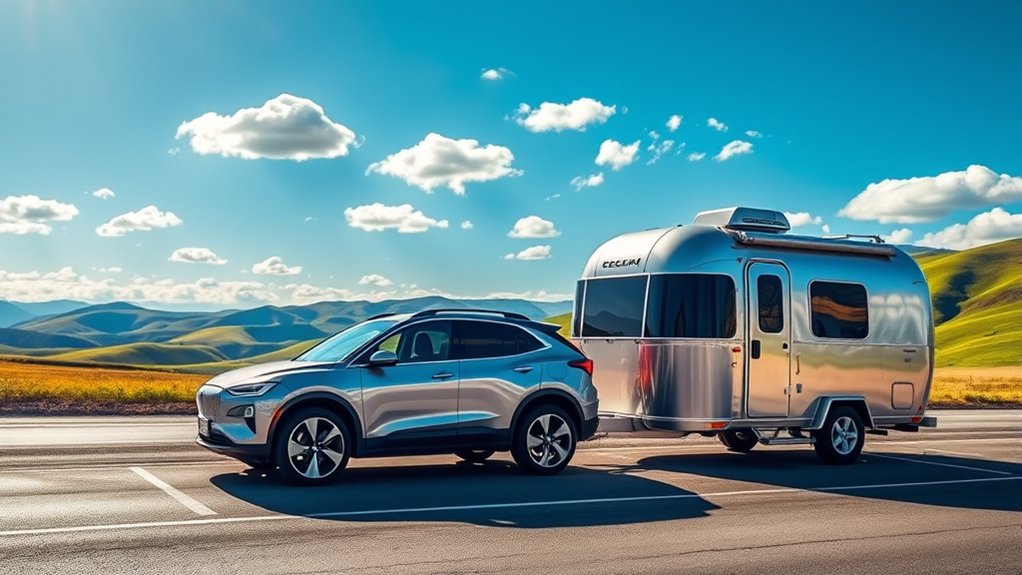
Charging an electric vehicle while towing a trailer takes more planning than a normal EV road trip. The trailer adds weight and aerodynamic drag, so your range drops, your charging stops come sooner, and some public chargers may be hard to reach while hitched.
The good news is that EV towing trips are manageable when you plan shorter legs, choose trailer-friendly charging stations, keep a healthy battery reserve, and know when campground Level 2 charging makes sense. The key is to plan around your real towing efficiency, not the vehicle’s unloaded range.
Quick Answer
To charge an EV while towing, plan charging stops before you leave, use DC fast chargers with pull-through or wide end stalls when possible, and keep a 10-20% arrival buffer. If a station is not trailer-friendly, you may need to unhitch safely before charging.
Key Takeaways
- Towing can cut EV range sharply, so plan with your real towing efficiency instead of the EPA range.
- Trailer-friendly DC fast chargers are best for road trips, but many sites still require unhitching.
- Campground Level 2 charging can work overnight if the site allows EV charging and the outlet is safe.
- A 7-pin trailer plug may maintain a trailer battery, but it will not recharge your EV’s main battery.
- Always check your EV owner’s manual before pushing, flat-towing, or moving the vehicle in neutral.
At a Glance
| Time Required | 20-60 minutes for a DC fast-charging stop; overnight for many campground Level 2 sessions |
| Difficulty | Moderate, because charger layout and trailer parking matter as much as charger speed |
| Tools Needed | EV route planner, charging apps, trailer chocks, hitch lock, portable Level 2 EVSE if campground charging is allowed, and the correct adapter for your vehicle |
| Cost | Varies by network, electricity rate, idle fees, campground policy, and how much energy your trailer setup uses |
Key Challenges of Charging EVs While Towing Trailers
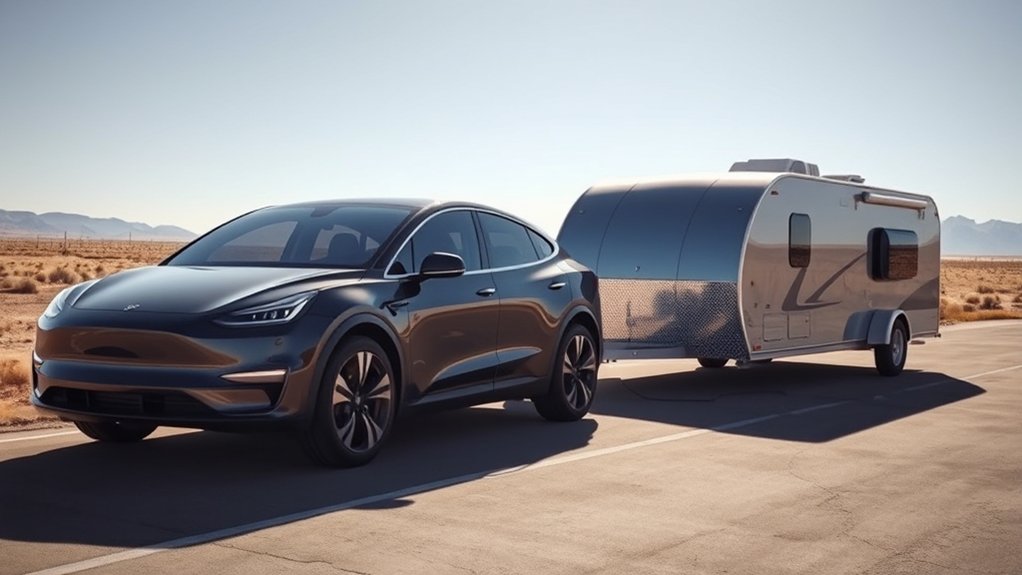
When you tow with an electric vehicle, the main challenge is not just battery size. It is the combination of range loss, charger placement, charging speed, and trailer maneuvering.
Towing usually lowers range because the vehicle has to move more weight and push a larger shape through the air. A low utility trailer may have a smaller effect than a tall travel trailer. Speed, headwinds, hills, cold weather, tire pressure, and payload can also change your range. In real-world testing, Edmunds found that towing a trailer with an EV truck increased electricity use by roughly 27%, which cut maximum range by a similar amount — a useful benchmark if you have not yet tested your own setup.
Plan towing legs from your real-world efficiency, not from the EV’s unloaded advertised range. If your EV normally gets 2.5 mi/kWh but drops to 1.3 mi/kWh while towing, your charging plan must change right away.
Public charger layout is the next problem. Many DC fast chargers are placed at the head of standard parking spaces. That works for a solo EV, but a truck and trailer can block traffic, block other chargers, or fail to reach the cable unless you unhitch.
For a smoother trip, look for pull-through chargers, wide end stalls, large travel plazas, dealership chargers with open lots, and charging sites with clear trailer access. Avoid tight urban chargers unless you have confirmed the layout.
Warning: Do not block multiple chargers, fire lanes, traffic lanes, or accessible spaces just to stay hitched. If the station is too tight, move on to a better site or unhitch in a safe area.
How to Plan an EV Towing Charging Route
Good route planning starts before you connect the trailer. Your goal is to build a route that matches your vehicle, trailer, weather, and charging access.
Step 1: Find Your Real Towing Efficiency
Take a short test drive with the trailer loaded as you plan to travel. Watch your EV’s energy use in mi/kWh or kWh/100 miles. Use that number in your route planner.
For example, if your truck has a 120 kWh usable battery and gets 1.5 mi/kWh while towing, the simple math gives about 180 miles from 100% to 0%. You should not plan to use all of that. A safer leg may be closer to 110-140 miles after you account for reserve, hills, wind, and charger uncertainty.
Step 2: Use a Practical Charging Window
Fast charging is usually quickest at lower and middle battery levels. It often slows as the battery approaches a high state of charge. For many towing trips, a practical plan is to leave a charger at about 80-90% when needed and arrive at the next charger with at least 10-20% remaining.
This buffer matters more when towing because a headwind, mountain pass, or detour can use far more energy than expected. Sustained full-power towing can also raise battery temperature, which may cause the truck’s thermal management system to briefly slow charging speed until the pack cools — one more reason to build in extra time on hot days or steep climbs.
Step 3: Check the Station Layout Before You Commit
Do not rely only on the charger count. Before you choose a stop, check:
- Recent user photos and reviews in charging apps
- Satellite view for driveway width and turning space
- Whether chargers are pull-through, angled, curbside, or nose-in
- Which side of your EV has the charge port
- Cable length and whether the charger can reach while hitched
- Nearby overflow parking if you need to unhitch
- Idle fees, time limits, and charger reliability notes
Pro Tip: Save two backup chargers for each long towing leg: one before your ideal stop and one after it. That gives you options if a charger is full, broken, blocked, or too tight for your trailer.
Best Charging Stops for EVs With Trailers
The best charging stop is not always the fastest charger on the map. When towing, the best stop is the one you can enter, charge at, and leave without unsafe backing or blocking other drivers.
DC Fast Chargers for Road Trips
DC fast charging is the best option for long-distance EV towing because it can add energy much faster than Level 2 charging. The U.S. Department of Energy says DC fast charging can add roughly 100 to 200+ miles of range in about 30 minutes under suitable conditions, though actual results depend on the vehicle, charger power, battery temperature, and state of charge.
When towing, remember that those are normal EV miles, not guaranteed towing miles. If your trailer cuts efficiency in half, the miles you recover per charging session may also feel much lower.
Charge port type matters for route planning, too. Tesla’s Cybertruck and Rivian’s newer R1T models use a native NACS/J3400 port and can charge directly at Tesla Supercharger stations. Trucks like the Chevrolet Silverado EV and GMC Sierra EV use CCS and typically need a NACS adapter to access those same stations, so confirm compatibility before you count on a specific network.
Level 2 Charging at Campgrounds
Campground charging can work well when you are staying overnight. Many RV sites have 240-volt power, and the Department of Energy lists Level 2 charging at about 25 miles of range per hour for a typical EV. Some vehicles and chargers can do more, while towing miles recovered per hour may be lower.
Before plugging in at a campground, ask permission. Some campgrounds charge extra for EV charging, some ban EV charging from RV pedestals, and some older pedestals are not suitable for long high-load charging.
- Use a UL-listed portable EVSE, not a homemade adapter.
- Match the EVSE current setting to the outlet and campground rule.
- Inspect the outlet for cracks, burn marks, looseness, or heat.
- Stop charging if the plug, cord, pedestal, or breaker feels hot.
- Do not run extension cords unless the EVSE manufacturer allows it.
Note: A 50-amp RV pedestal does not always mean you should charge at the maximum your portable charger allows. If the pedestal is old, shared, or warm, reduce the amperage or do not use it.
Hotel, Destination, and Travel Plaza Charging
Hotels and destination chargers can be useful if they have open parking lots. Call ahead and ask whether you can charge while attached to a trailer or park the trailer nearby. Travel plazas are often easier than dense shopping-center lots because they usually have wider driveways and more room to turn around.
What to Do If You Have to Unhitch at a Charger
Even with careful planning, some charging stops will require unhitching. Treat that as part of the trip plan, not as a surprise.
- Find a safe, legal area away from charger traffic.
- Park on level ground when possible.
- Chock the trailer wheels before disconnecting.
- Use the trailer jack correctly and keep hands clear of pinch points.
- Lock the coupler if you need to leave the trailer unattended.
- Move the EV into the charging stall and charge without blocking others.
- Reconnect carefully, check lights and chains, then do a walkaround before leaving.
If you will be towing often, practice hitching and unhitching at home first. A smooth routine can turn a stressful stop into a 5-10 minute task.
Top EVs for Towing and Their Charging Options
The best EV for towing depends on trailer weight, payload, range, charging speed, connector access, and whether you can comfortably fit your trailer into charging sites. Always check the exact trim, battery, wheels, tow package, and owner’s manual before towing.
Current EV Towing Examples
| EV | Towing Notes | Charging Notes |
| Chevrolet Silverado EV | Up to 12,500 lb max available towing on properly equipped Extended Range models, according to Chevrolet. | CCS charge port with up to 350 kW DC fast-charging capability; a NACS adapter is needed for Tesla Supercharger access. |
| GMC Sierra EV | Shares the Silverado EV’s Ultium platform; Elevation and Denali Extended Range trims are rated up to 12,500 lb, according to GMC. | CCS port with 800V architecture; GMC cites up to roughly 120 miles of range added in about 10 minutes on a compatible DC fast charger. |
| Tesla Cybertruck | Tesla has discontinued the lower-rated rear-wheel-drive trim; both remaining trims, Dual Motor AWD and Cyberbeast, are rated to tow up to 11,000 lb per Tesla. | Native NACS/J3400 port with direct Supercharger access; strong network coverage, but site layout still matters while towing. |
| Rivian R1T | Towing ranges from about 7,700 lb on Standard and Large Pack Dual Motor configurations up to 11,000 lb on Max Pack builds — confirm the rating for your exact configuration. | Newer models use a native NACS port with CCS adapter available; good adventure-focused route-planning tools, but many public chargers may still require unhitching. |
| Ford F-150 Lightning | Ford has discontinued Lightning production as part of a shift toward hybrid and extended-range (EREV) trucks. Used and remaining dealer-stock units are still on the market, with some configurations rated up to 10,000 lb. | CCS port; check current adapter access, software update status, and charge-network compatibility before planning a long towing trip on a used unit. |
Do not choose an EV for towing by max tow rating alone. Payload can run out before tow rating does, especially when you add passengers, cargo, hitch weight, tools, water, batteries, and camping gear.
Range Impact When Towing
Range loss is not one fixed percentage. A boxy camper at highway speed can hurt range much more than a small open trailer. A heavy trailer on flat roads may be easier than a lighter but taller trailer in a headwind.
Use these factors when planning each charging leg:
- Trailer shape: Height and frontal area often matter more than weight at highway speed.
- Speed: Slower highway speeds can improve efficiency while towing.
- Wind: A headwind can cut range quickly.
- Terrain: Long climbs use more energy, though some energy may return through regenerative braking on descents.
- Temperature: Cold weather can reduce battery efficiency and increase cabin-heating demand.
- Tire pressure: Underinflated EV or trailer tires waste energy and can overheat.
- Battery reserve: Keep enough charge for detours, broken chargers, and unexpected reroutes.
Planning Your Route for Efficient Charging Stops
Plan your route in layers. First, map your ideal DC fast-charging stops. Second, mark trailer-friendly alternatives. Third, add overnight Level 2 options at campgrounds, hotels, or destinations.
Charging Station Availability
Use an EV route planner that lets you adjust consumption, arrival battery percentage, charger networks, and charging speed. Then cross-check the route in charger review apps for photos and recent comments.
For many EV towing trips, comfortable legs may fall in the 80-140 mile range, but the right number depends on your actual towing efficiency. Do not force a 140-mile leg if wind, hills, or charger uncertainty makes a 90-mile stop safer.
Optimal Charging Locations
Good charging locations for EV towing usually have one or more of these features:
- Pull-through charging stalls
- Chargers placed beside long spaces rather than at the front of short spaces
- End stalls with room to angle the truck and trailer
- Large lots at travel plazas, truck stops, or highway rest areas
- Nearby overflow parking for safe unhitching
- Reliable recent check-ins from other EV drivers
Avoid tight parking garages, cramped downtown lots, chargers behind narrow curbs, and stations with short cables unless another driver has confirmed trailer access.
Tips for Using Campground Charging Stations
Campgrounds can be helpful for overnight charging, but they are not automatic EV charging stations. Always ask the campground before using an RV pedestal to charge your vehicle.
- Call before booking: Ask whether EV charging is allowed and whether there is an extra fee.
- Ask about the outlet: Confirm whether the site has 50-amp service, 30-amp service, or a dedicated EV charger.
- Bring the right EVSE: Use only a safe, listed portable charger that matches the outlet.
- Set the right amperage: Do not exceed the outlet, breaker, EVSE, or campground limit.
- Check for heat: Stop charging if the plug or outlet becomes hot.
- Plan overnight: Level 2 charging is best when you have hours, not minutes.
If the campground has a dedicated EV charger, use that before using an RV pedestal. Dedicated EV charging equipment is designed for the job and is often easier for the property owner to manage.
Alternative EV Charging Options While Towing
When standard fast chargers are not easy to use with a trailer, look for alternatives that reduce unhitching and backing.
Pull-Through Fast Charging
Pull-through DC fast chargers are the easiest public option for towing. They let you drive in, plug in, charge, and drive out with less maneuvering. These stations are still not available everywhere, so confirm the layout before you depend on one.
Destination Charging
Destination charging can work at hotels, parks, marinas, trailheads, and campgrounds if the parking area is trailer-friendly. It is usually slower than DC fast charging, but it can recover useful range while you sleep, eat, hike, or stay overnight.
Mobile or Emergency Charging
Portable charging from a standard household outlet is too slow for most towing road trips. It may help in an emergency, but it should not be your main plan. Roadside charging services may exist in some areas, but coverage is limited and should be treated as a backup only.
Emerging Trends in EV Charging for Towing Vehicles
EV towing is becoming more practical as electric trucks, larger battery packs, and charging networks improve. The biggest improvement for trailer owners will be better station design, not just faster chargers.
Watch for these trends:
- More pull-through charging: Travel centers and highway sites are slowly adding layouts that work better for trailers.
- Longer charging cables: Longer cables make it easier to reach charge ports on trucks with trailers attached.
- Better route planning: Apps are improving support for trailer weight, weather, elevation, and real-world efficiency.
- Broader connector access: The North American market is moving toward wider NACS/J3400 access, which can open more route options depending on your vehicle and adapter.
- A shifting truck lineup: Ford has stepped back from the all-electric F-150 Lightning toward hybrid and EREV trucks, while GM continues expanding Silverado EV and Sierra EV trim options — worth checking before you commit to a specific model for a towing build.
These upgrades help, but they do not remove the need to plan. A fast charger is only useful if your truck and trailer can reach it safely.
Charging Etiquette When Towing
Towing takes more space, so good charging etiquette matters. Park as neatly as possible, use the charger that blocks the fewest spaces, and move as soon as your charging session is complete.
- Do not occupy extra stalls unless there is no safe alternative.
- Do not leave a trailer blocking another charger.
- Watch idle fees and time limits.
- Use the lowest practical charging target if others are waiting.
- Leave a helpful charger review for other drivers towing trailers.
Frequently Asked Questions
How do you charge an EV while towing?
Plan your route around trailer-friendly chargers, check station photos before you arrive, and keep a battery reserve of at least 10-20%. Use pull-through DC fast chargers when possible. If the charger layout is too tight, unhitch in a safe parking area, chock and secure the trailer, then charge the EV.
Does my 7-pin trailer plug charge the battery?
A 7-pin trailer connector may maintain or slowly charge a trailer’s auxiliary 12-volt battery if your tow vehicle and trailer are wired for it. It does not charge your EV’s high-voltage traction battery. It also should not be treated as a replacement for shore power, solar, or a proper trailer battery charger.
What is the 80/20 rule for towing with an EV?
For EV trip planning, the 80/20 rule usually means charging to around 80% for faster stops and arriving with about 10-20% as a safety buffer. It does not mean you will keep 80% of your normal range while towing. Your towing range depends on trailer size, speed, wind, terrain, and temperature.
Can you put an electric car in neutral and push it?
Only follow the procedure in your EV owner’s manual. Some EVs have a transport, tow, or neutral mode, but pushing or towing the vehicle incorrectly can damage the drive system. If the vehicle is disabled and you are unsure, use a flatbed tow truck.
Can I charge my EV at an RV campground while towing?
Sometimes, but you need permission from the campground first. Use the correct listed portable EVSE, set the proper amperage, and inspect the outlet. If the plug or pedestal gets hot, stop charging. A dedicated campground EV charger is better than an old RV pedestal.
How far can an EV tow between charging stops?
It depends on the EV, trailer, speed, weather, terrain, and battery size. Many towing trips need shorter legs than normal EV trips. After a test drive, use your real towing efficiency to plan stops and keep a reserve for detours or broken chargers.
Is the Ford F-150 Lightning still available for towing?
Ford has discontinued production of the all-electric F-150 Lightning as it shifts toward hybrid and extended-range electric (EREV) trucks. New units can no longer be factory-ordered, but used and remaining dealer-stock Lightnings, some rated to tow up to 10,000 lbs, are still on the market. For a new all-electric towing truck, the Chevrolet Silverado EV, GMC Sierra EV, Rivian R1T, and Tesla Cybertruck remain in production.
Conclusion
Charging an EV while towing a trailer is possible, but it works best with a conservative plan. Expect shorter travel legs, check charger layouts before you arrive, and prioritize pull-through or wide charging sites. When you use campgrounds, ask permission and charge safely with the right equipment.
The most important habit is simple: plan from your real towing efficiency and keep a battery buffer. With the right route, backup chargers, and safe unhitching routine, you can tow with an EV and avoid most charging surprises.
Sources
- U.S. Department of Energy Alternative Fuels Data Center: Electric Vehicle Charging Stations – charging levels, Level 2 charging, DC fast charging, and connector-standard basics.
- Chevrolet Silverado EV official specifications – Silverado EV towing, range, and charging capability.
- GMC Sierra EV official page – Sierra EV towing and DC fast-charging specifications.
- Tesla Cybertruck official specifications – Cybertruck towing and charging specifications by configuration.
- Edmunds via The Seattle Times: What to know before towing with an electric pickup – real-world EV towing range-loss testing data.
- BGR: Why Ford Discontinued the Electric F-150 – Ford’s F-150 Lightning production discontinuation and shift to hybrid/EREV trucks.