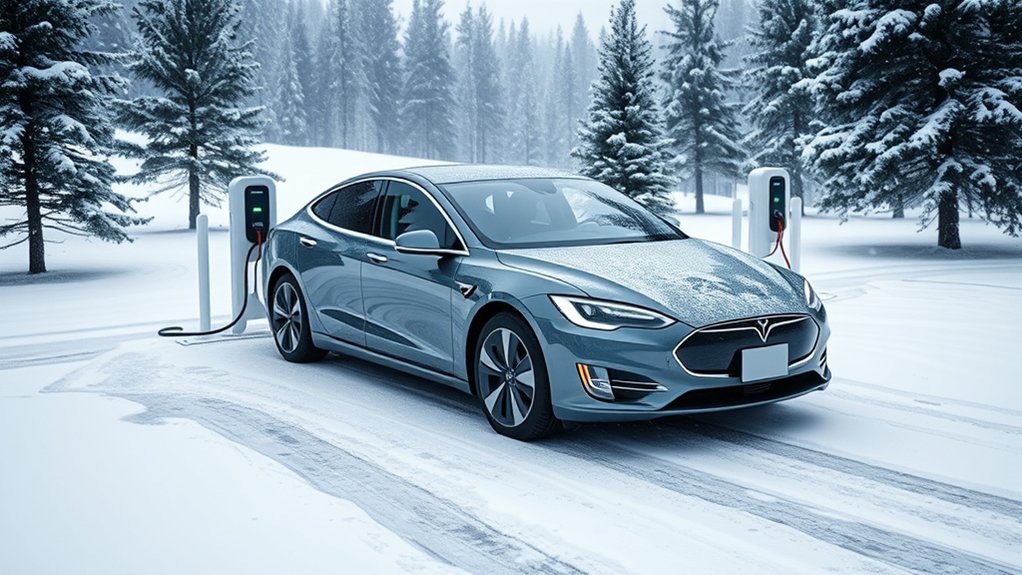
Yes, you can charge an EV in snow and ice when the charging equipment is properly installed, outdoor-rated where required, undamaged, and clear enough for the connector to seat fully. Snow and freezing weather do not make normal EV charging unsafe by themselves, but ice can block the port or latch and a cold battery can charge more slowly. Clear packed snow and ice from the connection area, use your vehicle’s preconditioning or defrost features when available, and plan extra time and range reserve for winter driving.
Last updated: September 8, 2026
Quick Answer
Yes. Use undamaged charging equipment, clear packed snow or ice so the connector can seat fully, and confirm the vehicle starts charging normally. A wet-weather-rated EV charging system can be used in snow, but never use equipment that is cracked, submerged, visibly damaged, or unable to make a secure connection. For a frozen charge-port door or latch, use the vehicle’s defrost, inlet-heater, or model-specific owner’s-manual procedure rather than forcing it.
Key Takeaways
- Clear snow and ice from the charging port, connector, and cable before you plug in.
- Precondition the battery while plugged in, or use your EV’s route planner before DC fast charging.
- Expect slower charging and shorter range in very cold weather, especially when using cabin heat.
- Use Level 2 charging at home when practical, and precondition the battery before DC fast charging when your EV supports it.
- Never force a stuck connector, use damaged equipment, or pour water into the electrical inlet or connector contacts; follow the vehicle manual for model-specific thawing instructions.
At a Glance
| Time Required | Usually a few minutes to inspect and clear the port, plus any extra charging time caused by a cold battery |
| Difficulty | Easy, as long as the connector is not frozen or damaged |
| Tools Needed | Soft cloth, soft brush, plastic scraper for exterior trim only, and your EV app or owner’s manual; a weather-safe cover is optional |
| Cost | Usually $0 for normal clearing and preconditioning; optional winter covers vary by vehicle and seller |
Understanding the Impact of Cold Weather on EV Performance
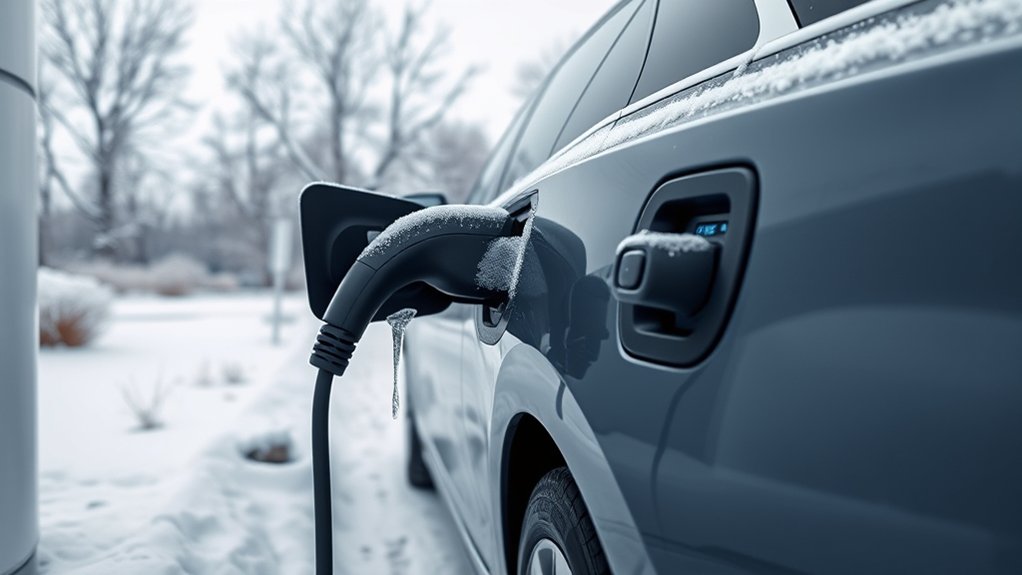
Cold weather affects your EV in two main ways. First, the battery may deliver less usable range because the car uses energy to heat the cabin and battery. Second, a cold battery may accept charge more slowly, especially at a DC fast charger.
Outdoor EV charging equipment is designed to handle normal weather when it is installed and used correctly. The U.S. Department of Energy notes that charging connectors are designed to be waterproof, while heavy snow or sleet can still freeze the connector. The practical winter risk is usually a blocked or frozen connection, damaged equipment, or poor site access—not snow touching an intact connector.
There is no single winter range-loss percentage that fits every EV. In Recurrent’s 2025–2026 analysis of more than 30,000 U.S. vehicles, the 34 models studied averaged about 78% of their maximum observed range at 32°F (0°C) and about 70% at 20°F (-7°C). Your result can be better or worse because speed, tires, wind, terrain, trip length, battery temperature, and cabin heating all matter.
That does not mean winter EV ownership is a nightmare. It means you should treat winter charging like winter driving: leave earlier, keep more reserve, check your route, and warm the vehicle while it is still plugged in whenever possible.
Cold weather does not make EV charging unsafe by itself. The bigger issues are ice-blocked connectors, frozen charge-port latches, slower battery charging, and shorter driving range.
Before You Plug In: Winter Charging Checklist
Use this quick checklist before connecting your EV in snow, freezing rain, or icy weather:
- Park safely: Choose a flat, well-lit spot where you can stand without slipping.
- Check the equipment: Look for cuts, exposed wiring, cracked insulation, damaged connector pins, or a charger that has been struck or submerged.
- Clear the area: Remove snow around the charging station and your charge-port door.
- Inspect the port: Make sure the charging port is not packed with snow, ice, slush, or road salt.
- Clear gently: Use a soft cloth or soft brush. Use a plastic scraper only on exterior trim or the charge-port door, never on electrical contacts. Do not insert metal tools into the port or connector.
- Connect firmly: Insert the connector straight into the port until it seats fully and the car confirms charging.
- Monitor the session: Check your vehicle screen or app to confirm charging has started.
- Avoid floodwater: Do not use charging equipment that is submerged or sitting in floodwater; move to a dry, undamaged charging location.
Warning: Never pour water into the electrical inlet or connector contacts, insert tools into the contacts, force a frozen connector, or charge with damaged or submerged equipment. For a frozen exterior door or latch, use the vehicle’s built-in defrost or inlet heater first and follow the exact owner’s-manual thawing procedure for your model.
Preparing Your EV for Winter Charging Conditions
Winter charging starts before you arrive at the plug. A warmer battery can charge more efficiently than a cold-soaked battery, and a clear charge port reduces the chance of connection problems.
Precondition the Battery When Possible
Preconditioning warms the battery and cabin before you drive or before you reach a fast charger. Many EVs let you schedule preconditioning from the dashboard or mobile app. Some vehicles also warm the battery automatically when you use the built-in navigation system to route to a fast charger.
For example, Tesla’s cold-weather guidance recommends warming the cabin and battery before driving, using Defrost Car for snow and frost, and using Trip Planner before charging so the battery can reach a better charging temperature. Ford also recommends plugged-in departure preconditioning on supported EVs. Your EV may use different names for these features, so check the owner’s manual for your exact model.
Pro Tip: If you charge at home, schedule cabin and battery preconditioning while the EV is still plugged in. That uses grid power instead of draining range from the battery right before you leave.
Protect Charging Equipment From Snow and Ice
If you charge outdoors, keep the connector off the ground and store the cable in its holster or another supported position when it is not in use. The U.S. Department of Energy recommends hanging the connector according to the manufacturer’s instructions and notes that a magnetic inlet cover or bag can help reduce freezing from heavy snow or sleet. Any cover should fit correctly and should not interfere with the connector or trap debris.
After a storm, inspect the cable and connector before use. Cold weather can make some materials stiffer, and plowed snow or ice can hide damage. If the connector is cracked, the cable jacket is split, or the station looks damaged, do not use it.
Keep the Charge-Port Door Clear
Brush snow away from the charge-port door before opening it. If the door or latch is frozen, use your vehicle’s defrost, charge-port heater, or app-based climate feature if available. Give the ice time to soften instead of forcing the door open.
Do not assume a connector is safe to use when a latch does not engage. Model behavior differs: some vehicles have specific low-speed charging allowances, while others may stop the session or report a fault. Follow your owner’s manual. If the connector will not seat normally or the car reports a charging fault, stop and troubleshoot instead of forcing the plug.
How to Safely Clear Charging Ports for EVs
Before you plug in, make sure the charging port and connector are clear of snow, ice, and packed slush. A blocked connector may not seat fully, and a poor connection can interrupt the charging session.
Use a soft cloth or soft brush to remove loose snow. For light ice around the charge-port door or exterior trim, use a plastic scraper carefully. Do not scrape, probe, or pour liquid into the electrical connector area. If frost affects the port door or latch, let the vehicle’s defrost or charge-port heater warm it gradually if your model has that feature, then follow any model-specific thawing method in the owner’s manual.
Also clear the ground around the charging station. Snow piles and frozen cables can create a tripping hazard, especially at night.
Choosing the Best Charging Station for Winter Conditions
The best winter charging station is not always the fastest one. In snow and ice, look for a station that is accessible, recently used, well-lit, and maintained.
- Check recent app status: Use your EV app, charging-network app, or the U.S. Department of Energy Alternative Fueling Station Locator to check availability before you drive there.
- Look for shelter: Covered garages, canopy chargers, and indoor parking structures reduce snow buildup on the connector and port.
- Read recent check-ins: User reviews can warn you about blocked stalls, payment failures, damaged cables, or poor snow removal.
- Match the connector: Confirm whether your EV uses J1772 for AC charging, CCS, SAE J3400 (formerly called NACS), CHAdeMO, or an approved adapter. Connector access varies by vehicle and charging network.
- Choose safe access: Avoid stations where the cable is buried, the parking spot is iced over, or snowbanks block the stall.
Note: “Available” in an app does not always mean “easy to use in a storm.” In winter, recent successful check-ins and clear site access matter as much as charger speed.
Level 1, Level 2, and DC Fast Charging in Cold Weather
Cold weather changes how you should think about charging speed. The U.S. Department of Energy Alternative Fuels Data Center explains that Level 1 charging uses a 120-volt outlet, Level 2 uses 240-volt residential or 208-volt commercial service, and DC fast charging can add about 100 to 200+ miles of range in about 30 minutes depending on the charger and vehicle.
Level 1 Charging
Level 1 charging is the slowest option. It can work for short daily driving, but it may struggle to recover range quickly in very cold weather. Use it only with a properly rated outlet and the portable charging cord approved for your vehicle.
Level 2 Charging
Level 2 charging is usually the best winter home-charging option. It gives you more overnight recovery than Level 1 and makes it easier to precondition the cabin and battery while plugged in.
DC Fast Charging
DC fast charging, often called Level 3 charging, is useful on winter road trips. But a cold battery may charge slowly until it warms. For best results, use your EV’s built-in navigation or battery preconditioning feature before you arrive, when available.
Do not rely on a universal monthly limit for DC fast charging. Instead, follow your owner’s manual, avoid holding the battery at 100% longer than needed, and use DC fast charging when the trip requires it.
Boosting Battery Efficiency During Charging
To improve winter charging results, focus on battery temperature, charging location, and range buffer.
- Precondition while plugged in: Warm the battery and cabin before departure so you start with more usable range.
- Keep a winter buffer: Do not run the battery as low as you might in mild weather. There is no universal reserve percentage; increase your margin when temperatures are lower, wind is stronger, roads are slower, or backup chargers are sparse.
- Charge higher before a trip: Many automakers recommend lower daily charge limits for battery health, but charging higher before a winter road trip can be useful. Follow your vehicle’s manual.
- Use targeted heat: Heated seats and a heated steering wheel often use less energy than heating the whole cabin aggressively.
- Check tire pressure: Cold air lowers tire pressure, and underinflated tires can reduce efficiency and winter handling.
For winter trips, plan charging around usable range, not the rated range on the window sticker. Cold, speed, wind, tires, hills, and heat all affect how far you can drive.
How to Fix Common Charging Problems in Cold Weather
Cold-weather charging problems usually come from ice, a cold battery, station issues, or a connector that is not seated correctly. Start with the simplest fix and avoid forcing any part.
The Car Will Not Start Charging
- Unplug and inspect the connector for snow, ice, or debris.
- Check the charging port for packed snow or frost.
- Reconnect firmly and wait for the vehicle to confirm charging.
- Try another stall if the station reports a fault.
- If the battery is very cold, start battery preconditioning or let the car warm itself while connected if your EV supports it.
The Connector Is Frozen or Stuck
Do not yank the cable. Use your vehicle’s app, defrost mode, inlet heater, or manual release process if your owner’s manual provides one. Give the latch time to thaw. If it still will not release, follow this site’s guide on how to unplug an EV charger safely, then contact the charging network, roadside assistance, or the vehicle manufacturer’s support line if the normal release steps fail.
Charging Is Much Slower Than Normal
Slow winter charging is often normal when the battery is cold. It is most noticeable at DC fast chargers. Use your built-in route planner to precondition before arrival, keep the car plugged in at home when possible, and allow extra time during single-digit or subzero weather.
The Cable or Station Looks Damaged
Do not use it. Report the station in the network app and move to another charger. Snowplows, road salt, freezing rain, and repeated cable drops can damage public equipment. If your own charger shows a warning after the weather event, use the exact error message and indicator pattern rather than guessing from color alone; see why an EV charger light turns red for a structured troubleshooting sequence.
Planning Winter Trips With Charging Stations in Mind
Winter road trips need more margin than warm-weather trips. Start by checking your EV’s route planner, then verify station status in a charging app before you leave. If possible, choose routes with backup stations instead of relying on one isolated charger.
When the weather is severe, arrive at DC fast chargers with more reserve than you would use in mild conditions. Avoid a universal arrival percentage: the right buffer depends on temperature, wind, elevation, speed, charger spacing, and whether reliable backup stations exist.
Build in extra time for battery preconditioning, slower charging, and station access. A charger may be working, but the stall could be blocked by snow or the cable could be stiff from ice.
Pro Tip: Before a winter trip, save two backup charging stops along your route. Pick one before your planned stop and one after it, so you have options if a charger is blocked, busy, or charging slower than expected.
Frequently Asked Questions
Is it okay to charge my EV in the snow?
Yes. EV charging equipment is designed for outdoor use when it is installed and used correctly. Before plugging in, clear snow from the charge port and connector, check for damage, and make sure the connector seats fully. Do not use a damaged cable or force a frozen plug.
How cold is too cold for an EV battery?
There is no universal “too cold” temperature for every EV. Modern vehicles use battery-management and thermal-control systems, but low temperatures can reduce available range, regenerative braking, power, and charging speed until the pack warms. Follow the temperature, storage, and charging limits in the owner’s manual for your exact model.
Can you charge an EV below freezing?
Yes. EVs can charge below freezing, but the vehicle may limit charging power while the battery is cold. Preconditioning before a DC fast-charging stop can reduce that slowdown on supported vehicles. At home, plugged-in departure preconditioning can warm the cabin and battery using grid power when the vehicle supports it.
Should I charge my EV to 100% in winter?
For daily use, follow your vehicle’s normal charge-limit recommendation. For a winter road trip, storm, or remote route, charging higher before departure can be useful because cold weather reduces usable range. Avoid leaving the battery at 100% longer than needed unless your owner’s manual says otherwise.
What should I do if my EV charge port freezes?
Do not force it open. Use the vehicle’s defrost, charge-port heater, climate preconditioning, or app-based winter feature if available. Keep water and tools out of the electrical contacts, and follow the model-specific thawing or manual-release procedure in your owner’s manual. Manufacturer instructions differ by vehicle.
Is life with an electric car in winter really a nightmare?
No. Winter EV driving requires more planning, but it is manageable. Keep more charge in reserve, precondition while plugged in, use reliable charging stations, check tire pressure, and give yourself extra time during extreme cold.
Can I leave my EV plugged in overnight in winter?
Usually, yes. Many EV manufacturers recommend leaving the vehicle plugged in when practical so the car can use grid power for battery temperature management and scheduled preconditioning. Set the normal charge limit recommended for your battery and vehicle, and follow the owner’s manual for long-term parking or storage.
Does the charging port need to be completely dry before I plug in?
Not in normal rain or snow when you are using properly installed, weather-rated, undamaged charging equipment. What matters is that the connector and inlet are not packed with snow, ice, debris, or floodwater and that the connector seats normally. If the equipment is damaged, submerged, or showing a fault, do not use it.
Conclusion
Charging your EV in snowy, icy conditions is normally safe with properly installed, weather-rated, undamaged equipment. Before you plug in, clear packed snow and ice, make sure the connector seats normally, and use your vehicle’s defrost or preconditioning features instead of forcing a frozen latch. Expect less range and slower DC fast charging when the battery is cold, so build in extra time and reserve. If the equipment is cracked, submerged, visibly damaged, or repeatedly faults, stop and use another charger.
Sources
- U.S. Department of Energy Alternative Fuels Data Center: Electric Vehicle Charging Stations — charging levels, connector terminology, and DC fast-charging context.
- U.S. Department of Energy Alternative Fueling Station Locator — finding public EV charging stations and route options.
- U.S. Department of Energy: Winterizing Your Electric Vehicle — outdoor connector storage, snow and sleet protection, preconditioning, and winter charging guidance.
- Recurrent: Best EV for Winter & Cold Weather Range — 2025–2026 real-world range-retention data from more than 30,000 U.S. EVs.
- Mazda USA: Can You Charge Your EV in the Rain or Snow? — wet-weather charging safety and weatherproof charging-system context.
- Tesla Model 3 Owner’s Manual: Cold Weather Best Practices — charge-port latch freezing, defrost guidance, battery preconditioning, and cold-weather charging behavior.
- Ford: Winter Ready—Cold Weather Electric Vehicle Confidence — plugged-in departure preconditioning guidance for supported Ford EVs.
- Hamednia et al.: Preheating Battery Electric Vehicles Before Fast Charging in Cold Climates — research support for battery preheating before fast charging.