
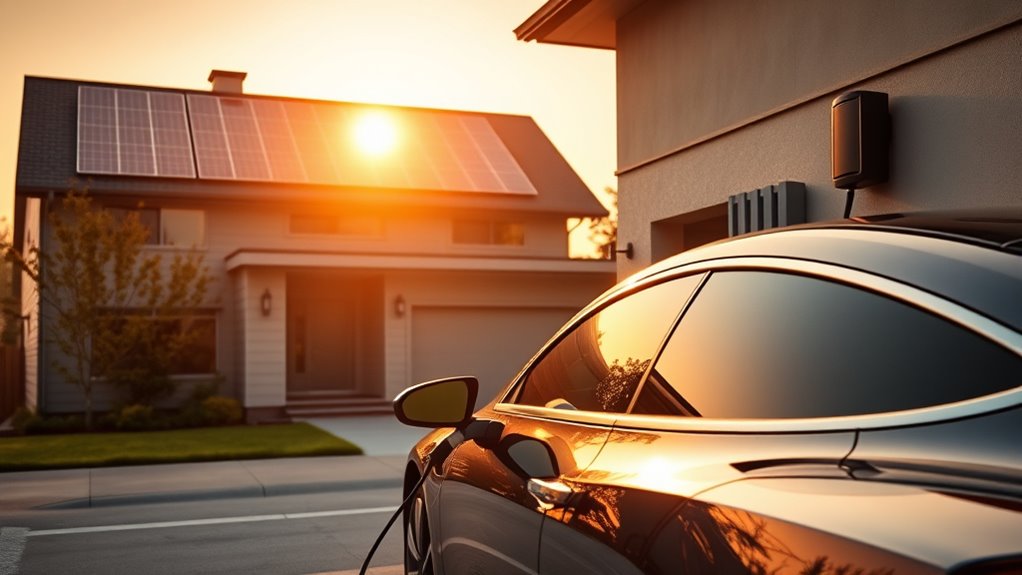
You can charge an EV with solar panels at home, but the practical setup is not just “panels plugged into a car.” Most homes use rooftop solar panels, an inverter, your electrical panel or subpanel, and a safety-listed EV charger. A battery is optional, but it helps if you want to charge after sunset, during outages, or when solar output dips.
Quick Answer
To charge an EV with solar panels at home, size your solar array around your driving kWh, install a compatible inverter and safety-listed Level 2 charger, and schedule charging during strong daylight. Add battery storage if you need nighttime charging or backup power. Use a licensed electrician for permits, wiring, and load calculations.
Key Takeaways
- A normal home solar EV setup uses solar panels, an inverter, your home electrical system, and an EVSE charger. Direct panel-to-car charging is not the usual setup.
- Level 2 charging is usually the best home option because it uses 240V power and can add range much faster than a standard 120V outlet.
- Panel count depends on your annual miles, EV efficiency, local sun, roof conditions, and whether you want solar to cover only driving or the whole home.
- Battery storage is optional for grid-tied homes, but it can help with nighttime charging, cloudy-day dips, and backup power.
- Federal incentive rules changed. Do not assume the old 30% solar credit, $7,500 EV credit, or charger credit applies to new 2026 projects.
At a Glance
| Time Required | Planning may take a few days to a few weeks. Installation usually takes 1 to 3 days once permits, equipment, and utility approvals are ready. |
| Difficulty | Advanced electrical project. Homeowners can plan the numbers, but installation should be handled by qualified solar and electrical professionals. |
| Tools Needed | Solar production estimate, recent electric bills, EV efficiency rating, charger specs, roof or site assessment, permits, listed EVSE, inverter, and electrician load calculation. |
| Cost | Varies widely by solar size, roof work, service-panel capacity, charger amperage, battery storage, labor, permits, and local rebates. |
How Solar EV Charging Works at Home
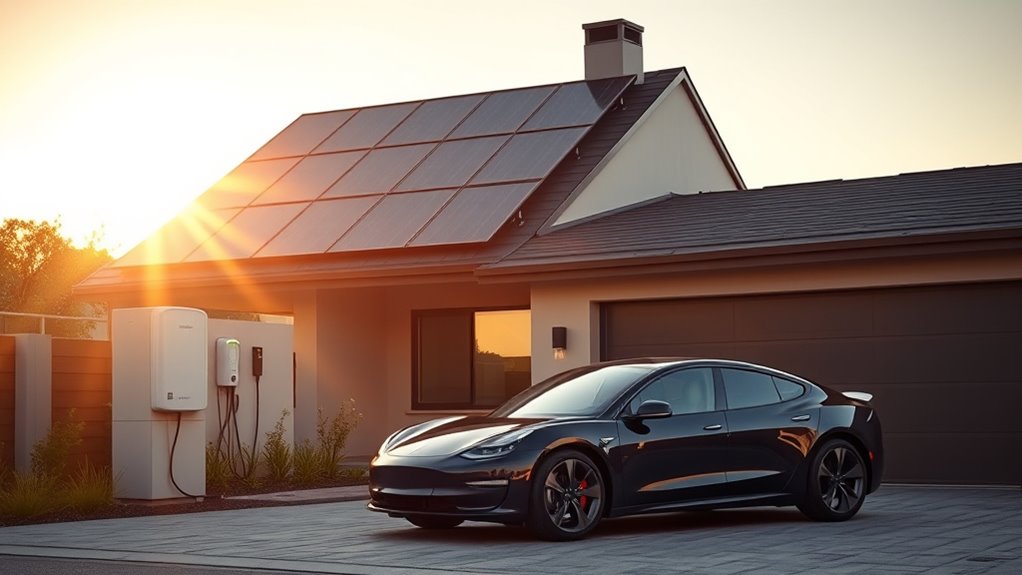
At home, solar EV charging starts with photovoltaic panels converting sunlight into DC electricity. A solar inverter then converts that DC power into AC power your home can use. From there, power flows through your electrical panel or subpanel to an EV charger, also called electric vehicle supply equipment or EVSE.
Most home EV charging is AC charging. That means the charger supplies AC power, and the vehicle’s onboard charger converts it to DC power for the EV battery. A true direct DC solar-to-car setup is possible only with specialized DC charging equipment and careful power control, so it is not the standard home approach.
Think of home solar EV charging as a coordinated system: panels make power, the inverter conditions it, the home electrical system routes it, and the EV charger safely delivers it to the car.
There are three common ways to use solar for EV charging:
- Grid-tied solar without a battery: Your panels offset your home and EV energy use. You can charge during the day, or you can draw from the grid later depending on your utility plan.
- Solar with a smart Level 2 charger: The charger schedules or adjusts charging so more of your EV energy comes from peak solar production.
- Solar plus battery storage: A home battery stores extra solar power for evening charging, backup power, or cloudy periods.
Warning: Solar EV charging involves high-voltage equipment and long-duration electrical loads. Use safety-listed equipment, follow local code and permit rules, and have a licensed electrician verify panel capacity, wiring, grounding, overcurrent protection, and outdoor ratings before use.
Step-by-Step Solar EV Charging Plan
A good setup starts with your driving needs, not with a random number of panels. Use this process before buying equipment:
- Estimate your EV energy use. Divide your yearly miles by your EV’s efficiency in miles per kWh. For example, 12,000 miles per year at 3.5 miles per kWh uses about 3,430 kWh per year.
- Check your home electricity use. Decide whether your solar array should cover only EV charging or both your home and EV.
- Estimate local solar production. Use a location-based solar calculator such as NREL PVWatts or an installer’s modeling tool. Roof direction, shading, tilt, snow, and climate all matter.
- Choose the charger size. Pick a Level 2 charger that matches your vehicle, your electrical service, and your solar goals.
- Decide whether you need a battery. Grid-tied homes can often skip batteries. Add storage if you want backup power, more nighttime solar use, or less grid dependence.
- Verify permits and interconnection. Your installer or electrician should confirm utility rules, local permits, code requirements, and inspection steps.
- Set charging schedules. Use your EV app, charger app, or energy-management system to favor daylight charging or lower time-of-use rates.
Pro Tip: If your utility has time-of-use rates, compare peak solar hours with off-peak grid rates. In some homes, the cheapest charging window may be midday solar. In others, it may be overnight grid power offset by daytime solar credits.
Choose the Right EV Charger
For most homeowners, a Level 2 charger is the best match for solar EV charging. A standard Level 1 outlet can work for low-mileage drivers, but it adds range slowly. Level 2 charging uses 240V power and can add range much faster, depending on the charger, circuit, and vehicle.
The U.S. Department of Energy’s Alternative Fuels Data Center explains that Level 2 charging equipment can operate across a broad power range, and actual charging speed depends on the EV battery, onboard charger, circuit capacity, and charger output.
When choosing a charger, look for:
- Safety certification: Choose equipment listed by a recognized testing laboratory. ENERGY STAR certified EV chargers can also help compare efficient models.
- Adjustable amperage: This helps match charging load to your home circuit and solar production.
- Scheduling: Timers and app controls help you charge during sunlight or cheaper utility periods.
- Solar-aware controls: Some chargers can increase or decrease charging based on solar surplus.
- Connector compatibility: Make sure the charger or adapter works with your vehicle’s inlet, such as J1772 or the newer J3400/NACS-style connector used by many vehicles.
- Outdoor rating: If the charger is mounted outside, it must be rated for outdoor use.
Level 2 Charging Speed
A Level 2 charger is practical for home solar charging because it can deliver far more power than a normal 120V outlet. Many home installations use a dedicated 240V circuit, but the exact charging rate depends on your service panel, breaker, wire size, charger settings, and the vehicle’s onboard charger.
In real use, a Level 2 charger may complete a typical daily top-off in a few hours. A deep charge from a low battery can take much longer. For planning, focus on how many kWh you need to replace each day rather than only the charger’s maximum rating.
Note: Bigger is not always better. A high-amperage charger may require a service-panel upgrade, and it may draw more power than your solar array can supply at one time.
Smart Solar Compatibility
Smart solar compatibility matters because solar output changes throughout the day. A smart charger can schedule charging, limit current, or adjust charging when your panels are producing extra power. This reduces grid draw and can prevent inverter or battery strain.
The best setup depends on your equipment. Some homes use a charger that talks directly to the inverter or home energy monitor. Others use a simple timer to charge during midday. A more advanced system may use a home battery, current sensors, and energy-management software to follow solar production in real time.
Size Your Solar System for Charging
To size a solar system for EV charging, start with annual energy use. The basic formula is:
Annual EV kWh = annual miles driven ÷ EV efficiency in miles per kWh
For example, if you drive 12,000 miles per year and your EV averages 3.5 miles per kWh, your annual EV charging need is about 3,430 kWh before charging losses. If your EV averages 3.0 miles per kWh, the same driving uses about 4,000 kWh per year.
Next, estimate how much energy one solar panel can produce in your area. A 400W panel may produce much more energy in a sunny, unshaded location than in a cloudy or shaded one. Local production modeling is more accurate than a national rule of thumb.
| Planning Item | What to Check |
|---|---|
| Annual miles | Use your odometer history or insurance mileage estimate. |
| EV efficiency | Use your vehicle’s miles per kWh from the dashboard, EPA data, or owner manual. |
| Charging losses | Add a margin because wall-to-battery charging is not 100% efficient. |
| Solar output | Model your roof with local sun, tilt, azimuth, shading, weather, and panel rating. |
| Future use | Plan for a second EV, longer commute, battery degradation, or home electrification if likely. |
Many EV owners land somewhere around several extra panels to a dozen or more panels for driving energy, but there is no universal number. A short commute in Arizona and a long commute in Michigan will not need the same array.
Add Battery Storage for Reliable Charging
Battery storage smooths the mismatch between solar generation and EV charging demand. Without a battery, your EV charges best when the sun is strong or when your utility gives you useful credits for exported solar. With a battery, midday solar can be stored for evening charging or backup use.
A battery is most useful when you want:
- Nighttime charging from stored solar energy
- Backup charging during outages
- Less grid draw during cloudy periods
- Better use of solar when export credits are low
- More control over time-of-use electricity rates
Size the battery in kWh, not just amp-hours. A home battery must also have enough inverter output to support the EV charger load. For example, a 7.2 kW charger can drain a small battery quickly and may exceed the battery inverter’s continuous output rating. Your installer should model both energy capacity and power output.
A battery does not automatically make EV charging off-grid. It must be large enough, powerful enough, and wired correctly to support the charger.
Connect the Inverter and Charger Safely
The safe connection path depends on your solar design, but a common grid-tied setup runs from solar panels to the inverter, then to the home electrical system, then to a dedicated EV charging circuit. Your charger should not be added casually to an overloaded panel.
The DOE home charging guidance recommends safety-certified equipment, electrician review, permits where required, and compliance with electrical code. EV charging equipment is a continuous high-load device, so correct wire sizing, breaker sizing, grounding, disconnects, and weather protection matter.
Inverter Wiring Basics
The inverter converts solar DC power into AC power that can be used by your home and charger. The inverter must be sized for the solar array and connected according to the manufacturer’s instructions, local code, and utility interconnection rules.
Key checks include:
- Correct inverter rating for the solar array
- Proper breaker and overcurrent protection
- Correct wire gauge and temperature rating
- Grounding and bonding according to code
- Clear labeling and disconnect access
- Utility approval for grid-tied export, where required
Charger Safety Checks
Before charging, verify that the EVSE is securely mounted, correctly wired, and protected from weather if outdoors. The circuit should be dedicated unless your local code and equipment instructions allow another approved setup.
Ask your electrician to confirm:
- The electrical panel can handle the added charging load
- The EVSE is listed and installed according to its manual
- The breaker, wire, and charger amperage match
- Any required GFCI protection is handled correctly
- The charger cable reaches without strain or trip hazards
- The installation passed inspection if permits are required
Warning: Do not bypass breaker limits, use undersized extension cords, or install a charger on a circuit that has not been evaluated for continuous EV charging. These shortcuts can create overheating and fire risks.
Charge During Peak Sun Hours
Charging during peak sun hours helps your EV use more of your own solar production. In many homes, this means scheduling charging from late morning through midafternoon, but the exact window depends on your roof orientation, shading, season, and weather.
A smart charger can make this easier by starting, stopping, or reducing charging based on a schedule or available power. If your panels are producing more than your home is using, the charger can send more of that surplus into the EV. If clouds reduce output, the charger can lower the amperage or pause charging.
For the best results, compare three numbers:
- Solar production: When your panels make the most usable power
- Utility rates: When grid electricity is cheapest or most expensive
- Driving schedule: When the car is parked at home long enough to charge
If your car is away from home during the day, you can still benefit from solar through net metering, net billing, utility credits, or a home battery, depending on local rules.
Manage Clouds and Power Fluctuations
Clouds can cause solar output to change quickly. If your charger is set higher than the available solar power, the system may draw from the grid, reduce charging, or trigger inverter and battery limits.
To keep solar charging stable, treat power fluctuations as a control issue. Lower the charger’s amp setting when solar production is weak, use a smart charger that can follow surplus solar, and check inverter logs if charging stops unexpectedly.
If charging stops when clouds pass, the fix is often not “more panels” right away. First check charger amperage, inverter limits, battery settings, and app schedules.
Common troubleshooting steps include:
- Charging starts and stops: Reduce amperage or enable a solar-following mode.
- Inverter trips: Check inverter capacity, battery output, heat, wiring, and error logs.
- EV charges from the grid: Adjust the schedule to stronger solar hours or review utility export rules.
- Battery drains too fast: Lower charger power or increase storage capacity after professional sizing.
- Production is lower than expected: Check shading, dirty panels, inverter alerts, weather, and seasonal sun angle.
Costs, Incentives, and Payback in 2026
The cost of solar EV charging depends on the solar array, charger, electrical work, battery storage, permits, utility rules, and financing. A simple charger installation can be modest if the electrical panel has room. Costs rise when you need trenching, a long wire run, a service-panel upgrade, a battery, or major roof work.
Do not rely on old federal incentive claims without checking current rules. Under Public Law 119-21, the consumer clean vehicle credit ended for vehicles acquired after September 30, 2025, the residential clean energy credit does not apply to expenditures after December 31, 2025, and the alternative fuel vehicle refueling property credit ended after June 30, 2026. State, local, and utility rebates may still be available.
For a realistic payback estimate, use this formula:
Annual charging savings = EV kWh charged from solar × avoided grid rate, adjusted for utility credits, battery losses, equipment cost, and maintenance.
If your utility offers net metering or favorable export credits, a battery may not be needed for savings. If export credits are low or outages are common, battery storage may be worth considering for control and backup rather than pure payback.
Note: Tax rules and rebate programs change. Before buying equipment, check your utility, state energy office, local permitting office, and a qualified tax professional.
Frequently Asked Questions
Can you charge an EV directly with solar panels?
Usually, no. Ordinary home solar panels do not plug directly into an EV. Most homes need solar panels, an inverter, electrical protection, and an EV charger. Direct DC solar charging requires specialized equipment and careful power management.
What is the 33% rule in solar panels?
There is no universal 33% rule for solar EV charging. Some people use one-third of annual energy demand as a rough budgeting target, but system design should be based on your actual kWh use, local solar output, roof conditions, utility rates, and charging schedule.
How many solar panels would I need to charge an EV?
Start with annual miles divided by miles per kWh. Then divide that yearly EV kWh need by the expected annual production of one panel in your location. Many drivers need several extra panels to a dozen or more, but the right number depends on driving, sunlight, shading, panel wattage, and charging losses.
Do I need a battery to charge my EV with solar?
No, not always. A grid-tied solar system can offset EV charging without a battery. A battery becomes more useful if you want nighttime solar charging, backup power, better use of surplus solar, or less grid draw during peak-price hours.
What drains an EV battery the most?
High speeds, cold weather, cabin heating, steep hills, heavy cargo, low tire pressure, aggressive acceleration, and frequent fast driving can reduce range. Smooth driving, correct tire pressure, preconditioning while plugged in, and moderate speeds help preserve battery energy.
Can solar panels fully charge an EV every day?
Yes, if the solar array is large enough, the vehicle is home during useful solar hours, and the system is designed for your daily kWh needs. If you drive long distances, park away from home during the day, or live in a low-sun area, you may need more panels, grid backup, or battery storage.
Conclusion
To charge your EV with solar panels at home, build the system around your real driving energy use, not a generic panel count. A practical setup usually includes a properly sized solar array, an inverter, a dedicated Level 2 charger, safe electrical protection, and smart scheduling. Battery storage can help with nighttime charging and backup power, but it must be sized for both kWh capacity and charger load.
The safest path is to model your annual EV kWh, compare utility rates and solar production, choose safety-listed charging equipment, and have qualified professionals handle wiring, permits, and inspection. With the right design, home solar can reduce grid dependence and make EV charging cleaner, more predictable, and easier to manage.
Sources
- U.S. Department of Energy Alternative Fuels Data Center — Charging Electric Vehicles at Home — backs home charging options, safety-certified equipment, permits, code compliance, and cost factors.
- U.S. Department of Energy Alternative Fuels Data Center — Electric Vehicle Charging Stations — backs Level 1, Level 2, and DC fast charging power and speed guidance.
- National Renewable Energy Laboratory PVWatts Calculator — supports local solar production estimates based on location and system details.
- ENERGY STAR Certified EV Chargers Product Finder — supports selecting efficient, certified EV charging equipment.
- Public Law 119-21 — backs current federal tax credit deadline changes for clean vehicles, residential clean energy, and refueling property.