

Two diesels leave the dealership on the same day. One spends its life towing trailers, climbing hills, and covering hundreds of motorway miles. The other gets the easy jobs: school runs, short trips to the shops, gentle acceleration, and hardly ever more than 2,000 RPM.
A few years later, the gently driven car could be the one facing a blocked diesel particulate filter, diesel fuel in its engine oil, and a repair bill running into thousands.
That sounds backwards. Surely working an engine harder wears it out faster?
With a diesel, the answer is more complicated. Low RPM can be more damaging than normal high RPM, but only under the wrong conditions. The important combination is engine speed, load, and temperature. Get that combination right, and you do not need to baby your diesel or thrash it.
Key Takeaways
- Engine speed, load, and temperature together determine whether your diesel is operating comfortably or under strain.
- Downshifting reduces lugging and protects the engine from unnecessary low-speed, high-load stress.
- Repeated short trips can interrupt DPF regeneration and contribute to fuel dilution of engine oil.
- A mistaken manual downshift can mechanically overrev the engine beyond the protection of its rev limiter.
Table of Contents
- RPM Is Only Part of the Story
- Low RPM Under Heavy Load: The Damage You Can Feel
- Short Trips: The Damage You May Not Feel
- How to Recognize a DPF Regeneration
- Long Idling Is Not Kind to a Diesel
- Normal High RPM Is Different From Mechanical Overrevving
- So, Which Is Worse: Low RPM or High RPM?
RPM Is Only Part of the Story
Imagine a diesel cruising along a flat road at 1,500 RPM. It is maintaining speed with very little effort. Now imagine the same engine at 1,500 RPM, climbing a steep hill in sixth gear with the accelerator pressed to the floor.
The rev counter shows the same number. The engine is having a completely different day.
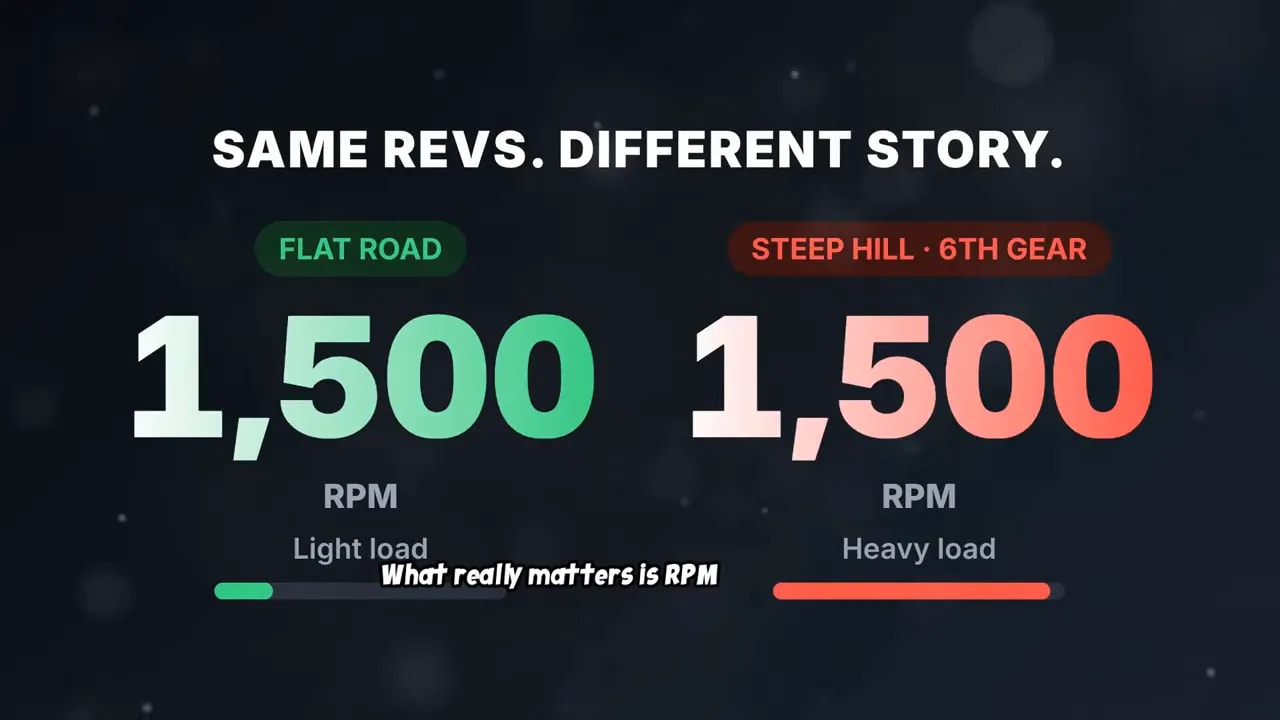
Three things matter together:
- RPM: How quickly the engine is turning.
- Load: How much work you are asking the engine to do.
- Temperature: Whether the engine and exhaust are warm enough to operate properly.
Low revs during an easy cruise are not automatically a problem. Low revs while demanding heavy pulling power can be. Equally, an engine that spends its life running cold on short journeys can develop problems without ever sounding strained.
There is no single magic RPM that suits every diesel. The numbers below illustrate the difference, not a universal shift schedule. Your owner’s manual remains the guide for your particular engine.
Low RPM Under Heavy Load: The Damage You Can Feel
Picture two drivers climbing the same hill. The first stays in sixth gear. The revs fall to 1,200 RPM, so he presses harder. The car shudders and slowly loses speed.
The second shifts down to fourth. The engine rises to 2,500 RPM. It sounds busier, but the vibration disappears and the car climbs smoothly.
The first driver is putting the engine under unnecessary strain. This is called engine lugging: asking for too much pulling power in too high a gear at too low an engine speed.

Because diesels pull strongly at low revs, lugging can feel almost normal. That does not mean the parts inside are happy.
Why Lugging Stresses Crankshaft Bearings
Under heavy load, each combustion event pushes hard on the piston. That force passes through the connecting rod into the crankshaft and its bearings.
During normal operation, the crankshaft journals and bearing surfaces are separated by a thin film of oil. The crankshaft’s rotation helps maintain that protective film.
Lugging combines heavy combustion loads with slow rotation. You are asking the oil film to withstand considerable pressure under conditions that make maintaining separation more difficult. Keeping the revs low is not necessarily keeping the stress low.
The Dual Mass Flywheel Takes a Beating Too
Many modern diesel cars have a dual mass flywheel. Its job is to absorb the engine’s twisting vibrations before they reach the gearbox.
The deep shudder you feel during lugging is exactly the kind of vibration this component has to deal with. Repeated punishment can wear it out, and replacing it, often alongside the clutch, can be expensive.
The Fix Is a Lower Gear
A lower gear gives the engine more leverage at the wheels. It can pull the same vehicle up the same hill without struggling so hard.
- In a manual: Shift from sixth to fifth, or fourth if needed, before the engine starts shuddering or losing speed.
- In an automatic: The gearbox usually changes down itself, but fuel-saving programming may keep it in a high gear longer than is comfortable.
- If an automatic starts lugging: A slightly firmer accelerator input may prompt a downshift. Alternatively, select a lower gear using the paddles or manual mode.
- When towing: Use tow/haul mode if fitted. It generally holds lower gears longer to help the engine handle the load.
If the engine is shuddering under load, do not keep demanding more power in the same gear. Change down. The revs rise, but the strain falls.
Short Trips: The Damage You May Not Feel
The second problem is quieter. Your diesel may feel perfectly smooth while its exhaust filter fills with soot and its engine oil becomes diluted with fuel.
A modern diesel depends on reaching suitable operating temperatures. Most modern diesel cars have a diesel particulate filter, or DPF, in the exhaust. It traps soot rather than allowing it out of the tailpipe.
That soot cannot stay there forever. Periodically, the filter needs to burn it away through a process called regeneration.
How DPF Regeneration Works
During a sustained motorway journey, exhaust temperatures can become high enough to burn soot naturally. Short trips often do not provide enough heat or enough uninterrupted time.
When necessary, the engine computer initiates active regeneration, raising exhaust temperatures to around 600°C, well over 1,000°F.

Many engines achieve this by injecting extra fuel late in the combustion cycle to heat the exhaust. The catch is that some of this fuel can reach the cylinder walls, pass the piston rings, and enter the engine oil.
Diesel fuel does not provide the lubrication the engine needs from its oil. As more fuel mixes into the oil, it becomes thinner and less able to protect the moving parts.
Why Repeated Five-Minute Journeys Cause Trouble
Suppose the car starts regenerating its DPF during a five-minute school run. You arrive and switch off before the process finishes. On a later trip, it tries again, only to be interrupted again.
Repeated incomplete regeneration can leave you with two problems:
- Soot continues accumulating in the DPF.
- Fuel dilution reduces the engine oil’s protective ability.
Eventually, a warning light may appear and the car may enter reduced-power mode. The owner who thought gentle driving was protecting everything can end up with a clogged filter and compromised oil.
These systems can have design problems too. An Australian class action concerning DPF systems in Toyota Hilux, Prado, and Fortuner vehicles covered more than 260,000 vehicles, and the court found the system defective. Even a brand with a strong reliability reputation is not immune.
For further background on filter operation and common problems, the RAC’s diesel particulate filter guide is a useful reference.
A Rising Oil Level Is a Warning, Not a Bonus
If your engine oil level rises between services, do not assume that means everything is fine. In a diesel experiencing regeneration problems, the extra volume may be fuel entering the sump.
An unexplained rise in oil level needs checking. The dipstick can show more liquid while the engine actually has less effective lubrication.
How to Recognize a DPF Regeneration
Many cars do not clearly announce every regeneration cycle. Instead, you may notice a few clues:
- The cooling fan keeps running after you switch off the engine.
- The idle speed is higher than usual.
- There is a hot, sharp smell from the exhaust.
- The stop-start system temporarily stops operating.
- A dashboard message appears on models that provide one.
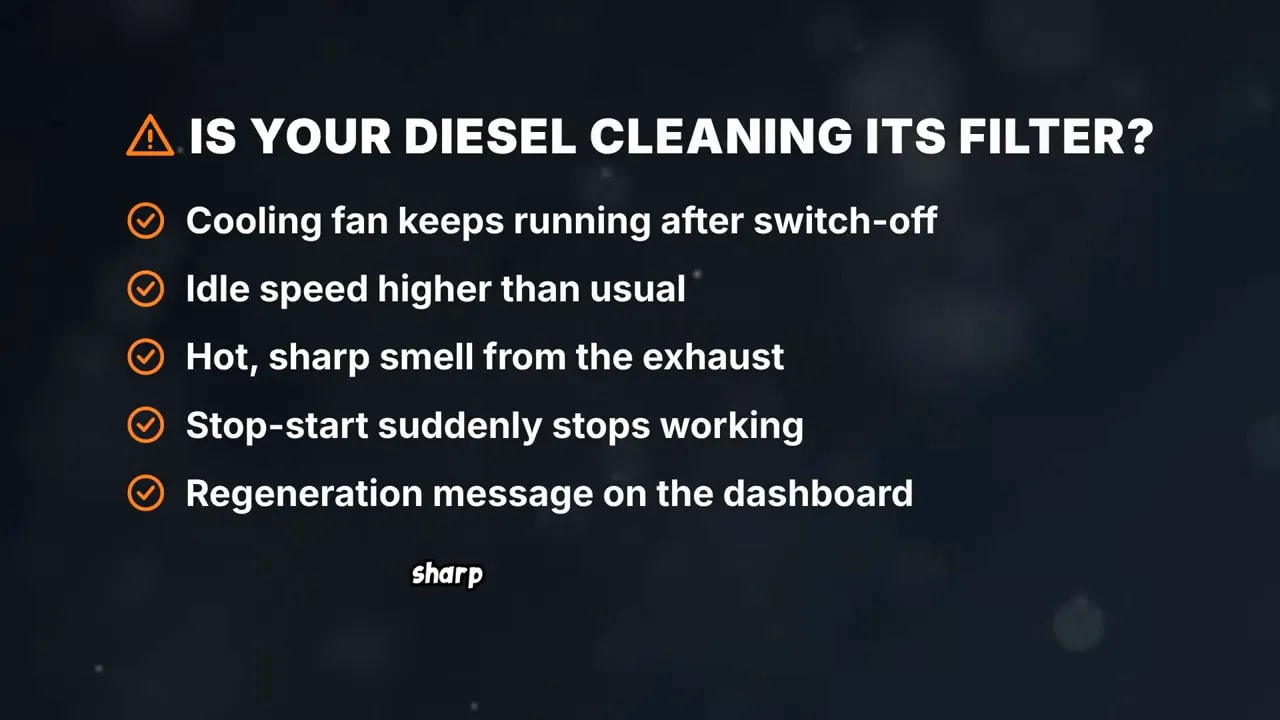
None of these signs alone proves that regeneration is happening. Together, they are a useful hint.
If it is safe and practical, continuing for another 10 to 15 minutes at a steady speed may give the process time to finish. Follow any specific instructions for your vehicle.
If you genuinely need to stop, stop. One interrupted regeneration is not a disaster. Repeatedly interrupting the process is the concern.
Give Your Diesel a Proper Run
Regular sustained driving helps provide the heat and time a DPF needs. Ford, for example, recommends around 20 minutes of steady main-road or motorway driving for some DPF-equipped models.
Your car may have different requirements, so check its manual. This is not an instruction to drive flat out or chase a particular rev-counter reading. The useful ingredients are a properly warmed engine, suitable driving conditions, and enough uninterrupted time.
Two precautions matter:
- Keep hot exhausts away from dry grass: Regeneration produces extremely high exhaust temperatures. Do not park or idle over dry grass.
- Do not ignore a persistent DPF warning: If the light stays on despite following the vehicle’s instructions, seek workshop attention rather than repeatedly trying a motorway blast.
Long Idling Is Not Kind to a Diesel
If gentle driving can cause trouble, surely sitting still with the engine running must be harmless?
Not necessarily. At idle, a diesel operates under very little load and can remain relatively cool. Incomplete combustion can contribute soot and unburned fuel to the oil.
That is why a long driveway warm-up every cold morning is not the protective habit it might seem. A modern diesel generally warms up faster and more cleanly when driven gently.
Avoid hard acceleration while it is cold. Let the temperature begin to rise and follow your manufacturer’s warm-up guidance. The answer is gentle movement, not a prolonged stationary warm-up and not immediate hard driving.
Normal High RPM Is Different From Mechanical Overrevving
Accelerating onto a motorway or overtaking with a warm engine is normal work for a diesel. Using higher revs within its intended operating range is not automatically harmful.
The most obvious everyday cost is usually extra fuel. But there is an important distinction between normal higher revs and forcing the engine beyond its mechanical limits.
The Wrong Downshift Can Destroy an Engine
You are driving a manual diesel at speed. You intend to shift from fifth to fourth, but accidentally select second.
When you release the clutch, the vehicle’s momentum can force the engine to turn far faster than it was designed to. Damage can happen almost instantly.
Lifting off the accelerator does not solve the underlying problem. The engine is no longer driving the wheels. The wheels are driving the engine.
A rev limiter usually works by reducing or cutting fuel. That can limit engine speed during acceleration, but it cannot reliably protect an engine being mechanically driven too fast through the gearbox.
Why Extreme RPM Can Cause Internal Collisions
Diesels generally have relatively low maximum engine speeds and limited clearance between pistons and valves.
At extreme RPM, the valve springs may not close the valves quickly enough. A valve can remain open as the piston comes up, causing a collision. The result can include bent valves, damaged pistons, or a ruined engine.
Most modern automatics refuse a requested downshift that would overrev the engine. In a manual, gear selection is your responsibility.
Take an extra half-second over downshifts at speed. Confirm the correct gear before releasing the clutch. It is a small habit with a potentially enormous payoff.
So, Which Is Worse: Low RPM or High RPM?
For everyday diesel use, low RPM in the wrong conditions is often the bigger concern. But engine speed alone does not decide whether you are doing damage.
- Low RPM with heavy load: Lugging strains the bearings and dual mass flywheel.
- Repeated short trips and prolonged idling: Insufficient heat and interrupted regeneration can clog the DPF and contribute to fuel dilution.
- Normal higher RPM with a warm engine: Generally part of normal operation, with increased fuel use as the main everyday trade-off.
- A mistaken downshift at speed: Can cause a mechanical overrev and immediate engine damage.
The practical habits are straightforward: change down when the engine struggles, give the car regular sustained runs suited to its manual, avoid prolonged idle warm-ups, and investigate a rising oil level.
You do not need to keep the revs as low as possible. You need to use the right revs for the work you are asking the engine to do.