
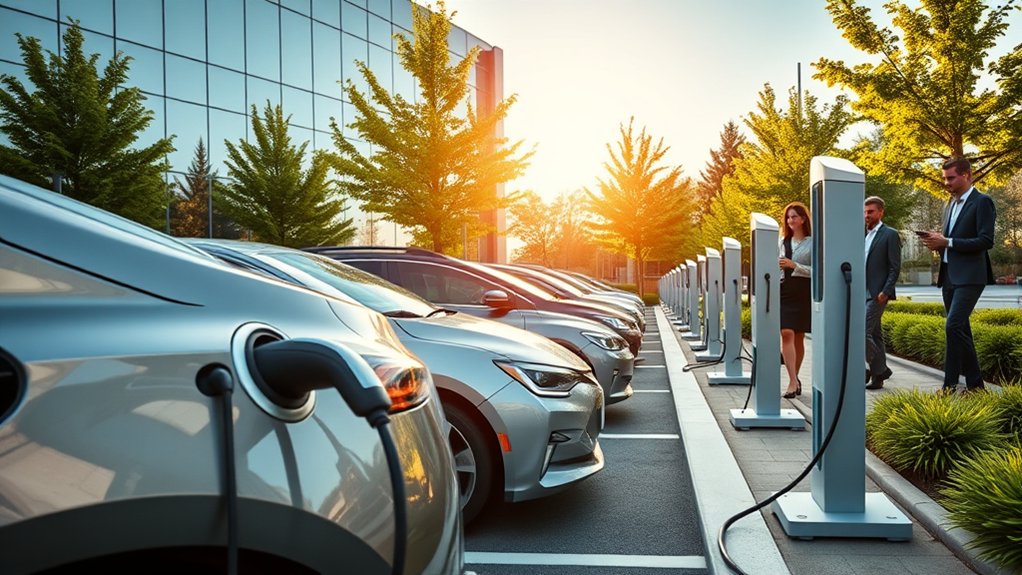
Workplace EV charging stations give employees a practical way to recharge while their vehicles are already parked during the workday. A good program starts with the right charger level, enough electrical capacity, clear access rules, safe installation, and a pricing policy that fits your company’s goals.
Quick Answer
Most workplace EV charging stations use Level 2 chargers because employees usually park for several hours. Employers should survey demand, check electrical capacity, plan accessible parking, choose networked or non-networked chargers, set clear usage rules, and budget for equipment, installation, electricity, maintenance, and software fees.
Key Takeaways
- Level 2 charging is usually the best fit for office parking because it matches a typical workday dwell time.
- Networked chargers are useful when you need access control, billing, reporting, reservations, or load management.
- Installation cost depends heavily on trenching distance, electrical capacity, panel upgrades, charger type, permits, and accessibility work.
- A written charging policy should define who can charge, how long sessions can last, what fees apply, and who enforces the rules.
- Electrical code, local permitting, ADA or ABA accessibility, and routine maintenance should be planned before equipment is ordered.
At a Glance
| Time Required | A small Level 2 project may take weeks to plan, while larger projects with utility upgrades, trenching, or permits can take several months. |
| Difficulty | Moderate to advanced. You need facilities, electrical, HR, finance, parking, and legal input. |
| Tools Needed | Employee survey, parking map, utility bills, electrical load review, licensed electrician, charger vendor quotes, and written charging policy. |
| Cost | Costs vary widely by site. Equipment, trenching, panel capacity, networking, permits, accessibility work, maintenance, and electricity rates all affect the final price. |
How Workplace EV Charging Stations Operate
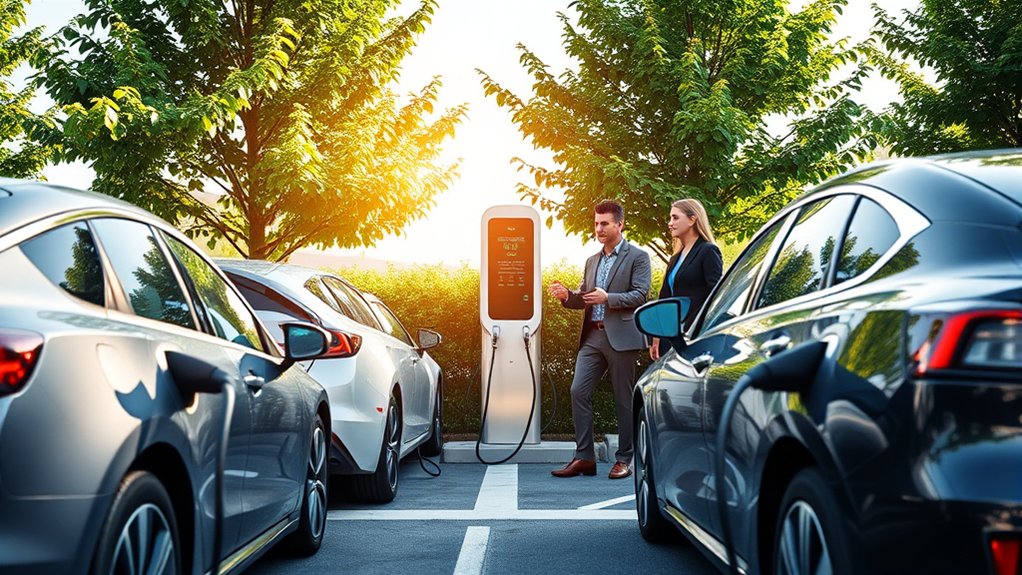
A workplace EV charging station, also called electric vehicle supply equipment or EVSE, moves power safely from the building’s electrical system to an employee’s electric vehicle. The charger communicates with the vehicle before power flows, which helps confirm that the connector is seated properly and the vehicle is ready to charge.
It also helps to know the difference between a station, a port, and a connector. A charging station is the physical location or charging post. A charging port can charge one vehicle at a time. A connector is the plug that attaches to the vehicle. One charging post may have more than one port or connector, but each port normally serves one vehicle at a time.
Most workplace programs use Level 2 workplace charging because employees often park for 4 to 10 hours. That makes Level 2 a strong fit for topping up during a normal workday without the high cost and electrical demand of DC fast charging.
Level 2 chargers are the most common workplace choice because one connector can often serve more than one vehicle per day when employees share stations and move charged vehicles on time.
Some chargers are simple and non-networked. Others are networked through Wi-Fi, cellular, or Ethernet. Networked chargers are not always required, but they are useful when you need RFID cards, mobile app access, billing, session logs, station-status alerts, reservation tools, or load management.
Top Reasons to Provide EV Charging for Employees
Providing EV charging at work is not just a parking-lot upgrade. It can support employee satisfaction, sustainability goals, and better use of company parking and energy resources.
Employee Attraction and Retention
Employees who drive EVs often value reliable charging where they spend the most time. Workplace charging can be especially helpful for people who live in apartments, condos, rental homes, or older houses where home charging is limited.
Charging access can also make your benefits package feel more modern. It shows that the company is paying attention to changes in commuting habits and offering practical support rather than just talking about sustainability.
Sustainability and Emissions Goals
Workplace EV charging can support cleaner commuting, especially when paired with renewable energy purchasing, onsite solar, or a broader transportation plan. It can also help with sustainability reporting when the charger software tracks electricity use and charging sessions.
For companies that report Scope 3 commuting emissions, workplace charging can be one part of a broader plan that may also include transit benefits, carpooling, bike facilities, and flexible schedules.
Reduced Range Anxiety
Charging at work gives employees more confidence that they can complete their commute, errands, and return trip without searching for public chargers. This matters most for employees with long commutes, cold-weather range loss, or no charging access at home.
Note: Workplace charging does not need to replace home charging. For many employees, it works best as a dependable backup or daytime top-up.
Assessing Your Company’s Charging Needs
Before buying chargers, measure demand. Guessing can lead to too few ports, wasted money, overloaded circuits, or chargers installed in the wrong parking area.
Current Employee Vehicle Usage
Start with an employee survey. Ask how many employees already drive EVs or plug-in hybrids, how many plan to buy one, how far they commute, whether they can charge at home, and how often they would use workplace charging.
| Factor | Why It Matters | Recommended Action |
|---|---|---|
| Current EV drivers | Sets the starting demand | Survey employees and invite voluntary EV registration |
| Commute distance | Shows who needs charging most | Prioritize long-distance commuters when ports are limited |
| Home charging access | Identifies employees with limited alternatives | Consider fair-use rules for employees without home charging |
| Parking dwell time | Determines charger speed needs | Use Level 2 for standard workday parking |
Parking and Site Layout
Choose parking spaces close enough to electrical service to reduce trenching and wiring costs, but do not ignore convenience, lighting, snow removal, drainage, security, and accessibility. If chargers are too far from where employees actually park, usage will suffer.
Dedicated EV charging bays help prevent non-EV vehicles from blocking the equipment. Clear signs and pavement markings also reduce confusion, especially when visitors and employees share the same lot.
Electrical Capacity and Utility Coordination
Ask a licensed electrician or electrical engineer to review panel capacity, transformer capacity, available circuits, future expansion space, and local permitting requirements. For larger projects, contact your utility early. Utility review can affect timeline, cost, and whether service upgrades are needed.
Pro Tip: Install conduit or extra panel capacity for future chargers when the parking lot is already open. It is often cheaper to plan expansion during the first project than to retrench later.
Expected Future Growth
Plan for more EVs than you have today. Employee demand can grow quickly once charging is visible and reliable. A scalable design may include spare conduit, room for extra breaker capacity, load-management software, and a policy that lets you add ports without rewriting the entire program.
Instead of relying on a single national forecast, use your own employee survey, local EV adoption trends, building capacity, and utility guidance. This gives you a plan that matches your workplace rather than a generic projection.
Choosing the Right Charging Level for Your Workforce
The best charging level depends on parking time, number of users, budget, and electrical capacity. Faster is not always better. For employees parked all day, a well-managed Level 2 program is usually more cost-effective than a small number of expensive fast chargers.
| Charging Level | Best Workplace Use | Main Trade-Off |
|---|---|---|
| Level 1 | Long dwell times, small pilot programs, or low daily mileage | Low cost, but very slow charging and limited daily turnover |
| Level 2 | Most employee parking lots and offices | Good balance of speed and cost, but may need sharing rules |
| DC fast charging | Fleet vehicles, visitor charging, high-turnover sites, or short dwell times | Fast charging, but higher equipment cost, utility demand, and installation complexity |
For many employers, a smart starting point is a small number of Level 2 ports in visible, accessible spaces, paired with a policy that encourages sharing. You can then expand as usage data proves demand.
Installation Costs and Financial Incentives
Workplace EV charging costs vary widely. The charger hardware is only one part of the budget. The final price can change based on trenching, distance to electrical service, panel upgrades, utility work, bollards, signs, networking, software, permits, inspection, and accessibility improvements.
Installation Cost Breakdown
Older U.S. Department of Energy cost research found broad ranges for non-residential EVSE equipment and installation, and it emphasized that a site-specific estimate is the only reliable way to budget a project. Use those ranges as planning context, not as a fixed quote.
- Equipment: Charger type, amperage, number of ports, cable management, display, payment system, and network capability affect cost.
- Electrical work: Panel capacity, breaker space, transformer capacity, conduit, trenching, boring, and distance from service affect installation cost.
- Site work: Concrete, asphalt repair, wheel stops, bollards, signs, lighting, striping, and drainage may be needed.
- Software: Networked chargers may include activation fees, monthly software fees, payment processing, reporting, and maintenance plans.
- Operations: Electricity, demand charges, repairs, cleaning, snow removal, and customer support should be included in the annual budget.
Available Financial Incentives
The federal Alternative Fuel Vehicle Refueling Property Credit, often called the 30C credit, applied to qualified property placed in service from January 1, 2023, through June 30, 2026. For new property placed in service after June 30, 2026, employers should not assume the federal credit is still available.
If your project was placed in service by the deadline, check the IRS rules carefully. Businesses generally had a 6% credit up to $100,000 per item, or 30% if prevailing wage and apprenticeship requirements were met. Location rules also applied, including eligible low-income or non-urban census tracts.
State, local, and utility incentives may still be available even when a federal program changes. Search your state energy office, utility website, and the AFDC laws and incentives database before finalizing your budget.
Long-Term Savings Potential
Workplace charging can create value, but it is not automatically a profit center. Savings depend on employee retention, sustainability goals, charging fees, demand charges, utility rates, and how well the stations are used.
To control long-term costs, review your utility rate structure, consider load management, avoid peak-time charging where possible, and decide whether the company will subsidize charging or recover costs from users.
How to Create an Effective Charging Policy
A written charging policy prevents confusion and keeps access fair. Publish it before the chargers go live, then update it as usage grows.
- Eligibility: Decide whether chargers are for employees only, visitors, fleet vehicles, tenants, or the public after hours.
- Registration: Require users to register their EV, contact details, and agreement to charging rules.
- Time limits: Set maximum session lengths so one vehicle does not block a port all day.
- Pricing: Choose free charging, a subsidized rate, cost recovery, or a rate slightly above local residential electricity costs.
- Idle fees: Consider fees or warnings when a vehicle remains parked after charging is complete.
- Enforcement: State who handles violations, warnings, towing, suspension, or repeat misuse.
- Priority rules: Decide whether long-distance commuters, employees without home charging, or fleet vehicles get priority.
- Privacy: Explain what session data is collected, who can see it, and how long it is retained.
How to Keep Charging Stations Safe and Compliant
EV charging equipment should be installed by qualified professionals and reviewed under the electrical code, building code, fire code, accessibility rules, and local permitting process that apply to your site.
Warning: Do not treat workplace EV charging as a simple extension-cord project. Use listed charging equipment, licensed electrical work, dedicated circuits where required, permits, inspections, and outdoor ground-fault protection where applicable.
For Level 1 outlets, the U.S. Department of Energy recommends commercial-grade NEMA receptacles on dedicated circuits, with ground-fault circuit interrupter protection for outdoor use. For Level 2 and DC fast charging, the electrical design should account for continuous load, conductor sizing, disconnects, protection from vehicles, and maintenance access.
Accessibility is also part of compliance. The U.S. Access Board’s EV charging guidance explains that accessible charging should consider routes, clear floor space, access aisles, operable parts, connector reach, payment systems, signs, and user interfaces. State and local rules may add specific requirements.
Managing Access and Usage of Charging Stations
Good management keeps chargers available for the people who need them. For a small program, a shared calendar, signs, and employee etiquette may be enough. For a larger program, networked chargers can automate access, session tracking, billing, and notifications.
Common access methods include RFID cards, mobile apps, employee badges, QR codes, or plug-and-charge features when supported. Choose a system that is simple enough for employees and visitors to use without constant support from facilities staff.
Usage monitoring helps you decide when to add more ports. Track peak charging times, average session length, idle time, failed sessions, energy use, and waitlist complaints. If the chargers are full most days, add sharing rules first, then expand capacity when the data supports it.
Load management can also protect your electrical system and reduce cost. Smart chargers can share available power across multiple ports, slow charging during peak periods, or prioritize vehicles that need charging most urgently.
Engaging Employees With Workplace EV Charging
Employees are more likely to use the program well when they understand how it works. Announce the launch, explain the policy, share etiquette rules, and show employees how to start and stop a session.
- Hold a short EV charging orientation or lunch-and-learn.
- Post signs that explain time limits, fees, and who to contact for help.
- Share a simple etiquette guide: charge, move, and report problems quickly.
- Invite feedback after the first 60 to 90 days.
- Use charger data to show utilization and explain future expansion decisions.
Ride-and-drive events can also help employees who are curious about EVs but unsure how charging works. This makes the chargers part of a broader education effort rather than just a parking-lot feature.
Preparing for Future EV Adoption Trends in the Workplace
Workplace charging needs will change as more employees buy EVs, battery ranges improve, connector standards evolve, and utilities adjust electricity rates. Build flexibility into your first installation.
Ask vendors about charger compatibility, cable management, software portability, warranty terms, parts availability, uptime support, and whether the equipment can support future connector needs. For many sites, future-proofing is less about buying the fastest charger and more about installing a scalable electrical and parking design.
Review the program at least once a year. Compare charger usage, employee feedback, maintenance tickets, electricity cost, and waitlist demand. Then decide whether to add ports, adjust pricing, change time limits, or move chargers to better parking locations.
Frequently Asked Questions
What is the 80/20 rule for EV charging?
The 80/20 rule usually means keeping an EV battery between about 20% and 80% for routine charging when possible. It is a battery-care guideline, not a strict requirement. For workplace charging, you can use it as an etiquette reminder: take only the charge you need, then move your vehicle so others can use the port.
How do you charge an EV at work?
Park in a designated EV charging space, connect the charger to your vehicle, and start the session using the method your employer requires, such as an RFID card, mobile app, employee badge, or charger screen. Follow the time limit and move your vehicle when charging is complete.
Are electric cars safe for pacemakers?
For most people with pacemakers or implanted cardiac devices, ordinary EV use is not considered a routine problem. Still, follow your cardiologist’s and device manufacturer’s guidance. Avoid pressing your chest or implant area against charging equipment, high-power cables, motors, or strong magnetic sources, and ask your doctor about any device-specific precautions.
What drains an EV battery the most?
High speeds, hard acceleration, extreme heat or cold, heavy cabin heating, towing, roof racks, underinflated tires, and steep terrain can reduce range. At work, charging policy cannot control every driving habit, but it can help employees top up enough for their commute without blocking chargers all day.
How many workplace EV chargers does a company need?
There is no universal number. Start with an employee survey, current EV count, commute distances, home charging access, and parking dwell time. Many employers begin with a small Level 2 pilot, monitor utilization, then add ports as demand grows.
Should employers charge employees for EV charging?
It depends on the goal. Free charging is simple and popular, but it can create congestion and fairness concerns. A modest fee can recover electricity and network costs while encouraging drivers to move their vehicles when charging is complete.
Conclusion
Workplace EV charging works best when it is planned like a real facilities program, not a one-time equipment purchase. Start with employee demand, confirm electrical capacity, choose the right charging level, design accessible spaces, set clear rules, and assign someone to manage maintenance and enforcement.
Level 2 chargers are usually the best fit for employee parking, but the right setup depends on your building, parking lot, budget, and workforce. With careful planning, workplace EV charging can support employees, reduce charging stress, and help your company prepare for the next stage of electric transportation.
Sources
- U.S. Department of Energy AFDC: Workplace Charging for Electric Vehicles — workplace charging planning, charger levels, management, pricing, and safety.
- U.S. Department of Energy AFDC: Electric Vehicle Charging Stations — EV charging station terminology and infrastructure basics.
- IRS: Alternative Fuel Vehicle Refueling Property Credit — federal 30C credit eligibility, amount, deadline, and claiming rules.
- U.S. Department of Energy AFDC: ADA Compliance for EV Charging Infrastructure — accessibility considerations for EV charging sites.
- U.S. Access Board: Design Recommendations for Accessible Electric Vehicle Charging Stations — accessible routes, operable parts, vehicle charging spaces, access aisles, and user-interface accessibility.
- U.S. Department of Energy: Costs Associated With Non-Residential Electric Vehicle Supply Equipment — cost factors for non-residential EVSE equipment, installation, operation, and maintenance.