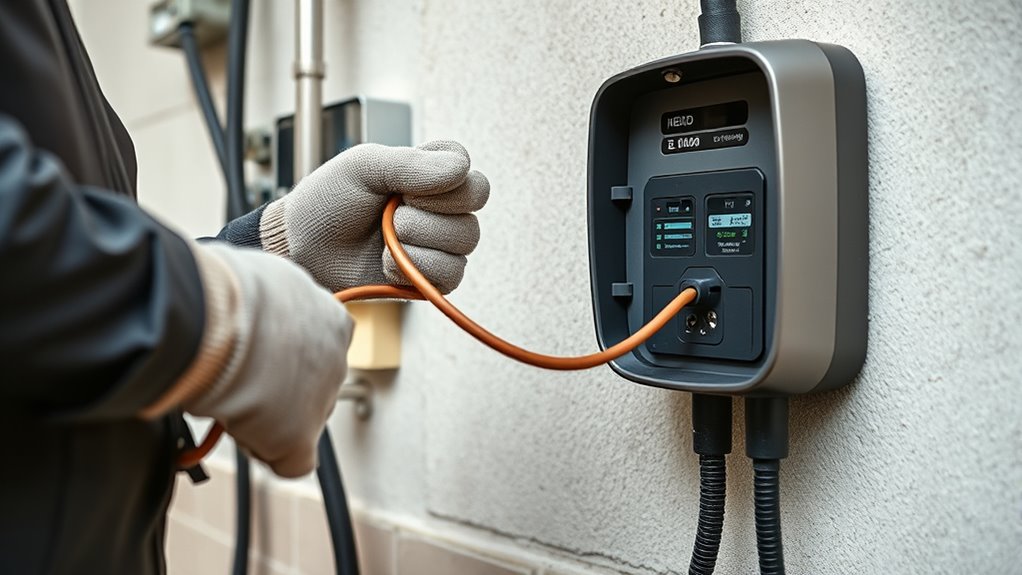
Grounding an EV charger is not just a final wire connection. It is a safety system that includes a listed charger, a correctly sized dedicated circuit, a reliable equipment grounding conductor, proper bonding, and working ground-fault protection. Because EV charging can run for hours at high current, the grounding and protection checks should be done by a qualified electrician before the charger is energized.
Quick Answer
To ground an EV charger safely, use a listed EVSE on a dedicated circuit, bond all exposed metal parts to the equipment grounding conductor, and verify GFCI/RCD protection with proper test equipment. Do not add a ground rod, jumper neutral to ground, or reuse an old outlet unless a qualified electrician confirms it meets local code.
Key Takeaways
- An EV charger must have a dependable equipment grounding conductor, not a makeshift neutral-ground jumper or adapter.
- A qualified electrician should verify bonding, conductor sizing, breaker rating, torque, ground-fault protection, and local permit requirements.
- Do not rely on a simple multimeter reading to prove earth resistance or fault loop impedance; those checks need proper instruments.
- RCD, GFCI, RCCB, or RCBO selection depends on the charger design, local code, and manufacturer instructions.
At a Glance
| Time Required | Usually 2–6 hours for a straightforward home installation, longer if the panel, conduit route, permit, or service capacity needs work. |
| Difficulty | Advanced electrical work. Panel wiring, grounding changes, and final testing should be handled by a qualified electrician. |
| Tools Needed | For the electrician: approved tester, torque screwdriver, circuit analyzer, loop impedance or ground testing equipment where required, PPE, and manufacturer installation manual. |
| Cost | Often a few hundred to several thousand dollars, depending on charger amperage, panel capacity, wiring distance, permit fees, and whether service upgrades are needed. |
Why EV Charger Grounding Matters
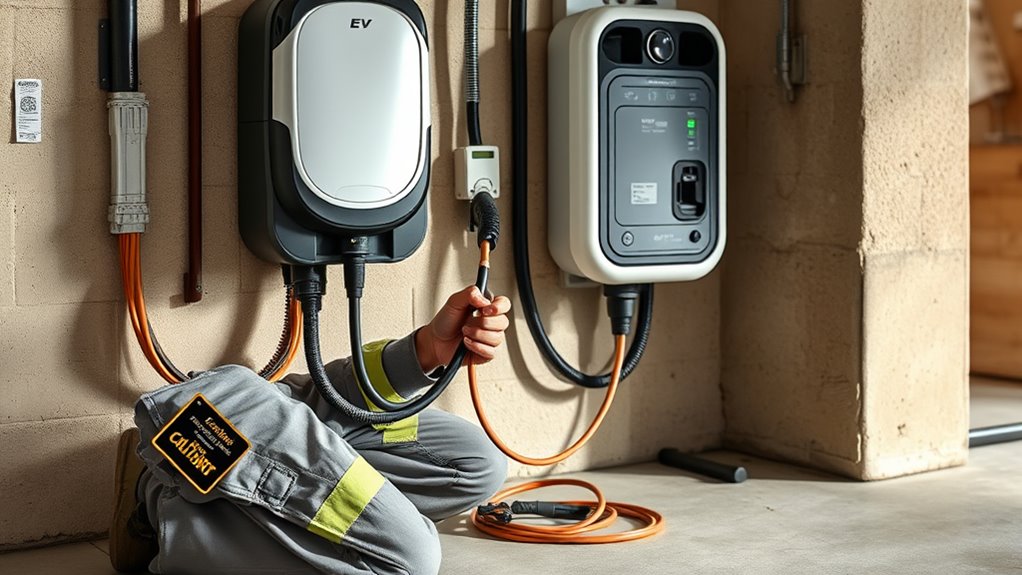
Grounding your EV charger matters because it helps keep exposed metal parts from staying energized during a fault. A correct equipment grounding conductor gives fault current a controlled path back to the source so the breaker, GFCI, RCD, or charger protection can disconnect power.
In the United States, EV charger wiring is usually checked against locally adopted electrical code, including the National Electrical Code, the EVSE manufacturer’s installation manual, and the local authority having jurisdiction. In IEC-based regions, the electrician follows the applicable local edition of IEC-style wiring rules and EV charging standards.
Grounding is only one part of the safety system. Bonding, overcurrent protection, residual-current protection, enclosure rating, conductor size, torque, and weatherproofing all matter. If one part is wrong, the charger may still power up, but it may not be safe under fault conditions.
Warning: Do not open the main panel, add a breaker, alter grounding conductors, or install a neutral-ground jumper unless you are qualified and legally allowed to do that work. EV charger circuits can carry lethal voltage and high continuous current.
What Earth Bonding Does for Safety
Earth bonding connects the charger’s exposed conductive parts, metal raceway where used, metal boxes, and other required conductive parts to the equipment grounding system. This reduces the chance that a metal enclosure, pedestal, or vehicle body remains energized after insulation fails.
Protective earth, often shortened to PE, is the conductor used for safety grounding. A PEN conductor is different: it combines protective earth and neutral in part of some supply systems. PEN issues are especially important in TN-C-S style systems because a lost PEN conductor can raise exposed conductive parts to dangerous voltage.
For common AC charging, the EVSE and vehicle also use a control system. SAE J1772-style charging includes a protective earth connection and control-pilot behavior that helps the equipment confirm safe charging states before power is delivered. That does not replace proper grounding in the building wiring; it depends on it.
A charger that works is not automatically a charger that is safely grounded. Final safety depends on bonding, protection devices, code-compliant wiring, and verified test results.
Verify the Earthing System Before You Install
Before installing a Level 2 EV charger, have the electrician confirm the building’s earthing or grounding system. The right test is not just “does the charger turn on?” The installation should be checked against the charger manual, local code, and inspection requirements.
The electrician should identify the supply arrangement, confirm whether the charger will be hardwired or plug-in, and check whether the existing panel can support the EV charging load. EV charging is treated as a continuous load in many code systems, so the circuit is not sized only by the charger’s plug shape or the breaker that happens to be available.
Check Existing Earthing
The existing grounding system should have a proper equipment grounding conductor back to the service equipment or required grounding point. The electrician should inspect the route for corrosion, loose lugs, damaged insulation, improper splices, overheated terminals, and unapproved adapters.
Older dryer or range receptacles deserve special attention. Some older NEMA 10-style outlets do not have a separate equipment grounding conductor. They should not be adapted for EV charging unless a qualified electrician confirms a code-compliant grounding path and installs the correct receptacle or hardwired connection.
Note: A separate ground rod beside the charger is not a shortcut for a missing equipment grounding conductor. Grounding electrodes and equipment grounding conductors serve different purposes and must be installed according to local code.
Test Earth Continuity
Simple continuity checks can show whether a de-energized grounding conductor appears connected, but they do not prove the entire fault-clearing path is safe. Earth resistance and fault loop impedance require proper test instruments and a person trained to use them.
The electrician should verify that the fault path is low enough for the protective device to operate as designed. In TT, TN, and other earthing systems, acceptable values depend on the protective device, local code, supply arrangement, and charger instructions. A fixed “10 ohms” target is not reliable for every EV charger installation.
How to Ground an EV Charger Step by Step
The safe way to ground an EV charger is to treat the job as a verified installation, not a quick connection. These are the practical steps a qualified electrician should complete before the charger is used.
- Confirm the charger listing and manual. Use EV supply equipment that is listed or certified for your region, such as equipment evaluated to relevant EVSE safety standards. Follow the exact terminal, conductor, breaker, and mounting instructions from the manufacturer.
- Check permits and local rules. The local authority having jurisdiction may require a permit, inspection, load calculation, specific GFCI/RCD protection, or a service upgrade.
- Choose hardwired or plug-in installation. Hardwired chargers reduce receptacle heat and plug wear in many permanent installations. Plug-in chargers need a properly rated, high-quality receptacle installed on a matching dedicated circuit.
- Size the circuit correctly. The breaker, conductors, raceway, receptacle if used, disconnect if required, and equipment grounding conductor must match the EVSE rating and local code.
- Bond the charger enclosure. The equipment grounding conductor must be landed on the correct grounding terminal, and any required metal box or raceway must be bonded.
- Torque all terminals. Loose connections can overheat during long charging sessions. The electrician should tighten lugs and terminals to the manufacturer’s stated torque values.
- Install required ground-fault protection. Use the GFCI, RCD, RCCB, RCBO, or built-in charger protection required by the charger design and local code.
- Test before use. Verify voltage, polarity where applicable, grounding continuity, bonding, fault protection, and charger operation before connecting a vehicle for regular charging.
- Document the result. Keep the permit, charger manual, circuit rating, breaker type, protection device model, test results, and inspection record.
Pro Tip: Save a photo of the charger nameplate, breaker label, and final test report. If the charger trips, overheats, or needs service later, those records help the electrician diagnose the problem faster.
Fix PEN Faults, Impedance, and Leakage
PEN faults, high loop impedance, and leakage current are not small details. They can decide whether a charger disconnects quickly during a fault or leaves dangerous touch voltage on exposed metal.
PEN Fault Detection
PEN fault detection is used in some regions and supply systems to detect a dangerous loss of the protective earth and neutral path. It is especially relevant where a combined protective earth and neutral conductor exists upstream of the installation.
Not every country uses the same earthing terms, and not every charger handles PEN fault protection the same way. Some chargers include open-PEN protection. Others require external protection or a different installation method. Follow the charger manual and local code instead of assuming every EVSE protects against every supply fault.
Leakage and Impedance
Leakage current protection disconnects the circuit when current leaves the intended path. In North America, this is often called GFCI protection. In many IEC-style systems, the terms RCD, RCCB, or RCBO are used.
Loop impedance is different. It tells the electrician whether enough fault current can flow to operate the protective device within the required time. If corrosion, loose terminals, undersized conductors, or a weak connection raises impedance, the protective device may not clear a fault as expected.
After any repair, nuisance tripping, water intrusion, panel change, receptacle replacement, or charger relocation, the circuit should be retested before normal charging resumes.
Choose the Right RCD, GFCI, and Breaker
The correct protection device depends on where the charger is installed. In the U.S., the installation may involve NEC Article 625 for EV charging equipment, Article 250 for grounding and bonding, and other local rules such as GFCI requirements for certain receptacles or locations. In other regions, the installation may use IEC-based rules and device types.
Do not assume a “2-pole 50A breaker” is always correct. A 50A circuit is common for some 40A plug-in EVSE setups, but many chargers use 20A, 30A, 40A, 50A, 60A, or larger circuits depending on the charger’s adjustable current setting and whether the unit is plug-in or hardwired.
RCD type also matters. Type A RCDs respond to AC and pulsating DC residual current. Type B RCDs cover a wider range of residual current, including smooth DC. Some EV chargers include 6 mA DC residual current detection, which may allow a Type A device upstream where local rules permit. If the charger does not include the required DC leakage detection, a different RCD type or protection method may be required.
Use the manufacturer-approved protection setup. Adding an extra GFCI or RCD in the wrong place can cause nuisance trips, while using too little protection can create a shock hazard.
Test and Maintain the Ground Connection
Once the charger is installed, maintenance keeps the grounding and protection system dependable. Press the test button on the GFCI, RCD, or charger protection device at the interval stated by the manufacturer, often monthly. If the device does not trip and reset correctly, stop using the charger and call an electrician.
Inspect the charger area regularly. Look for a loose plug, warm receptacle, melted smell, buzzing, discoloration, cracked conduit, water intrusion, damaged cable, corrosion, or repeated trips. These signs can point to a grounding, connection, overload, or protection problem.
At least once a year, or sooner if you notice problems, have the installation inspected. The electrician should check terminal torque where allowed, enclosure condition, bonding, grounding continuity, protection-device operation, charger logs if available, and any software or current-setting changes.
Common Grounding Mistakes to Avoid
- Do not use a neutral-ground jumper in a receptacle or charger. Neutral and ground are bonded only where local code permits, usually at service equipment, not downstream branch-circuit devices.
- Do not cut off or defeat a ground pin. That removes a key safety path and may void the charger’s listing or warranty.
- Do not rely on a cheater adapter. EV charging is a long-duration high-load use, not a place for temporary grounding tricks.
- Do not assume an old dryer outlet is safe. Many old outlets were not designed for continuous EV charging and may lack a separate equipment ground.
- Do not use an extension cord unless the charger manufacturer explicitly allows it. Undersized cords and worn connectors can overheat.
- Do not ignore repeated trips. Trips may point to leakage, moisture, damaged insulation, nuisance interaction between devices, or a wiring fault.
Frequently Asked Questions
Does an EV charger need to be grounded?
Yes. An EV charger needs a proper equipment grounding path and bonding so exposed metal parts do not remain energized during a fault. The exact grounding method must follow the charger manual, local electrical code, and inspection requirements.
Can you ground yourself by touching a charger?
No. Your body should never be part of a grounding path. EV charger safety comes from a code-compliant equipment grounding conductor, bonding, insulation, overcurrent protection, and GFCI/RCD protection, not from a person touching the charger.
Can I use an old dryer outlet for an EV charger?
Do not assume it is safe. Some older dryer outlets do not have a separate equipment grounding conductor, and many receptacles were not installed for long EV charging sessions. Have an electrician inspect the outlet, wiring, breaker, grounding path, and receptacle rating before using it.
What size ground wire does an EV charger need?
There is no single ground-wire size for every EV charger. The equipment grounding conductor is sized according to the circuit rating, wiring method, local code, and charger instructions. A qualified electrician should size it with the breaker and conductors as one system.
What is the 80/20 rule for EV charging?
For battery care, many EV owners charge to about 80% for daily use and reserve 100% for longer trips when the vehicle manufacturer recommends it. That habit is separate from charger grounding. Grounding and GFCI/RCD protection must be correct no matter what charge limit you set.
How do you prevent an EV charger from being stolen?
Use tamper-resistant mounting hardware, a lockable plug or cable holder where compatible, outdoor-rated fasteners, lighting, cameras, and a secure location. Do not add locks or cable clamps that interfere with ventilation, strain relief, connector release, or emergency disconnection.
Conclusion
Grounding your EV charger properly protects people, the vehicle, and the electrical system from avoidable fault hazards. The safest approach is to use a listed charger, install it on a dedicated circuit, bond the enclosure correctly, and verify the grounding and protection devices with proper test equipment. If you find a missing equipment ground, old receptacle, PEN fault concern, high impedance, water damage, heat, or repeated trips, stop using the charger until a qualified electrician fixes the issue.
Sources
- NFPA 70: National Electrical Code — grounding, bonding, EV charging equipment, and locally adopted electrical-code requirements.
- OSHA 29 CFR 1926.404 — grounding, ground-fault protection, and electrical safety requirements for construction settings.
- OSHA Electrical Incidents: Ground-Fault Circuit Interrupters — GFCI safety purpose and use.
- SAE J1772 Conductive Charge Coupler — EV connector, protective earth, and control-pilot charging interface reference.
- IEC 61851-1 Electric Vehicle Conductive Charging System — international EV conductive charging system requirements.