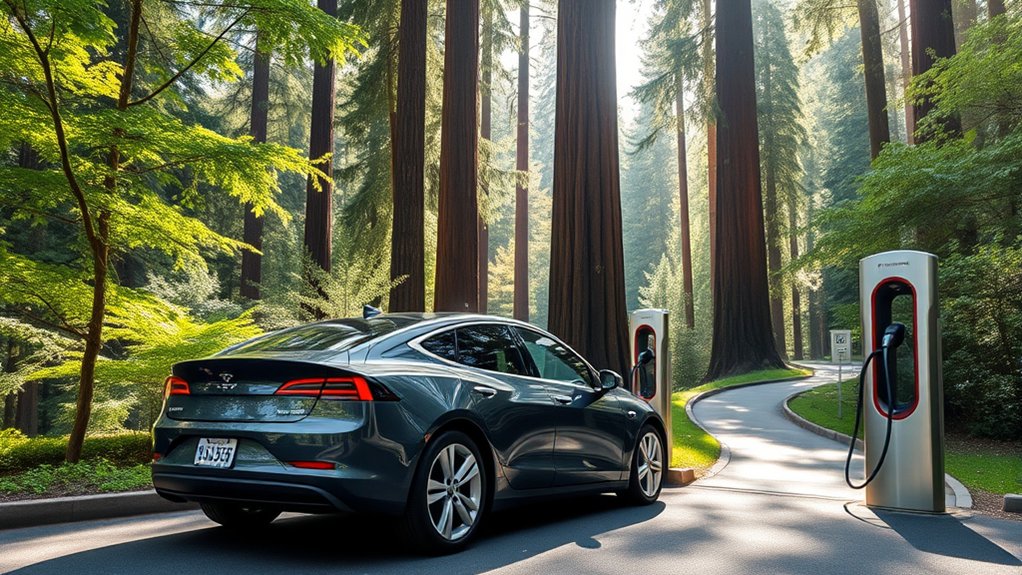
If you’re planning to visit U.S. national parks in an electric vehicle, build your route around verified chargers instead of assuming every park has the same setup. Some parks and gateway towns have convenient Level 2 chargers, a smaller number have nearby DC fast charging, and campground outlets may or may not be approved for EV use. The safest plan is to check official park information, confirm charger status in a live charging app, and arrive with enough range for detours, weather, elevation, and a backup stop.
Quick Answer
Yes, some U.S. national parks have EV charging, but coverage varies widely by park. Use the official National Park Service EV charging map and the DOE Alternative Fueling Station Locator before you go. Plan around Level 2 charging inside parks and DC fast charging in gateway communities.
Key Takeaways
- Do not rely on a fixed national charger count; station availability changes, so verify your route before each trip.
- Level 2 chargers are the most useful in parks because you can charge while hiking, dining, or staying overnight.
- DC fast chargers are often easier to find in gateway towns or highway corridors than deep inside park boundaries.
- Campground outlets are not automatically EV chargers; ask the campground first and use only safe, rated equipment.
- Bring the right adapter, save offline maps, and keep a backup charging stop outside the park.
At a Glance
| Time Required | 30 to 60 minutes of route planning before departure, plus charging time during the trip |
| Difficulty | Easy to moderate, depending on park remoteness and charger density |
| Tools Needed | NPS map, DOE station locator, your EV navigation system, charging-network apps, adapters, and offline maps |
| Cost | Varies by charging network, location, parking fee, lodging policy, and utility rate |
The Rise of EV Charging Stations in National Parks
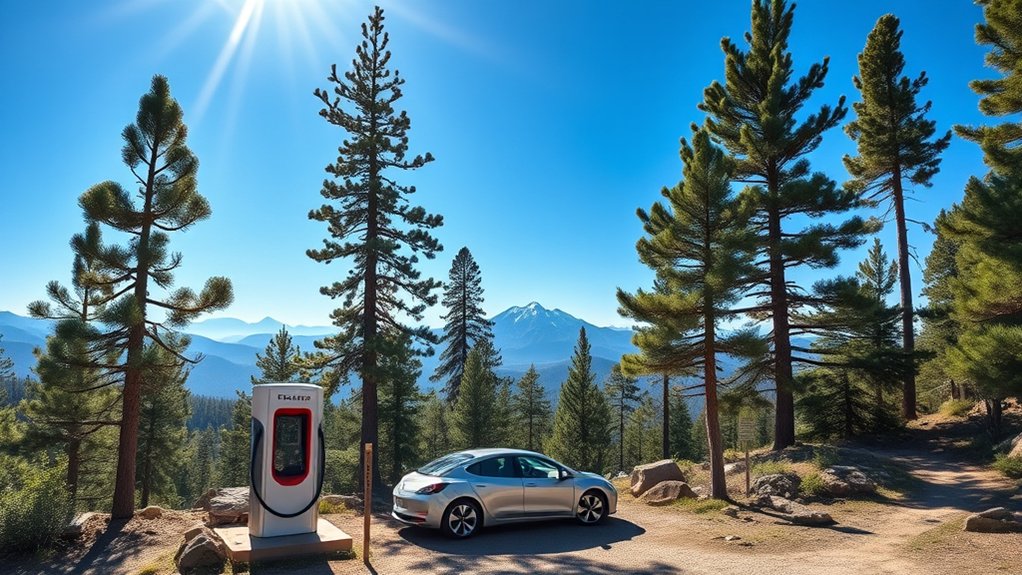
EV charging access around national parks has improved, but it is still uneven. The National Park Service EV charging page now points visitors to a map developed with the National Renewable Energy Laboratory. It shows chargers within national park boundaries and in some nearby gateway communities.
That matters because many parks are large, remote, mountainous, hot, cold, or far from dense charging networks. A charger that looks close on a map may still be 40 miles away by road, behind a park entrance, limited to lodging guests, occupied, or temporarily out of service.
A national park EV trip works best when you treat charging as part of the itinerary, not as an afterthought.
Use official tools first, then confirm details in charging-network apps. If a park has Level 2 chargers, they are often best used during long stops such as hikes, meals, scenic drives, lodge stays, or overnight visits. If you need a fast top-up, plan around DC fast chargers before you enter the park or after you leave.
Types of EV Chargers Available for Visitors
Knowing the charger type helps you set realistic expectations. The U.S. Department of Energy Alternative Fuels Data Center explains that charging time depends on your vehicle, battery size, state of charge, charger output, and electrical service.
Level 1 Charging
Level 1 charging uses a standard 120-volt outlet and is very slow. DOE estimates about 5 miles of range per hour of charging. This can help in an emergency or during a long overnight stay, but it is rarely enough for a busy park road trip.
Level 2 Charging
Level 2 charging is usually the most practical charging type inside or near national parks. DOE estimates about 25 miles of range per hour for a typical Level 2 session, though the actual rate depends on your car and the charger. This works well when your vehicle will sit for several hours.
DC Fast Charging
DC fast charging is designed for road trips and quick stops. DOE estimates about 100 to 200+ miles of range in 30 minutes under suitable conditions. In national park travel, DC fast chargers are often more common in gateway towns, highway corridors, visitor hubs, or private charging sites than deep inside remote park areas.
Note: Charging speed usually slows as your battery gets closer to full. For road trips, many EV drivers save time by fast charging to the range they need instead of waiting for 100% at every stop.
Find EV Charging Stations in National Parks
Finding EV charging stations in national parks is easier when you use more than one source. Start with official maps, then confirm details with live charging apps before you commit to a route.
Use the Official NPS Map
The NPS EV charging map is the best starting point because it is built for national park visitors. It can help you see whether charging is inside a park boundary, near a visitor area, or in a gateway community. Because the map is updated as new stations are added, check it close to your travel date instead of relying on old blog posts or screenshots.
Use the DOE Station Locator
The Alternative Fueling Station Locator from the U.S. Department of Energy lets you search for public charging stations by location. Use filters for connector type, charging level, access, and network so you do not route to a station your vehicle cannot use.
Confirm Real-Time Status in Charging Apps
After you find possible chargers, open the relevant charging-network app or your EV’s built-in navigation. Check whether the charger is available, offline, in use, blocked, restricted, or priced differently than expected. Recent driver check-ins can also warn you about broken plugs, slow charging, payment issues, or poor cell service.
Pro Tip: Save your charging stops offline before you enter the park. Cell coverage can disappear in canyons, mountains, forests, and desert basins.
Plan Your EV Route Before You Enter the Park
A strong national park EV route has three charging layers: a fast charger before the park, a destination charger during your visit, and a backup charger after your main stop. This keeps you from depending on one plug in a remote area.
- Charge before you enter: Start the park portion with more range than your route technically needs.
- Map the full loop: Include scenic drives, trailhead detours, lodge roads, campground roads, and return mileage.
- Check elevation: Long climbs use extra energy, while descents may recover some range through regenerative braking.
- Add a buffer: Keep extra range for weather, traffic, wildlife delays, road closures, and charger problems.
- Pick a backup: Identify a second charger outside the park before you lose signal.
If your route depends on one charger, treat the plan as fragile. If your route has two or three workable options, your trip will feel much easier.
Connector and Adapter Basics
Connector compatibility can make or break an EV park trip. Many Level 2 public chargers use J1772 connectors. Many non-Tesla DC fast chargers use CCS. Tesla vehicles and many newer North American charging plans use the NACS/J3400 connector, but access depends on your vehicle, adapter, network, and charger hardware.
Before you leave, confirm three things:
- Your vehicle’s connector: Know whether you need J1772, CCS, NACS/J3400, CHAdeMO, or an adapter.
- Your adapter rating: Use only adapters approved for your vehicle and the charging situation.
- The charger’s access rules: Some stations require an app, account, RFID card, credit card, or lodging access.
Do not assume every Tesla-branded charger works for every EV or that every non-Tesla charger works with a Tesla. Check compatibility in the app before you route there.
Top National Parks Offering EV Charging Stations
Several popular national park areas have EV charging inside the park, near visitor hubs, or in nearby towns. Availability changes, so use these as examples, not as guaranteed counts.
Parks and Gateway Areas to Check First
- Grand Canyon National Park: Check South Rim and nearby gateway charging before arrival, especially during busy seasons.
- Yosemite National Park: Look for chargers in Yosemite Valley, park lodging areas, and gateway communities outside the entrances.
- Yellowstone National Park: Distances are long, so check chargers near major developed areas and gateway towns.
- Death Valley National Park: Heat, distance, and elevation make pre-trip charging checks especially important.
- Cape Cod National Seashore: Coastal routes may offer more nearby public charging options than remote western parks.
- Cuyahoga Valley National Park: Its location near developed communities can make public charging easier to plan.
The best park for your EV is not always the one with the most famous scenery. It is the one where your route, charger access, connector type, and driving range all work together.
Essential Tips for Charging Your EV at Campgrounds
Campgrounds can be helpful, but they are not automatically EV charging stations. Some campgrounds allow EV charging at RV pedestals, some charge extra, and some prohibit it because of electrical capacity, safety, or fairness to other campers.
- Ask before plugging in: Confirm that EV charging is allowed at your campsite or RV pedestal.
- Confirm the outlet type: RV sites may have 30-amp or 50-amp service, but your EV equipment must match safely.
- Avoid overloading circuits: Set your vehicle to the correct amperage if your portable EVSE allows it.
- Use outdoor-rated equipment: Keep plugs dry, elevated, and protected from vehicle traffic.
- Do not block shared pedestals: Other campers may need the outlet for RV power.
Warning: Never use a damaged cord, loose adapter, underrated extension cord, or unapproved outlet setup to charge your EV. If the plug, cord, outlet, or breaker gets hot, stop charging and report the issue.
EV Charging Costs: What You Need to Know
EV charging costs in and around national parks vary by location, charging speed, network, parking rules, lodging policy, and utility rate. Some sites may be free, some may charge by time, some may charge by kilowatt-hour, and some may require a parking or lodging fee on top of the charging fee.
Before your trip, check pricing in the charging app and look for these details:
- Energy price: The cost per kilowatt-hour, if shown.
- Time-based price: Some chargers bill by the minute or hour.
- Idle fee: You may be charged if you stay plugged in after charging ends.
- Parking fee: A charger in a paid lot may cost more than the charging rate alone.
- Access limit: Some chargers are only for guests, employees, fleet vehicles, or specific networks.
Home charging is often cheaper than public charging, but that depends on your utility rate and the public station’s pricing. For a park trip, the goal is not only the lowest price. Reliability, connector access, and location matter just as much.
Strategies to Alleviate Range Anxiety in National Parks
Range anxiety usually comes from uncertainty, not just distance. You can reduce it by building a route with buffers and backups.
- Start full when it makes sense: Charge to a higher level before entering remote areas, especially if DC fast charging is limited.
- Use conservative range estimates: Your dashboard range may drop faster during climbs, cold starts, heat, wind, gravel roads, or high speeds.
- Check road conditions: Detours and closures can add many miles inside large parks.
- Use climate control wisely: Precondition while plugged in when possible, and avoid extreme cabin settings if range is tight.
- Keep your backup reachable: Do not use your last comfortable miles driving deeper into the park to test an uncertain charger.
In remote parks, it is smart to arrive at your final planned charger with enough range to reach an alternate station. That one habit prevents most stressful EV travel situations.
Weather, Terrain, and Vehicle Load Matter
National parks often include the exact conditions that reduce EV range: steep elevation changes, high-speed approaches, hot desert roads, cold mountain mornings, gravel access roads, and strong wind. Roof boxes, bike racks, cargo, passengers, and towing can also increase energy use.
Build extra range into your plan when you expect:
- Long climbs to viewpoints, passes, or alpine trailheads
- Very hot or very cold weather
- Strong headwinds
- Unpaved or rough access roads
- Heavy cargo, bikes, kayaks, or roof storage
- Long idling time for heat or air conditioning
Regenerative braking can recover energy on descents, but do not count on it to fully offset a long climb. Plan with a buffer first, then treat recovered range as a bonus.
What’s Next for EV Charging in Parks?
EV charging around parks should continue to evolve, but expansion will not happen evenly at every site. Some parks have limited grid capacity, historic landscapes, sensitive ecosystems, seasonal access, or remote locations that make charger installation more complicated.
Federal and state programs can support more charging infrastructure. The National Electric Vehicle Infrastructure Formula Program provides funding to states for eligible EV charging infrastructure, including installation, network connection, operations, maintenance, data sharing, and reliability requirements. Still, NEVI is mainly a corridor and state-led program, not a guarantee that every park entrance or campground will receive a charger.
For visitors, the practical takeaway is simple: expect more options over time, but verify your current route every time you travel.
Tips for Planning Your National Park EV Road Trip
A good EV road trip plan is simple, current, and realistic. Use this checklist before you leave:
- Check official park information: Start with the NPS EV charging map and the park’s own visitor pages.
- Use a live charging map: Confirm status, connector type, pricing, and recent check-ins.
- Plan DC fast charging outside the park: Use it before long scenic drives or remote entrances.
- Use Level 2 charging during long stops: Plug in while hiking, eating, touring, or sleeping.
- Call the campground or lodge: Ask whether EV charging is allowed and whether fees apply.
- Carry the right adapter: Bring only approved adapters that match your EV and charging equipment.
- Save offline maps: Include chargers, park roads, exits, and backup stations.
- Leave with a buffer: Do not finish a scenic drive with only a few miles of range left.
If you follow those steps, you can enjoy the park instead of watching the battery gauge all day.
Frequently Asked Questions
What is the 80/20 rule for EV charging?
For road trips, the 80/20 rule usually means using the middle part of the battery efficiently: avoid arriving too close to 0%, and avoid waiting for 100% at every DC fast charger because charging often slows near the top of the battery. A common approach is to arrive with a safe buffer and fast charge only to the level needed for the next reliable stop.
Do national parks have EV chargers?
Some national parks have EV chargers, and some have chargers mainly in nearby gateway communities. Availability varies by park, season, network, and access rules. Check the official NPS EV charging map, the DOE station locator, and your charging-network app before you go.
What are the new EV charging rules for national parks in 2026?
There is no single 2026 EV charging rule that applies the same way to every national park visitor. Charging rules depend on the specific park, campground, lodge, parking area, and charging network. Always check current park guidance and posted station rules before plugging in.
Is it cheaper to charge my EV at home or at a charging station?
Home charging is often cheaper, especially if your utility rate is low or you have an overnight rate plan. Public charging can cost more because it may include network fees, demand costs, parking fees, or idle fees. For national park trips, compare price with reliability and location.
Can I charge my EV at a national park campground?
Only if the campground allows it and the electrical setup can support it safely. RV pedestals are not automatically public EV chargers. Ask the campground before plugging in, use properly rated equipment, and follow any posted amperage, fee, and parking rules.
Which charger type should I look for on a national park EV trip?
Use DC fast chargers for quick road-trip stops before or after the park. Use Level 2 chargers when your car will be parked for several hours. Treat Level 1 charging as a slow backup, not your main plan, unless you are staying overnight and driving only short distances.
Conclusion
EV travel in U.S. national parks is very possible, but it rewards planning. Check official charging maps, confirm real-time station status, know your connector, ask before using campground power, and keep a backup charger within reach. With a smart charging plan, you can spend less time worrying about range and more time enjoying overlooks, trails, wildlife, and quiet scenic roads.
Sources
- National Park Service: Electric Vehicle Charging — official NPS EV charging map and visitor reference.
- DOE Alternative Fuels Data Center: Station Locator — public charging station search tool.
- DOE Alternative Fuels Data Center: Electric Vehicle Charging Stations — charger levels, connector types, and charging speed guidance.
- DOE AFDC: Electric Vehicle Charging Infrastructure Trends — national charging infrastructure tracking and trend reports.
- DOE AFDC: National Electric Vehicle Infrastructure Formula Program — federal EV charging infrastructure funding overview.