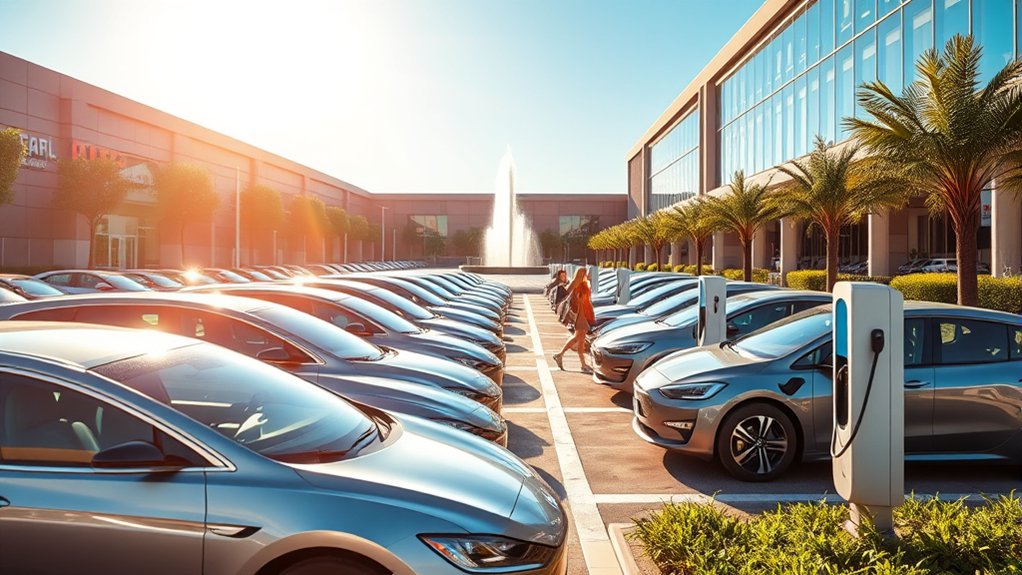
EV charging stations can turn a shopping mall or retail parking lot into a more useful destination for drivers who want to shop, eat, or run errands while they charge. The strongest projects start with customer dwell time, utility capacity, charger type, accessibility, payment, maintenance, and incentives, not just the fastest charger available.
Quick Answer
Shopping malls benefit most from a planned mix of Level 2 chargers for longer visits and selective DC fast chargers for short stops. The best setup includes visible parking stalls, clear pricing, accessible design, utility coordination, reliable maintenance, and signage that helps EV drivers find the chargers before they arrive.
Key Takeaways
- Level 2 chargers work well for shoppers who stay 1–3 hours, while DC fast chargers fit quick visits and highway-adjacent retail centers.
- The biggest cost drivers are trenching, utility upgrades, panel capacity, permits, labor, networking, and ongoing maintenance.
- Public retail charging needs accessible parking design, clear signage, lighting, payment access, and a support plan for broken chargers.
- Incentives change quickly, so verify federal, state, utility, and local programs before setting a final budget.
At a Glance
| Time Required | Several weeks to several months for planning, utility review, permitting, installation, inspection, and network activation. |
| Difficulty | Moderate to advanced. Commercial EV charging requires electrical design, permits, utility coordination, accessibility planning, and ongoing support. |
| Tools Needed | Site plan, electrical load data, charger usage goals, licensed electrical contractor, utility contact, permitting plan, signage plan, and maintenance provider. |
| Cost | Public Level 2 projects may start in the low thousands per connector, while DC fast charging can cost tens of thousands per connector before major utility upgrades. |
What Is EV Charging and Why It Matters for Shopping Malls
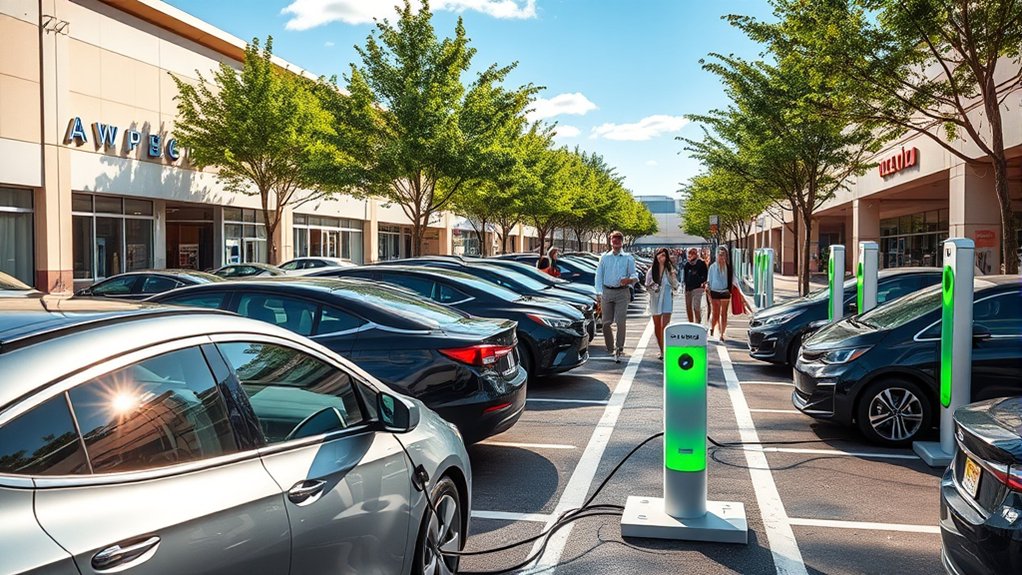
EV charging gives electric vehicle drivers a place to add range while they park. For shopping malls, supermarkets, restaurants, cinemas, and retail plazas, it can support longer visits because drivers can charge while they shop instead of making a separate charging stop.
The goal is not simply to install chargers. The goal is to match the charger type to the visit. A customer who plans to shop and eat may be happy with a Level 2 charger. A driver stopping for a short errand may prefer DC fast charging. The U.S. Department of Energy Alternative Fuels Data Center notes that Level 2 charging can add about 25 miles of range per hour, while DC fast charging can add about 100 to 200 miles or more in about 30 minutes, depending on the vehicle and charger.
For retail properties, EV charging can also improve brand perception, support sustainability goals, and make the parking lot more useful to a growing group of drivers. Still, the business case works best when the chargers are easy to find, easy to pay for, reliable, and placed near stores customers actually want to visit.
What Types of EV Charging Can Shoppers Expect?
Most retail sites use either Level 2 chargers, DC fast chargers, or a mix of both. Level 1 charging is usually too slow for public retail use because it adds only a small amount of range during a normal shopping trip.
| Charger Type | Best Retail Use | Typical Shopper Fit |
|---|---|---|
| Level 2 AC | Malls, grocery stores, restaurants, cinemas, gyms, and employee parking. | Best for visits lasting about 1 to 3 hours. |
| DC fast charging | Highway-adjacent malls, travel plazas, big-box retail, and short-stop destinations. | Best for drivers who want a meaningful charge in about 20 to 40 minutes. |
| Level 1 | Rarely ideal for public retail charging. | Too slow for most shopping trips, but may work for staff or overnight parking. |
Note: Faster is not always better. DC fast charging costs more to install and may trigger higher utility demand charges, so it should be used where fast turnover matters.
How to Effectively Implement EV Charging Stations in Retail Environments
A successful retail EV charging project follows a clear planning process. Before ordering equipment, define what the chargers need to accomplish for the property.
- Study customer dwell time. Match chargers to how long people stay. Level 2 works well for longer visits. DC fast charging fits quick-stop retail or high-traffic corridors.
- Check electrical capacity early. Ask the utility and a licensed electrical contractor to review service capacity, transformer limits, panel space, trenching distance, and future expansion needs.
- Choose the charger mix. A mall may use several Level 2 ports near main entrances and a smaller number of DC fast chargers near major traffic routes.
- Plan the site layout. Place chargers where they are visible, well lit, accessible, and close enough to stores to feel convenient without blocking high-turnover spaces.
- Set pricing and payment rules. Decide whether charging will be free, paid, validated with purchases, limited by time, or tied to a loyalty program.
- Handle permits and inspections. Commercial EV charging usually needs electrical permits, code review, utility coordination, and final inspection.
- Launch with maintenance support. Assign responsibility for cleaning, cable management, payment issues, network monitoring, and repairs.
Warning: Do not install commercial EV charging equipment without a licensed electrical contractor, required permits, utility coordination, and local code review. Poor planning can overload electrical service, create safety issues, or leave expensive chargers unusable.
Key Components of EV Charging Infrastructure for Malls
Retail EV charging infrastructure includes more than the charger mounted on the parking lot pedestal. A complete system should include:
- Electrical service capacity: Panels, transformers, conduit, wiring, switchgear, and utility service must support the planned load.
- Charger hardware: Choose Level 2 or DC fast chargers based on dwell time, traffic volume, and budget.
- Connector support: Newer sites may need to consider CCS, J3400/NACS, and adapter use as vehicle connector standards shift.
- Networking and software: Networked chargers allow payment, access control, session tracking, fault alerts, pricing updates, and reporting.
- Energy management: Load sharing can help multiple chargers operate without exceeding site capacity.
- Payment access: Drivers should understand pricing before charging and should not be forced into a confusing app-only experience.
- Signage and wayfinding: Parking lot signs, digital directories, and charging apps help drivers find the stalls.
- Maintenance plan: Someone must inspect cables, screens, payment systems, plugs, lighting, pavement markings, and network status.
The AFDC procurement and installation guidance recommends planning for scope, budget, utility engagement, permits, signage, security, operations, and maintenance before installation begins.
Costs of Installing EV Charging Stations
Installation costs vary widely because every site is different. A charger mounted close to existing electrical service may be far cheaper than one that requires long trenching, transformer upgrades, new switchgear, concrete work, or major utility improvements.
| Cost Area | Planning Range | What Changes the Price |
|---|---|---|
| Public Level 2 equipment | AFDC lists about $3,500 per connector for public Level 2 equipment. | Networking, pedestal style, cable management, payment features, and durability. |
| Public Level 2 installation | AFDC lists an average of about $2,500 per connector. | Distance to power, trenching, pavement repair, panels, permits, labor, and signage. |
| DC fast charger equipment | AFDC lists about $38,000 to $90,000 per connector. | Power level, cabinet design, connector type, cooling, payment hardware, and network features. |
| DC fast charger installation | AFDC lists about $20,000 to $60,000 per connector. | Utility upgrades, transformers, switchgear, concrete pads, construction complexity, and demand management. |
Budget beyond the hardware. Include design, permitting, inspection, software fees, cellular or network service, warranty, repairs, customer support, snow removal if needed, restriping, and marketing. If the chargers are paid, also account for payment processing fees and sales tax rules in your area.
Pro Tip: Ask contractors to price future conduit and panel capacity during the first build. It is often cheaper to prepare for later expansion while the parking lot is already open for construction.
Enhancing Customer Experience With EV Charging Stations at Malls
EV charging improves the shopping experience when it removes friction. Drivers want to know where the chargers are, whether they work, what they cost, how long they can park, and what they can do while the car charges.
Place charging stalls near useful entrances, but avoid taking every premium space in a busy lot. The best locations are visible, well lit, easy to navigate, and close to stores, restrooms, restaurants, or entertainment. Clear pavement markings and signs help reduce confusion between EV-only parking, accessible spaces, loading zones, and short-term parking.
Charging can support longer customer dwell time, but it should not be treated as a guaranteed sales machine. Pair chargers with practical offers such as cafe discounts, loyalty points, free charging with a minimum purchase, or parking validation. Dynamic screens on chargers can promote tenant deals, but the pricing and charging instructions should stay clear and easy to read.
Benefits of EV Charging Stations for Malls and Retailers
Retail EV charging can help malls compete for drivers who plan errands around charging availability. The value depends on charger reliability, location, pricing, and whether the retail mix gives drivers something useful to do while they wait.
Increased Foot Traffic
Drivers often use maps and charging apps to find stations before they arrive. Listing chargers in reliable station directories can put your property in front of shoppers who may not have planned to visit otherwise.
Longer Dwell Time and Retail Engagement
A Level 2 session can fit a meal, movie, workout, or grocery trip. DC fast charging can fit a coffee stop or quick errand. When the property gives drivers a reason to stay nearby, charging time can become retail time.
Brand and Tenant Value
EV charging signals that the property is modern and driver-friendly. It can also support tenants that want to reach higher-intent shoppers, especially restaurants, grocery stores, entertainment venues, and service businesses.
New Revenue Channels
Chargers can generate direct charging revenue, tenant promotions, loyalty engagement, and parking-data insights. Some properties own and operate the chargers directly, while others work with a charging network or third-party operator.
How EV Charging Supports Sustainability in Retail
EV charging can support a retail property’s sustainability goals, especially when it is paired with efficient building operations, renewable electricity, and smart load management. It also helps customers who are already driving electric vehicles choose a destination that supports their transportation needs.
Reducing Carbon Footprint
Charging infrastructure supports the shift away from gasoline use. The local emissions benefit depends on the electricity mix, charger use, and whether the site uses renewable energy or buys renewable power.
Supporting Renewable Energy Initiatives
Some retail properties pair EV charging with solar canopies, community solar, renewable energy purchases, or battery storage. These systems may reduce peak grid demand and help control energy costs, but they need site-specific engineering. Avoid assuming that solar alone will cover a fixed percentage of charging demand without a load study.
Enhancing Brand Reputation
Visible charging stations can strengthen a sustainability message when they are reliable and well maintained. Broken chargers, unclear pricing, and blocked stalls can damage trust, so operations matter as much as installation.
Attracting New Customers Through EV Charging
EV charging can attract new customers when the location is useful, easy to find, and priced fairly. Retailers should think of chargers as part of the customer journey, not just as parking equipment.
| Retail Goal | How EV Charging Helps |
|---|---|
| Bring in new visitors | Drivers may discover the property through charging maps and station locator apps. |
| Increase dwell time | Charging gives shoppers a reason to stay long enough for food, errands, or entertainment. |
| Support tenant promotions | Stores can offer validated charging, loyalty rewards, or discounts during charging sessions. |
| Improve customer convenience | Drivers can combine charging with daily tasks instead of making a separate stop. |
Accessibility, Safety, and Parking Lot Design
Public-facing EV charging must be easy and safe for more than one type of driver. The U.S. Access Board provides design recommendations for accessible EV charging, including accessible routes, clear ground space, operable parts, and parking spaces that can support mobility access.
Good retail charging design should include:
- Accessible routes: Drivers should be able to move from the charging space to the building entrance without crossing unsafe traffic paths.
- Clear pavement markings: Mark EV charging spaces, accessible charging spaces, time limits, and towing rules clearly.
- Lighting and visibility: Chargers should feel safe during evening shopping hours.
- Cable management: Cables should not create tripping hazards or block accessible routes.
- Weather protection where possible: Canopies can improve comfort and may support solar, but they add cost and require structural planning.
- Security and monitoring: Cameras, lighting, and routine inspections can reduce vandalism and cable damage.
Operations, Maintenance, and Reliability
A charger that does not work is worse than no charger at all because it frustrates customers and damages the property’s reputation. Build an operations plan before launch.
- Monitor uptime: Use network alerts to identify offline chargers, failed payment screens, communication problems, or connector faults.
- Inspect hardware: Check cables, plugs, screens, pedestals, bollards, signage, and pavement markings on a set schedule.
- Keep stalls open: Enforce time limits and prevent non-charging vehicles from blocking EV spaces.
- Provide support: Display a clear customer support phone number or QR code on each charger.
- Plan repairs: Set service-level expectations with the charging network or maintenance contractor.
- Track usage: Review charging sessions, peak times, revenue, energy use, and customer complaints to improve pricing and expansion plans.
Incentives and Funding to Check in 2026
Funding can improve the business case, but incentive rules change quickly. The IRS Alternative Fuel Vehicle Refueling Property Credit applied to qualifying property placed in service from January 1, 2023, through June 30, 2026. For projects started after that window, verify current federal rules before assuming a tax credit is available.
Also check state energy offices, utilities, air-quality districts, local governments, and charging-network programs. The National Electric Vehicle Infrastructure Formula Program supports eligible public charging through states, but projects must meet program rules and state plan requirements.
Before applying for incentives, prepare a basic package that includes the site address, charger type, number of ports, estimated power demand, utility contact, preliminary site plan, accessibility plan, cost estimate, and expected public access rules.
Pricing and Payment Models for Retail EV Charging
Pricing affects both customer satisfaction and charger turnover. Free charging can attract drivers, but it may also cause long parking sessions and higher operating costs. Paid charging can recover costs, but unclear pricing can frustrate shoppers.
Common retail pricing models include:
- Free charging: Useful for short promotions, tenant perks, or limited Level 2 use, but it needs time limits.
- Paid per kWh: Clear for drivers where local rules allow energy-based pricing.
- Paid per minute: Helps encourage turnover, especially after a vehicle is done charging.
- Validated charging: Customers receive free or discounted charging after a purchase.
- Loyalty-based charging: Charging discounts are tied to a mall app, store rewards, or membership program.
- Operator-owned charging: A third party owns and manages the stations while the property hosts them.
Whatever model you choose, display pricing clearly at the charger and in the charging app before the session begins.
Future Trends in EV Charging for Retail Spaces
Retail EV charging is moving toward faster hardware, better payment access, more reliable networks, and smarter energy management. Malls that plan for expansion will be in a better position as vehicle adoption, connector standards, and utility rates change.
Smart Charging Infrastructure Integration
Smart charging can balance power across multiple chargers, reduce peak demand, and help the property avoid expensive electrical upgrades. Networked systems can also provide real-time charger status, pricing control, reporting, and remote troubleshooting.
Renewable Energy Utilization
Solar canopies, battery storage, and renewable energy purchasing may help some retail sites lower emissions and control costs. The right setup depends on roof or canopy space, sun exposure, local utility rates, demand charges, and the charging load profile.
Advanced Payment Solutions
Drivers increasingly expect contactless payment, clear pricing, app support, credit-card access, and simple receipts. Retailers should choose systems that are easy for first-time visitors, not only for drivers who already use a specific charging network.
Connector Changes and Open Standards
Connector standards are changing as more vehicles and charging networks support the SAE J3400/NACS connector alongside CCS. Retail property owners should ask vendors how their equipment supports current vehicles, adapters, future connector updates, and open networking standards.
Frequently Asked Questions
How much does it cost to install EV charging stations at a mall?
Costs vary by charger type, distance to electrical service, trenching, utility upgrades, permits, and labor. Public Level 2 projects often cost far less than DC fast charging, while DC fast chargers can require major electrical and utility work.
Should a shopping mall choose Level 2 or DC fast chargers?
Use Level 2 chargers for longer visits such as shopping, dining, movies, gyms, or employee parking. Use DC fast chargers where drivers need quicker sessions, such as highway-adjacent retail, travel corridors, or short-stop shopping centers.
How much does it cost to charge an electric car at a mall?
The cost depends on the site owner, network, local electricity rates, charger speed, and pricing model. Some malls offer free or validated Level 2 charging, while others charge by kWh, minute, session, or parking time.
Is it free to charge an electric car at a supermarket?
Sometimes. Some supermarkets offer free charging as a customer perk, but many locations charge a fee or limit free charging to certain networks, loyalty members, or time periods. Always check the station screen or charging app before plugging in.
Can I charge my EV at Walmart?
Many Walmart and Sam’s Club locations have EV chargers or are planned to receive them, but availability varies by store. Check the Walmart app, the charging network app, or a public station locator before driving there to charge.
What is the 80/20 rule for EV charging?
In simple terms, the 80/20 rule means most EV charging often happens at home or work, while a smaller share happens in public places. For malls, that public share still matters because drivers need convenient destination charging during shopping, dining, and travel.
Conclusion
EV charging stations can make a shopping mall or retail parking lot more convenient, more visible to EV drivers, and better aligned with modern sustainability goals. The best results come from careful planning: match charger speed to customer dwell time, confirm electrical capacity, design accessible stalls, set clear pricing, and maintain the equipment after launch. When the chargers are reliable and easy to use, they can support both shoppers and retailers.
Sources
- U.S. Department of Energy Alternative Fuels Data Center: Electric Vehicle Charging Stations — charger levels, charging speed, and public charging basics.
- U.S. Department of Energy Alternative Fuels Data Center: Procurement and Installation for EV Charging Infrastructure — planning steps, installation considerations, cost ranges, permitting, and maintenance.
- Internal Revenue Service: Alternative Fuel Vehicle Refueling Property Credit — federal credit timing and eligibility details.
- Alternative Fuels Data Center: National Electric Vehicle Infrastructure Formula Program — NEVI funding framework and public access requirements.
- U.S. Access Board: Design Recommendations for Accessible Electric Vehicle Charging Stations — accessible EV charging space and route guidance.
- International Energy Agency: Global EV Outlook 2025, Electric Vehicle Charging — global EV charging infrastructure trends.